7 Valuable Hiking Backpack Tips to Consider before Buying
The pack felt fine in the store. Twenty minutes into the trail, your shoulders were screaming.
If that sounds familiar, you are not alone. Most people choose a hiking backpack the way they choose a carry-on suitcase. They grab something in roughly the right size range, check the price tag, and move on.
The problem is that backpacks do not work like luggage. They interact directly with your skeleton, and if the fit is off, your body will let you know.
Before you walk into a gear shop or open another browser tab full of reviews, there are a few hiking backpack tips worth understanding first. None of them involves brand loyalty, but most involve your own measurements. Here is what actually matters to find a comfortable fit.
TL;DR: Hiking Backpack Tips
To find the right pack, ignore your height and measure your torso instead. Make sure the hip belt carries most of the weight, use the load lifter straps to pull the pack closer to your spine, match the liter capacity to your actual trip length, and prioritize back panel ventilation. Always test the pack at home with realistic trail weight before cutting off the tags.
Common Backpack Sizing Myths
Walk into any gear store, and someone will almost certainly ask your height. Reach out to a forum, and someone will post a chart matching pack size to shoe size. It is well-intentioned and almost entirely wrong.
Pack sizing is based on your torso length, not how tall you are. Two people who are both five foot nine can have torso measurements that differ by four inches. That difference determines whether a pack rides comfortably or shifts around and digs into the top of your hips. Height is a convenient shorthand, but it just does not tell the full story.
The other piece of advice that gets recycled endlessly is to buy big, so you have room to grow into it. Buying a 65-liter pack for day hikes does not give you flexibility. It gives you extra space to fill with things you do not need, and it adds weight before you have packed a single item.
A good fit is specific, and avoiding gear anxiety means buying exactly what you need. The tips below will help you get specific.
Tip 1: Focus on Torso Length (The Single Most Important Fit Metric)
Backpack sizing is based on your torso length, not your height, and it is the single most important number in this whole process.
Our complete guide to measuring your torso for a backpack walks through exactly how to find yours in under a minute, and REI’s Backpack Fit Guide has a helpful visual demonstration if you’d rather watch than read.
Many modern packs also feature adjustable torso systems via velcro or sliding tracks. This is worth checking for, since it can save you from returning a pack that simply needed a one-inch adjustment on the back panel.
Field Note: Do this measurement at home before you shop, not in the store aisle. Have someone help you if possible. A flexible tailor’s tape works best, but a piece of string and a ruler will do the same job perfectly.
Tip 2: Let Your Hip Belt Carry the Load
Your shoulders should not do the heavy lifting. Your hips should. A properly fitted hiking backpack transfers most of the load (typically 70 to 80 percent) to your hips and pelvis, with the shoulder straps resting lightly enough to stabilize the pack rather than carry it. When that balance is off, you end up with aching traps and a very long afternoon.
For the hip belt to do its job, it needs to wrap around your hip bones, not your waistline. The padding should sit directly on your iliac crest, centering the weight over the strongest part of your lower body. If the belt is cinched around your belly instead, the load has nowhere stable to land.
If you have a particularly narrow frame or waist, you might struggle to get a standard hip belt tight enough to carry this load. Many premium gear brands offer interchangeable or highly adjustable hip belts to solve this specific issue, so check if the belt sizing is customizable before committing to a pack.
The Secret Weapon: Load Lifters
To achieve that optimal weight distribution, you need to utilize your load lifters. These are the small straps above your collarbone that connect the shoulder straps to the top of the pack frame.
Cinching these gently pulls the top of the pack closer to your spine. This keeps the weight from sagging backward and shifting your center of gravity, which reduces shoulder strain when the rest of the pack fit is already dialed in. Just avoid pulling them too tight, as over-tightening can pinch your shoulder joints and restrict movement.
While adjusting your harness straps, keep an eye on the sternum strap across your chest as well. This strap should sit about one inch below your collarbones to stabilize the shoulder harness. Avoid overtightening it, as pulling it too tight will pinch the shoulder straps inward and restrict comfortable breathing during steep climbs.
Field Note: When fitting a pack in the store, load it with at least 15 to 20 pounds before testing the hip belt. An empty pack tells you almost nothing about where the belt will actually sit once it has weight behind it.
Tip 3: Choose the Right Backpack Capacity
It is tempting to buy a massive bag just in case. Maybe you will take a longer trip someday, or maybe you will need the extra room for extra layers. The problem is that extra space usually just leads to packing heavy items you do not need. Pick a liter size that matches the trips you actually take, not the trips you might take eventually.
Carrying a 65-liter pack on a day hike is like commuting in a moving truck. The bag itself adds weight, and the extra volume becomes a psychological invitation to keep adding things. Start with the smallest pack that genuinely fits your typical outing. You can always upgrade later if your hiking genuinely evolves.
Liter Capacity Ranges at a Glance
Capacity
Best For
Trip Length
10 to 20 liters
Day hikes, short outings
2 to 4 hours
20 to 35 liters
Full day hikes
4 to 8 hours
35 to 50 liters
Weekend trips
1 to 2 nights
50 to 70+ liters
Multi-day backpacking
3+ nights
10 to 20 liters
Best For: Day hikes, short outings
Trip Length: 2 to 4 hours
20 to 35 liters
Best For: Full day hikes
Trip Length: 4 to 8 hours
35 to 50 liters
Best For: Weekend trips
Trip Length: 1 to 2 nights
50 to 70+ liters
Best For: Multi-day backpacking
Trip Length: 3+ nights
If you are still figuring out your budget, check our guide to the Best Hiking Backpacks Under $100. It breaks down solid options by capacity range without the premium price tag.
Field Note: When in doubt between two sizes, go smaller. It is easier to become a more efficient packer than to walk 8 miles with unnecessary weight dragging on your shoulders.
Tip 4: Prioritize Ventilation (How to Avoid a Sweaty Back)
If you hike in the summer or run warm, a flat foam back panel will leave your shirt drenched in sweat within the first mile.
Look for a pack with a suspended mesh system that creates an airflow gap between the bag and your back. It sounds like a small thing until you are halfway up a ridge in August and your entire back feels like a sauna.
A flat foam panel presses the pack flush against your spine, giving heat nowhere to escape. A tensioned mesh panel holds the pack slightly away from your back, creating a channel for air to circulate.
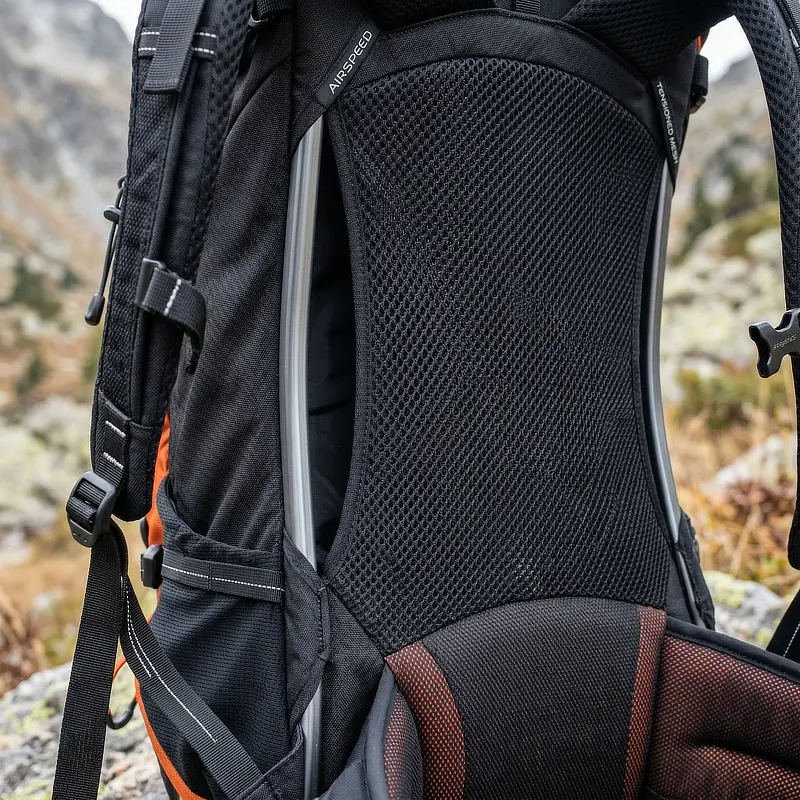
The physical tradeoff is that suspended mesh packs tend to shift the weight slightly away from your center of gravity. This can make them feel a bit less stable under very heavy, multi-day loads. However, for most casual hikers carrying moderate weight, the ventilation benefit wins easily.
Field Note: Try on packs in the store with a shirt on, not over a jacket. The fit and airflow gap can feel very different depending on what you are wearing underneath.
Tip 5: Check the Access Points (Front-Zip vs. Top-Loading)
Top-loading backpacks are the traditional format, and they are still widely used for good reason. They are sturdy, they handle heavy loads cleanly, and they shed rain well. But they have one significant limitation: to reach anything below the top layer, you essentially have to unpack the whole bag.
Front-panel and side-zip packs solve this with a U-zip or J-zip opening that lets you access the main compartment like a duffel bag. You can see everything at once and grab what you need without dismantling your careful organization. For beginners who are still figuring out how to pack efficiently, that kind of access is genuinely useful.
Knowing how to pack your gear is just as important as how you access it. For a full breakdown on organization, read our guide on how to pack a hiking backpack.
Field Notes: Rain is when access design stops being theoretical. A top-loading pack can work beautifully when everything is dry and organized, but it becomes frustrating fast when your rain shell is buried under food, stove, and spare layers.
This is where front or side access earns its keep, not because it is fancy, but because it helps you reach the thing you need before the rest of your gear gets wet.
Field Note: If you do use a top-loading pack, keep your rain jacket or any frequently needed item in the top lid pocket so it is always within reach without opening the main compartment.
Tip 6: Consider Women’s Specific Backpack Shapes
Women-specific backpacks are not just smaller versions of unisex packs, and they are definitely not just a different color. They are engineered with contoured shoulder straps that route around the chest rather than crossing over it. They also feature hip belts that are angled to match the geometry of female hips.
These differences come from real anatomical differences in shoulder width, torso curvature, and hip angle. If you are a woman who has tried on a unisex pack and found it uncomfortable, that is probably not a comfort issue. It is a geometry issue.
The straps may dig in at the wrong angle, or the hip belt may not sit where it needs to sit. A woman’s specific pack is worth trying before you assume the problem is just the weight. Reading a dedicated guide to the Best Hiking Backpacks for Women can help you cover specific fit considerations in detail.
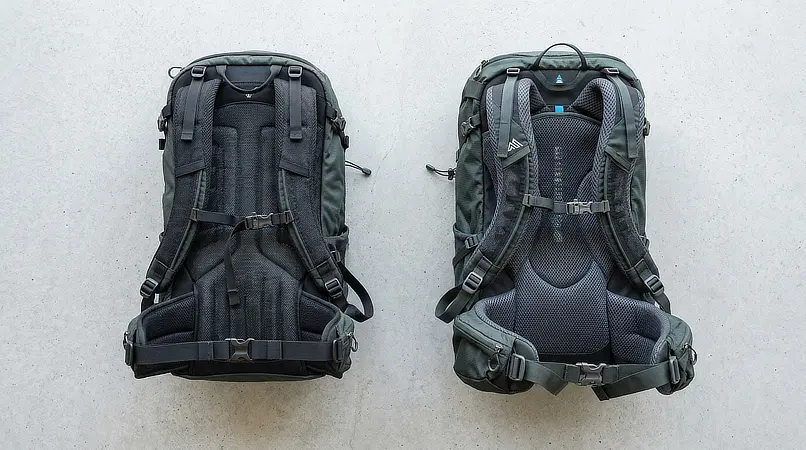
Field Note: When trying on a women’s specific pack, pay close attention to where the shoulder straps converge at the sternum strap. On a well-fitted women’s pack, the sternum strap should sit comfortably across the chest, not cutting across the throat.
Tip 7: Don’t Skip the ‘Living Room Test’ (Fit Your Pack with Real Weight)
Trying on an empty backpack tells you almost nothing about how it will feel on the trail. The fit shifts entirely when you add weight. Straps that seemed perfectly placed can start to dig, and hip belts that felt snug can slide down or out of position. You need real weight to get a real read.
Before you cut off the tags, load the pack with the approximate weight you actually plan to carry. Aim for 10 to 15 pounds for day hikes, or 25 to 35 plus pounds for multi-day trips. Walk around your home for at least 30 minutes. Go up and down stairs, lean forward, and twist side to side.
Notice where pressure builds, where the pack shifts, and whether the hip belt stays put. This is one of the most effective tests you can perform at home to mirror real trail conditions before committing.
Field Note: Most outdoor retailers will let you do a weighted test in the store with a sandbag. Ask for one. If they do not offer it, that is worth noting because a good gear shop knows this is part of the fitting process.
One Last Thought Before You Buy
The right backpack is not the most expensive one, or the one with the longest feature list. It is the one that carries your load without making your body hate you by mile three.
Take your torso measurement. Test the hip belt with real weight. Think honestly about the trips you actually plan to take.
Those three steps alone will put you ahead of most people who walk into a gear shop and leave with the wrong pack. You do not need to be an expert to choose well. You just need to know what to look for, and now you do.
What is the most frustrating thing about your current backpack? Drop a comment below. Whether it is a hip belt that will not stay put or straps that dig in after an hour, chances are there is a fix, and other readers are probably dealing with the exact same thing.
Founder & Gear Research Editor

Sonia Zannoni
I’m Sonia, the founder of Best Trail Backpacks. I don’t test gear myself. For every pack I cover, I read the manufacturer’s specs and sizing charts and look for what owners report again and again.
Fit comes first, because a pack that doesn’t match your torso and hips will hurt no matter what it cost. My goal is to help you choose a pack that suits your body, your trip and your budget.
About the Founder
Wonderful Help.
I love the outdoors and hike regularly with day hikes and my dog. My pack I have had for many years although it is a bit dusty with the day hikes being the priority.
I went through the suggestions you made being that I am considering longer hikes. If your doing overnight are you suggesting a frame because of the weight? What would be considered heavy loads?
Not considering cost what is the most important hiking quality? Appreciate your information.
To answer your first question, if you go on hikes lasting several days, I would definitely pick a hiking backpack with a frame. Nowadays many backpacks are built with an internal frame, which doesn’t add much extra weight to the overall pack.
As for what I consider heavy loads, I find that carrying 50-60 lbs on your back to be quite heavy, personally. A load of your hiking backpack should not exceed 25% of your weight.
Lastly, I think that the most important quality that a backpack should have is the fit. Your rucksack should fit perfectly to avoid any discomfort and shoulders as well as back strains.
Hope this help.