
How to Find a Hiking Partner and Meet Someone New Safely
A group hike for Saturday is open on your phone. The organizer is a name you don’t know, and you’re wondering who these people are and whether you’ll be the slow one at the back.
None of your friends hike, and most advice says go alone or “join a group,” as if turning up for a stranger’s hike were nothing. Hesitating here is sensible. Wanting company and wanting to be careful about who it is are both reasonable.
Working out how to find a hiking partner comes down to where people actually meet hiking company, how to tell whether a group or a person suits you, and how to meet someone new without putting yourself at risk. The usual advice skips that middle part.
You’ll get a step-by-step way to go from a led group walk to one person you trust, with what to check at each step, and safety steps taken from park services and outdoor organizations rather than from fear.
TL;DR: How to Find a Hiking Partner
- Start where someone else has done the vetting: a club walk with a trained leader, a volunteer trail day or a course, then choose one person from there.
- Before you join a group, read the listing for the grade, the pace, a named leader and someone who walks at the back.
- Match one person on pace, experience and goals, and know which of you can navigate and handle first aid.
- For a first hike with someone new: a short, busy trail, your own car, their name in your trip plan, and your own instincts.
Already have someone in mind? Skip ahead to how to meet someone new for a first hike safely.
Where to Find Hiking Company, From Most Vetted to Least
Start where someone else has done the checking: a club or federation walk with a trained leader, a trail work day with a crew leader, or a course. Online groups are free and flexible, but nobody checks the organizer’s experience. Friends bring trust, though maybe not your kind of hike.
Maybe your friends would rather do brunch, the one local group you found only meets on weekdays, or everyone in its photos looks a generation older than you. Each of those is a different problem, and the routes below solve them in different ways.
They’re in order of how much someone else has checked before you arrive. If you’re nervous, I’d start with a led club walk, because a trained leader sets the pace and a backmarker (a volunteer who walks last) keeps the slowest hiker with the group.
Every route trades something. Clubs bring leaders, grades and some screening, but also fees, waivers, fixed dates and less say over where you go, while online groups and friends give you freedom with less checking. Here’s how the routes compare.
Route
What someone has already checked
What it asks of you
Suits you if
Clubs and federations with led walks
A trained volunteer leader, a published grade and pace, sometimes fitness screening
Fixed dates, and at some clubs dues and a waiver; Ramblers lets you try two or three walks free
You want structure and a leader for your first outings
Volunteer trail days
A crew leader runs the day, and no trail-work experience is needed
A day of trail work; paid trips such as Volunteer Vacations charge a fee for food, campsites, tools and supervision
You’d like to meet people while doing something useful
Skills courses and guided outings
An instructor or guide runs the day
Set dates and a course fee; a wilderness first aid course takes two days
You want a skill and company in the same weekend
Online groups (Meetup and similar)
Varies by group, and Meetup can’t monitor events
Free to join and RSVP; Meetup+ is optional; some groups charge dues or event fees
You need flexible dates and will read a listing carefully
Friends and coworkers
Trust is already there
Matching their pace and the hikes they want
You’d rather start with people you know
Clubs and federations with led walks
What someone has already checked: A trained volunteer leader, a published grade and pace, sometimes fitness screening
What it asks of you: Fixed dates, and at some clubs dues and a waiver; Ramblers lets you try two or three walks free
Suits you if: You want structure and a leader for your first outings
Volunteer trail days
What someone has already checked: A crew leader runs the day, and no trail-work experience is needed
What it asks of you: A day of trail work; paid trips such as Volunteer Vacations charge a fee for food, campsites, tools and supervision
Suits you if: You’d like to meet people while doing something useful
Skills courses and guided outings
What someone has already checked: An instructor or guide runs the day
What it asks of you: Set dates and a course fee; a wilderness first aid course takes two days
Suits you if: You want a skill and company in the same weekend
Online groups (Meetup and similar)
What someone has already checked: Varies by group, and Meetup can’t monitor events
What it asks of you: Free to join and RSVP; Meetup+ is optional; some groups charge dues or event fees
Suits you if: You need flexible dates and will read a listing carefully
Friends and coworkers
What someone has already checked: Trust is already there
What it asks of you: Matching their pace and the hikes they want
Suits you if: You’d rather start with people you know
Clubs and Federations With Led Walks
Hiking clubs and national federations run walks with a volunteer leader and a published grade, and most welcome newcomers. Every country has its own, so the club near you may have a different name from the ones below.
In the UK, Ramblers groups let you try two or three walks free before you join, and some always walk with a backmarker. In Australia, Bushwalking NSW has a club finder and recommends starting with a club activity led by an experienced leader.
Alpine Club of Canada sections run trips with experienced volunteer leaders, mostly free or at cost to members. In the US, look at your local Sierra Club chapter’s outings, or the hike listings of an Appalachian Mountain Club chapter near you.
Volunteer Trail Days, Courses and Guided Outings
A trail work party puts you beside the same people for a whole day, with a crew leader running it. The Washington Trails Association, which keeps a list of community hiking groups, suggests volunteer work parties as one way to meet hiking company.
Longer volunteer trips work the same way. The American Hiking Society’s Volunteer Vacations put crews of 6 to 20 with a crew leader, no trail-work experience needed, and the fee covers food, campsites, tools and supervision but not your travel.
Skills courses and guided outings fill up with people who want the same thing you do. A wilderness first aid course runs over two days, which gives you plenty of time to notice who you’d happily share a trail with.
Online Hiking Groups
Meetup and sites like it are free to join and RSVP. Meetup+ is an optional paid upgrade you don’t need to join a hike, and some groups charge their own dues and show a “Request to join” button.
Groups vary a lot. Some require a face photo and remove members for bad behavior, and Meetup itself says it can’t monitor what happens at events. So the listing and the organizer are what you check, and the listing checks further down show you how.
Friends, Coworkers and Local Noticeboards
Friends, coworkers and their friends already come with trust, which is the hardest part to build with a stranger. The catch is that they may want a flat loop and a coffee stop when you want a summit, or the other way around.
Outfitter in-store events and noticeboards, and local bird or naturalist clubs, are low-key places to meet people who are already outdoors. A bird walk moves slowly and leaves room to talk, which makes it an easy first outing if group hikes still feel like a big step.
Three Beliefs That Keep People From Finding Hiking Company
Three beliefs keep people at home. A partner adds some safety, but the National Park Service warns it’s no reason to relax your own preparation. Beginner-graded outings mean you don’t have to get fit first, and joining Meetup is free, while many club walks are free to try.
A Partner Adds Safety, but It Doesn’t Replace Your Own Preparation
A lot of advice treats a partner as the safety plan. The National Park Service’s Appalachian Trail safety page puts it more carefully: a partner may add some safety, but it shouldn’t make you complacent.
The reason is that two people can share the same blind spot. If neither of you packed a headlamp or checked the forecast, there are now two of you in the dark without one.
So company is a choice, not a safety requirement. Hiking alone is a choice of its own too, with its own preparation.
You Don’t Have to Get Fit Before You Join a Group
A common worry is being the slow one who holds everyone up, and that’s why clubs grade their outings. An Appalachian Mountain Club chapter, for example, rates hikes on a six-level scale with a stated group pace, and Sierra Club leaders grade difficulty and can screen for fitness and experience.
Pick the grade that matches the hikes you already do, not the ones you’re hoping to work up to. A well-run group regroups and keeps someone at the back, so the slowest hiker isn’t left walking alone.
Most Ways to Find Company Cost Little or Nothing
Some people put off Meetup because they think they’ll be charged for Meetup+ just to join a hike. Joining and RSVPing are free, and Meetup+ is an optional upgrade.
Charges come only when a particular group sets them: member dues, or a fee for a paid event, which on the free plan also carries a Meetup service fee.
Clubs are often cheaper to try than people expect. Sierra Club chapter outings are mostly free and open to non-members, Ramblers lets you try walks free, and Alpine Club of Canada section trips are mostly free or at cost to members.
Clubs can still ask for membership fees and a signed waiver, so read the listing before you RSVP rather than finding out at the trailhead. Courses are the exception: expect a fee, so pick one for the skill you want and count the company as a bonus.
How to Read a Group Hike Listing Before You Show Up
A good listing tells you what you’re signing up for: the grade, the pace, who leads and what training they have, whether someone walks at the back, and any dues or waivers. When a listing leaves those out, ask the organizer before you go rather than on the trail.
Say the listing reads “moderate, all welcome” and nothing else. Moderate to a group that hikes every weekend can mean a pace you’ve never held, and “all welcome” doesn’t tell you whether anyone will wait.
Pace matters most, because a group that outpaces its slowest member splits up, and a split group is when people get left behind or lost. Here’s what to look for, and why each one matters:
- Grade or difficulty, so you can match it to the hikes you already do comfortably.
- A stated pace, because it tells you whether the group will stay together at your speed.
- A named leader and their training, including first aid, so you know who is responsible for the group if someone turns an ankle.
- A backmarker or sweep, and regrouping at junctions, because that’s what keeps the slowest hiker with everyone else.
- Group size, since a very large group is harder for one leader to keep together.
- Cost, including dues and waivers, so nothing surprises you at the trailhead.
- Who it’s aimed at, such as beginners, an age band like 40s and 50s, women, or LGBTQ2+ members, because a group built for people like you can make a first outing easier.
Some listings mention carpooling. On the Sierra Club chapter pages I read, carpooling is a private arrangement between participants and not part of the outing, so whether you share a car with people you’ve just met is your call.
If a listing leaves these out, message the organizer and ask three things: what pace they keep, who walks at the back, and what experience the organizers have. A good organizer answers easily, and a vague reply tells you something too.
Quick Tip: Compare the listing’s grade and distance with the longest hike you’ve done comfortably, and for your first outing pick one at that level or a step below it.
Those are the checks for a group. Choosing one person to hike with takes a different set.
How to Find a Hiking Partner Who Matches Your Pace, Skills and Goals
A good hiking partner matches your pace, experience and goals, and you know which of you navigates and handles first aid. Before a first hike, ask how far and fast they usually go, what they carry, and what they’d do if one of you wanted to turn back.
Say you met someone on a club walk who’s easy to talk to, and over the last mile they mention a much longer, faster hike they’d like to do next. It’s tempting to say yes because you get along.
I’d put pace ahead of personality for a first hike. Good conversation doesn’t help much when one of you waits at every junction and the other is pushing to keep up, and that strain spoils the day for both of you.
Here’s what to check in one person:
- Pace and fitness, meaning how far and how fast they usually hike compared with what you do comfortably, because that decides whether you can stay together.
- Experience and skills, including who navigates and who has first aid training, so you’re not both assuming the other one has it covered.
- Goals for the day, whether that’s a summit, photos or a social walk, because someone chasing a summit and someone stopping for every view will frustrate each other.
- Reliability and how they communicate, such as confirming plans and telling you when something changes, since that’s how they’ll behave if plans change on the trail too.
- Their own essentials, meaning their own water, food, layers and light, so neither of you is counting on the other’s pack.
If neither of you navigates, that’s the skill to learn first, starting with how to use a compass. It’s what gets you back when a junction isn’t signed.
For first aid, the course type to look for as a new hiker is wilderness first aid, which takes 16 hours over two days in NOLS’s wilderness medicine courses. Wilderness first responder, at 80 hours, is the professional standard for guides and trip leaders.
Course names differ by country and provider, so look for the course type rather than a particular school.
If you worry that you’re too slow for anyone to hike with, match on pace rather than fitness. A partner who wants the same unhurried day is a better match than a fitter one who’d rather push, and the next section explains why the slowest person sets the pace anyway.
Ask those questions plainly before the first hike, by message or over coffee. How they answer the turn-back question tells you more than the list of trails they’ve done.
How to Meet Someone New for a First Hike Safely
Keep your own way out with a new partner: a club walk or group outing first, then a short one-on-one hike on a busy trail. Drive yourself, put their name in your trip plan, let the slower hiker set the pace, and trust your instincts.
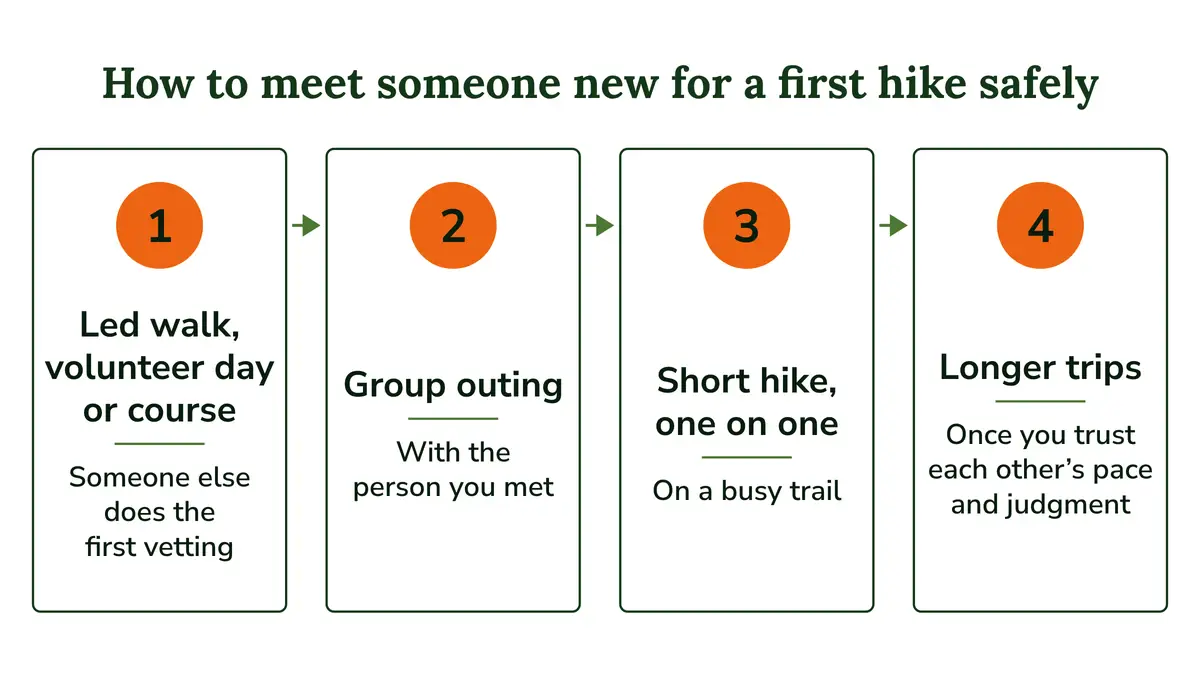
The order matters more than any single step. Someone else does the first vetting on a led walk, a volunteer day or a course, and then you hike with the person you met on a group outing.
After that comes a short hike one on one on a busy trail, then longer trips. At no point are you alone with a near-stranger at a first meeting.
I’d want the first one-on-one hike to be one I could turn back from in ten minutes. That way, if the pace is wrong or something feels off, ending the day early is an easy, ordinary choice instead of a long walk out.
Before the Hike
Meet first on a club walk or a group outing if you can. Bushwalking NSW recommends the same: start with a club activity led by an experienced leader.
Coffee first helps you get a feel for someone, but I wouldn’t treat it as enough on its own. An hour at a table tells you nothing about their pace or what they’d do if the weather turned, so the trail plan still matters.
Put your new partner’s full name in your trip plan, because searchers need to know who is with you; the rest of what to leave in a trip plan stays the same. Canada’s AdventureSmart trip plan, for one, asks for the name of everyone in your group.
At the Trailhead
Meet at a public trailhead and drive yourself. Arriving in your own car means you decide when to leave, whether that’s after the hike or five minutes after you’ve met.
The Pacific Crest Trail Association gives similar advice for trailheads in general: keep your car ready and leave if the people there make you uneasy. If something feels off when your new partner arrives, a short message saying you’re heading home is enough.
On the Trail
Choose a short hike on a busy trail for the first one. Other people are around, and turning back is easy if the day isn’t working.
Let the slowest person set the pace, which is the Forest Service’s hiking advice for any group. It keeps you together, and it shows you how your new partner handles walking at someone else’s speed.
Each of you carries your own basics, such as water, food, a layer and a light, instead of assuming the other has them. If you’re not sure what that covers, the Ten Essentials for a day hike make a good checklist.
And trust your instincts about strangers, as the National Park Service puts it on the safety page linked above. If a comment or a suggested detour bothers you, that’s reason enough to head back.
After the First Hike
Afterward, decide whether you want to hike together again. If you do, build up in steps: a longer day next, then a first overnight, only once you trust each other’s pace and judgment.
If it didn’t click, the club walk or listing where you met will have other people on the next outing.
For your next step, open your local club’s or federation’s outings page, pick one beginner-graded walk in the next few weeks, and check its pace and leader against the listing checks above before you RSVP.
Founder & Gear Research Editor
Sonia Zannoni
I’m Sonia, the founder of Best Trail Backpacks. I don’t test gear myself. For every pack I cover, I read the manufacturer’s specs and sizing charts and look for what owners report again and again.
Fit comes first, because a pack that doesn’t match your torso and hips will hurt no matter what it cost. My goal is to help you choose a pack that suits your body, your trip and your budget.
About the Founder
