
How to Wash a Backpack? — A Step-by-Step Guide
Nowadays, backpacks are universally used since there is one for every purpose you could think of on the market. If you are like me and owned several rucksacks, that get used extensively, sooner or later, it will come a time when you will need to wash your backpack because it will be dirty and smelly.
I find that backpack owners can be divided into two categories. Within the first, you will find people that feel great pride in having a filthy backpack as proof of all the excursions they have gone through. The second category regroups individuals who like to keep their rucksack clean, and in pristine condition as they consider their rucksack to be an investment and want to keep it for the years to come.
Therefore, this post is for the second group of people. If you belong to the first category, then you must read the best trail backpacks to look for your next backpack. Why? Simply put, by mishandling your hiking bag the way you do, you will definitely need a new one soon!
So, without further ado, here are two ways to clean your rucksack along with some tips to help you take care of your investment!
How to Wash Your Backpack
First off, no matter how you decide to clean your rucksack, there are a few things you must do first before proceeding with the cleaning of your backpack.
- Remove all items from the pockets as well as from all the compartments of your hiking bag and leave the pockets unzipped.
- Vacuum clean the inside to remove any debris, dirt, rocks, and dust. Don’t forget to vacuum all the nooks and crannies of your bag (corners, seams). You might be surprised by what can lurk in your rucksack!
- Use a wet cloth to remove any loose dirt from outside the bag.
- Remove the internal metal frame when possible.
- Remove all detachable pockets, straps, the harness as well as the hipbelt. Wash these items separately by following the procedure described below for hand washing your backpack.
- Inspect the rucksack before cleaning it, and trim any excess thread, especially near the zippers to prevent any damage to the backpack.
- Look for any stains. Pre-treat them with either a stain remover or a mixture of detergent and water in a ratio of 1:1. Brush the stain and wait for about 30 minutes, then rinse the area completely.
Hand Washing Your Backpack
- Fill up the bathtub or the sink, depending on the size of your bag, with cold water and add the soap. Mix it with your hands.
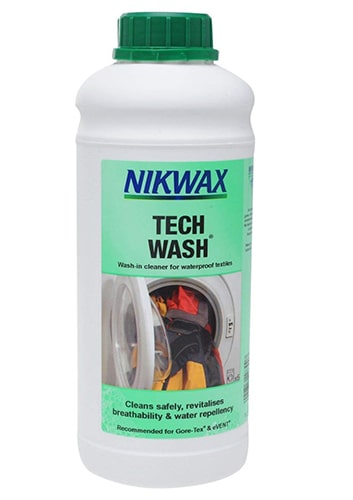
- Always use a dye-free, chemical-free detergent such as Nikwax Tech Wash to avoid removing the waterproofing layers and prevent discoloration of your rucksack.
- For the next step, you have two options:
- Place the backpack in the bathtub or the sink and shake it to clean the bag.
- Or use a washcloth and soak it in the soapy water, and wipe the inside and the outside of the bag to wash the backpack.
- Clean the corners and the seams by using an old toothbrush.
- Don’t forget about the zippers! Use an old toothbrush to remove any debris lodged into the zippers gently. Don’t brush the zippers too hard as you might remove the water-resistant coatings on them.
- Drain the bathtub (or sink).
- The next step is what I like to call the “rinse cycle.” There are again two ways of doing this:
- Submerge the backpack in a bathtub (or sink) filled with cold water and shake the bag thoroughly to rinse it.
- Or the second option which is better, in my opinion, is, to use a detachable showerhead to rinse the rucksack to remove all traces of soap.
- Always air dry the bag. Never use a dryer machine to dry the knapsack. If you have a clothing line, hang the backpack upside down in the shades, no direct sunlight. If not, dry the pack inside in a cool, well-ventilated place and away from any direct heat source. I also recommend that you put some towels in the bag to absorb the extra moisture. Moreover, the towels will help the bag retain its shape.
- Let it completely dry before your next use.
Watch the video below to see how it’s done:
Washing Machine Your Backpack
I don’t recommend using this method to clean your backpack. It should only be used as a last resort.
- For thorough cleaning, turn your backpack inside out and leave all the pockets and compartments opened.
- Put the rucksack in a laundry bag or an old pillowcase and tie a knot at the top. Doing so will prevent the straps or any loose parts of the backpack from getting tangled up in the washing machine, especially if you are using a top-load machine with an agitator, which can cause damage to the washer as well as your pack.
- Select the delicate or the hand wash cycle.
- Wash the knapsack in cold water and with a chemical-free, dye-free detergent. You can use the mild detergent Nikwax Tech Wash.
- Follow the same procedure to dry your backpack as the one described in the handwash method.
Removing the Mildew Smells
Now, if your rucksack stinks like it has a mildew smell to it, here is a short procedure for getting rid of the mold and having your backpack smell fresh and clean for your next outing on the trail.
This procedure must be done outdoors and on a sunny day to eradicate the mold.
- Use a cloth (a disposable one) and carefully brush off the mold from the backpack. Go easy with the brushing. You don’t want to spread the spores to the entire bag.
- Next, rub the area of the knapsack that has the mold with alcohol.
- Sponge the area with a washcloth soaked with water to rinse.
- Let the rucksack dry in the sun. Even though I mentioned earlier that you should always let your pack dry in the shades, here you need the benefits of the sunlight to kill the remaining spores that could be present in the backpack.

Paramount Tips for Cleaning Your Backpack
Here are some tips to help you keep your backpack clean and therefore extend its lifespan.
- It is of the utmost importance that you follow to the letter the manufacturer’s instructions for cleaning your backpack to avoid any damage or remove the waterproofing coating of the bag.
- How do you prevent mildew? Remove any wet items from the rucksack once you get home from your hiking excursions.
- Treat the zippers after you have cleaned the backpack with silicone spray to lubricate them and to keep them working smoothly, therefore preventing the zippers from getting stuck.
- It is imperative that after each outing you check your bag, remove any stains right away and wipe the inside and outside of the backpack with a damp cloth to remove any dirt.
- Always let the bag dry thoroughly before your next use.
- You should thoroughly wash your backpack no more than 1-2 times/year.
Final Thoughts
If you are like me and view your backpack as an investment and want to keep your pack for years to come, it is imperative to take great care of your hiking bag by cleaning it after every hiking excursion.
I recommend hand washing your knapsack if there are no recommendations from the manufacturer to avoid damaging and ruining your rucksack. So, even if the bag is really filthy, first try to hand wash it. However, if you find that the backpack is still dirty, then, as a last resort before throwing it out, try the washing machine method described above.
If nothing works or the backpack end up being ruined after washing it in the washer, thus you should consider buying another hiking backpack to replace it. So, if you need help in buying your backpack, read my post about the best hiking backpacks available online here.
If you have any inquiries or suggestions about cleaning backpacks, please, leave a comment below.
Founder & Gear Research Editor

Sonia Zannoni
I'm Sonia, the founder of Best Trail Backpacks. I don't test gear myself. For every pack I cover, I compare the published specs and sizing charts, read what independent testers found, and look for what owners report again and again.
Fit comes first, because a pack that doesn't match your torso and hips will hurt no matter what it cost. My goal is to help you choose a pack that suits your body, your trip and your budget, and to tell you plainly where the evidence runs out.
About the Founder

Hello Sonia.
Currently, I have two backpacks. One of them is foreign, and the other one was locally made in my school environment by a lady that usually makes a backpack for sale. The locally-made one is made using leather, so I haven’t washed it for a long time now. I just clean the stains if there are any and dust the inside.
The other backpack is a big one. It’s currently dirty. Let’s see what I can do with this guide.
Hey, good luck with washing your backpack. If you need any help, please let me know by dropping me a line here, and I will gladly assist you any way I can.
Hi Sonia, you are so so funny 😆🤣 to say that. A dirty backpack, is it a thing to pride about? Of course, if it is, they certainly would need a new one. Lol
Well, I belong to the 2nd set that wants their backpack to be clean because it really cost me some good money to get it. Thanks for sharing this guide.
Hey, I glad to see that you found humor in my post ? ?. What can I say, I do have my moments!! But kidding aside, I also belong in the second group that wants to keep their backpacks clean. Because the last thing I want to be doing is buying a new backpack every few outings because I was careless!
Don’t get me wrong, I do have several backpacks, but each serves a different purpose!
Hi, I love the simplicity with which you write. The change I observed in the appearance of my backpack after using the Nikwax Tech Wash was wonderful. One cycle through the machine and my hiking bag had a like-new appearance. There were no leftover residues or harsh chemicals to worry about. This product exceeded my expectations for real.
Nice write-up
Thank you for sharing your experience using the Nikwax Tech Wash. It’s a fantastic product to have around the house as it works miracles, as it makes washing backpacks a breeze!
Hi Sonia
The last thing you think about when buying backpacks is the need to clean them. I really enjoyed this article as all the essential tips that you require to accomplish this task are given. I do not like washing my backpack, as it can be challenging to do it right.
If you want your rucksack to last a long time, you need to look after them, clean them and check for natural wear and tear. I am a great believer in repairing stuff before throwing them away. A little elbow grease is all that is required to make them near new.
It is a shame that we live in a throwaway society, where backpacks are not kept. What is your recommendation for the use of hiking bags when they come to the end of their life?
Thanks
Antonio
Well, I actually never given a thought about recycling my old backpacks! This is a great idea!
One thing you can do is, remove the buckles, the straps, the zippers if they are still in good condition, and keep them as spare parts for your other backpacks.
Another option could be to give it away to charity if the hiking backpack is still in a decent condition as I wouldn’t donate a beat-up rucksack just for the sake of getting rid of it. They could do small repairs and give it to people in need.
Hello Sonia!
I am myself a person who made several tens of trips on foot over time, and there were enough times that I wore a backpack with provisions of drink and food. There was no way it didn’t get dirty after being taken in several rides, and when it came to washing it, I directly chose the least indicated method – to wash it in the automated machine. And even then, I did not follow any custom instructions. I washed it as I do with ordinary laundry.
I am a man who doesn’t even have patience with sorting laundry by colors, so I did not care very much about backpack-washing methodology. Still, the rucksack stayed further available for new trips anyway! It was bought in February 2017, and I still have it. However, during the last six months, I did not make any other backpacked trips on foot.
Thanks for advising us about how to take care of our “riding bags.” So the bathroom is a more suitable place for washing them.
Best regards,
Peter
When you use the washing machine it does not mean that you will inevitably ruin your backpack! It all depends on the quality of your rucksack, I guess you have a high-quality backpack! Thanks for sharing your story.
I was always termed lazy enough not to wash my backpack regularly. But after reading your post, I think I was right.
To be honest, I never gave so much detailed thought on how to clean my backpack. But I think after going through your post, I can use the tips and ideas you shared to wash my backpack. I am sure it’s not only me but many people out there who wouldn’t know how to clean their hiking backpacks correctly.
Thanks for the detailed info on washing backpacks. I can do it in the right way now.
Thank you, Nick, I am glad I could help you keep your hiking backpack clean for years to come!
Hello there, thanks for taking the time to write a post about washing a backpack, as I think it will be of great help to all the hikers’ enthusiasts out there.
In recent times getting my backpack clean seems to be a problem, although I wash it I can’t just get all the debris and stains out, but I believe I would be able to do so after using these steps you have outlined.
Thanks!
Personally, by using the Nikwax Tech Wash soap, I find it less tedious to hand wash my backpack. I also always inspect my rucksack for any stains or dirt after each use. That way, it is much easier to clean a freshly made stain than an embedded stain.
This article is very informative! I am one of those that loves taking my backpack on all of my adventures, but hate having a dirty backpack! Although I typically do a pretty good job keeping it clean, there are some tips here that are new to me that I will incorporate into cleaning it. Thank you so much for your help!
I glad that you found value in my post. What were the tips about washing your backpack that were new to you? I’m curious to know!
For me, since I always wash my hiking bag by hand, I was surprised to learn that you need to put your backpack in a pillowcase when machine washing your rucksack!
I am not a big fan of washing my backpack by myself, so I always try to make use of the machine. It has been my friend in this aspect, but I see here that I have been washing it the very wrong way for quite some time now, and I will need to make some amendments to that.
It always takes a few months before I wash mine, though. How long do you think is required before I wash my backpack.
What I usually do is after each of my outings, I empty my hiking bag and remove any dry dirt by vacuuming. Also, I check my backpack for the presence of stains, which I remove immediately by using a mixture of soap and water. I try to hand wash my backpack using the procedure that I described in the post no more than twice a year.
I hope it helps.
I really don’t like doing the washing of my backpacks myself, so I always love the machine way, lol. Right from when I was young, I’ve been a serious lover of backpacks, and I’ve grown up and still am.
I always wash them at a very long interval because I hardly put them on the floor, even when I don’t have where to drop it, my legs are always ready to accommodate, so they rarely get dirty, but whenever they do, my washing machine is a lifesaver.
Thanks for stating these tips, they will help me take proper care when washing my backpacks.
You are right not to wash your backpack regularly. It is recommended by many backpack manufacturers to clean your rucksack no more than 1-2/year.
One thing that I like to do is to check my backpack after each of my outings for the presence of any stains or dirt. If there are stains, I will clean them right away by applying some soap locally and rinsing with water. I also remove any dirt on and in the bag by vacuuming it.
Indeed, many people don’t know how to wash a backpack in the right way. Consequently, for this reason, they tend to damage the bag. The tips you provided here will help people clean their hiking backpacks without ruining them.
Most times, I hand wash my hiking bags as it gives me the chance to do it with utmost care. Before using machine wash on a backpack, make sure you consider the manufacturer’s take on it’s washing techniques. Thank you.
I put together this post about the proper way to wash a backpack mainly to provide help in keeping your favorite backpack for years to come!
Personally, I find that hand washing my hiking bag allows me to clean the clutter within my bag and recover some lost change as well!
Thanks for sharing your thoughts and advice.
I have lots of backpacks which I hardly clean because I don’t have a good soap to clean it. Some time ago, I washed one, and it started losing its texture, and since then, I haven’t been washing them at all.
However, I would follow these guidelines you have given here to wash some of the backpacks that I have at home. I hope it goes well this time. Thanks for sharing this post.
I highly recommend that you use the Nikwax Tech Wash products along with the tips provided in this post to wash your backpack. By doing so, this time around, you shouldn’t have any problems. Let me know how your backpacks turned out.
One of my main reasons for not wanting to use a backpack is because I find them unclean and smelly. I don’t know why I never thought of washing it. It seems the obvious solution now! Thanks for your advice and tips on how to clean a backpack by hand. I want to keep mine looking new for as long as possible!
Absolutely, by taking good care of your backpack, you will be able to keep it for many years to come!
Furthermore, I feel that the removal of stains and dirt after each use on your knapsack should be part of the planning of your hiking excursions as much as drafting your itinerary, packing your hiking bag, and so on. By doing so, it won’t feel like a chore!