
Best Waterproof Daypacks for Rainy Hikes (and When a Liner Is Enough)
Affiliate Disclosure: Some links on this page are affiliate links. If you buy through one, I may earn a commission at no extra cost to you. Commission never decides which products I recommend. Read the full disclosure.
The listing said 100% waterproof, so you trusted it through two hours of steady rain. Then you opened it at the trailhead and found a wet phone and a fleece you could wring out.
Go to the maker’s own page and that promise usually comes with conditions the listing skipped: roll the top at least three times, don’t put it under water, or a flat “not a dry bag.” So this isn’t on you. Plenty of waterproof daypacks get sold on one loose word.
How a pack keeps water out is what decides how it behaves in rain, and almost no listing tells you how it’s built.
What you really want to know is whether you need a true waterproof pack, a cheaper pack with a liner, or a dry bag with straps, and which packs stay comfortable for hours.
By the end you’ll know how each pick keeps water out, what its maker says it won’t do, which one fits your back and your day load, and when the pack you already own plus a liner is the smarter buy.
TL;DR: Waterproof Daypacks
- Exped Typhoon 25 for light loads in steady rain: a taped liner keeps your layers dry, but the carry is minimal and the load limit is 11 lb.
- Rab Veil XP 30 for long, fast wet days: a fully taped waterproof shell and 30 L, with a running-style hip belt that sits high by design.
- Hyperlite Elevate 22 for fit: three torso sizes and a padded hip belt, dry in showers, but add a liner for all-day rain.
- If your hikes see showers more than all-day rain, a liner in the pack you already own may be all you need.
Here’s how the three picks compare, in the order I cover them below.
Product Name
Best For
Key Strength
Main Tradeoff
Price Tier
Light loads in steady rain, weekend commuters
Taped waterproof liner in a 1 lb pack
One-size harness, webbing waist strap, 11 lb limit
$$
Fast, long wet days
Fully taped waterproof shell, IPX4, 30 L
Hip belt sits high by design, thin fabric
$$
Fit first, showers more than all-day rain
Three torso sizes, padded hip belt
Not a dry bag: two owners report wet contents in long rain
$$$
Exped Typhoon 25
Best For: Light loads in steady rain, weekend commuters
Key Strength: Taped waterproof liner in a 1 lb pack
Main Tradeoff: One-size harness, webbing waist strap, 11 lb limit
Price Tier: $$
Rab Veil XP 30
Best For: Fast, long wet days
Key Strength: Fully taped waterproof shell, IPX4, 30 L
Main Tradeoff: Hip belt sits high by design, thin fabric
Price Tier: $$
Hyperlite Elevate 22
Best For: Fit first, showers more than all-day rain
Key Strength: Three torso sizes, padded hip belt
Main Tradeoff: Not a dry bag: two owners report wet contents in long rain
Price Tier: $$$
Price tiers: $ under $100 | $$ $100 to $249 | $$$ $250 and up
If you already own a daypack that fits and your rain comes in showers, the last section may save you buying anything.
What Makes Waterproof Daypacks Actually Keep Water Out
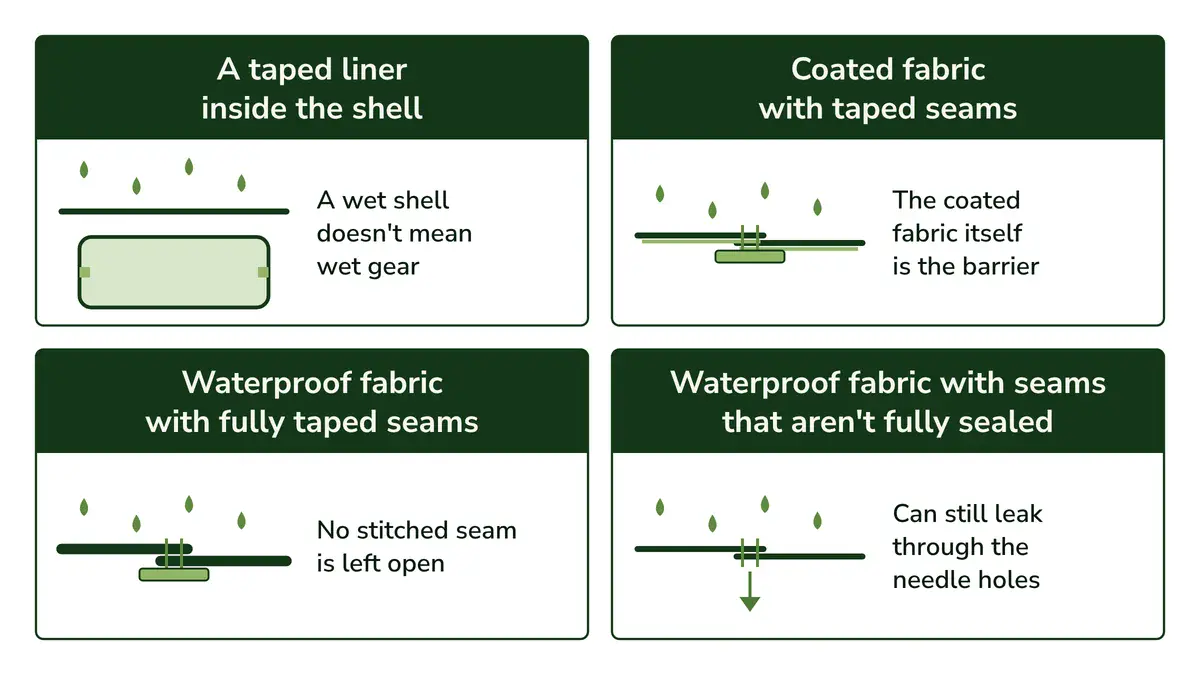
A daypack keeps rain out in one of four ways: a taped liner inside the shell, coated fabric with taped seams, waterproof fabric with fully taped seams, or waterproof fabric with seams that aren’t fully sealed. The build decides what happens in steady rain.
And each maker says plainly, somewhere on its own pages, what its pack won’t do. That’s the second thing worth reading before you buy.
Think back to that soaked fleece. The tag never told you which of those four builds you were carrying, and that’s the first thing I’d want to know.
If your rain comes in passing showers, most builds will cope. If it rains for hours where you hike, the build matters more than anything else on the spec sheet.
Here’s what I weighed for every pick below, and why each one counts:
- How the waterproofing is built, because it decides what happens in the second hour of steady rain.
- What the maker says the pack won’t do, because that’s the honest limit of the waterproof claim.
- Torso fit and where the hip belt sits, because a belt on your waist leaves your shoulders carrying the load.
- Load limit, because a frameless pack pushed past it hangs its weight on your shoulders.
- Weight, since you’ll carry the pack on dry days too.
- Access on the trail, because a roll-top makes you stop and unroll to reach anything inside.
- Price tier, because a liner in a pack you already own costs far less.
Four Ways a Daypack Keeps Rain Out
How the waterproof layer is built matters more than the word on the tag. A liner or a fully taped shell keeps steady rain out, while waterproof fabric with seams that aren’t fully sealed can still leak through the needle holes.
By waterproof I mean the pack keeps water out through its fabric and its seams, instead of just slowing it down. The longer story of waterproof versus water-resistant, with DWR, zippers and seams, lives in my rain cover guide.
Here are the four builds and why each one behaves the way it does:
- A taped liner inside the shell. The waterproof layer sits inside the outer fabric, away from scuffs and from the soaked outside, so a wet shell doesn’t mean wet gear.
- Coated fabric with taped seams. There’s no separate liner. The coated fabric itself is the barrier, with tape over the seams where it was sewn.
- Waterproof fabric with fully taped seams. The shell is the barrier and every seam is taped, so no stitched seam is left open.
- Waterproof fabric with seams that aren’t fully sealed. The fabric stops water, but each stitch makes a hole, and water can find those holes in long rain unless every seam is sealed.
That last one catches a lot of buyers, because waterproof fabric sounds like a waterproof pack. Hyperlite’s own help center says its fabric is waterproof before it’s stitched, and that the seam tape it adds afterward doesn’t guarantee a fully waterproof pack.
The one pick here built this way is the Elevate. Two of its owners report wet contents after long rain, while others stayed dry in showers. That’s why the build is the first question I ask about any pack in this guide.
It’s more than comfort, too. The National Park Service notes that wet clothes can lose up to 90% of their insulating value, so the spare layer in your pack is the one thing that really has to stay dry.
What Each Maker Says Its Pack Won’t Do
None of these packs is a dry bag. Exped calls the Typhoon 100% waterproof when you roll the top at least three times, and Hyperlite says the Elevate isn’t a dry bag. Rab rates the Veil XP 30 to IPX4, which means splashes from any direction, not going under water.
Exped’s roll-top instructions for the Typhoon say to roll it back toward the shoulder straps at least 3 times for full protection. REI’s listings add that it isn’t meant for prolonged submersion. Both conditions belong right next to the word waterproof.
Picture a rain stop where you’re cold and in a hurry. You stuff the jacket back in, give the top one quick fold and clip it shut. That half roll is where a roll-top lets water in, whatever the fabric.
That’s why Exped asks for at least three rolls: each fold adds another layer of overlap water has to get past, so fewer folds means a weaker seal.
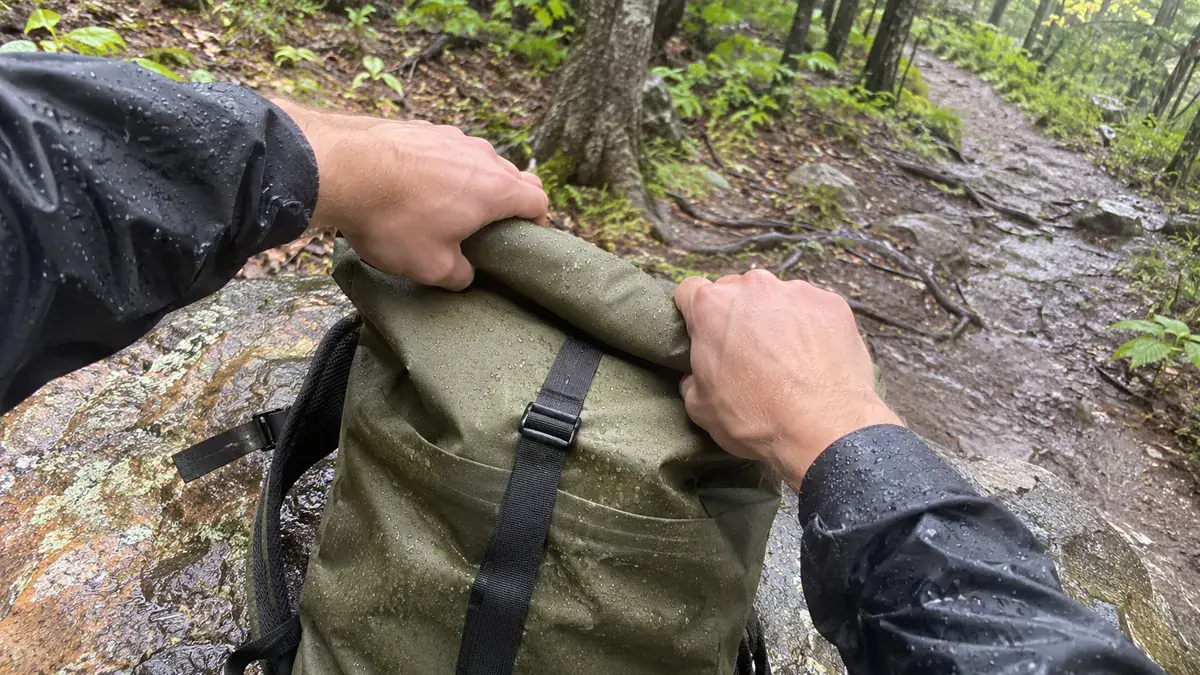
Hyperlite is the most direct of the three. It calls the fabric 100% waterproof, but its care page says plainly that the Elevate 22 is “NOT a dry bag.” I read that as the maker telling you to pack a liner for all-day rain.
Rab says the Veil XP 30 is tested to IPX4. That’s a splash rating: water splashed from any direction, not immersion.
So if you’ll be on the water, you need a pack rated for going under, and none of these three is. The welded, IP67-rated pack in my Ortlieb Atrack review is the one on this site built for that.
Torso Fit and Where the Hip Belt Sits
Comfort over hours comes down to torso length and where the hip belt lands. The Elevate comes in three torso sizes, the Rab in two back lengths and the Typhoon in one. Only the Elevate has a padded hip belt meant to take weight off your shoulders.
Here are the torso numbers as each maker or retailer gives them:
- Exped Typhoon 25: one size. REI listed 16 to 20 inches for the previous version, and Exped doesn’t publish a range for the current one.
- Rab Veil XP 30: S-M fits 16 to 18 inches and M-L fits 19 to 20 inches.
- Hyperlite Elevate 22: Small 15 to 17 inches, Medium 17 to 19 inches, Large 19 to 21 inches.
Measure your torso before you look at any of them, then check that number against each range. It’s the one figure every size choice here depends on.
A hiking hip belt works by resting on your hip bones, so the load sits on your hips instead of hanging from your shoulders. The three picks handle it very differently:
- Typhoon: a removable webbing waist strap (REI lists it for waists or hips of 22 to 46 inches), which steadies the pack but doesn’t carry weight.
- Rab: a hip belt that Rab’s own support team says sits higher by design, because the pack is built mainly for running.
- Elevate: a padded, removable hip belt that fits 28 to 50 inches.
If you’re on the shorter side, you may know the feeling of a belt that rides up to your waist by midmorning. Once it’s there it has nothing to rest on, and your shoulders take over.
For women and shorter torsos, I’ll be plain: I didn’t find a women’s-specific waterproof daypack. The Elevate’s Small comes closest, though it isn’t a promise of fit, and the one-size Typhoon suits average torsos going by the previous version’s range.
The Rab’s S-M suits shorter torsos too. But two women owners with 26 and 27 inch waists had to shorten its waistband themselves, and Rab publishes no waist range to check against.
If your torso is at the short or long end, that number comes before the waterproofing. A dry pack that rides wrong for six hours isn’t the better pack.
Load Limit, Weight and Getting at Your Gear
All three picks weigh between about 1 and 1.25 lb, so the real differences are load and access. A roll-top opens only from the top, and outside pockets are quicker to reach but sit outside the waterproof layer. The Typhoon’s 11 lb limit is the number to check first.
Exped sets an 11 lb load limit on the Typhoon and on its lighter sibling, the Cloudburst. Hyperlite rates the Elevate to 25 lb, and owners repeat about 15 lb as comfortable.
I don’t have a load limit from Rab for the Veil XP 30, so I won’t guess one.
Weight barely separates them. Carrying a waterproof pack of about a pound on a dry day costs you very little.
Access is where you notice the roll-top. Reaching a snack means unclipping and unrolling, which is the last thing you want to do in the rain. The outside pockets are quicker, but they sit outside the waterproof layer, so keep them for things that can get wet.
On price, the Typhoon and the Rab sit in the middle tier ($$) and the Elevate in the top tier ($$$).
For Light Loads in Steady Rain: Exped Typhoon 25
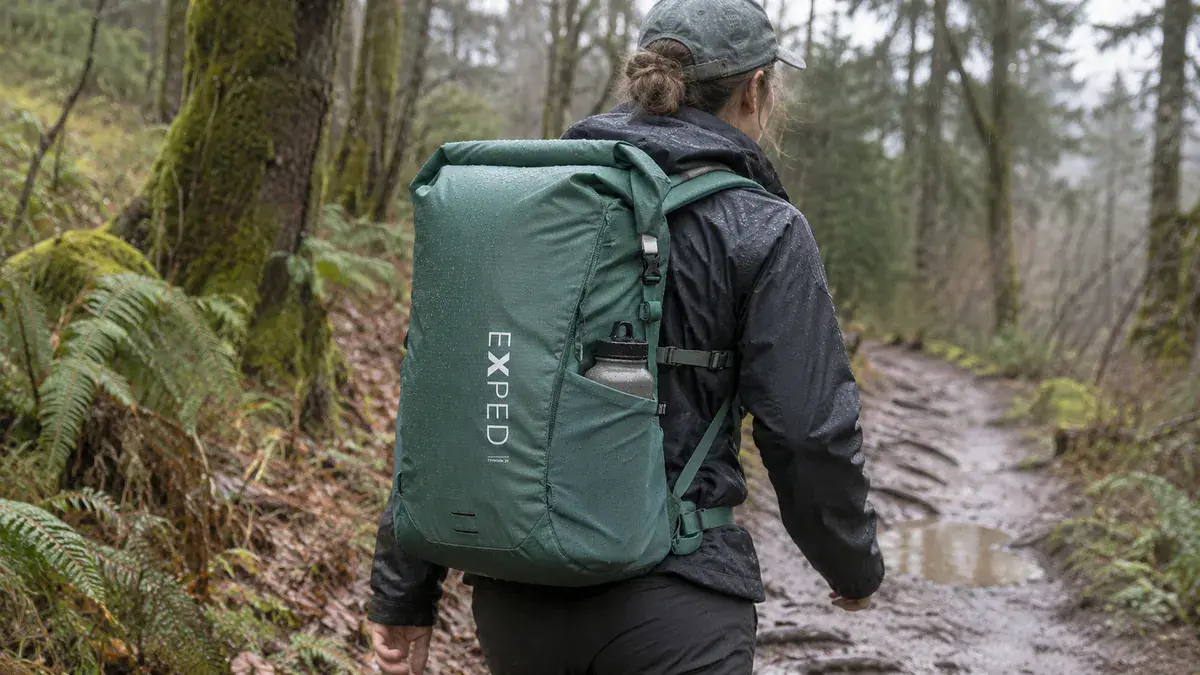
The Typhoon hides a seam-taped waterproof liner inside a separate outer shell, so your layers stay dry even when the outside fabric is soaked. It weighs about 1 lb and costs about what a regular daypack does.
The catch is the carry: one size, a webbing waist strap and an 11 lb limit.
Best For
- Day hikers in wet climates carrying a light load, under 11 lb, who want the phone and spare layers dry without fiddling with a separate liner.
- Commuters who hike on weekends, since REI lists a bike light anchor for the ride in.
- Average torsos, roughly 16 to 20 inches going by REI’s figure for the previous version, since it comes in one size.
Why It Stands Out
The strongest point is the liner. Exped builds a 3,000 mm liner with factory-taped seams into a 1,500 mm outer shell, in a pack of about 1 lb, at roughly the price of a regular daypack.
Those millimeter figures are the water column: how much water pressure a fabric holds back before it leaks, so higher means more waterproof. The liner rates twice the shell, and it’s the layer your gear sits in.
Because the waterproof layer sits inside the shell, it stays away from scuffs and from the wet outer fabric. It’s a pack liner sewn and taped into the pack, so there’s nothing to forget at home and nothing to tear as you pack.
A handful of owners across REI’s two listings, about four reports, say the contents stayed dry through a storm, a heavy downpour or a sudden squall. One owner says the inside stayed “100% dry.”
Key Features and What They Mean
- Roll-top closure, with two ways to close it on the current version. Exped says to roll it back toward the shoulder straps at least 3 times. Half a roll on a rushed rain stop is where water gets in.
- Liner that turns inside out. You can clean and dry it after a muddy day, which matters on a pack that lives in wet weather.
- Front zippered pocket and two stretch side pockets. Keys and bottles without opening the top, but they sit outside the liner and aren’t waterproof. Two owners say the side pockets hold bottles securely.
- Frameless air mesh back pad. Fine for a light load, which is what the 11 lb limit assumes.
- Sternum strap with whistle, daisy chains and stowable pole loops, per REI’s listing. Small extras for the trail. REI notes it isn’t hydration compatible, so plan on bottles.
- About 1 lb. Exped lists 1 lb with the removable parts off and 1 lb 1 oz with everything on.
Owners describe it as comfortable when full, with padded straps and back.
If you want something lighter still, Exped’s Cloudburst 25 weighs 9.5 oz and sits in the lowest price tier ($). Its PU-coated fabric with fully taped seams is the waterproof layer, with no separate liner.
The tradeoff is thinner fabric. It has the same 11 lb limit and a removable hip strap, and Exped calls the compartment waterproof against rain when rolled at least 3 times, not when submerged. It has almost no owner reviews yet.
Where It Falls Short
The main limitation is the carry. Exped sets an 11 lb load limit on a frameless back with a webbing waist strap, so past that your shoulders take the weight. If you’re unsure where your day load lands, my guide on how heavy your pack should be helps.
One owner wanted a more substantial waist belt for heavier loads. That’s a single comment, but it fits the design.
REI says it isn’t meant for prolonged submersion. One owner of the previous version, on long hikes up side canyons, titled a review “Dry-ish bag”: water that pooled on the roll-top after a splash seeped in, though the pack was never under water.
That’s one report against about four dry ones, but it’s worth knowing Exped’s 100% waterproof claim has an exception.
It comes in one size, and no owner report I read covers a long torso, so tall hikers are left guessing. The owner reviews are also short-term, so there’s no long-term durability evidence either way. I’d keep the tags on through the return window.
And yes, a trash bag liner does nearly the same job. A regular pack plus a liner is still the cheaper route, and I come back to it in the last section.
The Typhoon earns its place when you’d rather not remember, pack and protect a liner every time, or when electronics ride in your pack every day.
Pros and Cons
Pros
Taped liner kept contents dry in heavy rain for most owners who reported on it
About 1 lb
Liner turns inside out for cleaning
Regular-daypack price tier ($$)
Cons
11 lb limit with a webbing waist strap
One size only
No hydration sleeve or port
Outside pockets aren’t waterproof
Who Should Skip It
- Anyone carrying more than about 11 lb, or who wants a padded hip belt to take the weight.
- Hydration bladder users, since there’s no sleeve or port.
- Long torsos, because it comes in one size.
- Anyone who needs a pack to survive going under water, which REI says it isn’t meant for.
Verdict
The Typhoon is my pick when your load is light and you want the dry layer built in, so you never think about a liner again. Most owners who reported on rain say it kept their gear dry in real downpours, and it costs about what a regular daypack does.
If you carry more than 11 lb, look at the Rab or the Elevate instead.
 Exped Typhoon 25
A light roll-top daypack with a seam-taped liner built in, so your layers stay dry in steady rain. Best for loads under its 11 lb limit.
Rab Veil XP 30: Taped Seams and Room for a Long Wet Day
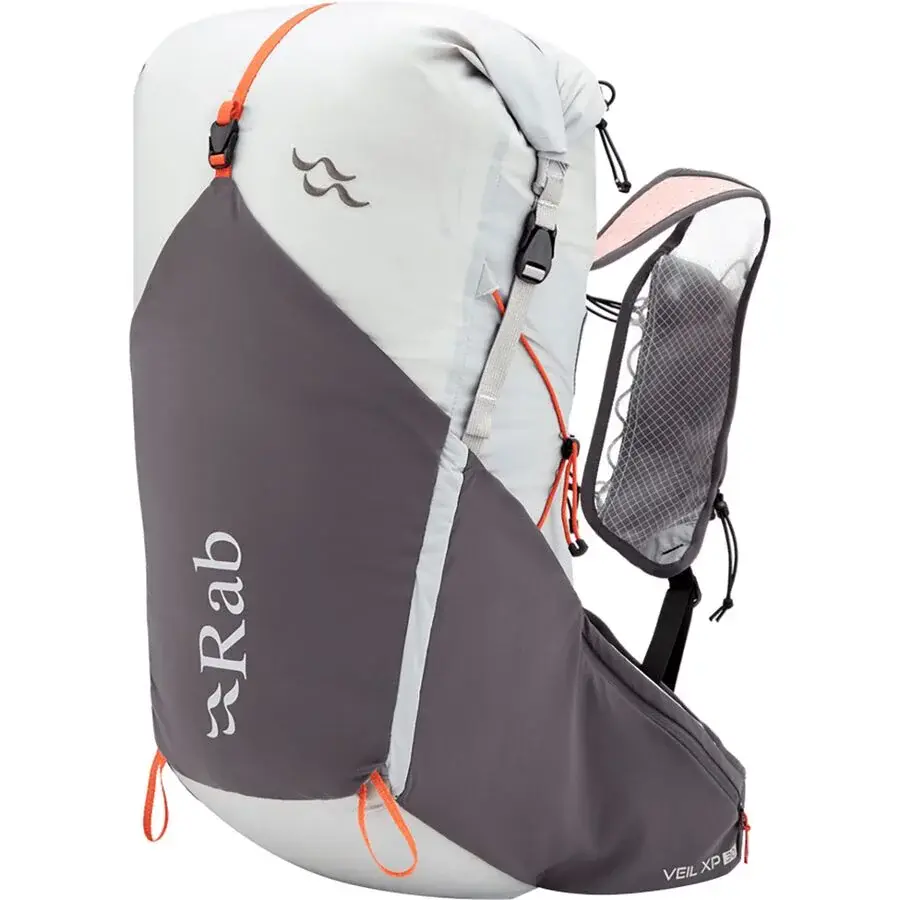
The Veil XP 30 makes the shell itself the waterproof layer: waterproof fabric with fully taped seams, tested by Rab to IPX4. It holds 30 L at about 1.25 lb, enough for spare layers on a long wet day.
Rab builds it mainly for running, though, so its hip belt sits higher than a hiking belt.
Best For
- Fast hikers and long-day hikers in wet climates who want sealed waterproofing, room for layers (30 L) and a light pack.
- Hikers who like a vest-style fit and want to grab things without stopping.
- Shorter torsos, through the S-M back length (16 to 18 inches), with the waistband caveat below.
Why It Stands Out
Its strongest point is a fully taped waterproof shell, tested to IPX4, at 30 L and 1 lb 4 oz (size M), in the middle price tier. Rab’s Veil XP 30 page lists the taped seams and the IPX4 test.
With no separate liner to forget and no stitched seam left open, there’s less to go wrong in steady rain. IPX4 covers rain and splashes from any direction, though not going under water.
Owners who mention rain say their gear stayed dry, and one calls it “really waterproof.” Another says it “eliminated the need for internal dry bags,” which matches what Rab claims for it.
Key Features and What They Mean
- Mono Mesh harness with harness pockets. It wraps your upper body like a vest, so the load doesn’t bounce, and the pockets sit where you can reach them while walking. Owners like grabbing layers and snacks without taking the pack off.
- 3D mesh back panel, front stretch stash pocket and side pouches. Places for things you want outside the roll-top, so you open the main compartment less often in the rain.
- Z-pole attachment. Holds folding poles on the pack when you don’t need them.
- Roll-top with a side buckle. The same rule applies: the seal depends on rolling it properly.
- Hip belt with laser-cut ventilation and zipped pockets, per Rab. Somewhere for a phone or snack you can reach without stopping.
- Two back lengths. S-M fits 16 to 18 inches and M-L fits 19 to 20 inches. Most owners mark it true to size.
About thirty owners have reviewed it on Rab’s own site, and the comfort comments keep coming back to how it hugs the back and stays stable at speed. One owner felt it sway when loaded.
Owners report carrying about 15 to 20 lb on multi-day trips. That’s their experience of the whole pack, not a sign that the hip belt carries the load.
Where It Falls Short
The main limitation is the hip belt. Answering an owner on its review page, Rab’s support team said the belt sits higher than a standard backpack’s by design, because the pack is built mainly for running.
Two owners say it lands on the waist or stomach instead of the hips, and one of them had a sore back after a day hike because it sat on her waist. On this pack the belt steadies the load more than it carries it.
Small waists are the second catch. Two women owners with 26 and 27 inch waists had to shorten the waistband themselves, and Rab publishes no hip belt range to check against.
The fabric is thin. Two owners report damage from rock, a puncture and a tear, and a third warns it can tear on branches or sharp rock.
Two owners report stitching failures, one on a strap and one on a bottle pocket seam. One owner calls it “stronger than it looks,” so give it some care around rock.
Isn’t this a running pack? Yes, Rab builds it for runners and fast hikers. It’s here because it’s the one pick with taped seams on a waterproof shell and room for a long wet day, and the list below says who it won’t fit.
Pros and Cons
Pros
Fully taped waterproof shell, tested to IPX4
30 L at about 1.25 lb
Harness pockets you can reach on the move
Cons
Hip belt sits high by design
Thin fabric that owners report damaging on rock
No published waist range
Who Should Skip It
- Hikers who want the hip belt on the hip bones, carrying the weight.
- Small waists, under about 27 inches, unless you’re willing to alter the belt.
- Brushy or rocky off-trail routes, where the thin fabric can puncture or tear.
- Anyone who needs protection under water, since IPX4 is a splash rating.
Verdict
I’d pick the Rab for fast or long wet days, when you want sealed waterproofing and room for layers and you’re happy with a vest-style carry. It’s the one pick here that pairs a fully taped shell with 30 L of space.
If you want your hips to carry the load, the Elevate fits that job better.
 Rab Veil XP 30
A 30 liter roll-top with a fully taped waterproof shell, tested by Rab to IPX4, for fast or long wet days. Its hip belt sits high by design, so it steadies the load more than it carries it.
The Fit-First Pick: Hyperlite Mountain Gear Elevate 22
The Elevate is the fit-first pick: three torso sizes and a padded hip belt in a pack of about 1.1 lb. Hyperlite says plainly that it’s not a dry bag.
Owners say it stays dry in showers, but in hours of steady rain several of them add a liner inside.
Best For
- Hikers who want a real hip belt and a torso size that fits, in wet but not constant rain, carrying up to about 15 lb, the figure owners repeat.
- Women and shorter hikers through the Small (15 to 17 inches), and tall hikers through the Large (19 to 21 inches).
- Hikers who don’t mind adding a liner on all-day wet hikes.
Why It Stands Out
Its strongest point is fit: three torso sizes and a padded, removable hip belt (28 to 50 inches) in a pack Hyperlite lists at 17.7 oz in size Medium.
The fabric is Dyneema Composite Hybrid, which Hyperlite describes as 100% waterproof and super durable. Still, one owner on a long rainy trek wrote, “The bottom of the pack just soaks up moisture.”
More than a hundred owners have reviewed it on Hyperlite’s own site. On rain, several say it kept their gear dry in passing showers and light to moderate rain.
Key Features and What They Mean
- Roll-top with a long collar and one G-hook strap. The collar expands for a bulky jacket, but one owner says small items at the bottom are slow to reach.
- Side pockets sized for water bottles. Some owners carry two, though a few can’t reach them with the pack on, so you may stop to drink.
- A small front mesh pocket, and no inside or hip belt pockets. Hip belt pockets are the most repeated owner wish.
- Hydration port and loop. A bladder works, which helps on a pack you wear for hours.
- Narrow shoulder straps with minimal padding. Owners notice them with 2 to 3 L of water aboard.
Sizing runs short. Several owners sized up from Medium to Large, including one with a 19 inch torso, and another wrote that it “fits a little small in the torso length.” If you’re at the top of a range, size up.
Two owners say the fabric is loud, so expect some crinkle as you move. And one owner’s back got sweatier than with a ventilated mesh-back pack.
Where It Falls Short
The main limitation is sustained rain, at the top price tier. Hyperlite’s Elevate 22 care instructions say it’s “NOT a dry bag,” and its help center says seam tape doesn’t guarantee a fully waterproof pack.
Owners found that edge. Two report wet contents in long rain: one on a multi-day trek in Iceland, one after a four-hour rainy hike. Several owners now carry a pack liner inside, and one says they “used a pack liner and never worried about rain.”
It also costs more than twice what the Typhoon does, and several owners say it’s expensive for what it includes. On durability, several praise the build after long use, while one says it ripped two hours into a hike.
So if it still needs a liner, why pay for it? Because it comes in three torso sizes with a padded hip belt, it carries better than a dry bag with straps, and in showers it needs nothing. The liner is insurance for the days the rain doesn’t stop.
Pros and Cons
Pros
Three torso sizes and a padded hip belt
Light for a pack with real sizing
Fabric Hyperlite calls 100% waterproof
Hydration compatible
Cons
Not a dry bag: two owners report wet contents in long rain
Top price tier ($$$)
Small front pocket and no hip belt pockets
Noisy fabric for some owners
Who Should Skip It
- Anyone who needs gear dry through hours of steady rain without a liner.
- Anyone who wants organization, hip belt pockets or a large front pocket.
- Budget buyers, since it sits in the top price tier.
- Hikers bothered by noisy fabric.
Verdict
The Elevate is my pick when fit comes first and your rain comes in showers, with a liner packed for the days it doesn’t stop. Three torso sizes and a padded belt give it the best chance of sitting on your hips properly.
If the rain where you hike lasts all day and you don’t want a liner, the Typhoon or the Rab keeps water out better.
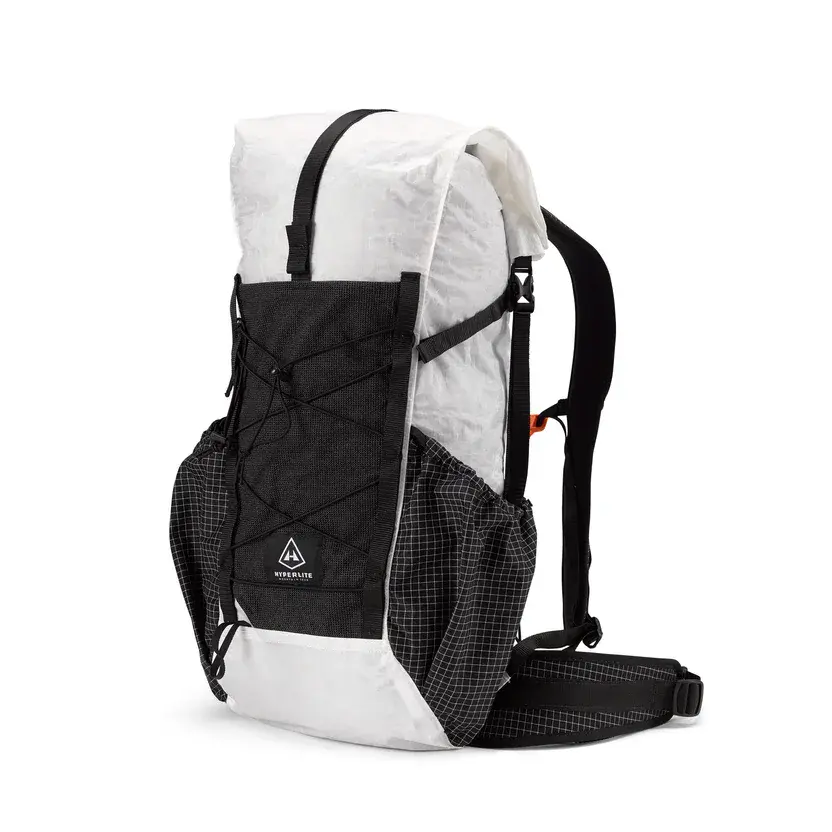 Hyperlite Mountain Gear Elevate 22
Three torso sizes and a padded hip belt make this the fit-first pick. Hyperlite says it's not a dry bag, so pack a liner for all-day rain.
When a Regular Daypack Plus a Liner Is the Smarter Buy
If your hikes see showers more than all-day rain, a liner inside the pack you already own often does the job for far less.
A waterproof daypack earns its price when you’d rather not depend on a liner, when electronics ride along every day, or when one pack covers your commute too.
The Elevate’s own owners make the point: in all-day rain, several of them line a top-tier pack anyway. If a pack that already fits you is sitting in the closet, a liner does the same job in it.
For a lot of hikers, that’s where I’d land: a liner inside, and a cover only if you want one. If you do, my picks for backpack rain covers that stay put are in their own guide.
A waterproof daypack still earns its place in three cases:
- You’d rather not depend on remembering, packing and not tearing a liner, because the dry layer is always there.
- Electronics ride in your pack every day, so one forgotten liner costs more than the pack.
- Your commute and your hike share one pack, and you want it dry on both.
If you need a new pack anyway, a comfortable regular daypack plus a liner often costs less than a waterproof one. My roundup of comfortable daypacks for beginners is a good place to start.
And if you want one bag for the office and the trail, the hybrid daypacks I cover come with laptop sleeves, without full waterproofing.
Pack your usual rainy-day load, spare layer included, and weigh it, then check your torso number. Those two numbers tell you whether the Typhoon’s 11 lb limit works, which Rab or Elevate size to look at, or whether a liner in the pack you own is enough.
Founder & Gear Research Editor
Sonia Zannoni
I’m Sonia, the founder of Best Trail Backpacks. I don’t test gear myself. For every pack I cover, I read the manufacturer’s specs and sizing charts and look for what owners report again and again.
Fit comes first, because a pack that doesn’t match your torso and hips will hurt no matter what it cost. My goal is to help you choose a pack that suits your body, your trip and your budget.
About the Founder
