
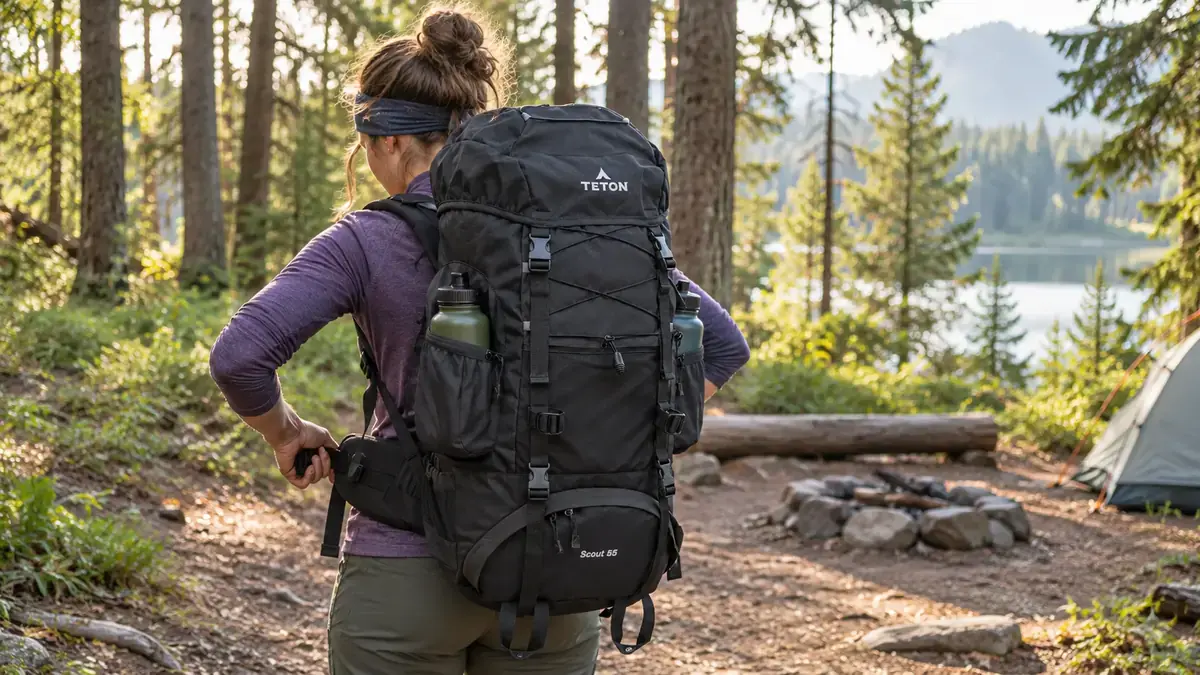
Teton Scout 55L Review (Formerly the Scout 3400): A Budget Pack for Your First Overnights
Affiliate Disclosure: Some links on this page are affiliate links. If you buy through one, I may earn a commission at no extra cost to you. Commission never decides which products I recommend. Read the full disclosure.
You’d like to try a night or two outside, but a premium pack is hard to justify before you know you’ll enjoy it. The Teton Scout keeps coming up under $100 with thousands of ratings, yet one listing says it fits medium and tall hikers and Teton says shorter torsos.
Being stuck here is normal, and it isn’t your fault. The pack changed names, the listings contradict each other, and some listings describe who it fits by height (“medium and tall”) when packs fit by torso.
If you searched for a Teton Scout 3400 review, you’re reading about the same pack under its current name, the Scout 55L. What you want to know is plain enough: is it enough for a first one to three night trip, and will it fit your back?
You’ve also heard the stories about cheap packs that dump the weight on your shoulders by mile three, or split a seam on the second trip. Nobody can decide well from information that disagrees with itself.
By the end you’ll know whether your torso falls inside the Scout’s range, what owners report about how it holds up, and what Teton’s warranty really covers. You’ll also know whether to buy it or look at the Explorer instead, so you buy one pack, not two.
TL;DR: Teton Scout 3400 Review
- The Scout 55L is the Scout 3400 under its current name: the same 55 liter pack, judged here on today’s specs.
- It suits first overnights of one to three nights on a budget, for torsos of 15 to 19.5 inches, including smaller adults and teens.
- Skip it if your torso is over 19.5 inches (look at the Explorer), if you count every ounce, or if you want a hip belt pocket.
- The tradeoff: a budget price, thousands of happy owners and a limited lifetime warranty, against a 4.3 pound empty weight, a narrow torso range and a sleeping bag compartment some owners find tight.
Best For: first-time backpackers on a budget with torsos of about 15 to 19 inches, planning one to three nights
Key Strength: a 4.7 average across more than 7,000 Amazon ratings, with capacity, pockets and build the themes owners praise most, at a budget price
Main Weakness: the torso range stops at 19.5 inches, and the pack weighs 4.3 pounds empty with no hip belt pocket
Verdict: a sensible first overnight pack if your torso is in range; measure before you buy
Buy if: your torso is 19.5 inches or less and you want one roomy, well-organized pack for short trips without a big spend
Skip if: your torso is over 19.5 inches, every ounce matters, you want hip belt pockets, or you live outside the US and are counting on the warranty
Scout 3400 or Scout 55L: What You’re Actually Buying
Many people still search for the Scout 55L as the Scout 3400. Amazon’s current listing still names the model Scout 3400, and 55 liters is about the old 3,400 cubic inches.
Teton’s old Scout 3400 page, since taken down, sent shoppers to what it called the newest version, and the specs it listed (55 liters, a 15 to 19.5 inch torso, a 26 to 60 inch belt) match today’s Scout 55L.
Search the old name and you land on pages that don’t agree with each other, with different dimensions and different prices. Many of them still describe the 3400 as it was listed years ago, and those numbers no longer match the pack on sale now.
What carries over is the part that matters on your back: the 3/4 frame, the torso adjustment, the separate sleeping bag compartment and the rain cover that lives in its own bottom pocket. Teton’s current pages carry a new logo and new product codes, with no note of anything redesigned.
So is it the old pack or a new one? Teton calls it a newer version without listing what changed. What can be checked (the volume, the frame and the feature set) lines up with the 3400, so I treat them as the same pack and go by today’s specs.
Every figure in this review comes from Teton’s current Scout 55L page. The Amazon listing still carries Teton’s older product code, but its own chart gives the same torso range, belt range and dimensions, so the numbers hold either way.
The Scout family comes in three sizes on paper. The 55L and 65L are current, and Teton marks the 45L as discontinued, so this review is about the 55L.
If you’ve already measured your torso and it’s under 19.5 inches, the verdict and the product box are at the end of this review.
What Decides Whether a Budget Pack Works for Your First Overnights
Three things decide it before price does: whether your torso fits the pack’s adjustment range, how the frame moves the load onto your hips, and whether the capacity suits one to three nights. Torso comes first, because a pack that doesn’t fit your back can’t carry well at any price.
Weight, warranty and price matter too, and I judge the Scout on them further down. They only count once the pack fits, though, so these three come first.
Your Torso Length, Not Your Height, Decides Where the Hip Belt Lands
Packs are sized by torso length, from the bony bump at the base of your neck to the top of your hip bones, not by height. If your torso is longer than a pack’s longest setting, the belt rides above your hip bones and the weight moves onto your shoulders.
Here’s why that matters so much. A hip belt carries weight because it wraps the bony shelf at the top of your pelvis. Pushed higher, onto the soft waist, it has nothing to rest on and can only squeeze, so the load slides back up the shoulder straps.
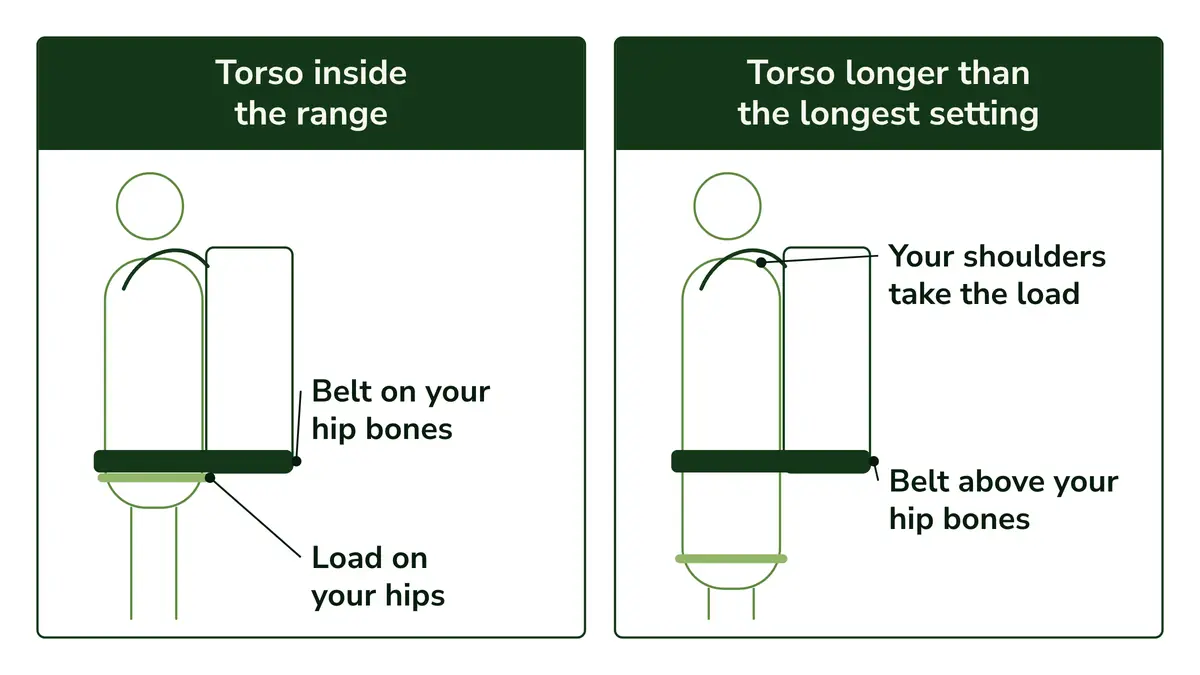
So if the belt creeps up to your waist two hours in and your shoulders start to burn, the belt is usually sitting right where the harness puts it. On a back that’s too long for the pack, that’s above the bones it’s meant to sit on.
Some listings still describe fit by height, such as “medium and tall.” Two people of the same height can have torsos inches apart, which is why Teton sizes the Scout by torso instead.
Before you compare any numbers below, grab a tape and a friend and learn how to measure your torso. That one figure is criterion one, and for the Scout it’s the deciding one.
What a 3/4 Frame Does With the Load
The frame is what lets the hip belt carry the weight. The Scout has what Teton calls a 3/4 frame, shorter than the Explorer’s full-length one, and Teton matches it to shorter torsos. The Scout’s frame adjusts, so the harness can move to match your torso.
A frame is the stiff structure inside the back panel. It holds the pack’s shape under weight, so the load stays upright and transfers down to the belt rather than slumping and dragging on the straps.
Teton’s own pages describe the Scout as designed for shorter torsos and the Explorer as built for full-size torsos. I read the frame length as a clue to who the pack is built for: a shorter frame matches a shorter back.
Inside its range, the Scout’s harness moves up or down so the belt can land on your hip bones. That’s criterion two: a frame that can be set to your back, not just a frame.
How Much 55 Liters Holds for One to Three Nights
Teton calls the Scout 55L ideal for one to three day trips, and owners describe fitting the gear for a three-day, two-night trip. It has its own sleeping bag compartment, though some owners find it tight. For longer trips, the Scout 65L keeps the same torso range with more room.
Teton’s description says one to three days and its spec list says two to three, so I go with one to three. Owners describe two and three night trips with it, which fits either reading.
Capacity is the theme owners bring up most in Amazon’s review summary, with more than 400 mentions and most of them positive. The summary says owners find it fits tons of stuff, and one owner calls it “very solid and roomy.”
If you plan trips of three to five days, the Scout 65L has the same torso and belt ranges with 10 more liters. The 45L is marked discontinued at Teton, so I wouldn’t go looking for one.
If you’re not sure 55 liters suits the trips you have in mind, check what size backpack your trips need before you order. That’s criterion three, and for one to three nights the Scout clears it.
How the Scout 55L Fits, Carries and Holds Your Gear
The Scout fits torsos from 15 to 19.5 inches and hips from 26 to 60 inches, with M and L settings. Owners rate it 4.7 across more than 7,000 Amazon ratings, and capacity, pockets and build are the themes they praise most.
The costs are a 4.3 pound empty weight, no hip belt pocket and no load range.
Fit: Who the 15 to 19.5 Inch Torso Range Really Suits
Teton designs the Scout for shorter torsos, and Amazon’s own fit data agrees. One Amazon bullet says medium and tall, but Teton’s own pages don’t back that up. Start at M for a 15 to 17 inch torso and at L for a longer one.
Teton’s Scout 55L page lists a torso range of 15 to 19.5 inches (about 38 to 50 cm) and a waist belt range of 26 to 60 inches. The belt fits a wide range of hips, from slim to large, while the torso range is only 4.5 inches wide.
That’s why fit on this pack is decided by torso first. A belt that closes around your hips does nothing for you if the harness can’t put it on your hip bones.
You may still be thinking that Amazon says it fits medium and tall hikers. One of its bullets does, but the rest of the evidence points the other way, and it’s worth seeing how much of it there is:
- Teton’s own page says the Scout is designed for shorter torsos, so the maker’s wording is the starting point.
- Teton’s Explorer page describes that pack as built for full-size torsos, which tells you where Teton itself draws the line.
- Amazon’s own product description says it fits kids and smaller adults, contradicting the bullet on the same listing.
- Amazon’s fit data lists the Fit Type as short torso, with a summary of good fit for smaller torsos.
I trust Teton’s numbers over a retail bullet, because the maker sets the range and the bullet can’t stretch it. If your torso is over 19.5 inches, no setting on this pack will reach it.
Inside the range, Teton’s own guidance is simple. The M and L marks are on the back of the pack: a 15 to 17 inch torso starts at M or lower, and a longer one at L.
Put at least 20 pounds in the pack before you adjust anything, because an empty pack sits differently from a loaded one. Once the torso is set, learn how to adjust your hiking backpack straps in the right order, so the belt stays on your hips.
Owners back up the short torso fit. Amazon’s review summary says many owners like the shoulder strap height and back adjustment, including owners with short torsos, and some find it well suited to petite women.
Of the owners who mention fit in that summary, most are positive. The complaints it names are tight bottle holders and a tight sleeping bag compartment, not the harness. For long torsos there’s no owner pattern I could read, so Teton’s own range is the best guide there.
Teton adds lumbar foam padding and ergonomic shoulder straps, and describes the pack as “built for long-haul comfort.” The Amazon listing mentions molded channels for airflow. Neither comfort over long days nor ventilation shows up as an owner pattern, so I’d keep both as Teton’s claims.
Organization and Access: Sleeping Bag Compartment, Pockets and Rain Cover
The Scout has a zippered sleeping bag compartment, two side bottle pockets, lid and front bungees, a hydration sleeve and a rain cover in its own bottom pocket. Owners like the pockets but call the bottle holders tight and are split on the sleeping bag compartment.
The sleeping bag compartment has its own zipper at the bottom, so the bag goes in last at camp and comes out first. Owners are split on its size: some find it roomy, while others say a bulky bag barely fits.
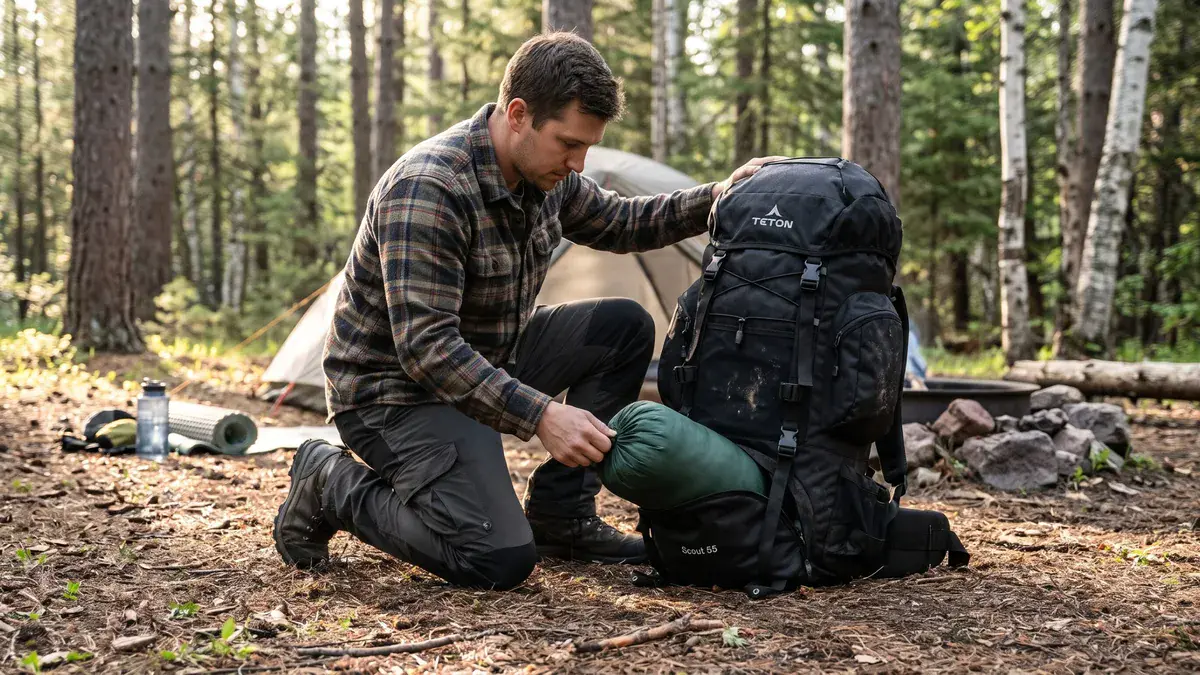
One owner writes, “My sleeping bag barely fit.” A compact bag is the safer match, so check your sleeping bag’s packed size before you order.
The rest of the layout gives you places to put things on the outside:
- Two side bottle pockets keep water reachable, though owners call them tight, so check how wide your bottles are.
- Lid and front bungees hold a wet layer or a sit pad where you can grab it without opening the pack.
- Compression straps cinch a half-full pack so it doesn’t sag and sway when you’re carrying less.
- A hydration sleeve takes a reservoir (not included), with room for a 3 liter one according to Amazon’s chart.
Owners often praise the organization, and one sums up the layout as “lots of zippers, pockets and places to hang things.” The catch is the hip belt, which has no pocket at all.
Snacks and your phone go in the lid or a strap pocket, or the pack comes off. One owner wishes it had a waist pocket or another pocket within reach on the move.
The integrated rain cover is a real plus at this price, because it’s one less thing to buy. The fabric itself is water repellent, not waterproof, so the cover does the work in rain. One owner reports a tear in the cover, a single report rather than a pattern.
Where things go in a 55 liter pack changes how it carries, so it’s worth learning how to pack a hiking backpack so the weight sits on your hips. That covers the order inside the main compartment, which I won’t repeat here.
Weight Against Durability: What 4.3 Pounds Buys You
Empty, the Scout weighs 4.3 pounds, on the heavy side for 55 liters. Construction draws the highest share of positive mentions in Amazon’s review summary, with most calling the fabric and zippers sturdy. Teton states no load range, and one owner who carried 50 pounds reports strap creep.
Teton gives two weights: 4.3 pounds for the pack and 4.5 pounds as the item weight. Amazon shows other figures, so I go with Teton’s. Every pound of empty pack is a pound you carry before you add food and water, which matters most to hikers who count ounces.
Now the worry that brought many readers here: do cheap packs fall apart? In Amazon’s review summary, about nine in ten owners who mention the build are positive.
They call the material and zippers sturdy, and one says it rubbed against trees, bushes and rocks with no rips.
Teton’s current page lists the fabric as polyester diamond ripstop without a denier, while Teton’s old Scout 3400 page gave, and the Amazon listing still gives, 600D polyester diamond ripstop. The higher the denier number, the thicker the thread, which adds weight but stands up better to rubbing.
What the Scout doesn’t give you is a load rating. Teton doesn’t state how much weight it’s meant to carry, so plan your load from how heavy your pack should be for an overnight rather than from the pack.
Two single comments are worth knowing about without overreading them. One owner who carried 50 pounds says it did well “except for the creeping of the straps,” and another reports a squeak with every step. Neither shows up as a pattern.
So the weight is the price of a sturdy build at a budget cost. The build answers the fall-apart worry well, and the warranty section below covers what happens if a seam does fail.
Where the Scout 55L Stands Out, and Where It Falls Short
Its strongest point is the owner record: more than 7,000 Amazon ratings at a 4.7 average, with capacity, pockets and build the most praised themes. Its main limitation is a torso range that stops at 19.5 inches. If your back is longer, no adjusting will fix that.
What Sets It Apart
The themes in those ratings repeat: capacity, pockets and build. A big owner base saying the same things is stronger evidence than a handful of glowing comments, because one-off luck and one-off bad days wash out.
Put that next to a budget price and a limited lifetime warranty, and you get a pack that does a lot of what a first overnight needs without asking much of your wallet.
Where It Falls Short
The torso range is 4.5 inches wide and tops out at 19.5. Past the longest setting, the belt rides above your hip bones and your shoulders take the load, so torso length is the one number that can rule this pack out.
Some retail copy says otherwise. One Amazon bullet says the pack fits medium and tall hikers, and a Cabela’s listing says average to larger frames, while Teton’s own page says shorter torsos. I go with the maker.
For a long-torso reader, I’d put that limit above everything else in this review. Room, pockets and price can’t make up for a belt that sits on your waist.
Who the Scout 55L Suits, and Who Should Skip It
It suits first-time backpackers on a budget with torsos of about 15 to 19 inches, smaller adults and teens heading to Scout camp, for trips of one to three nights.
Skip it if your torso is over 19.5 inches, you count every ounce, you want a hip belt pocket, or you live outside the US and are counting on the warranty.
The Scout makes sense for:
- First-time backpackers on a budget with a 15 to 19 inch torso. I’d start here if you want to find out whether you like overnights before spending more.
- Petite and smaller adults. Teton’s range and Amazon’s fit data both point to short torsos, and some owners describe it suiting petite women.
- Teens and Scouts. Owners mention buying it for a son or daughter for Scout camping, and for a teen whose torso already measures at least 15 inches, the adjustable range leaves some room to grow.
- Hikers planning one to three nights who want lots of pockets and a separate sleeping bag compartment.
I’d skip it if:
- Your torso is over 19.5 inches. No setting reaches you, so look at the Explorer, which I compare with the Scout below.
- You want a hip belt pocket, because the Scout has none and snacks mean a stop.
- Every ounce matters. At 4.3 pounds empty, lighter 55 liter packs exist if weight is your priority.
- You plan very heavy loads. Teton gives no load range, and the one heavy-load report mentions strap creep.
- You live outside the US and are counting on the warranty, because Teton’s warranty applies in the US and its territories only.
If torso or trip length rules the Scout out but your budget is the same, I’ve sorted other budget hiking backpacks under $100 by the job each one does.
If you can spend more and expect to backpack often, a step up to backpacking packs matched to your torso and load buys you a better harness and lighter materials.
The Scout is one unisex model, and owners describe it suiting petite women. If you’d rather have a harness shaped for a woman’s body, my picks of hiking backpacks for women are the place to compare.
Scout 55L Pros and Cons
The pros come from what owners report and what Teton’s specs confirm: room and pockets for short trips, a build owners call sturdy, and a wide belt range at a low price. The cons are a torso range capped at 19.5 inches, a heavy empty weight and some tight spots.
Pros
Room and organization for one to three nights, with a separate sleeping bag compartment and an integrated rain cover, so there’s less to buy for a first trip.
A build most owners call sturdy, with the fabric and zippers singled out, which speaks to the worry that cheap packs fall apart.
A wide 26 to 60 inch belt and an adjustable torso for short and medium backs, at a budget price with a limited lifetime warranty behind it.
Cons
A torso range that stops at 19.5 inches, so longer backs can’t get the belt onto their hips.
4.3 pounds empty, with no load range stated by Teton, which leaves you to plan your own load limit.
No hip belt pocket, bottle pockets that owners call tight, and a sleeping bag compartment some owners find tight.
What Teton’s Lifetime Warranty Covers, and What It Doesn’t
Teton backs the Scout with a limited lifetime guarantee against defects in materials or workmanship, for the original owner with proof of purchase, in the US and its territories only. Wear and tear, accidents and misuse aren’t covered, and the fix is a repair, part or replacement, never a refund.
I read Teton’s warranty policy in full, because “lifetime” on a budget pack sounds bigger than it usually is. Here’s what it says in plain terms:
- Covered: defects in materials or workmanship, so a seam or buckle that fails early from a fault in how it was made.
- Not covered: wear and tear, misuse, neglect, and damage from accidents, pets or severe weather. Teton names fabric fading and seam tape peeling as normal wear.
- Who can claim: the original owner, with proof of purchase from Teton or an authorized retailer.
- Where: the United States and its territories only.
- What you get: troubleshooting, a repair, a replacement part or a comparable replacement, with no guarantee of the exact model or color, and no returns or refunds under the warranty.
So a seam that splits on your second trip is a defect, and that’s covered. Fabric that fades or scuffs from a few seasons of use is wear, and that part is yours to manage.
For a first-time buyer, I’d treat “lifetime” as protection against a bad unit, not a promise the pack lasts forever. That’s still worth having at this price. One owner who had an issue called Teton’s customer service “fantastic,” though that’s one experience.
Where you buy matters for the warranty. Teton doesn’t say whether Amazon counts as an authorized retailer, so keep your receipt and buy from Teton, from Amazon.com (sold by Amazon or Teton’s own store) or from a retailer Teton lists, not a third-party seller.
Scout or Explorer? The One Number That Decides It
Your torso length decides it. Teton fits the Scout to 15 to 19.5 inch torsos and the Explorer 65L to 19 to 23 inches, so they overlap only at 19 to 19.5 inches. The Explorer is heavier and costs more, with more room and a hip belt pocket.
Teton’s product pages list an integrated rain cover on both packs. Here’s how they line up on Teton’s numbers:
Spec
Scout 55L
Explorer 65L
Torso range
15 to 19.5 in
19 to 23 in
Waist belt
26 to 60 in
28 to 70 in
Capacity
55 L
65 L
Weight
4.3 lb pack weight
5 lb
Frame
3/4 frame
Full frame
Suggested trip
1 to 3 days
3 to 5 days
Hip belt pocket
No
Yes
Price tier
$
$$
Torso range
Scout 55L: 15 to 19.5 in
Explorer 65L: 19 to 23 in
Waist belt
Scout 55L: 26 to 60 in
Explorer 65L: 28 to 70 in
Capacity
Scout 55L: 55 L
Explorer 65L: 65 L
Weight
Scout 55L: 4.3 lb pack weight
Explorer 65L: 5 lb
Frame
Scout 55L: 3/4 frame
Explorer 65L: Full frame
Suggested trip
Scout 55L: 1 to 3 days
Explorer 65L: 3 to 5 days
Hip belt pocket
Scout 55L: No
Explorer 65L: Yes
Price tier
Scout 55L: $
Explorer 65L: $$
Price tiers: $ under $100 | $$ $100 to $249 | $$$ $250 and up
Outside the overlap, the choice makes itself. A torso under 19 inches belongs in the Scout, and one over 19.5 inches belongs in the Explorer, because only one of the two can put the belt on your hips.
If your torso is 19 to 19.5 inches, I’d let trip length and pockets break the tie. You’re near the top of the Scout’s range and at the bottom of the Explorer’s.
The Explorer gives you more adjustment to grow into, more room and a hip belt pocket, at the cost of about 0.7 pounds more and a price only a little higher.
For one to three nights and a tighter budget, the Scout covers you. For three to five nights, or if you want snacks on the belt, the Explorer is the better match.
Is Teton a brand to trust with your first pack? Its warranty covers defects for the original owner, and construction draws the highest share of positive mentions in the Scout’s Amazon reviews. For the longer-torso pack and the fuller answer on the brand, read the Teton Explorer review.
Teton Scout 3400 Review Verdict: Is the Scout 55L Enough for Your First Overnights?
If your torso measures inside 15 to 19.5 inches and you’re planning one to three nights on a budget, I think the Scout 55L is a sensible first overnight pack. It’s roomy, well organized and widely praised for its build.
If your torso is longer, or every ounce matters, it’s the wrong pack at any price, and the Explorer or a mid-tier pack is your next look.
The deciding number is your torso, so don’t skip the tape measure. Inside the range, the Scout gives you room for a short trip, pockets everywhere but the belt, a rain cover in the box and a warranty against defects.
What you give up for the price is weight, a hip belt pocket and space in the sleeping bag compartment. For a first trip or two, most readers in range can live with all three.
Measure your torso before you order, and if it’s 19.5 inches or less, check the Scout 55L from Teton, Amazon.com or a listed retailer and keep the receipt for the warranty.
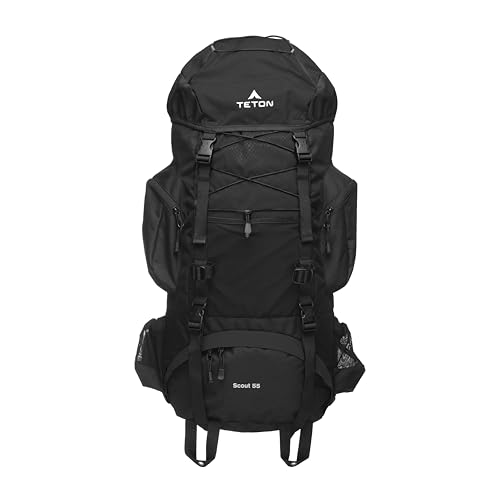 Teton Scout 55L
A roomy, well-organized budget pack for first overnights of one to three nights, if your torso measures 15 to 19.5 inches.
Founder & Gear Research Editor
Sonia Zannoni
I’m Sonia, the founder of Best Trail Backpacks. I don’t test gear myself. For every pack I cover, I read the manufacturer’s specs and sizing charts and look for what owners report again and again.
Fit comes first, because a pack that doesn’t match your torso and hips will hurt no matter what it cost. My goal is to help you choose a pack that suits your body, your trip and your budget.
About the Founder
