
How Heavy Should Your Hiking Backpack Be? Weight Limits for Day Hikes and Overnights
You loaded the pack for a long day or your first night out, lifted it off the floor and thought, that can’t be right. The forums ask whether 35 pounds is too much, and nobody says what the person asking weighs.
Other pages give a percentage, leave the math to you, and rarely agree. From inside the straps, a load that’s too heavy and a pack that fits badly feel exactly the same. Getting stuck here is normal, and it isn’t your fault.
So how heavy should a hiking backpack be for your body, on this trip? And when your shoulders ached last time, was it really the weight?
By the end you’ll have your own limit in pounds for a day hike and an overnight, plus a simple way to weigh the loaded pack at home. You’ll also know whether the fix is to trim, repack or refit, before you spend money on another pack.
TL;DR: How Heavy Should a Hiking Backpack Be
- REI’s guidelines: a loaded day pack no more than about 10 percent of your body weight, a loaded backpacking pack no more than about 20 percent. Treat both as upper limits, not targets (for a 150 lb hiker, about 15 lb and 30 lb).
- Water adds up fast: about 2.2 lb per liter.
- Weigh yourself with and without the loaded pack to get the real number.
- Under your limit and still sore often points to packing or fit, not weight, and each has its own fix.
How Heavy Should a Hiking Backpack Be for Your Body Weight?
REI’s rule of thumb is that a loaded day hiking pack should weigh no more than about 10 percent of your body weight, and a loaded backpacking pack no more than about 20 percent. For a 150 lb hiker, that’s about 15 lb and 30 lb.
REI’s pack weight guidelines count the whole loaded pack, food and water included. So the number to compare is the pack as it leaves the car, not the pack before you fill your bottles.
That finally gives the forum question something to be measured against. Is 35 pounds too much for a first overnight? For a 180 lb hiker it sits just under the limit, and for a 150 lb hiker it’s over.
Here’s what the two percentages come to at a few common body weights, so you can find the row closest to yours.
Your Body Weight
Day Hike Pack (about 10 percent)
Backpacking Pack (about 20 percent)
120 lb (54 kg)
about 12 lb (5.4 kg)
about 24 lb (10.9 kg)
150 lb (68 kg)
about 15 lb (6.8 kg)
about 30 lb (13.6 kg)
180 lb (82 kg)
about 18 lb (8.2 kg)
about 36 lb (16.3 kg)
210 lb (95 kg)
about 21 lb (9.5 kg)
about 42 lb (19.1 kg)
120 lb (54 kg)
Day Hike Pack (about 10 percent): about 12 lb (5.4 kg)
Backpacking Pack (about 20 percent): about 24 lb (10.9 kg)
150 lb (68 kg)
Day Hike Pack (about 10 percent): about 15 lb (6.8 kg)
Backpacking Pack (about 20 percent): about 30 lb (13.6 kg)
180 lb (82 kg)
Day Hike Pack (about 10 percent): about 18 lb (8.2 kg)
Backpacking Pack (about 20 percent): about 36 lb (16.3 kg)
210 lb (95 kg)
Day Hike Pack (about 10 percent): about 21 lb (9.5 kg)
Backpacking Pack (about 20 percent): about 42 lb (19.1 kg)
If your pack already comes in under your number and still hurts, skip ahead to the three-case check near the end. That part is written for you.
I’d treat each number as a ceiling, not a target to pack up to. A lighter load is fine as long as nothing you need stays home. And the limit is for this trip: an extra night or a hot day changes what goes in.
So the first check is simple: the loaded weight against your own limit for this trip. To make it, you need a real number rather than a guess.
How to Weigh Your Loaded Pack at Home
That pack you lifted off the floor deserves a real number. A bathroom scale gets you there in a minute: weigh yourself, then weigh yourself holding the loaded pack, and the difference is what you’ll carry.
- Step on the bathroom scale on your own and note the number.
- Pick up the loaded pack, or put it on, and step on again.
- Subtract the first number from the second. That’s your pack weight.
Weigh it the way it will be carried: bottles or reservoir full, food in, and the layers the trip needs. An empty bottle or a jacket still on the bed gives you a number you won’t actually carry.
Quick Tip: Weigh the pack with the water in. Two liters add about 4.4 lb, so leaving them out makes the number look better than the trail will feel.
If you want to know what each item weighs, REI suggests a kitchen or luggage scale. Adding those up gives you your base weight, which comes up again a little further down.
Now put your number next to your row in the table. Over, under or close, it tells you which of the three cases near the end fits your pack.
Why the 20 Percent Rule Isn’t a Safety Line
REI presents its 10 and 20 percent figures as guidelines, not safety lines. Trip length, season and comfort items all add weight, and very petite hikers often go over the figure anyway. A physics model also suggests the load you can carry doesn’t grow in step with body weight.
The Percentage Is a Guideline, Not a Limit Your Body Enforces
A lot of hikers treat 20 percent like the point where safe turns into unsafe. REI doesn’t present it that way. It calls the figures guidelines, a starting point for packing rather than a threshold your body checks at the trailhead.
What adds weight, according to REI, is the trip itself. A longer trip means more food, water and fuel, and colder or wetter weather means warmer, heavier layers. Comfort items, like a camp chair or a real pillow, add weight you might decide is worth it.
On a multiday trip REI still suggests staying close to 20 percent, which means choosing the rest of your gear more carefully.
Terrain and heat matter too, though REI’s figures don’t account for them. A steep, rocky trail makes the same load harder work than a flat one. On hot days the National Park Service advises drinking water often, so you’ll be carrying more of it.
Fair enough if you’re thinking a percentage can’t know how fit you are. Carrying a pack regularly does make the same load easier work over time. The way to get there is gradual: practice walks with a slightly heavier pack, adding a little each time.
Bigger and Stronger Doesn’t Mean a Bigger Share
It’s tempting to think a bigger or stronger hiker can carry the same share, or more. A physics model of pack weight by Michael O’Shea at Kansas State University suggests otherwise.
The model assumes strength follows the cross-section of your leg muscles rather than your overall mass. Mass grows faster than that cross-section as bodies get bigger, so in the model the load a hiker can carry doesn’t rise in proportion to body weight.
It’s a simplified model, and it fits best for groups with similar fitness and training. I still find it a useful check on the idea that a bigger body should automatically carry a bigger share.
If You’re Smaller Than Average
If you’re on the smaller side, the 20 percent rule can feel like a test you keep failing. REI notes that very petite backpackers often go over it, because gear only gets so light, whatever the size of the person carrying it.
If you’re very petite, going over on an overnight is common, and it doesn’t mean you packed badly. If that’s you, I’d use the number as a guide for trimming extras, not as a verdict on you.
It also helps when your group decides who carries the stove and the tent. REI suggests spreading shared items around, and weighing each pack afterward shows whether anyone ended up well over their own number.
If you’re hiking with children, start with packs sized for kids and keep their loads light.
What Your Pack Weight Is Made Of: Base Weight, Food, Water and Fuel
Base weight is everything in your pack except food, water and fuel. REI suggests working on that number because it barely changes from trip to trip. On a day hike, though, water is often the heaviest single thing you carry.
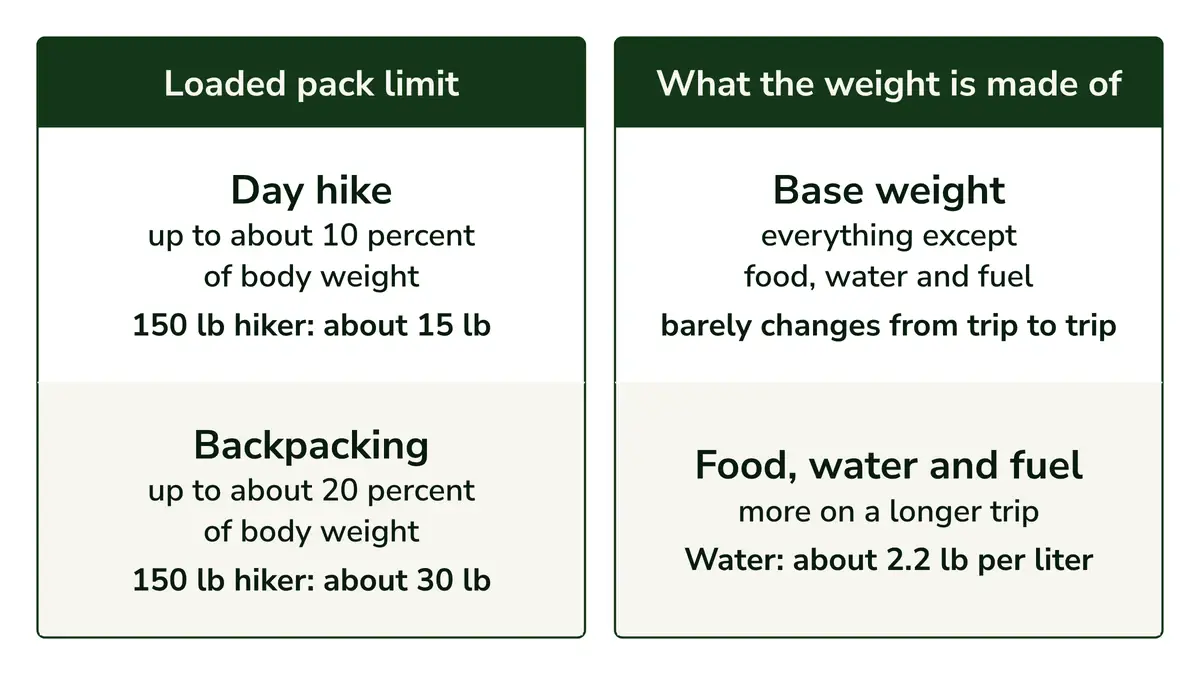
A liter of water weighs about a kilogram, which is about 2.2 lb. So two liters add about 4.4 lb, and three liters about 6.6 lb, before anything else goes in.
For a 120 lb hiker, the day limit is about 12 lb. Two liters of water take about 4.4 lb of that, more than a third, before lunch, a jacket or a first-aid kit goes in.
REI also sorts backpackers by base weight: under 10 lb is ultralight, under 20 lb is lightweight, and most traditional backpackers come in under 30 lb. Those bands are useful context, not a goal you need to chase.
That’s the real tradeoff in any pack. Every pound you cut gets weighed against what has to stay: enough water, a warm layer, a rain layer and the Ten Essentials, the basic safety kit the National Park Service recommends bringing on a hike.
Before trimming anything, check what a day hike actually needs, so the cuts come from the extras. On a hot day I’d keep every bit of the water: it may be the heaviest thing in the pack, but it’s the last thing to cut.
One quiet way loads creep past the limit is a pack bigger than the trip. Empty space tends to fill with just-in-case extras, so it helps to know what size pack fits your trips.
Weight is only half of how a pack feels, though. Where that weight rides on your body matters just as much.
Why the Same Weight Feels Lighter When Your Hips Carry It
A hip belt sitting on top of your hip bones puts most of the weight on your hips, where your legs’ strong muscles take it, instead of on your shoulders. That’s why a pack under your limit can still hurt when the belt rides high.
The belt rests on your pelvis, and your legs hold your strongest muscles, so a well-placed belt hands them most of the load. When the shoulder straps carry it instead, REI notes the strain goes to your shoulder, neck and upper-back muscles, and over a long day it adds up.
That’s the usual story behind “my pack isn’t that heavy, but my shoulders are killing me.” The weight might be fine. It’s just sitting on the wrong part of you.
The pack also has to be built for the load you put in it. On a day pack, REI says a hip belt starts to matter once the load passes about 15 lb, and frameless packs (no internal stays or frame sheet) suit lighter loads.
So if your full day load is past about 15 lb and your pack has a thin belt or none, that’s worth knowing. Daypacks with a real hip belt are built to move that load onto your hips.
Overnight packs work the same way, with one more number to check if the maker lists it: the pack’s load range. Osprey, for example, lists one in its packs’ specs.
If your overnight load runs past that range, look at backpacking packs matched to your load rather than trying to adjust around it.
Once the size is right, the order you tighten things in is what settles the weight on your hips. That’s why it’s worth learning to adjust the straps in order.
That gives you the two remaining checks: does the load ride on your hips, and is the pack built for that load?
Too Heavy, Badly Packed or Badly Fitted? How to Tell Which
Put your pack weight next to your number, and most sore-pack problems fall into one of three cases. If you’re over the limit, the fix is to trim.
If you’re under it but the pack pulls you backward or sways, the weight is probably packed in the wrong place. If you’re under it with the belt off your hip bones and your shoulders doing the carrying, it’s fit.
Most of the time it’s one of these three, and it’s worth knowing which before you spend money on a new pack. A new pack won’t fix a packing problem, and a lighter load won’t fix a pack that’s the wrong size for your back.
Over Your Limit: Trim
If the scale says you’re over your number for this trip, the weight itself is the problem, and the fix is to carry less. My guide on how to lighten your pack walks through what to cut. Whatever goes, keep the water, layers and safety basics in.
Under Your Limit but It Pulls or Sways: Repack
If you’re under your number but the pack tugs you backward or sways side to side, the weight is fine and its position is the problem. Heavy things sitting far from your back, or shifting in a half-empty pack, keep pulling you off balance.
The fix is in where things go, and here’s how to pack a hiking backpack so the same weight sits closer to your back and stays put.
Under Your Limit but Your Shoulders Carry It: Refit
If the weight is fine but your shoulders still end up carrying it, look at fit. REI’s signs are easy to check with a friend or a mirror:
- The hip belt padding should hug the top of your hip bones. If it won’t stay there, the load has nothing to rest on and slides up to your shoulders.
- The shoulder strap anchors should sit 1 to 2 inches below the top of your shoulders. If they sit well off that, either the hip belt is at the wrong height or the pack’s torso length is wrong for you.
- The shoulder straps shouldn’t be doing most of the carrying. If they are, one of the two checks above is usually off.
Straps can’t make up for a pack set to the wrong torso length. So the first check is to measure your torso length and compare it with the pack’s size, then go back through the strap adjustments from the hip section above.
One more thing: if pain or numbness lasts after the pack is off, that’s one for a clinician, not a strap adjustment.
Before you buy a new pack or cut anything, do one thing tonight. Load the pack for your next trip the way you’ll carry it, weigh it on the bathroom scale and see which of the three cases it lands in.
Founder & Gear Research Editor

Sonia Zannoni
I’m Sonia, the founder of Best Trail Backpacks. I don’t test gear myself. For every pack I cover, I read the manufacturer’s specs and sizing charts and look for what owners report again and again.
Fit comes first, because a pack that doesn’t match your torso and hips will hurt no matter what it cost. My goal is to help you choose a pack that suits your body, your trip and your budget.
About the Founder
