
Best Hiking Backpacks for Backpackers: 3 Picks Matched to Your Torso, Hips and Load
Affiliate Disclosure: Some links on this page are affiliate links. If you buy through one, I may earn a commission at no extra cost to you. Commission never decides which products I recommend. Read the full disclosure.
You’re about to choose your first big pack by the liters on the label, your height and how it felt empty in the store. That’s how a first overnight goes wrong within hours, with the hip belt at your waist, shoulders burning and a shirt soaked against your back.
It’s a common mistake, and not a careless one. An empty pack tells you little about a loaded one, some capacity names round up, and the two numbers that decide fit can be hard to find.
You’re here for the best hiking backpacks for backpackers: a pack for overnights and multi-day trips that fits your torso and hips, carries your load for hours and is worth the money for the trips you really take. This list is for nights out, not day hikes.
Below are three current packs, each in a men’s and a women’s version, with the torso and hip belt numbers for every version, standard and extended. Check yours against them before you order, and you can buy once.
TL;DR: Best Hiking Backpacks for Backpackers
- Osprey Rook 65 (men’s) and Renn 65 (women’s) for warm-weather overnights at moderate loads, with a ventilated mesh back and a rain cover in the box.
- Gregory Stout 70 (men’s) and Amber 68 (women’s) for bigger, heavier loads, with a real frame, a stated 50 lb maximum and Plus Size versions to 60-inch hips.
- REI Co-op Trailmade 60 for a first overnight up to REI’s 35 lb comfort figure, with extended hip sizes built into the same pack.
- Check your torso and hip numbers against the exact version before you order, because they matter more than the liters on the label.
Here’s how the six versions compare, one row each so every version gets its own link. The Extended Fit and Plus Size numbers are in the fit table further down.
Product Name
Best For
Key Strength
Main Tradeoff
Price Tier
Tall or broad men, warm overnights
Ventilated mesh back, rain cover included
Little outside storage, no load rating
$$
Women with 14 to 19 in torsos, warm overnights
Ventilated mesh back, rain cover included
Hard-to-reach hip belt pockets, squeak reports
$$
Heavier multi-day loads
Real frame, 50 lb stated maximum
Few independent reviews, no rain cover
$$$
Shorter-torso women carrying more
68 L on a 14 to 19 in torso, Plus Size version
One owner review on this version, no rain cover
$$$
First overnights up to 35 lb
Extended hip size in the same pack, front U-zipper
Basic features, few current reviews
$$
First overnights, 15 to 19 in torsos
Extended hip size to 54 in, front U-zipper
Basic features, few current reviews
$$
Osprey Rook 65
Best For: Tall or broad men, warm overnights
Key Strength: Ventilated mesh back, rain cover included
Main Tradeoff: Little outside storage, no load rating
Price Tier: $$
Osprey Renn 65
Best For: Women with 14 to 19 in torsos, warm overnights
Key Strength: Ventilated mesh back, rain cover included
Main Tradeoff: Hard-to-reach hip belt pockets, squeak reports
Price Tier: $$
Gregory Stout 70
Best For: Heavier multi-day loads
Key Strength: Real frame, 50 lb stated maximum
Main Tradeoff: Few independent reviews, no rain cover
Price Tier: $$$
Gregory Amber 68
Best For: Shorter-torso women carrying more
Key Strength: 68 L on a 14 to 19 in torso, Plus Size version
Main Tradeoff: One owner review on this version, no rain cover
Price Tier: $$$
REI Co-op Trailmade 60 (men’s)
Best For: First overnights up to 35 lb
Key Strength: Extended hip size in the same pack, front U-zipper
Main Tradeoff: Basic features, few current reviews
Price Tier: $$
REI Co-op Trailmade 60 (women’s)
Best For: First overnights, 15 to 19 in torsos
Key Strength: Extended hip size to 54 in, front U-zipper
Main Tradeoff: Basic features, few current reviews
Price Tier: $$
Price tiers: $ under $100 | $$ $100 to $249 | $$$ $250 and up
If you already know your torso length and hip measurement, jump to the fit table in the next section to see which versions cover you.
How to Judge the Best Hiking Backpacks for Backpackers Against Your Own Numbers
Every pick was judged on the same questions, in order: does the torso range include yours, does the hip belt close on your hip bones, and will it carry your real load on your real trips? Weight and price come last, because a pack that doesn’t fit costs you twice.
Here’s the full order I used, and why each step sits where it does:
- Torso range. If your torso length falls outside it, nothing else on the spec sheet can fix the fit.
- Hip belt range. The belt has to close on your hip bones, or the load ends up on your shoulders.
- The load you’ll carry. A frame designed around 30 pounds carries differently at 40, so the brand’s stated figure matters.
- Capacity for your trips. Too small and gear ends up strapped outside; too big and you fill it with things you didn’t need.
- What’s in the box and how you reach your gear. A missing rain cover is an extra purchase, and a pack that only opens from the top is slower to dig through.
- Weight and price. They matter, but only between packs that already fit you.
I put fit first because it’s the one thing you can’t adjust your way out of later. A pack that’s a few ounces heavier but sits on your hips will usually carry better by evening than a lighter one hanging off your shoulders.
Who This List Is For (and Who Should Look Elsewhere)
These three packs are for overnights and multi-day trips, from a first night out to about a week, with a sleeping bag, shelter and food inside. If your hikes end the same day, a 60 to 70 liter pack is more than you need.
Maybe you’ve done day hikes for a while and you’re ready to sleep out for the first time. That’s the hiker I had in mind here. If you’re not there yet, the packs in my roundup of hiking daypacks are sized for a day on the trail.
If you’re coming back to hiking with a sore back, my roundup of backpacks for back pain is built around back comfort. A back that keeps hurting after hikes is one to take to a clinician, though, rather than something a new pack should be expected to fix.
Why only three? Two strong picks dropped out while I was researching: the Mystery Ranch Radix 57 is no longer sold new, and REI marks its Flash 55 as discontinued. I’d rather give you three packs you can still buy than pad the list with ones that are running out.
Torso First, Then the Hip Belt
Torso length, not height, decides the fit: measure from the base of your neck to the top of your hip bones, then check the version’s range. REI’s backpack guide says 80 percent or more of the weight should ride on your hips, which only works if the belt sits there.
Here’s what a miss looks like. When the torso range is wrong for you, the hip belt lands above or below your hip bones and has nothing to grip. The pack sags, and by midafternoon your shoulders are carrying what your hips should.
If you haven’t measured yet, here’s how to measure your torso step by step. It takes a few minutes, and it’s the number every pick below is judged on first.
Hips come next. Measure around the top of your hip bones, which sits a little above your pants waistband, so the number isn’t your pant size.
Each pair below has a version for larger hips: Osprey’s Extended Fit packs reach 70 inches, Gregory’s Plus Size versions run 39 to 60 inches, and the Trailmade’s larger hip size goes to 53 inches (men’s) or 54 inches (women’s).
If you’re a bigger hiker, you may know the standard belt that never quite closes, or closes only on the last inch of strap. That’s the problem the extended versions solve, on the same torso range as the standard pack.
The women’s versions differ in more than color. REI describes women’s-specific packs as having shorter, narrower torso dimensions, with hip belts and straps contoured for women, and notes that smaller sizes can suit shorter hikers of any gender.
If none of the three women’s versions here suits you, there are more choices in my roundup of hiking backpacks for women.
A few brand numbers don’t agree with each other, so I’ve kept both figures where they clash:
- Renn torso: Osprey’s chart says 14 to 19 inches, while REI lists 15 to 20 inches for the Renn and 15 to 21 inches for the Renn Extended Fit.
- Amber 68 hip belt: Gregory’s own page gives two ranges, 22 to 48 inches and 27 to 46 inches.
- Trailmade women’s torso: REI’s page gives 15 to 19 inches in the spec table and 17 to 21 inches in the feature list.
Here’s every version in one place, with the numbers as each brand publishes them.
Pack
Torso
Hip Belt
Capacity
Osprey Rook 65
17 to 22 in
25 to 50 in
62 L (spec table)
Osprey Rook 65 Extended Fit
17 to 22 in
40 to 70 in
65 L
Osprey Renn 65
14 to 19 in (REI: 15 to 20)
25 to 50 in
60 L (spec table)
Osprey Renn 65 Extended Fit
14 to 19 in (REI: 15 to 21)
40 to 70 in
61 L
Gregory Stout 70
16 to 21 in
28 to 48 in
70 L
Gregory Stout 70 Plus Size
16 to 21 in
39 to 60 in
70 L
Gregory Amber 68
14 to 19 in
22 to 48 in or 27 to 46 in
68 L
Gregory Amber 68 Plus Size
14 to 19 in (REI)
39 to 60 in
68 L
REI Co-op Trailmade 60, men’s
17 to 21 in
31 to 41 in or 40 to 53 in
60 L
REI Co-op Trailmade 60, women’s
15 to 19 in (REI also lists 17 to 21)
31 to 41 in or 41 to 54 in
60 L
Osprey Rook 65
Torso: 17 to 22 in
Hip Belt: 25 to 50 in
Capacity: 62 L (spec table)
Osprey Rook 65 Extended Fit
Torso: 17 to 22 in
Hip Belt: 40 to 70 in
Capacity: 65 L
Osprey Renn 65
Torso: 14 to 19 in (REI: 15 to 20)
Hip Belt: 25 to 50 in
Capacity: 60 L (spec table)
Osprey Renn 65 Extended Fit
Torso: 14 to 19 in (REI: 15 to 21)
Hip Belt: 40 to 70 in
Capacity: 61 L
Gregory Stout 70
Torso: 16 to 21 in
Hip Belt: 28 to 48 in
Capacity: 70 L
Gregory Stout 70 Plus Size
Torso: 16 to 21 in
Hip Belt: 39 to 60 in
Capacity: 70 L
Gregory Amber 68
Torso: 14 to 19 in
Hip Belt: 22 to 48 in or 27 to 46 in
Capacity: 68 L
Gregory Amber 68 Plus Size
Torso: 14 to 19 in (REI)
Hip Belt: 39 to 60 in
Capacity: 68 L
REI Co-op Trailmade 60, men’s
Torso: 17 to 21 in
Hip Belt: 31 to 41 in or 40 to 53 in
Capacity: 60 L
REI Co-op Trailmade 60, women’s
Torso: 15 to 19 in (REI also lists 17 to 21)
Hip Belt: 31 to 41 in or 41 to 54 in
Capacity: 60 L
One adjustable torso covers a range, but the ends of a range are where fit gets tight. If your torso is under 15 inches, or right at the top of the Rook’s 22, check the exact version before you order and keep the return window in mind.
The Load You’ll Carry, and What Each Brand Actually States
Osprey publishes no load range for the Rook and Renn, Gregory gives the Stout and Amber a 50 lb maximum, and REI rates the Trailmade comfortable to 35 lb. A maximum is what a frame is built for, not a weight that feels good, so plan around your real load.
REI staff say the same about Osprey in REI’s product Q&A. Several retailers list 30 to 40 lb for the Rook and Renn, and one lists 25 to 35 lb, so treat those as store figures rather than Osprey’s.
So does a 50 lb maximum mean the Gregory feels fine at 50 lb? It doesn’t. That’s the ceiling the frame is built to handle, and how any load feels depends on where the belt sits on you and how the weight is packed.
A real frame is what lets a heavier load ride on your hips instead of sagging onto your shoulders.
Count the extras too. If your overnight kit has grown a camp chair, a pillow or a coffee setup, those pounds belong in the load you plan around.
Where that weight sits in the pack matters as well, and my guide on how to pack a backpack covers keeping the heavy items close to your back.
Here’s what each pair weighs and what each brand says it carries.
Pack
Weight
Stated Load
Rain Cover
Osprey Rook 65 / Renn 65
3.6 to 3.9 lb across versions
None on Osprey’s page (retailers list 30 to 40 lb)
Included
Gregory Stout 70 / Amber 68
3.48 to 3.98 lb across versions
50 lb maximum (standard versions)
Not included (US versions)
REI Co-op Trailmade 60
3 lb 3 oz to 3 lb 8 oz
Comfortable up to 35 lb
Not included
Osprey Rook 65 / Renn 65
Weight: 3.6 to 3.9 lb across versions
Stated Load: None on Osprey’s page (retailers list 30 to 40 lb)
Rain Cover: Included
Gregory Stout 70 / Amber 68
Weight: 3.48 to 3.98 lb across versions
Stated Load: 50 lb maximum (standard versions)
Rain Cover: Not included (US versions)
REI Co-op Trailmade 60
Weight: 3 lb 3 oz to 3 lb 8 oz
Stated Load: Comfortable up to 35 lb
Rain Cover: Not included
Capacity for the Trips You Actually Take
REI’s capacity bands are simple: 30 to 50 liters for one to three nights, 50 to 80 liters for three to five, and 70 liters or more beyond that. A bigger pack invites more weight, so buy for the trips you take, not the trip you might take someday.
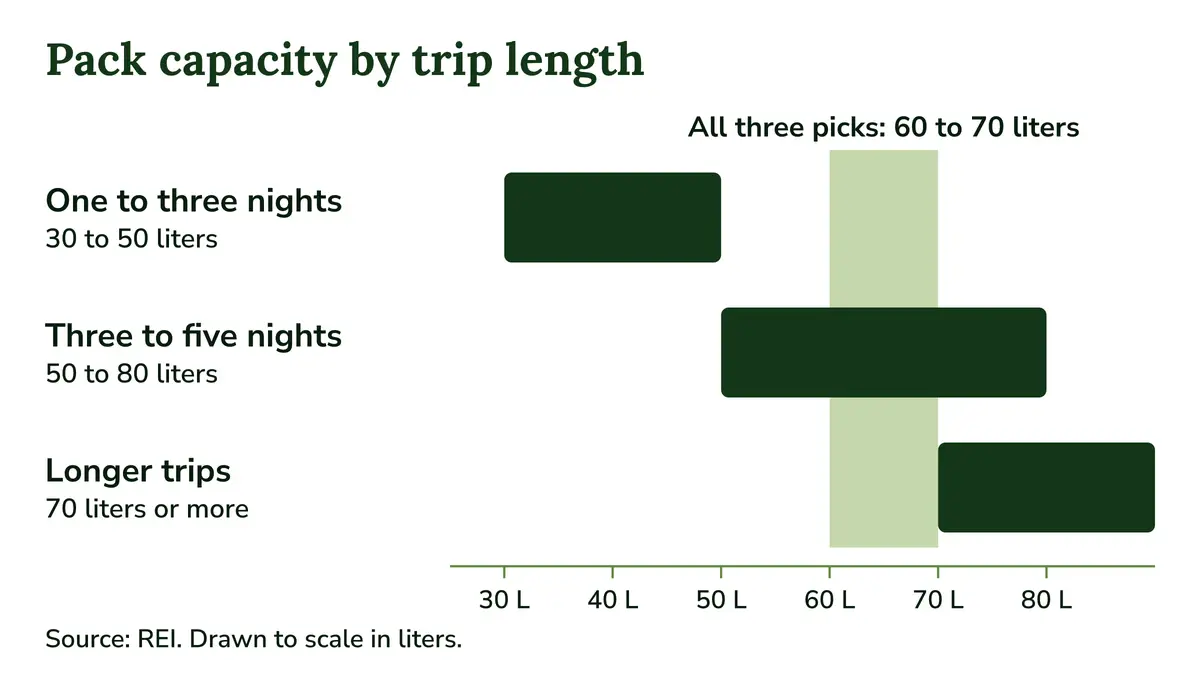
That’s the Goldilocks problem in a nutshell. A pack with room to spare tends to fill itself, and every “just in case” item is weight on your hips by the end of the day. REI also notes that most backpacking packs start at about 45 liters.
All three picks sit at 60 to 70 liters, which suits multi-night trips. If you only plan single overnights, you’re at the upper edge of what you need, and that’s a good reason not to size up again.
The liters on the label can also round up. Osprey calls these packs 65L, but its own spec tables list the Rook at 62 liters, the Renn at 60 and the Renn Extended Fit at 61. Only the Rook Extended Fit reads 65.
What’s in the Box, How You Reach Your Gear, Weight and Price
Two of the three pairs come without a rain cover, so budget for one if you hike where it rains. The Trailmade adds a front U-zipper, while the Osprey and Gregory packs open from the top and the sleeping bag compartment, and all three weigh about 3 to 4 pounds.
Picture reaching for a rain jacket packed mid-bag when the sky opens. On a top-loader you pull out what’s above it first, while a front zipper lets you open the pack and reach in. If that sounds like your trips, access matters more than the number of pockets.
On weight, the lightest version here is the women’s Trailmade at 3 lb 3 oz, and the heaviest is the Stout 70 Plus Size at 3.98 lb. None of these is an ultralight pack.
I’d planned a lighter-load pick, but REI’s Flash 55 is discontinued, and no current option I researched held up well enough to replace it. If saving weight is your priority, this list isn’t the right fit.
On price, the Rook, Renn and Trailmade sit in the middle tier and the Gregory pair in the top tier. If your budget is firmly under $100, my list of hiking backpacks under $100 is a better place to start.
The Ventilated-Back Pick: Osprey Rook 65 and Renn 65
The Rook 65 (men’s) and Renn 65 (women’s) suit overnights up to a week at moderate loads, with a ventilated mesh back and an included rain cover. Owners report comfortable carries in the 25 to 35 lb range. The catch is little outside storage and no load rating.
Best For
- First-time and value-minded backpackers on overnights up to about a week at moderate loads, who want a ventilated pack without paying top-tier prices
- Warm-weather hikers, because the suspended mesh back keeps the pack off your shirt
- Tall or broad men. Owners on REI include a 6 ft 5 in broad-shouldered Extended Fit buyer and a 6 ft 2 in owner at 225 to 250 lb
- A teen who’s still growing. One REI owner’s 14-year-old, at 5 ft 6 in, fits the Rook at its smallest setting, so the pack has room to grow with them
- Larger hikers through the Extended Fit versions, with hip belts up to 70 inches, though the owner evidence for those comes from men only
Why It Stands Out
What sets this pair apart is a ventilated, comfortable carry at moderate loads, with the rain cover included, in the middle price tier. Osprey also backs it with its All Mighty Guarantee, which promises to repair or replace damage at no cost.
The ventilation is what owners mention most. Reviewers on REI and Osprey’s site keep coming back to the trampoline-style back, and one owner on REI summed it up as “25°C hiking with no back sweat,” which is about 77°F.
Key Features and What They Mean
Here’s what Osprey lists, and what each feature means once the pack is loaded.
- AirSpeed suspended mesh back. The pack rests on a tensioned mesh panel with a gap behind it, so air moves and less sweat soaks your shirt.
- Ladder-lock torso adjustment with 4 inches of travel. You get one size per version and set it to your own back: 17 to 22 inches on the Rook and 14 to 19 inches on the Renn, according to Osprey’s size and fit chart.
- 4.0 mm LightWire peripheral frame. A light wire hoop around the edge carries the load down to the hip belt, which suits moderate loads better than heavy ones.
- Sleeping bag compartment with a floating divider. Your bag or camp layers come out the bottom without unpacking from the top.
- Integrated, removable rain cover. It stows in its own pocket, so there’s nothing extra to buy for a wet forecast.
- Mesh side pockets and zippered hip belt pockets. Water and snacks stay reachable on the move, though Renn owners have complaints about the belt pockets.
- Daylite compatible. It works with Osprey’s Daylite daypack, sold separately, if you want a small pack for side trips from camp.
- Capacity. The name says 65L, but Osprey’s spec tables give 62 liters for the Rook, 60 for the Renn, 61 for the Renn Extended Fit and 65 for the Rook Extended Fit.
- Materials. Bluesign approved, 100% recycled 600D polyester with a DWR made without PFAS. That’s a water-repellent finish on a fairly tough fabric, not a waterproof pack.
Two more things come up in owner reviews. Owners on Amazon and Osprey’s site say a bear canister fits sideways, and reviewers on REI, Amazon and Osprey’s site describe the pack hugging the back so the load stays put.
Men’s vs Women’s Fit
The two share one feature list; the fit is where they part. Osprey’s size chart puts the Rook at 17 to 22 inches of torso and the Renn at 14 to 19 inches. REI lists the Renn at 15 to 20 inches, an inch off.
Both hip belts run 25 to 50 inches on the standard versions and 40 to 70 inches on the Extended Fit versions. The Extended Fit packs also get longer shoulder straps, repositioned pockets and a longer sternum strap, on the same torso range.
Petite women get a mixed picture on the Renn. Amazon’s review summaries lean cautious, including a 5 ft 1 in owner who says it may not fit perfectly on the smaller side.
On REI, a 5 ft 2 in owner likes the adjustability for a short torso, and a 5 ft 3 in owner praises the comfort. If you’re near the bottom of the range, those two sources together are a reason to check your exact number first.
I couldn’t find a single written owner review of the Renn Extended Fit on any page I read, so plus-size women’s fit on it is unknown. The Extended Fit evidence so far comes from men, and REI’s summary on both packs says they fit slightly large based on reviews.
Where It Falls Short
Storage is the most common complaint. Owners on REI and Osprey’s site point out how little outside storage there is and that there’s no front stretch pocket, so a damp jacket has nowhere to go but inside or strapped on.
Osprey also publishes no load limit. On Osprey’s site, one owner mentions minor hip bruising at about 40 lb, and another says the belt digs in unless the lower compression straps are tight.
The Renn has two extra issues. Its owners say the hip belt pockets are hard to use once the belt is cinched.
Three reviewers on REI’s Renn page also mention noise. One found the squeaking “maddening” a few miles into a 40-mile trip, and another returned hers because it creaked with every step.
Is this a stripped-down Osprey, then? Not where it counts. It keeps the suspended mesh back, the adjustable torso, the sleeping bag compartment and the All Mighty Guarantee, and what it drops is outside storage and a stated load rating.
How much the missing front pocket matters depends on your trips. On dry summer overnights I wouldn’t worry about it, but if you hike where layers go on and off all day, you’ll notice it.
Pros and Cons
Pros
Ventilated mesh back that owners confirm in warm weather
Rain cover included, stowed in its own pocket
Extended Fit versions for hips up to 70 inches
Osprey’s All Mighty Guarantee for damage and defects
Cons
Little outside storage and no front stretch pocket
No load rating from Osprey
Renn hip belt pockets are hard to reach when cinched, and some Renn owners report squeaking
Who Should Skip It
- Petite women at or below the bottom of the Renn’s range, unless you’ve checked your number against both Osprey’s and REI’s figures
- Anyone who wants a front pocket for a wet layer or quick-grab gear
- Hikers who regularly carry more than about 40 lb, where owner comfort reports start to slip
- Noise-sensitive Renn buyers, given the squeak reports
Verdict
I’d pick the Rook or Renn for most first overnights in warm weather at moderate loads, as long as your torso falls inside the version’s range. The ventilated back and the included rain cover are real advantages at this price, and the Rook has hundreds of Amazon ratings.
The limits are just as clear: top-loading storage with little on the outside, and no stated load rating. If you can live with both, this is the pair I’d look at first.
 Osprey Rook 65
A ventilated mesh back and a rain cover in the box, for warm-weather overnights at moderate loads. Torsos of 17 to 22 inches.
 Osprey Renn 65
The women's version, for torsos of 14 to 19 inches, with the same ventilated back and included rain cover.
For Bigger, Heavier Loads: Gregory Stout 70 and Amber 68
The Stout 70 (men’s) and Amber 68 (women’s) are the big framed top-loaders, with a wishbone alloy frame, a stated 50 lb maximum and Plus Size versions with hip belts to 60 inches. The catch is no rain cover and thin owner evidence on these versions, mostly from Gregory promotions.
Best For
- Hikers who want a big framed top-loader with a sleeping bag compartment and a stated 50 lb ceiling, at a lower price than Gregory’s flagship packs
- The hiker who carries extra comfort items, like a chair or a fuller camp kitchen, and needs the room and the frame for them
- Plus-size hikers through the Plus Size versions, with a 39 to 60 inch hip belt. Three reviewers on REI’s Amber 68 Plus page call it a good fit for plus-size women, two of those reviews syndicated from Gregory
- Shorter-torso and smaller-framed women through the Amber. Two reviewers of the older Amber 65 on Backcountry say it fits smaller frames well, though that’s the previous model
Why It Stands Out
This is a full framed 70 liter pack (68 for the Amber) with a stated 50 lb maximum, a bottom sleeping bag compartment, dedicated Plus Size versions and a limited lifetime warranty. It’s also the one pair here in the top price tier.
Gregory’s warranty terms cover defects in materials and workmanship for as long as you own the pack. They exclude abuse, improper cleaning or storage, and normal wear and tear, so it protects you against a bad seam, not a pack that’s simply worn out.
Key Features and What They Mean
Here’s what Gregory lists, and what it means with a heavy load on your back.
- Wishbone alloy frame with an alloy steel and fiberglass cross stay. This is the part that lets a heavier load ride on your hips instead of pulling on your shoulders.
- One-size VersaFit adjustable torso. The Stout covers 16 to 21 inches and the Amber 14 to 19 inches, and you set it yourself. Owners say dialing it in takes a little time.
- Bottom sleeping bag compartment with a removable divider. Your sleeping bag comes out without unpacking everything above it.
- Front oversized stretch mesh pocket and side mesh pockets with side access. Layers and bottles stay outside the main bag, though owners say these get tight when the pack is full.
- Large zippered hip belt pockets and a hydration sleeve. Snacks and a phone ride on the belt, and there’s room for a reservoir if you use one (not included).
- Fabric. 40% recycled 210D nylon and 420D nylon with a DWR designed without PFAS, so it’s water-repellent, not waterproof.
Owner reports on heavier loads are mixed, and there aren’t many. The only Amber 68 review I found anywhere, syndicated across three sites, describes about 45 lb on a five-day trip, comfortable the whole time.
One detailed Stout owner on Gregory’s site says the opposite: it carries poorly above 30 lb, and even a 20 lb overnight load didn’t sit well. Both are single reports, so I wouldn’t lean hard on either one.
Men’s vs Women’s Fit
The Amber is the shorter, narrower version: 14 to 19 inches of torso against the Stout’s 16 to 21, 2 liters smaller, and about 0.17 lb lighter.
Its hip belt starts narrower than the Stout’s 28 to 48 inches, though Gregory’s own page gives two ranges for it, 22 to 48 inches and 27 to 46 inches. If your hips sit near either end, it’s worth asking Gregory or the seller before you order.
Both Plus Size versions take hip belts from 39 to 60 inches on the same torso range. One owner on REI’s Amber 68 Plus page says it “fits perfectly around my hips.”
Small waists are the weak spot. Two reviewers on different versions say the hip belt slips unless it’s cinched all the way, and one with a 30 inch waist says that fully cinched, it bruised his hips within two hours.
Women’s evidence is thin. The Amber 68 has just one owner review anywhere, so most of what owners say about women’s fit comes from the older Amber 65 and the Amber 68 Plus.
Where It Falls Short
The US version, the one linked here, comes without a rain cover. Gregory sells one separately, and my roundup of backpack rain covers can help if you’d rather pick your own. Gregory’s European versions include a cover, so check the listing if you buy outside the US.
There’s no front U-zip either, so mid-pack gear comes out through the top. On a 70 liter pack, that can mean a fair bit of unpacking to reach one layer.
The outside pockets get tight once the pack is full. Reviewers on three different pages say so, and one on REI found the side pocket “extremely tight for a normal Nalgene bottle.”
The bigger issue is how little independent evidence there is for this version. At least 10 of the 12 reviews on Gregory’s site are labeled as free product, and most of the written reviews on REI were collected in a promotion.
That doesn’t make those reviews wrong. It does mean the current pack’s track record is short, and I’d give that real weight before loading it to 40 lb or more.
If the Stout costs less than Gregory’s flagship packs, what’s missing? From the specs: no front zip, no rain cover, a single adjustable torso size rather than several, and less owner evidence behind it.
Pros and Cons
Pros
A real load-carrying frame with a stated 50 lb maximum
70 liters (68 on the Amber) with a bottom sleeping bag compartment
Plus Size versions with a 39 to 60 inch hip belt
Limited lifetime warranty against defects
Cons
No rain cover with the US version
Pockets get tight when the pack is full
Hip belt slip reported on small waists
Little independent owner evidence on the current version
Who Should Skip It
- Slim-waisted hikers planning heavy loads, given the belt-slip reports
- Anyone who wants front zip access or a rain cover in the box, since the US Stout and Amber have neither
- Anyone who relies on side-pocket bottles with a full pack, because those pockets tighten as the pack fills
- Readers who want a long, independent owner record before they buy
Verdict
I’d choose the Stout or Amber when your load is genuinely heavy or bulky and you want a real frame, a stated 50 lb ceiling and Plus Size options. You’d be accepting that the owner record for this version is still thin and mostly promotional.
If you’re searching for the Amber 65, that’s the older model, and Gregory now lists the Amber 68 in its place. If you carry moderate loads and want a cover in the box, the Osprey pair is the easier choice.
 Gregory Stout 70
A real frame, a stated 50 lb maximum and Plus Size versions, for heavier and bulkier loads.
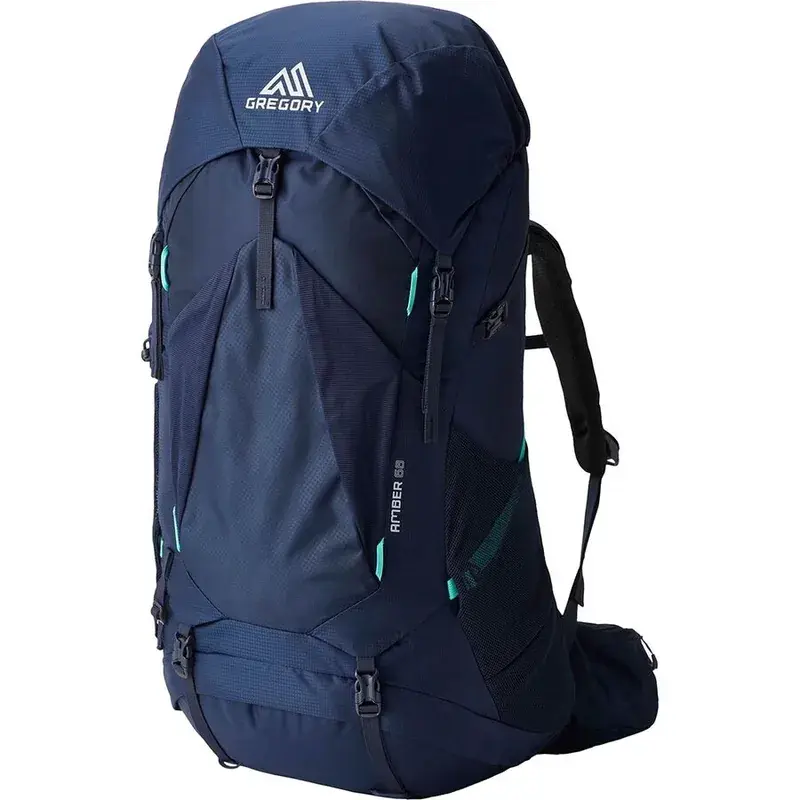 Gregory Amber 68
68 liters on a 14 to 19 inch torso, with a Plus Size version for hips up to 60 inches.
For a First Overnight: REI Co-op Trailmade 60, Men’s and Women’s
REI built the Trailmade 60 for newer backpackers: a front U-zipper, front-reach bottle pockets, packing tips printed under the lid, and extended hip sizes in the same pack, up to 53 or 54 inches. REI rates it comfortable up to 35 lb, and current reviews are few and mostly free-product.
Best For
- First-time backpackers on one to three night trips with loads around 35 lb or less, the load REI designed and rates it for
- Larger and plus-size hikers who need an extended hip belt, men and women alike. Owners across three listings back this up, including a 6 ft 4 in owner at over 300 lb with room left on the extended belt
- Families sharing one pack, since the torso adjusts and the pack can be handed down
One owner on the men’s page calls it “a simple beast,” and that’s a fair summary. It does the basics a first trip needs without much on top.
Why It Stands Out
The standout is fit range inside one model. The men’s pack comes with a 31 to 41 inch or a 40 to 53 inch hip belt, and the women’s with 31 to 41 inches or 41 to 54 inches, at the same price.
It’s also built for a first trip. The front U-zipper reaches mid-pack gear, the angled bottle pockets let you drink without taking the pack off, and REI prints packing and fit tips under the lid.
REI’s satisfaction guarantee lets members return it within one year and non-members within 90 days, with a few exceptions. That’s a store policy rather than a product warranty, but on a first pack it’s a real safety net while you work out the fit.
Owners also say the torso is easy to set, though most of those reviews came with free product. A first-trip pack should forgive a few beginner mistakes, and that’s where these features earn their place.
Key Features and What They Mean
Here’s what REI lists, and what each part means on a first overnight.
- Spring steel internal frame and adjustable back panel. The torso runs 17 to 21 inches on the men’s pack and 15 to 19 inches on the women’s, though REI’s women’s page also lists 17 to 21 inches in one place.
- Comfortable carry up to 35 lb. That’s REI’s own figure, and it’s best read as the load the pack was designed around.
- Sleeping bag compartment with a collapsible divider. You can keep the bottom zone separate or open it into one space.
- Bottom straps. A tent or foam pad can ride on the outside.
- Attached lid. It isn’t removable, so you can’t strip it for weight or overstuff the top.
- Materials. 100-denier ripstop and 400-denier recycled nylon, marked “bluepass certified” (REI’s term, not bluesign), with a DWR made without PFAS, from a Fair Trade Certified factory.
On comfort over hours, early owner reviews are mostly positive at 28 to 33 lb. One owner wrote “Very comfortable, no pain after 10 mile hike” at 33 lb, though there’s also a pattern of shoulder complaints, covered below.
On heat, a handful of owners say it doesn’t run hot, one on an 80-plus degree day, though another notes it has no dedicated ventilation system.
The new U-zipper gets mixed notes in three current reviews: awkward at first, then handy, and it only opens fully with the pack laid flat.
Men’s vs Women’s Fit
The men’s pack covers 17 to 21 inches of torso and the women’s 15 to 19, each with two hip widths. REI’s summary on both pages says they fit slightly large based on reviews.
Short torsos get a mixed picture. One owner with a 15 inch torso and another at 5 ft 0 in say it works, but one found the padding pushed against the head at the smallest setting, and a 5 ft 4 in owner called the women’s pack very long.
REI Product Support advises anyone with a torso under 15 inches to look at a different pack. Women on the previous version complained about thin straps that rubbed, but I haven’t seen that complaint on the current one yet.
Where It Falls Short
The feature set is basic. The lid is fixed, several owners find the sleeping bag divider pointless, and there’s no rain cover.
Owners across current and previous listings say the load sits heavily on the shoulders, one with shoulder pain 4 miles in at 30 lb. One detailed review of the previous version describes the belt sliding down the belly near 50 lb on a broad, 6 ft, 265 lb build.
The current-version evidence is thin: 26 reviews, 18 of them incentivized, and mostly short-term. On the current pack, one reviewer had a lid strap pull out of its stitching on two packs, and another had a buckle break at first packing.
What owners say about long-term durability comes from the previous version, where sternum strap failures showed up as a pattern alongside owners who used it hard for years. Whether the redesign changes that isn’t known yet.
Is a store-brand pack good enough? For a first trip, the evidence says yes: REI designed it for newer backpackers, the frame and torso adjustment are real, and owners of very different bodies report a good fit. Its limits are features and small parts.
One owner of the previous version put it well: “Good for your first pack, but not your last one.”
Pros and Cons
Pros
Extended hip sizes built into the same pack
Front U-zipper and bottle pockets you can reach on the move
REI’s stated comfortable carry up to 35 lb
REI’s satisfaction guarantee while you work out the fit
Cons
Fixed lid you can’t remove
No rain cover included
Shoulder-load complaints from several owners
Few reviews on the current version
Who Should Skip It
- Hikers who want a removable lid or a lighter pack, since the lid is fixed and none of these is ultralight
- Torsos under 15 inches, as REI’s own support team advises
- Anyone who regularly carries 40 lb or more, well past REI’s comfort figure
- Anyone expecting a rain cover in the box
Verdict
I’d pick the Trailmade for a first overnight on a moderate load, especially if you’re a larger hiker who needs the extended hip size without hunting for a separate model. It’s a good first pack that may not be your last, and that’s fine for a first season.
If you already carry more than 35 lb, the Gregory pair has the frame for it, and if a cooler back matters most, the Osprey pair is the one to look at.
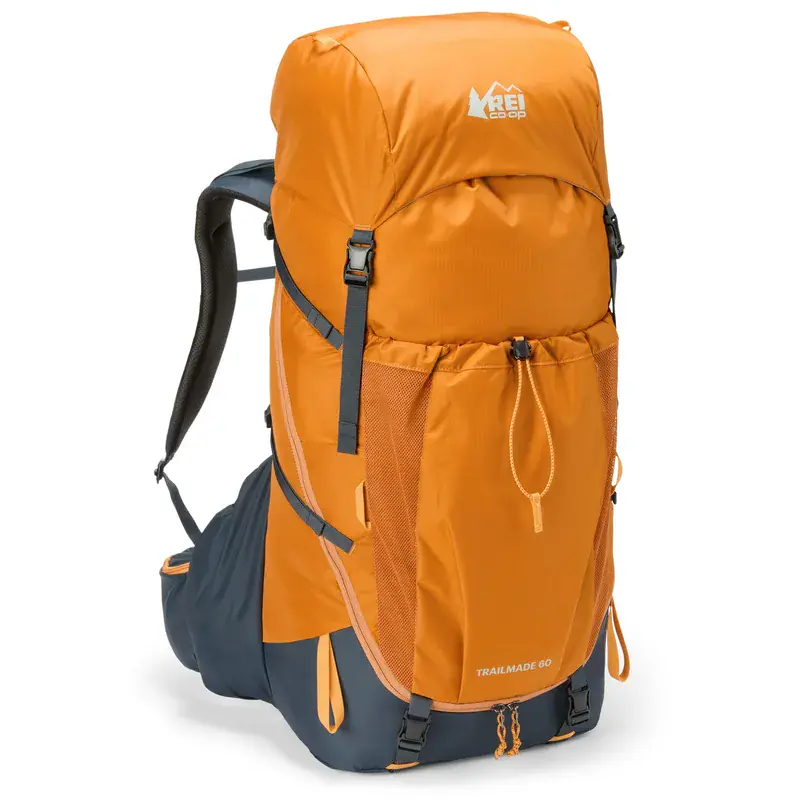 REI Co-op Trailmade 60 (Men's)
Built for a first overnight, with a front U-zipper and an extended hip size in the same pack.
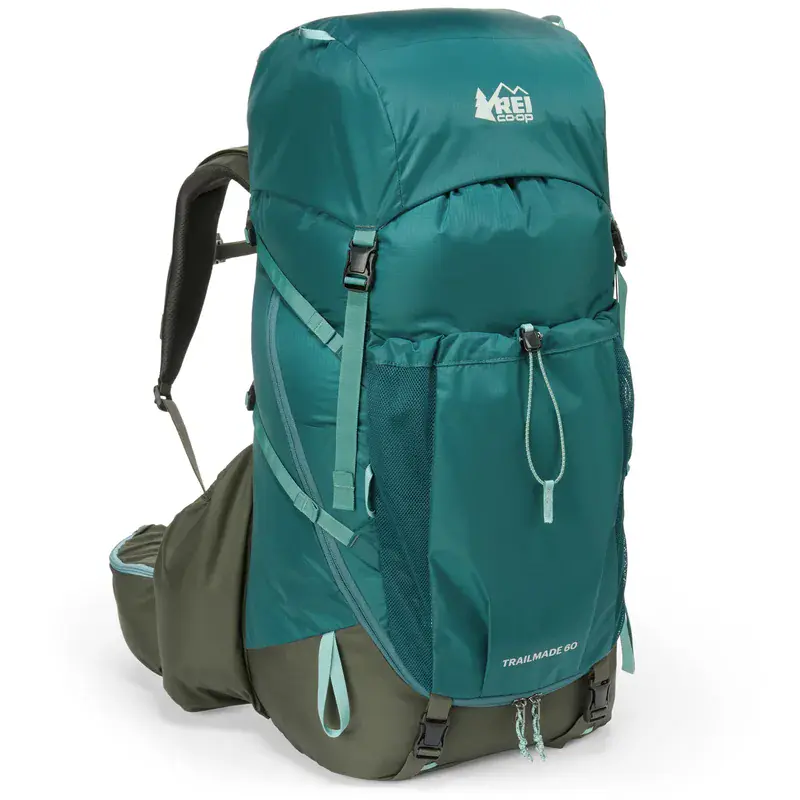 REI Co-op Trailmade 60 (Women's)
The women's version, for torsos of 15 to 19 inches, with hip sizes up to 54 inches.
Three Checks Before Your Pack’s Return Window Closes
Before you order, measure your torso and hips and check both against the exact version you’re buying, standard or extended. When it arrives, load it with your real kit and run the fit checks while you can still return it, because Osprey’s guarantee, for one, doesn’t cover fit or preference.
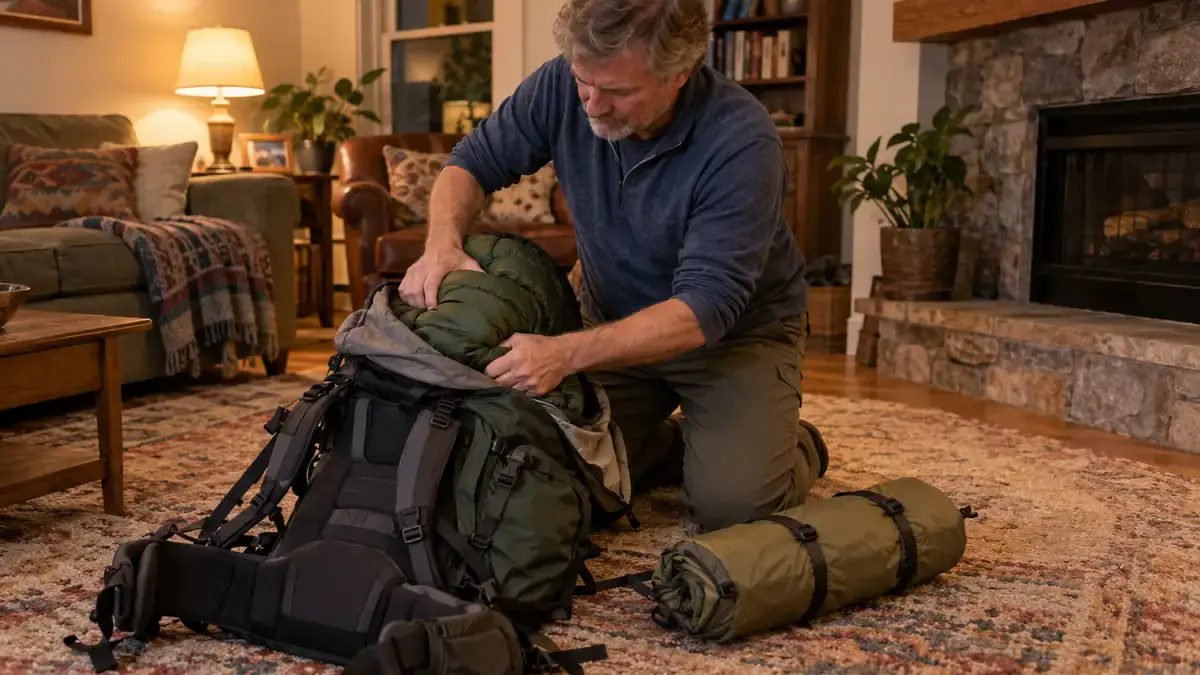
It’s tempting to keep a new pack spotless and save it for the trip. That’s the one habit that can cost you the return, so do the checking at home first.
- Measure, then match the exact version. Take your torso length and hip measurement and check both against the version you’re ordering, standard or extended, because each pair splits its fit across versions.
- Load it with your real kit and run the fit checks. Pack the gear you’ll actually carry, set the hip belt on your hip bones first, then snug the shoulder straps and the load lifters (the short straps from the top of each shoulder strap to the pack, which pull the load in toward your back). My hiking backpack tips before buying cover the rest of the try-on.
- Know what covers you if it doesn’t fit. Osprey’s guarantee excludes fit and preference, Gregory’s warranty covers defects, and REI’s satisfaction guarantee runs one year for members or 90 days for non-members. Check your seller’s return window before the first long hike.
Measure your torso and hips tonight, and check both numbers against the fit table above before you order.
Founder & Gear Research Editor

Sonia Zannoni
I’m Sonia, the founder of Best Trail Backpacks. I don’t test gear myself. For every pack I cover, I read the manufacturer’s specs and sizing charts and look for what owners report again and again.
Fit comes first, because a pack that doesn’t match your torso and hips will hurt no matter what it cost. My goal is to help you choose a pack that suits your body, your trip and your budget.
About the Founder
