5 Best Hiking Backpacks for Women: Better Fit, Less Shoulder Pain
Affiliate Disclosure: Some links on this page are affiliate links. If you buy through one, I may earn a commission at no extra cost to you. Commission never decides which products I recommend. Read the full disclosure.
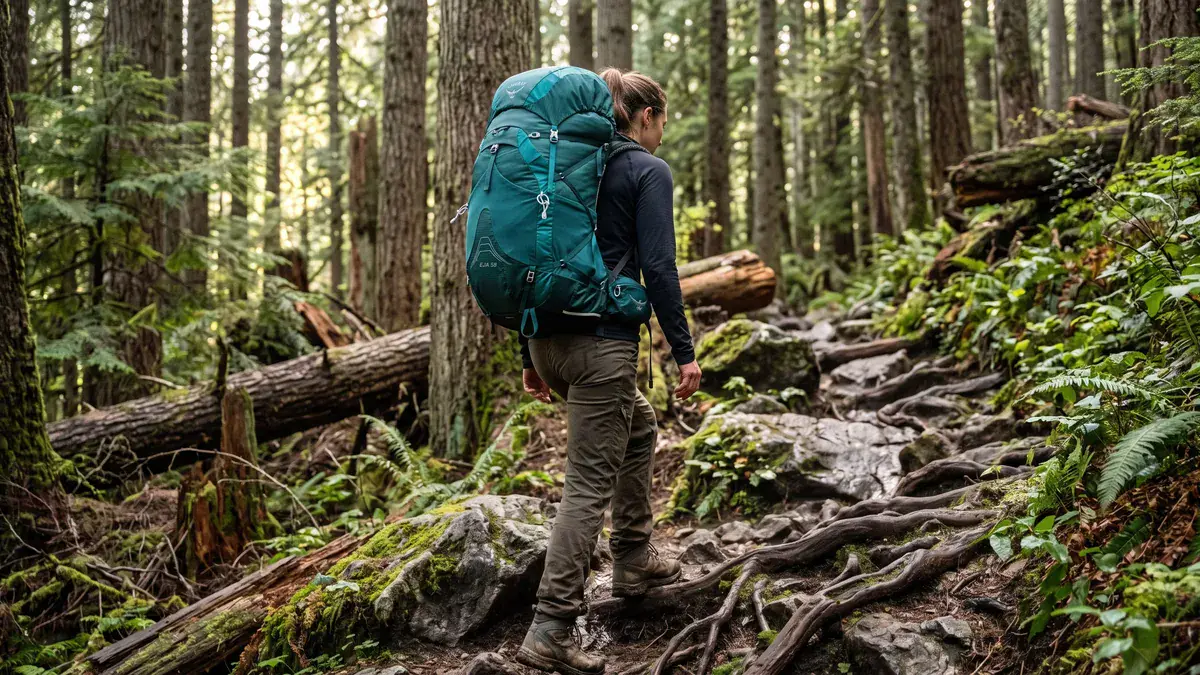
You did everything right in the store: loaded it, walked a lap, checked the mirror. By the second hour on the trail your collarbones are sore and the hip belt is sitting on your waist, so your shoulders are carrying the whole load.
That’s frustrating, and it isn’t your fault. Many unisex and borrowed packs are sized around a longer back and wider shoulders, which is exactly where a lot of women’s bodies differ.
You’re here for the best hiking backpack for women that will actually fit your torso, shoulders and hips on an overnight or a long weekend. Here are five backpacking packs from 50 to 58 liters, compared on the numbers that decide where the weight ends up.
By the end you’ll know which one matches your body and your load, and how to check the fit at home before the return window closes.
TL;DR: Best Hiking Backpacks for Women
- Light loads and a back that runs hot: the Osprey Eja 58, the lightest pack here, rated by Osprey for loads of 30 to 35 pounds.
- Multi-day trips with a moderate load: the Gregory Maven 58, with a braced frame and a padded mesh back. For weekends with front access, its sibling, the Gregory Jade 53.
- Narrow shoulders and heavier loads: the Deuter Aircontact Core 55+10 SL, the heaviest pack here, with Deuter’s slimmer SL harness.
- Heavy loads and a fit you can fine-tune: the Osprey Ariel 55, rated by Osprey for 30 to 60 pounds, with a hip belt and shoulder straps you adjust on the pack.
The Five Best Hiking Backpacks for Women: Quick Comparison
Here’s how the five line up before you get into the details.
Product Name
Best For
Key Strength
Main Tradeoff
Price Tier
Weekend trips with front access
FreeFloat hip belt and 3.5 in of torso adjustment
About 4 lb, heavy for 53 L
$$$
Narrow shoulders and heavier loads
SL harness and pivoting hip fins
Heaviest here, at about 5 lb
$$$
Light loads and a hot back
Lightest here, under 3 lb, with tensioned mesh
Load range tops out at 35 lb
$$$
Heavy loads and a tuned fit
60 lb rating, adjustable belt and straps
About 4.8 lb, second heaviest here
$$$
Multi-day trips with moderate loads
Braced frame and padded mesh back
Some owners find it strained past 20 to 30 lb
$$$
Gregory Jade 53
Best For: Weekend trips with front access
Key Strength: FreeFloat hip belt and 3.5 in of torso adjustment
Main Tradeoff: About 4 lb, heavy for 53 L
Price Tier: $$$
Deuter Aircontact Core 55+10 SL
Best For: Narrow shoulders and heavier loads
Key Strength: SL harness and pivoting hip fins
Main Tradeoff: Heaviest here, at about 5 lb
Price Tier: $$$
Osprey Eja 58
Best For: Light loads and a hot back
Key Strength: Lightest here, under 3 lb, with tensioned mesh
Main Tradeoff: Load range tops out at 35 lb
Price Tier: $$$
Osprey Ariel 55
Best For: Heavy loads and a tuned fit
Key Strength: 60 lb rating, adjustable belt and straps
Main Tradeoff: About 4.8 lb, second heaviest here
Price Tier: $$$
Gregory Maven 58
Best For: Multi-day trips with moderate loads
Key Strength: Braced frame and padded mesh back
Main Tradeoff: Some owners find it strained past 20 to 30 lb
Price Tier: $$$
Price tiers: $ under $100 | $$ $100 to $249 | $$$ $250 and up
How to Choose a Women’s Hiking Backpack That Actually Fits
If your shoulders ache by the second hour and the straps press on your collarbones, the pack may be the wrong length for your back rather than too heavy. Once it matches your torso, the hip belt can sit on your hip bones and take the load off your shoulders.
Features are the easy part to compare. What decides comfort is where the weight ends up, which comes down to torso length, strap shape and how the hip belt sits. That’s why I’d sort out these fit points before comparing pockets.
Torso Length, Not Total Height
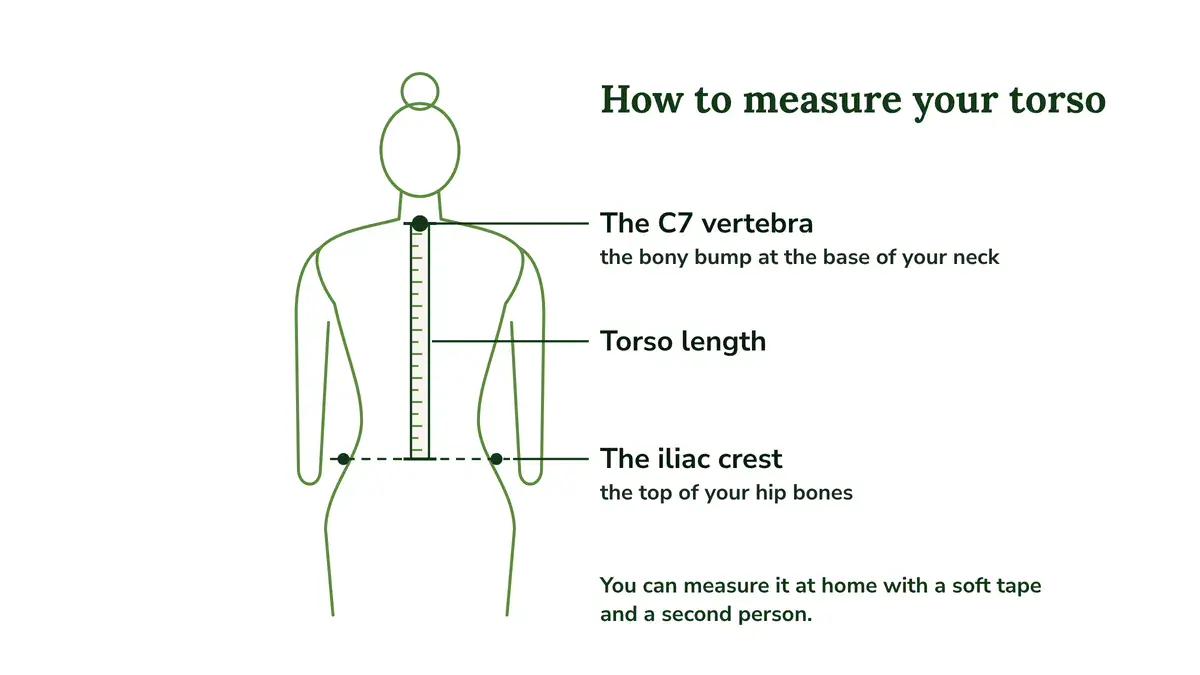
Torso length runs from the bony bump at the base of your neck (the C7 vertebra) to the top of your hip bones (the iliac crest), and it doesn’t follow your height. Two women of the same height can need different pack sizes.
REI’s guide to sizing and fitting a backpack makes the same point: torso length, not height, decides the size, and the ranges vary between brands and models.
You can measure it at home with a soft tape and a second person, and my guide on how to measure your torso walks through it step by step. Then compare your number with each pack’s own size chart, not a general women’s average.
S-Curve Shoulder Straps
Straight shoulder straps run down from the top of the pack in a fairly straight line, which can press across the chest and sit wide on narrower shoulders. S-shaped straps curve around the chest instead.
Deuter’s explanation of its backpack fits describes its SL straps as S-shaped, with softer edges and narrower spacing between them for smaller frames.
Not every woman needs the same strap shape. If your shoulders are broad, a strap set that’s too narrow can crowd your neck, so look at how far apart the straps sit, not only at the women’s label.
Angled and Contoured Hip Belts
REI’s fitting advice puts the hip belt padding on top of your hip bones, so most of the load rests on your hips rather than your shoulders. That works because your legs hold some of the strongest muscles in your body.
Deuter shapes the hip fins on its SL packs as a cone that narrows toward the top, to follow the angle of women’s hips instead of sitting flat. The closer a belt matches your shape, the less you have to cinch it to keep it up.
If a belt keeps slipping or leaves sore spots, check two things before you blame the pack. First, the torso setting may be off, which moves the belt off your hip bones, and that costs nothing to fix.
Second, the belt itself may be the wrong size for your hips. Check whether the brand sells an extender (Gregory does) before you exchange the pack.
A Note on Inclusivity and Plus-Size Fits
If a standard women’s pack fits your torso but the hip belt runs out of adjustment or the straps cut in, you need longer belts and straps rather than a different torso size.
Gregory’s plus-size packs come with extended shoulder straps and hip belts, and Gregory compares the fit to apparel sizes 2X to 6X. For overnight trips, that line includes the Jade 63 Plus Size, which fits hips from 39 to 60 inches, and the Amber 68 Plus Size.
Osprey also makes an Eja 58 Extended Fit, with a hip belt Osprey says fits up to 70-inch hips and longer shoulder straps. If a pick here fits your torso but not your hips, check for an extended or plus-size version before you settle for a pack that pinches.
Back Ventilation
Ventilation matters most on warm hikes and long climbs, when a sweaty back is the first thing you notice. A tensioned mesh panel, like Osprey’s AirSpeed on the Eja, holds the pack off your back so air can move behind it.
Gregory’s AirCushion panel on the Maven takes another route: padded mesh that rests against your back, which Gregory says is over 90 percent air. You get more cushioning and a little less open space behind you.
The tradeoff is that a suspended panel can hold the load a little farther from your spine, and one Eja owner on REI says that’s what pulled her backward under a full load.
Whichever back you choose, pack the heavy gear close to your back and the pack will carry more steadily.
Capacity and Load Range
These five run from 50 to 58 liters depending on size, plus the Deuter’s 10-liter extension in the lid. That’s enough for an overnight or a long weekend with a tent, a sleeping system and food, and for longer trips if your kit is compact.
If you’re still working out how big a pack you need, my beginner’s guide covers what size and features actually matter. And if your trips are day hikes, my guide to daypacks for beginners covers lighter, simpler options.
Load range matters as much as liters, because it’s the weight the frame was designed to move onto your hips. Go past it and expect more of the load on your shoulders. Here’s what each brand rates its pack for:
- Osprey Eja 58: 30 to 35 pounds
- Deuter Aircontact Core 55+10 SL: about 22 to 44 pounds (10 to 20 kg)
- Gregory Jade 53 and Gregory Maven 58: up to 50 pounds
- Osprey Ariel 55: 30 to 60 pounds
Weekend Comfort With Front Access: Gregory Jade 53
Best For: Weekend and overnight backpackers who want a ventilated back, front access and an adjustable fit, and don’t mind a few extra ounces.
Key Specs
- Weight: 4.02 lb (SM/MD), 3.88 lb (XS/SM), per Gregory
- Capacity: 53 liters (SM/MD), 50 liters (XS/SM)
- Torso range: 15 to 19 inches (SM/MD), 14 to 17 inches (XS/SM)
- Hip belt fit: 25 to 48 inches (SM/MD), 24 to 46 inches (XS/SM)
- Torso adjustment: 3.5 inches
- Maximum load: 50 lb
- Frame: perimeter wire frame
- Access: top, U-Zip front panel and a bottom sleeping bag compartment

Why It Stands Out
The hip belt is what sets the Jade apart. Gregory describes its FreeFloat belt as linked to the frame by a panel that moves and flexes with your body, so the belt can follow your hips on each step instead of staying locked in place.
That design aims at fewer pressure points when your hips rotate on uneven ground, which is where a rigid belt tends to rub. Gregory pairs it with 3.5 inches of torso adjustment and a full-length tensioned mesh back panel, so you can fine-tune the fit and keep air moving.
Owner reviews are fewer than for the Eja or the Maven (8 on Backcountry, averaging 4.5 out of 5), and most rate it highly. One owner who walked a 350-mile trail with it says they’d look for a lighter pack.
Pros
3.5 inches of torso adjustment, so you can fine-tune where the belt sits within each size.
FreeFloat hip belt, which Gregory designed to move with your hips rather than against them.
Full-length tensioned mesh back panel, which keeps air moving on warm days.
U-Zip front access and extra-large hip belt pockets, so you can reach gear without unpacking from the top.
Cons
At about 4 pounds, it’s heavy for its volume next to the Eja and the Maven.
53 liters (50 in XS/SM) gets tight for trips longer than about three nights unless your kit is compact.
The Verdict
I’d pick the Jade 53 for weekend trips if a forgiving fit and front access matter more to you than a light pack.
Its moving belt, 3.5 inches of torso adjustment and a 24 to 48 inch belt range across the two sizes give you room to get the fit right. You pay for that in weight: about 4 pounds.
- Who it fits: Weekend and overnight hikers with torsos from 14 to 19 inches who value comfort and access over weight.
- Who should skip it: Anyone planning trips longer than three nights who needs more room, or anyone counting every ounce.
A Slimmer Fit for Narrow Shoulders: Deuter Aircontact Core 55+10 SL
Best For: Women whose shoulder straps keep sliding outward on standard packs, and anyone carrying heavier loads on multi-day trips.
Key Specs
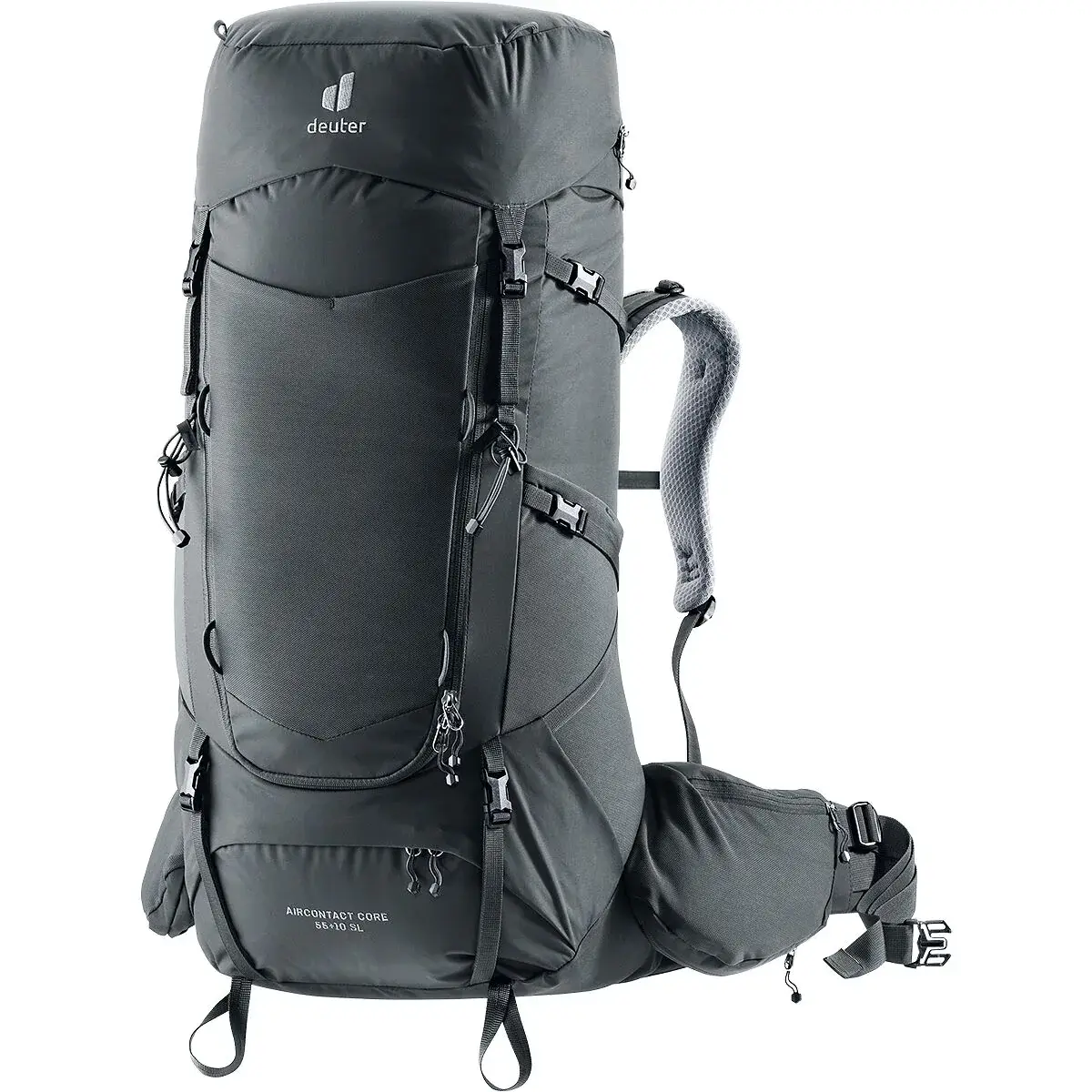
- Weight: about 5 lb (2,260 g), per Deuter
- Capacity: 55 liters, plus 10 liters in the height-adjustable lid
- Back length: 14.2 to 19.7 inches, across Deuter’s five VariClick settings
- Recommended load: about 22 to 44 lb (10 to 20 kg)
- Materials: 500D textured polyamide and 235D recycled polyamide, made without intentionally added PFAS
- Frame: aluminum Y-frame
- Access: top, U-shaped front zipper and a separate bottom compartment
Denier (the D) describes how thick the fibers in a fabric are. A higher number like 500D usually means a tougher, heavier fabric, while a lower number like 100D saves weight but scuffs sooner on rock and brush.
Why It Stands Out
SL stands for Slim Line, Deuter’s women’s fit. On this pack it means a shorter back and a harness Deuter designed for slimmer builds, with narrower S-shaped straps set closer together and hip fins shaped to the angle of the hips.
That strap spacing matters if standard straps keep drifting toward the edge of your shoulders, because straps that start closer to your neck have less room to slide outward.
Deuter also mounts the straps on a pivoting shoulder system (ActiveBalance) and the hip fins on a flexing attachment (VariFlex), both meant to let the harness follow your movement under load.
Owner reviews of this pack are still scarce, and Deuter’s own page shows none yet. So what I can tell you rests on Deuter’s specs, which makes the loaded fit check at home more important than usual.
The practical extras help on a long trip: a bottle holster on the hip fin, room for a 3-liter reservoir, a wet compartment inside and a detachable lid.
Pros
SL harness with narrower, closer-set straps, for shoulders that standard straps slide off.
Aluminum Y-frame, with Deuter recommending loads up to about 44 pounds (20 kg).
U-shaped front zipper and a separate bottom compartment, so you can reach gear without unpacking.
A 10-liter extension in the lid, for the trip when extra food or a bulky layer won’t fit.
Cons
About 5 pounds by Deuter’s figure, the heaviest pack here.
Very few owner reviews so far, and Deuter doesn’t publish a hip belt range, so the loaded fit check at home matters more.
The narrow SL harness may crowd your neck if your shoulders are broad.
The Verdict
If your straps keep slipping off your shoulders and you carry heavy loads, I’d put this Deuter at the top of your list. Its narrower, closer-set SL straps and Y-frame target exactly that combination.
The cost is pack weight: at about 5 pounds, it takes a real share of your load before you’ve packed anything.
Deuter recommends up to 44 pounds, while Gregory lists 50 as the maximum for its two packs and Osprey rates the Ariel to 60. The reason to pick it is the fit: a Y-frame and narrower straps that stay on slim shoulders, where a wider harness slides off.
- Who it fits: Backpackers with narrower shoulders carrying heavier loads, up to Deuter’s recommended 44 pounds, on multi-day trips.
- Who should skip it: Hikers with broad shoulders, and anyone trying to keep the weight of the pack itself down.
A Light Pack That Breathes: Osprey Eja 58
Best For: Hikers with a compact kit who want a light pack and a ventilated back, and who rarely carry more than about 35 pounds.
Key Specs
- Weight: 2.822 lb (M/L), 2.717 lb (XS/S), per Osprey
- Capacity: 58 liters (M/L), 55 liters (XS/S)
- Torso range: 16 to 19.5 inches (M/L), 13.5 to 17 inches (XS/S), per Osprey’s sizing
- Torso adjustment: 4 inches
- Load range: 30 to 35 lb
- Frame: 4 mm LightWire frame
- Main fabric: bluesign-approved recycled 100D nylon ripstop with a PFAS-free water repellent

Why It Stands Out
At under 3 pounds in both sizes, the Eja is the lightest pack here by more than half a pound. Osprey didn’t strip the fit features to get there: the AirSpeed tensioned mesh holds the pack off your back, and a ladder adjustment gives 4 inches of torso range.
Owners mostly back that up. The Eja averages 4.3 out of 5 across 81 REI reviews and 4.5 across 31 on Amazon. Owners on REI keep coming back to the cool mesh back, and two who carried 30 to 35 pounds on multi-day trips say it stayed comfortable.
The lower ratings are mostly about fit. One owner with wider shoulders and straighter hips had the pack slip until her shoulders hurt, and another felt the frame corners press below the hip belt. The most-read critical review found the padding thin and felt the load pull backward.
All three are reasons to try it loaded before you commit.
Osprey rates the Eja for 30 to 35 pounds, and its 4 mm wire frame is built for it. If your kit with food and water stays under that, the Eja makes sense. If winter layers or a bear canister push you over, look at the Ariel, Jade or Deuter.
Pros
Lightest pack here, at 2.822 lb in M/L per Osprey, which leaves more of your weight budget for food and water.
AirSpeed tensioned mesh, for airflow behind your back on hot climbs.
4 inches of torso adjustment, so you can fine-tune within each size.
Removable lid and two zippered hip belt pockets, for less weight and easier access to snacks.
Cons
The load range tops out at 35 pounds, so it’s the wrong pack for heavy or bulky kit.
The main fabric is 100D nylon, lighter than the 400D polyester on the Jade’s body, so it will generally scuff sooner on rock and brush.
Osprey’s product page doesn’t list a hip belt range. REI’s listing gives 26 to 50 inches for XS/S and 28 to 50 for M/L, so check the belt fit at home within the return window.
The Verdict
The Eja 58 is my pick if you pack light and your back runs hot. It’s the lightest pack here, it still adjusts 4 inches at the torso, and owners often praise its cool mesh back.
- Who it fits: Hikers with compact kits under about 35 pounds and torsos from 13.5 to 19.5 inches who want ventilation.
- Who should skip it: Anyone carrying heavy or bulky gear, and anyone with a torso over 19.5 inches.
A Fit You Can Tune for Heavy Loads: Osprey Ariel 55
Best For: Backpackers who carry heavy loads on multi-day trips and want to fine-tune the fit at the hips and shoulders, and don’t mind a heavier pack.
Key Specs
- Weight: 4.818 lb (M/L), 4.774 lb (XS/S), per Osprey
- Capacity: 55 liters (M/L), 52 liters (XS/S)
- Torso range: 13.5 to 17 inches (XS/S), 16 to 19.5 inches (M/L), per Osprey
- Load range: 30 to 60 lb
- Frame: LightWire frame with an AirScape foam back panel
- Main fabric: bluesign-approved 420HD nylon packcloth with a PFC-free water repellent
- Access: top, a large front panel zipper and a zippered sleeping bag compartment
- Rain cover: included

Why It Stands Out
On many packs, the padded part of the hip belt is a fixed length. The Ariel’s belt extends and adjusts in length and angle, its shoulder straps can be reshaped on the pack, and the torso adjusts too. You can tune the fit at three points instead of one.
That matters if your hips and torso don’t match the same size. A belt that can’t close snugly on your hip bones pushes the load back onto your shoulders.
The other number is the load range. Osprey rates the Ariel for 30 to 60 pounds, the highest rating in this list. Its foam back panel holds the load close to your body instead of on a suspended mesh.
That range counts everything in the pack, including food, water and a bear canister, so a four-day trip can pass 35 pounds sooner than you’d expect.
Owners rate it 4.5 out of 5 on both Backcountry (15 reviews) and Amazon (101 ratings). Several mention the padded straps, the front access and how easy it is to adjust on the move, and one carried 30 to 35 pounds for a whole trip in comfort.
The critical reviews I read center on the hip belt. One owner with an XS/S couldn’t tighten it enough. Another, carrying about 26 pounds over two days, found it hard to set on her hips and felt the weight shift to her shoulders.
So if your hips are narrow, try the pack loaded at home before the return window closes.
Pros
A hip belt that adjusts in length and angle, plus reshapeable shoulder straps and an adjustable torso.
Rated for 30 to 60 pounds, the highest load range here.
Front panel zipper and a sleeping bag compartment, so you can reach gear without unpacking from the top.
Rain cover included.
Cons
About 4.8 pounds, close behind the Deuter as the heaviest pack here.
Osprey’s product page doesn’t list a hip belt range, and REI’s listing starts the XS/S belt at 26 inches, which can be too big on a very small waist.
One owner says the rain cover tightens with a single bungee, and she lost hers to wind on a ridge.
The XS/S holds 52 liters, so shorter torsos get a little less room.
The Verdict
I’d choose the Ariel 55 if you carry heavy loads and a standard fit never quite works on your hips or shoulders. It adjusts at the torso, belt and straps, and Osprey rates it for up to 60 pounds. You pay in pack weight, at about 4.8 pounds.
- Who it fits: Backpackers with torsos from 13.5 to 19.5 inches who carry heavy loads and want to fine-tune the fit.
- Who should skip it: Anyone counting ounces, and anyone with a torso over 19.5 inches.
Between Light and Supportive: Gregory Maven 58
Best For: Women planning multi-day trips with moderate loads who want frame support and a ventilated back without the heaviest packs here.
Key Specs
- Weight: 3.40 lb (XS/SM), 3.50 lb (SM/MD), per Gregory
- Capacity: 54 liters (XS/SM), 58 liters (SM/MD)
- Torso range: 14 to 17 inches (XS/SM), 16 to 20 inches (SM/MD)
- Hip belt fit: 24 to 46 inches (XS/SM), 25 to 48 inches (SM/MD)
- Maximum load: 50 lb
- Frame: perimeter wire frame with a fiberglass anti-barreling cross stay
- Back panel: AirCushion mesh
- Hip belt: FreeFloat

Why It Stands Out
The Maven sits between the Eja and the heavier packs here. Its perimeter frame has a fiberglass cross stay that Gregory says keeps the pack from barreling, which means bulging into a rounded shape that pushes the load away from your back.
A pack that holds its shape keeps the weight close to your spine, so the hip belt can do its job without you overtightening the shoulder straps. Gregory pairs that frame with the same FreeFloat belt idea as the Jade and an AirCushion mesh back panel.
The details help on a multi-day trip: an On-The-Go pocket on the shoulder strap, a full-length side zipper into the main compartment and a bottom sleeping bag compartment.
Owners are mostly happy (4.2 out of 5 across 21 REI reviews), with comfort praised most often. The split is on heavier loads: some carry 20 to 35 pounds comfortably, while three say it struggles somewhere between 20 and 30 pounds.
That’s well under Gregory’s 50-pound maximum, so I’d treat the Maven as a moderate-load pack.
Pros
Perimeter frame with an anti-barreling cross stay, which keeps a full pack’s weight close to your back.
FreeFloat hip belt, designed by Gregory to move with your hips.
AirCushion mesh back panel, for airflow with padding against your back.
Full-length side zipper, so you can reach gear in the middle of the pack.
Cons
About 0.7 pounds heavier than the Eja, size for size.
Some owners find it uncomfortable past 20 to 30 pounds, despite the 50-pound rating.
The XS/SM holds 54 liters, so shorter torsos get less room.
The Verdict
If you want one pack for multi-day trips with a moderate load, the Maven 58 is the one I’d look at first.
Its braced frame and FreeFloat belt are built to keep the load steady on your hips, and at about 3.5 pounds it’s lighter than the Jade and well under the Deuter.
- Who it fits: Multi-day backpackers with torsos from 14 to 20 inches carrying moderate loads.
- Who should skip it: Anyone who regularly carries more than about 25 pounds, weight-first packers who want the lightest frame, and anyone with a torso under 14 inches.
How to Know If You Actually Need a Short-Torso Pack
Reviews often call a pack good for a short torso without saying what short means. Your torso length decides whether a pack’s hip belt lands on your hip bones or above them, so it’s the number to have before you compare sizes.
Measure from the C7 bump at the base of your neck down to the line between the tops of your hip bones, with a soft tape and a second person holding it. For your hip size, wrap the tape around the top of your hip bones on that same line.
Once you have your number, here’s where it lands on each pack’s published sizing.
Pack and size
Torso range
Hip belt range
Gregory Jade 53, XS/SM
14 to 17 in
24 to 46 in
Gregory Jade 53, SM/MD
15 to 19 in
25 to 48 in
Deuter Aircontact Core 55+10 SL
14.2 to 19.7 in, set with VariClick
Not published
Osprey Eja 58, XS/S
13.5 to 17 in
26 to 50 in (REI listing)
Osprey Eja 58, M/L
16 to 19.5 in
28 to 50 in (REI listing)
Osprey Ariel 55, XS/S
13.5 to 17 in
26 to 45 in (REI listing)
Osprey Ariel 55, M/L
16 to 19.5 in
28 to 50 in (REI listing)
Gregory Maven 58, XS/SM
14 to 17 in
24 to 46 in
Gregory Maven 58, SM/MD
16 to 20 in
25 to 48 in
Gregory Jade 53, XS/SM
Torso range: 14 to 17 in
Hip belt range: 24 to 46 in
Gregory Jade 53, SM/MD
Torso range: 15 to 19 in
Hip belt range: 25 to 48 in
Deuter Aircontact Core 55+10 SL
Torso range: 14.2 to 19.7 in, set with VariClick
Hip belt range: Not published
Osprey Eja 58, XS/S
Torso range: 13.5 to 17 in
Hip belt range: 26 to 50 in (REI listing)
Osprey Eja 58, M/L
Torso range: 16 to 19.5 in
Hip belt range: 28 to 50 in (REI listing)
Osprey Ariel 55, XS/S
Torso range: 13.5 to 17 in
Hip belt range: 26 to 45 in (REI listing)
Osprey Ariel 55, M/L
Torso range: 16 to 19.5 in
Hip belt range: 28 to 50 in (REI listing)
Gregory Maven 58, XS/SM
Torso range: 14 to 17 in
Hip belt range: 24 to 46 in
Gregory Maven 58, SM/MD
Torso range: 16 to 20 in
Hip belt range: 25 to 48 in
If your number sits where two sizes overlap, the hip belt range and how much adjustment each size offers can break the tie. Osprey’s chart puts 16 and 17 inches in either Eja size, and Gregory’s sizes overlap the same way.
A torso under 14 inches narrows this list to the two Osprey packs: the Ariel XS/S and the Eja XS/S both start at 13.5.
Whatever you order, check it at home with weight in it, not empty. REI suggests about 15 pounds for a fitting, and I’d add a walk around the house and a few stairs to see where the belt settles.
Keep the tags on until you’re sure, because a pack that fails this check is far cheaper to return than to replace.
Final Verdict: Choosing the Best Women’s Hiking Backpack for Your Trail
There’s no single best pack in this list, because the right one depends on your torso, your shoulders and how much you carry. Here’s how I’d narrow it down.
- Comfort and front access for weekend trips: start with the Gregory Jade 53.
- A light kit and a back that runs hot: the Osprey Eja 58 is the lightest option, as long as you stay inside its 30 to 35 pound range.
- Straps that slide off your shoulders and heavier loads: the Deuter Aircontact Core 55+10 SL is cut for that.
- Heavy loads and a fit you want to fine-tune: the Osprey Ariel 55 adjusts at the hips, shoulders and torso.
- One pack for multi-day trips with a moderate load: the Gregory Maven 58 balances weight and support.
Before you order anything, measure your torso and check it against the size table above. That number, plus a loaded walk around the house before the return window closes, is what keeps you from paying for a second pack that hurts the same way.
Founder & Gear Research Editor
Sonia Zannoni
I’m Sonia, the founder of Best Trail Backpacks. I don’t test gear myself. For every pack I cover, I read the manufacturer’s specs and sizing charts and look for what owners report again and again.
Fit comes first, because a pack that doesn’t match your torso and hips will hurt no matter what it cost. My goal is to help you choose a pack that suits your body, your trip and your budget.
About the Founder