
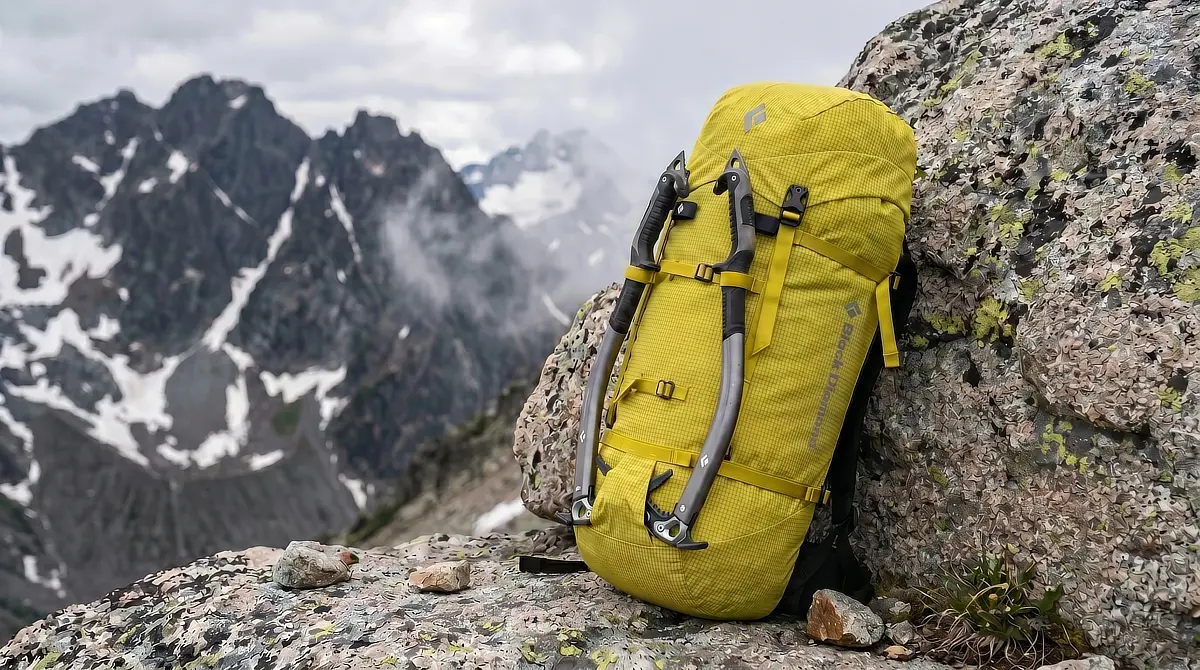
Black Diamond Speed 40 Backpack Review: A Modular Alpine Tool Built to Summit
Affiliate Disclosure: Some links on this page may be affiliate links. If you buy through them, Best Trail Backpacks may earn a small commission at no extra cost to you. As an Amazon Associate, I earn from qualifying purchases.
Most 40-liter packs are built around one assumption. You put things in, you carry them, and you stop. The Black Diamond Speed 40 operates on a completely different premise. This pack is designed to transform on the mountain, shedding weight and bulk as the terrain gets serious.
If you are considering the Speed 40 for alpine climbing, mountaineering approaches, or mixed scramble-to-summit objectives, the question is not just whether it fits well at the trailhead. The real question is how it handles when you strip it down and move fast on a technical route. That is the exact context where this pack earns or loses its place in your kit.
This review breaks down what the Speed 40 actually is, what it does well, where it has limitations, and most importantly, who should put it on their back.
TL;DR: Black Diamond Speed 40 Backpack Review
The Anatomy of an Alpine Pack: What Makes the Speed 40 Different
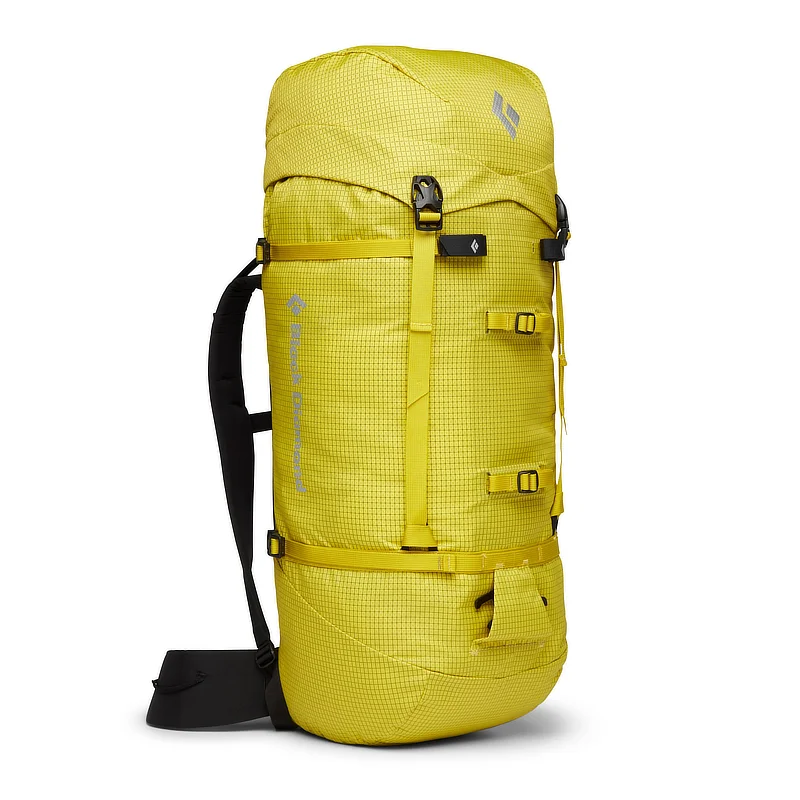
Understanding this pack means understanding what alpine climbing actually demands of a bag. Approach packs live a brutal double life. On the way to a route, they carry crampons, ropes, ice tools, layers, and food. On the route itself, you want as little bulk and swing as possible.
A pack that cannot adapt to both phases is either dead weight on the technical section or inadequate on the approach. The Speed 40 is built around a principle Black Diamond calls “Strippable Design.” This means major structural components (the top lid, the hip belt padding, and the rigid internal frame sheet) are all fully removable.
Pull them off, and you have a stripped-down technical climbing bag with a clean profile and reduced mass. Leave them on, and you have a fully supported load-carrier with dependable load transfer, which is the system’s ability to shift the pack’s weight off your shoulders and onto your stronger pelvic bones.
Trail Story: There is a specific feeling that happens somewhere above 10,000 feet when your pack stops cooperating with your body and starts fighting it. The hip belt sits wrong, the load has crept backward, and every step on the technical pitch feels slightly off-balance.
Most climbers have been there at least once, usually because they were carrying an approach pack that was never designed to go where the terrain went. The whole point of a modular strippable pack is to prevent that moment.
You build your load for the walk-in, then renegotiate your relationship with your gear before the real climbing starts. The Speed 40 is engineered specifically around that transition point.
The Materials: X-Rip Nylon and UTS Coating
The main body fabric is Black Diamond’s own X-Rip 210-denier nylon with a UTS (Ultra Tear Strength) coating. The 210d weight is on the lighter end for an alpine pack, but the X-rip weave pattern reinforces tear resistance without adding bulk. For hikers who dislike noisy gear, the X-Rip fabric is also a relatively quiet technical nylon compared to the crinkly sound of Dyneema or stiff, high-denier Cordura.
The UTS coating adds weather resistance and tear strength, but it is still not a fully waterproof pack. Black Diamond sells the rain cover separately, which tells you how to read the protection level: fine for light precipitation and alpine splash, not something to trust alone in heavy, sustained rain. If you expect long downpours, a rain cover (check out our guide to the Best Backpack Rain Covers) or dry bags are still the safer choice.
The front of the pack also features a welded abrasion patch in the highest-wear zone. This is specifically reinforced for contact with crampons and sharp tool edges. This is a direct acknowledgment that this pack lives on mountains where metal gear sits against the fabric constantly.
Editor’s Note: Some third-party retailers currently flag that this item contains PFAS and restrict shipping to California, New York, or Colorado. If avoiding PFAS is part of your buying criteria, check current retailer shipping policies before ordering.
The Hardware: Dogbones, PickPockets, and Glove-Friendly Buckles
Where the Speed 40 separates itself from general hiking packs is in the climbing-specific hardware. The ice tool attachment system uses metal dogbone loops, which are rigid aluminum brackets that slide through the head of an ice axe to secure it, instead of plastic toggles. In sub-zero temperatures, plastic toggles can become brittle and fail. Metal hardware is generally far more dependable in freezing conditions.
The Micro Ice-Tool PickPockets are protective fabric sheaths at the bottom of the pack that keep the sharp picks tucked securely against the body of the bag. This prevents them from snagging on ropes or clothing during movement.
The main hood buckles are designed specifically for gloved hands, including thick winter mittens. Struggling with fiddly buckles when your hands are cold and the wind is picking up is not just inconvenient; it can quickly become a safety issue. Black Diamond designed the Speed 40 for the conditions where that problem actually occurs. A tuck-away rope strap over the lid allows a climbing rope to be secured for the approach, then folds out of sight when not needed.
Suspension and Fit: Two Sizes, Dual-Density Foam
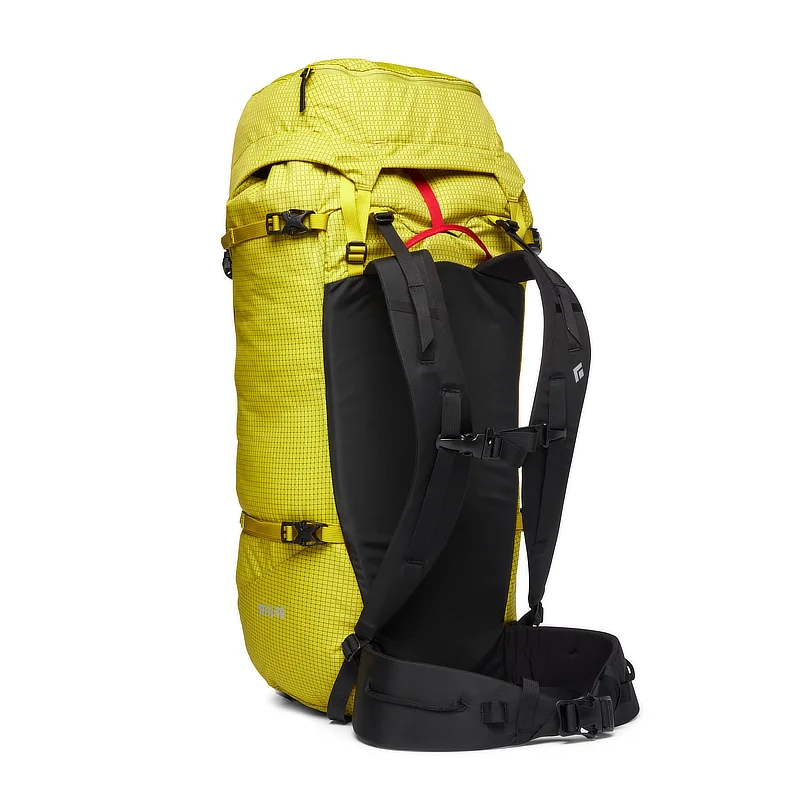
The pack is available in S/M, fitting torso lengths from 16 to 19 inches (41 to 48 cm), and M/L, fitting torso lengths from 18.5 to 21.5 inches (47 to 55 cm). Notably, the S/M model features a 38-liter capacity and weighs 2.37 lbs (1077 g), while the M/L model holds the full 40 liters and weighs 2.46 lbs (1115 g).
The shoulder straps use dual-density foam, designed to distribute the pressure of heavier loads. In plain terms, the firmer outer foam layer prevents the strap from collapsing flat under heavy weight, while a softer inner foam layer rests comfortably against your body. This combined design prevents the digging sensation that cheap, single-density foam creates after a few hours on the trail. The back panel is explicitly moisture-wicking to help manage sweat during high-output climbing approaches.
Inside, the removable frame sheet consists of a semi-rigid plastic sheet and a foam pad that gives the pack its structure. When removed, this foam insert can double as a minimalist bivy pad, which is a thin emergency sleeping pad used for basic insulation if you are forced to spend a night on a high ledge. A fixed 20mm webbing hip belt (which is a thin, unpadded safety strap designed to keep the pack from bouncing when the main hip pad is stripped) sits underneath as a backup when you strip the main hip pad for technical climbing. This keeps the pack close to your body without the bulk of a fully padded hip belt.
Performance in Practice: Comfort, Organization, and Tool Carry
Comfort and Load Transfer
At roughly 1.1 kg for the fully configured pack, the Speed 40 sits in a highly reasonable weight class for a feature-loaded alpine bag. The dual-density shoulder straps and removable padded hip belt handle load transfer effectively during the approach phase, keeping the weight stable and centered.
To get the most out of this suspension, understanding How to Pack a Hiking Backpack for Balance and Comfort is highly recommended, especially when transition periods require you to strip the rigid frame sheet.
When the frame sheet is removed, the pack’s structure depends entirely on how tightly and logically you have packed your gear. For experienced alpine climbers who pack methodically, this is a standard technique. For hikers new to technical terrain who tend to pack casually, an improperly loaded frameless Speed 40 can shift and sag. The modularity is an excellent feature for the right user, but it does require some packing discipline.
For a practical look at how the strippable frame and climbing hardware actually function in the field, this independent breakdown by expedition leader Aaron Linsdau provides excellent on-mountain context:
Field Notes: Looking closely at how the internal frame sheet integrates with the removable bivy pad, it is clear that Black Diamond prioritized minimalist utility over plush trail comfort.
When the frame is out, the pack is incredibly light, but any hard, sharp, or poorly packed items inside will press directly against your back.
This means your packing strategy has to change depending on whether you are in approach mode or technical summit mode.
Organization and Accessibility
The Black Diamond Speed 40 is a top-loader, which means the primary access is through the main compartment via the removable lid. This is standard for alpine and technical climbing packs. You load for the approach, access gear at the route, and strip the lid when it is time to move light.
The tradeoff is strict organizational simplicity. There are no side water bottle pockets on this pack. Instead, internal organization relies on the main compartment, lid pockets, and an internal hydration sleeve with a routing port. To work around the lack of side pockets on technical terrain, your best option is to run an internal hydration bladder through the routing port, or loop a modular shoulder-strap bottle holster to the harness for quick access.
If you need to quickly access a snack, a map, or a small piece of gear mid-route, planning your load before you leave the ground is part of using this pack effectively.
Ice Tool Carry and Crampon Management

The metal dogbone ice tool attachment system is genuinely well-designed. Ice tools are awkward, heavy objects with sharp points aiming in multiple directions. The Speed 40 handles them securely and safely. The PickPockets system keeps the picks from catching on rope or gear during movement, preventing disruption when it matters most.
The crampon compatibility implied by the welded front abrasion patch confirms that Black Diamond designed this fabric to survive rugged contact points. On a standard hiking pack, crampons will abrade through the fabric in a single season. The X-rip construction and abrasion patch are there specifically to outlast that abuse.
Who Is This For? The Right Hiker and the Wrong One
The Ideal User
The Speed 40 was built for alpine climbers, mountaineers, and serious scramblers who need a single pack that handles both the approach and the technical objective. If your trips involve a long walk-in with heavy gear followed by a summit push where weight and profile matter, the strippable design solves a real problem. It accomplishes this without requiring you to haul two separate bags.
It also suits experienced hikers who do multi-day routes in technical terrain and understand the difference between a traditional hiking backpack and a specialized approach pack. This pack rewards a methodical packer. The better you understand load sequencing and compression, the more the Speed 40 works in your favor.
Who Should Look Elsewhere
General trail hikers who want organizational complexity, side bottle pockets, multiple zippered panels, or a hip belt with pockets will find the Speed 40 frustrating. Its feature set is tuned entirely toward climbing performance, not casual trail convenience. If you need something simpler for weekend outings, checking out the Best Daypacks for Beginners will offer much more practical utility.
Ultralight backpackers looking to shave grams will find the climbing-specific hardware, welded patches, and metal attachments to be unnecessary weight for non-technical objectives. Anyone who wants a daily commuter, a gym-to-trail hybrid, or a campus bag should look at more versatile designs, such as those featured in our guide to the Best Hybrid Daypacks.
If you want a dedicated alpine pack but need slightly more plush padding, the Osprey Mutant 38 is a strong alternative. Conversely, if you want something even more minimalist, the Mammut Trion 38 utilizes a streamlined roll-top closure and running-vest-style straps for a fast-and-light profile.
Pros
Versatile strippable design for fast technical pushes
Mountain-ready durability with X-Rip 210d nylon and UTS coating
Metal dogbone ice tool attachments that resist freezing
Practical Product Lifetime Warranty
Cons
Limited non-climbing organization and pocket access
Lacks side water bottle pockets for general trail use
Dependent structural stability when the frame sheet is removed
Premium price point tuned strictly for alpine objectives
Maintenance and Longevity
Cleaning and Storage
The X-Rip nylon and UTS coating respond best to hand washing in cold or lukewarm water with a mild, non-detergent soap. Machine washing can degrade the UTS coating over time and stress the seams and welded patches. Rinse thoroughly and allow the pack to air dry completely before storage. It is best hung loosely so air can move through the interior.
After alpine use, pay particular attention to the ice tool attachment loops and crampon contact zones. Mud, ice melt, and salt residue from winter approaches can work into the stitching and hardware if left without cleaning. A soft brush on the abrasion patch area helps clear debris from the weave. Store the Speed 40 loosely stuffed or hanging, never compressed in a stuff sack.
Weather Protection and Care
Inspect the metal dogbone loops and crampon attachment straps before each season for any signs of wear on the stitching. Metal hardware holds up well in the cold but should be dried properly after wet trips to prevent surface oxidation.
The UTS coating adds weather resistance, but it is not a permanent substitute for a rain cover or dry bags in sustained wet weather. If the face fabric stops shedding light moisture well, follow Black Diamond’s care guidance and use a compatible water-repellent treatment only if the manufacturer recommends it.
Final Verdict: The Alpine Workhorse That Earns Its Place
The Black Diamond Speed 40 is not trying to be everything to everyone. That strict focus is exactly what makes it worth the investment if it matches your actual outdoor objectives. The modular, strippable design is a thoughtful engineering decision that solves the approach-to-technical-terrain transition problem better than packs that simply ignore it.
The Speed 40 is a refined, minimalist tool built for the high peaks, not the local nature trail. It intentionally sacrifices pocket accessibility and external water storage to give you a clean, catch-free profile that will not snag on rock or ice.
If you are heading into technical terrain, its modular suspension gives technical users a strong balance of support, simplicity, and strip-down flexibility, but casual hikers will find its lack of features frustrating.
Questions about fit, sizing, or whether the Speed 40 makes sense for your specific objective? Drop them in the comments below. The right pack for a glacier approach is not always the right pack for a scramble route, and the details of your plans matter more than a general recommendation ever could.
Founder & Gear Research Editor

Sonia Zannoni
I’m Sonia, the founder and Gear Research Editor behind Best Trail Backpacks. I research hiking backpacks through a comfort-first lens, with a focus on fit, back pain, ventilation, practical trail use, and the small design details that can make or break a hike.
I do not pretend to personally test every backpack I cover. Instead, I compare manufacturer specifications, product details, verified buyer patterns, and practical fit guidance to help casual hikers make better buying decisions without getting buried in gear jargon.
My goal is simple: help you choose a backpack that fits your body, your trail plans, and your budget, without the usual overwhelm.
About the Founder


Hello Sonia, thanks for doing a review on the Black Diamond Speed 40 backpack.
I go hiking a lot, and I have seen a lot of backpacks that are not good enough to withstand the harsh outdoor conditions, which is unfortunate. So, maybe the next time I hit the trails, I should let my fellow hikers know about the Speed backpacks from Black Diamond 😉
I really enjoy reading your review fill with insightful information as I learned something new today. I wasn’t very familiar with the Black Diamond’s brand. I will undoubtedly buy the Speed 40 backpack to bring along for my next hiking trip.
Thank you for stopping by. I think that the Speed 40 backpack is an excellent choice as your hiking companion. If you need further help, drop me a line, and I will gladly give you more assistance. Happy hiking!
The Black Diamond Speed Backpacks are perfect for my adventures. I live in the tropics, and we take that trek to Blue Mountain Peak once or twice a year.
The Speed series Backpacks is so stylish looking. Even though the colors available are limited, I like the grey one.
I like the style of the zippers and the fact that you can remove parts of the bag when not in use. I am always conscious about the weight because when we start, it might feel okay, but after the long uphill hike, it will feel heavy.
The nylon material looks sturdy enough, which is a good thing since my backpack gets beat up quite a lot!
I think that you can’t go wrong with the Black Diamond Speed series backpacks. I find the Speed pack to be the ideal companion for a day-hike.
Contrarily to you, I live in a Nordic country, Canada, and the summertime is not very long. So, I use my Speed 40 backpack during the winter when I am going cross-skiing. I find that the Backpack is the perfect size for a ski excursion. I try to keep the bag lightweight by putting only the bare essentials. Because as you said, after carrying a hiking bag for a while, it seems to get heavier and heavier!