
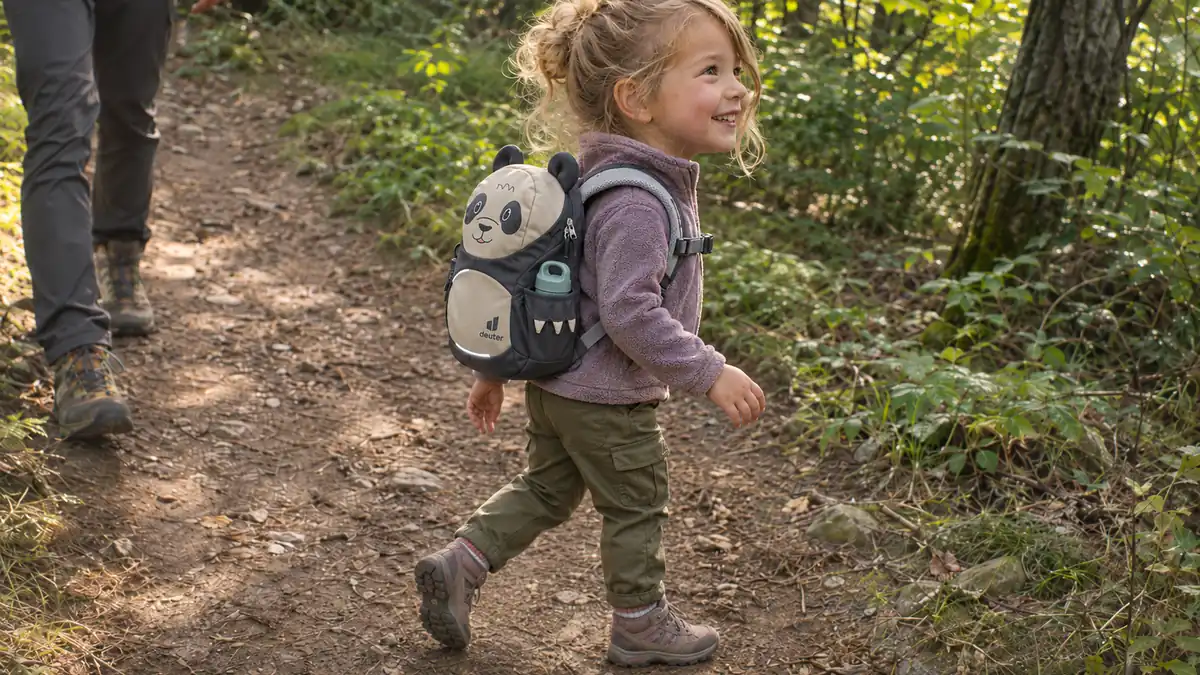
Best Kids Hiking Backpacks: 4 Picks by Age and Height
Affiliate Disclosure: Some links on this page are affiliate links. If you buy through one, I may earn a commission at no extra cost to you. Commission never decides which products I recommend. Read the full disclosure.
Your child begged to carry their own pack. Twenty minutes up the trail it’s hanging off one shoulder, bumping the backs of their knees, and then it’s on your arm.
That’s not your fault, and it isn’t your child’s. Kids’ packs are sold by the age on the tag, but each brand measures fit its own way.
The weight advice online runs anywhere from 10% to 20% of body weight, too. So a pack can say “ages 6 to 12” and still be wrong for your 7-year-old.
You came for the best kids hiking backpack for your child’s size and the hike you’re planning, plus a straight answer on how heavy it can be.
You’ll find four packs here, from a preschooler’s snack pack to one a tween can grow into, each matched to the makers’ own height and back-length numbers, plus a weight check you can do tonight on the bathroom scale.
TL;DR: Best Kids Hiking Backpack
- Deuter Kikki for preschoolers (Deuter sizes it for kids about 39 to 51 inches (98 to 130 cm) tall, ages 3 and up) carrying a snack, a small bottle and a spare layer on short walks
- Osprey HydraJet 12 for early grade-schoolers who drink better from a tube; fill the 1.5 L reservoir partway for a small child
- REI Co-op Tarn 18 for kids about 6 to 10 who carry their own water, lunch and layer, with a real hip belt
- Deuter Fox 30 for tweens and young teens (about 43 to 66 inches, or 110 to 168 cm, tall) on long day hikes, with a back length that adjusts as they grow
This table lines up the four picks by the child each one suits and the main tradeoff you take on with it.
Product Name
Best For
Key Strength
Main Tradeoff
Price Tier
Preschoolers about 39 to 51 in (98 to 130 cm) tall
Very light, with a sternum strap and reflective details
8 L, no hip belt
$
Early grade-schoolers who drink better from a tube
1.5 L reservoir included
Full reservoir adds about 3.3 lb; no hip belt
$
Kids about 6 to 10 on half-day or full-day hikes
Hip belt with pockets and kid-sized buckles
Sold only at REI; the room invites overpacking
$
Tweens and young teens about 43 to 66 in (110 to 168 cm) tall
Adjustable back and hip fins that grow with the child
2.5 lb empty; highest price here
$$
Deuter Kikki
Best For: Preschoolers about 39 to 51 in (98 to 130 cm) tall
Key Strength: Very light, with a sternum strap and reflective details
Main Tradeoff: 8 L, no hip belt
Price Tier: $
Osprey HydraJet 12
Best For: Early grade-schoolers who drink better from a tube
Key Strength: 1.5 L reservoir included
Main Tradeoff: Full reservoir adds about 3.3 lb; no hip belt
Price Tier: $
REI Co-op Tarn 18
Best For: Kids about 6 to 10 on half-day or full-day hikes
Key Strength: Hip belt with pockets and kid-sized buckles
Main Tradeoff: Sold only at REI; the room invites overpacking
Price Tier: $
Deuter Fox 30
Best For: Tweens and young teens about 43 to 66 in (110 to 168 cm) tall
Key Strength: Adjustable back and hip fins that grow with the child
Main Tradeoff: 2.5 lb empty; highest price here
Price Tier: $$
Price tiers: $ under $100 | $$ $100 to $249 | $$$ $250 and up
Before you pick from the table, check your child’s height against the makers’ numbers in the first section below.
How to Choose the Best Kids Hiking Backpack for Your Child’s Size
This is about the pack your child wears on a day hike. Child carriers and overnight packs are separate questions.
Start with your child’s height and back length, not the age on the tag, because each maker measures fit its own way. Then match it to the load: a snack and a layer, or water, lunch and rain gear. On a long hike, keep it near 10% of their weight.
You can stand in front of two packs, both labeled for your child’s age, and one will be twice the size of the other. The label can’t settle it. These are the things that do, in the order I weighed them for every pick below:
- The maker’s height or back-length range against your child, because that range decides where the straps and any belt land on their body
- What the pack must carry and what it weighs empty, since the empty pack already uses part of a small child’s weight allowance
- A hip belt or not, which matters more as the load grows
- A sternum strap, so the shoulder straps stay on small shoulders
- Bottle pockets your child can reach alone, or they’ll wait for you to stop before they drink
- Visibility and a whistle, for trailhead parking lots and for the moment they get ahead of you
- Room to adjust as they grow, if you want more than a season or two out of it
- Price against how long it will fit, because a cheap pack they outgrow in a year isn’t always the cheaper buy
Why Height and Back Length Beat the Age on the Label
Deuter sizes its kids’ packs by body height and back length, while REI and Osprey use age, so two packs both labeled for a 6-year-old can fit differently. Measure your child’s height and back, then compare those numbers with each maker’s own range instead of the age on the label.
Deuter sizes the Kikki for children about 39 to 51 inches (98 to 130 cm) tall. The Fox 30 covers about 43 to 66 inches (110 to 168 cm), with a back length of about 11 to 16.5 inches (28 to 42 cm).
REI rates the Tarn 18 for ages 6 to 12, and Osprey rates the HydraJet 12 for ages 4 to 12. Line those age labels up against Deuter’s heights and you’re comparing different things.
Each maker measures fit differently, which is the point of this table: put your child’s numbers next to each row.
Pack
Maker’s Fit Measure
Capacity
Empty Weight
Hip Belt
Deuter Kikki
Ages 3 and up; about 39 to 51 in (98 to 130 cm) tall; back length about 9.5 to 12 in (24 to 30 cm)
8 L
0.68 lb (310 g)
None
Osprey HydraJet 12
Ages 4 to 12 (Osprey)
12 L plus 1.5 L reservoir
0.75 lb (Osprey); about 1.1 lb with the empty reservoir (REI)
None
REI Co-op Tarn 18
Ages 6 to 12 (REI); one size
18 L
1 lb
Yes, with zippered pockets
Deuter Fox 30
About 43 to 66 in (110 to 168 cm) tall; back length about 11 to 16.5 in (28 to 42 cm), adjustable
30 L
2.5 lb (1,150 g)
Pull-forward hip fins
Deuter Kikki
Maker’s Fit Measure: Ages 3 and up; about 39 to 51 in (98 to 130 cm) tall; back length about 9.5 to 12 in (24 to 30 cm)
Capacity: 8 L
Empty Weight: 0.68 lb (310 g)
Hip Belt: None
Osprey HydraJet 12
Maker’s Fit Measure: Ages 4 to 12 (Osprey)
Capacity: 12 L plus 1.5 L reservoir
Empty Weight: 0.75 lb (Osprey); about 1.1 lb with the empty reservoir (REI)
Hip Belt: None
REI Co-op Tarn 18
Maker’s Fit Measure: Ages 6 to 12 (REI); one size
Capacity: 18 L
Empty Weight: 1 lb
Hip Belt: Yes, with zippered pockets
Deuter Fox 30
Maker’s Fit Measure: About 43 to 66 in (110 to 168 cm) tall; back length about 11 to 16.5 in (28 to 42 cm), adjustable
Capacity: 30 L
Empty Weight: 2.5 lb (1,150 g)
Hip Belt: Pull-forward hip fins
The back measurement works the same way it does for an adult: from the base of the neck down to the top of the hip bones. The steps in my guide on how to measure torso length work on a child, then you compare the number with the maker’s range.
The usual objection is that they’ll outgrow it in a year. There are three honest ways around that:
- Buy a pack whose back adjusts. The Fox 30’s back length moves over about 5.5 inches (14 cm).
- Buy one with room to grow. One Tarn 18 owner calls it “A pack she can grow into.”
- Start small and size up later. The cheaper small pack does the job now, and you buy the next size when it’s needed.
What I wouldn’t do is buy two sizes up because the age label stretches that far. That’s how a pack ends up bouncing against the backs of the knees. Sizing up only makes sense where the back actually adjusts.
How Heavy Your Child’s Loaded Pack Should Be
KidsHealth says children should carry no more than 10% to 20% of body weight, and Cleveland Clinic reports the American Academy of Pediatrics’ 15% ceiling, with 10% as ideal. On a long hike, aim for the lower end. Water is the heavy part: about 2.2 lb (1 kg) per liter.
It’s hard to judge by lifting the pack yourself. A few pounds feels like nothing in your hand and a lot more on a 45-pound child by the second hour.
KidsHealth’s backpack safety guide puts the limit at 10% to 20% of body weight. That advice was written for school backpacks, and 20% is a ceiling, not a target.
Cleveland Clinic’s advice on child backpack weight reports the American Academy of Pediatrics’ ceiling as 15% and calls 10% the ideal. Put those together with a long day on uneven ground, and I’d aim for about 10%.
Deuter’s own load guidance by age points the same way: about 2.2 lb (1 kg) for preschoolers, about 6.6 lb (3 kg) in elementary school, and about 8.8 to 11 lb (4 to 5 kg) before age 12.
Water is what tips the scale. A liter weighs about 2.2 lb (1 kg), so a full 1.5 L reservoir is about 3.3 lb.
Osprey lists the HydraJet 12 at 0.75 lb, and REI lists it at about 1.1 lb with its empty reservoir. Fill that reservoir and the total is about 4.4 lb, more than the whole 10% budget for a 40-pound child.
Here’s what 10% and 20% look like at common weights, so you don’t have to do the math at the trailhead.
Child’s Weight
10% (Aim Here on Long Hikes)
20% (KidsHealth’s Upper Limit)
30 lb
3 lb
6 lb
40 lb
4 lb
8 lb
50 lb
5 lb
10 lb
60 lb
6 lb
12 lb
80 lb
8 lb
16 lb
30 lb
10% (Aim Here on Long Hikes): 3 lb
20% (KidsHealth’s Upper Limit): 6 lb
40 lb
10% (Aim Here on Long Hikes): 4 lb
20% (KidsHealth’s Upper Limit): 8 lb
50 lb
10% (Aim Here on Long Hikes): 5 lb
20% (KidsHealth’s Upper Limit): 10 lb
60 lb
10% (Aim Here on Long Hikes): 6 lb
20% (KidsHealth’s Upper Limit): 12 lb
80 lb
10% (Aim Here on Long Hikes): 8 lb
20% (KidsHealth’s Upper Limit): 16 lb
The check takes two minutes on a bathroom scale. Weigh your child and work out 10% of that number, then put the packed pack on the scale and compare.
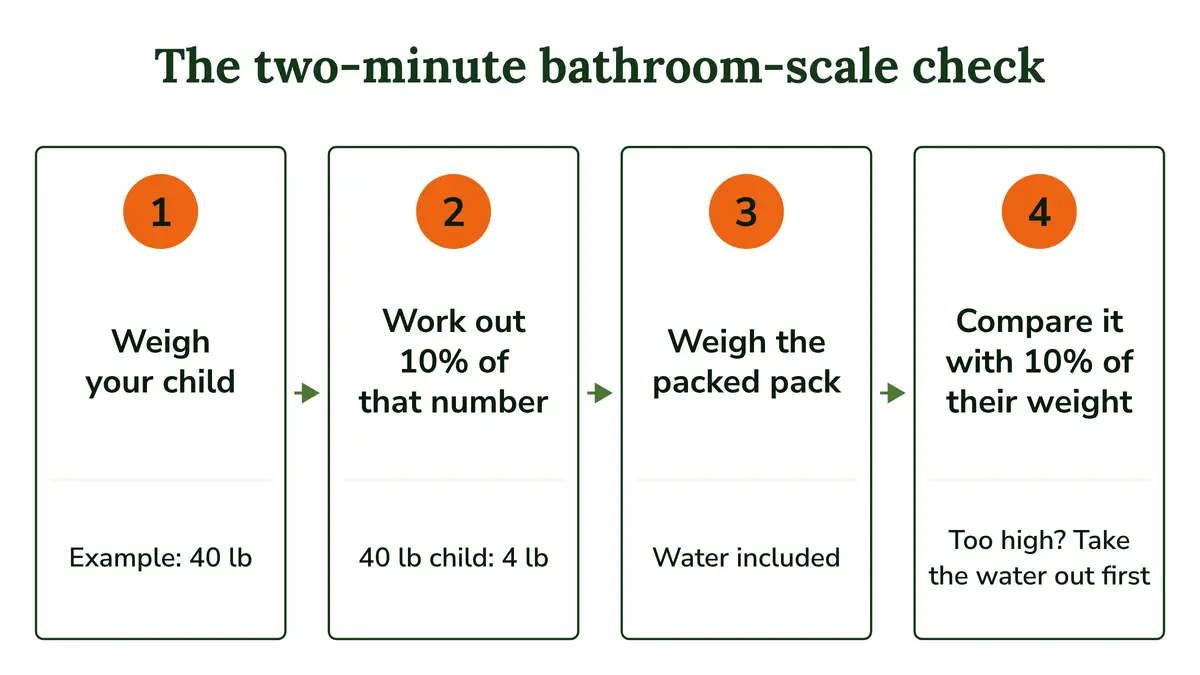
Watch how your child moves with it, too. KidsHealth lists trouble getting the pack on or off, leaning forward to carry it, and back pain as signs it’s too heavy. If your child has back pain or numbness, talk to their doctor.
Your own load runs on different numbers, and the guide to pack weight limits for adults covers those for day hikes and overnights.
What a Hiking Pack Does That a School Backpack Doesn’t
A sternum strap keeps the straps from sliding off small shoulders, and stretch side pockets let a child grab a bottle alone. On bigger packs, a hip belt takes part of the load, but only on the hip bones. Reflective details and a whistle add visibility and a signal.
So can your child just wear their school backpack? On a flat loop, it might be fine. Once the trail climbs, the differences show up: a sternum strap, a hip belt on the bigger picks and stretch pockets for a bottle.
REI even says the Tarn 18’s internal sleeve fits a school binder, so one pack can do both jobs.
If a strap keeps slipping off your child’s shoulder on the first climb, that’s common with small shoulders. A sternum strap clips the two straps together across the chest so they can’t spread apart.
Kikki owners on CampSaver say the same thing in older reviews: the chest strap is what keeps the pack in place.
A hip belt works differently. It only carries weight when it sits on the hip bones. Above them it has nothing to rest on, so the load slides back to the shoulders, which is why the belt matters more as the load grows.
Whatever the pack, KidsHealth’s advice holds: two wide, padded straps, both worn, tightened so the pack sits close and centered in the middle of the back, not sagging toward the bottom.
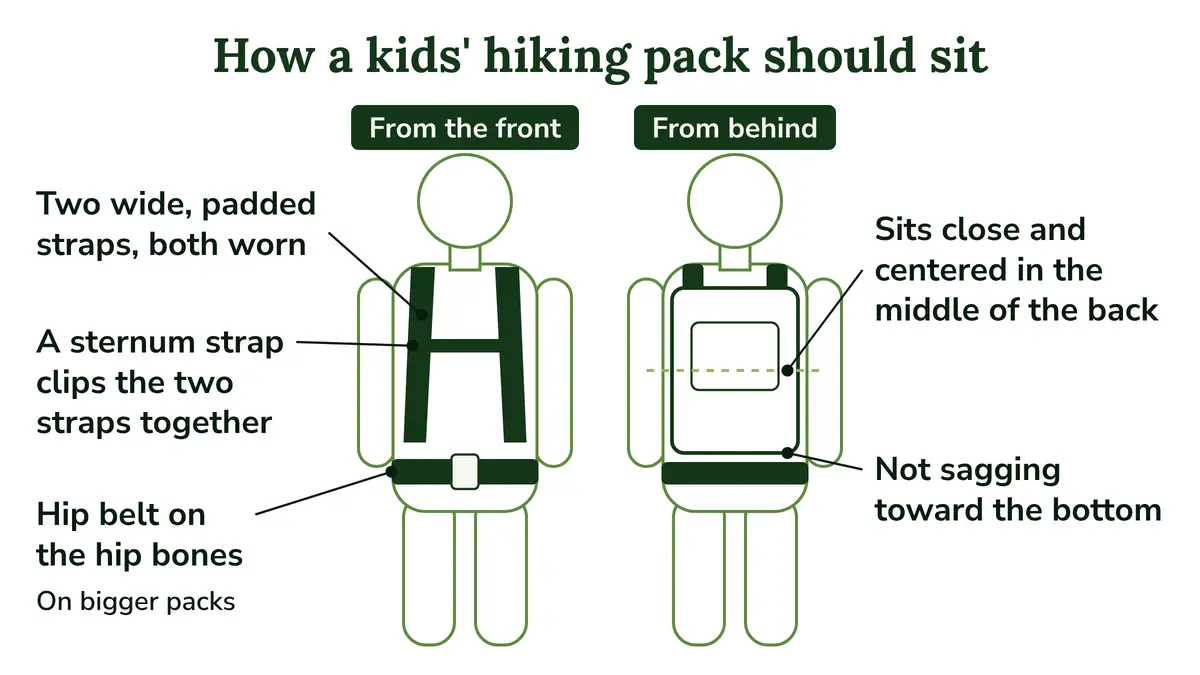
On a pack with a belt or hip fins (short padded wings that wrap onto the hip bones and work like a small hip belt), tighten the hips first, then the shoulder straps, then the sternum strap.
The guide on adjusting the straps in order works the same way on the Tarn 18 or the Fox 30.
The small details count on a trail, too:
- Bottle pockets your child can reach without taking the pack off, so drinking doesn’t depend on you stopping
- A whistle on the strap, a signal they carry with them
- Reflective details, so a small child shows up in a trailhead parking lot at dusk
Two of the four picks can put weight on the hips: the Tarn 18 has a hip belt with zippered pockets, and the Fox 30 has pull-forward hip fins. The Kikki and the HydraJet 12 have neither, which is one more reason to keep their loads small.
What Your Child Carries and What Stays With You
Give a young child the light things they’ll use: a snack, a small bottle and a spare layer. The water and layers they can’t carry go in your pack, so your daypack needs extra room. Older kids can carry more if the load stays near 10% of their weight.
Plenty of kids want to carry the real gear, the first aid kit or the big water bottle, because that’s what the grown-ups carry. I’d give them the job without the weight: their own snack, bottle and jacket, things they’ll reach for and feel responsible for.
Everything else rides with you. Go through the full list of what goes in a day hike pack and split it into what your child uses and can carry, and what stays in your pack.
That overflow is why your own pack needs a few spare liters. If yours is already full on a solo hike, look for a daypack with room for a child’s extras before the first family outing.
The bigger kids’ packs come with a catch. Those extra liters are room to keep things organized, not room to fill, and an 18 L or 30 L pack packed to the top will pass 10% quickly.
For Preschoolers on Short Walks: Deuter Kikki
The Deuter Kikki is an 8 L preschool pack, sized by Deuter for children about 39 to 51 inches (98 to 130 cm) tall and ages 3 and up. At 0.68 lb (310 g), it carries a snack, a bottle and a layer, with a sternum strap and reflective details.
Best For
Preschoolers about 39 to 51 inches (98 to 130 cm) tall who carry a snack, a small bottle and a spare layer on short family walks and day hikes.
Why It Stands Out
It’s very light for a pack that still has a 2-way adjustable sternum strap and reflective details. It also averages 4.7 stars across hundreds of Amazon ratings.
CampSaver owners describe it as durable and well built, and several say their child loves it, which matters more than any spec when the wearer is three.
Key Features and What They Mean
- Sternum strap on S-shaped shoulder straps. It keeps the straps on small shoulders when your child bends, climbs or runs. One older CampSaver review calls it “a must for little shoulders.”
- 0.68 lb (310 g) empty. Deuter suggests about 2.2 lb (1 kg) for a preschooler, so the empty pack leaves most of that for water and a layer.
- Reflective eyes and details. A small child is easier to spot at a trailhead or in a parking lot.
- Two elastic side pockets. A small bottle stays where your child can reach it.
- Inner elastic compartment. A wet or sweaty layer stays apart from the snacks.
- Contact back. Deuter describes it as a light padded back with an airy cover.
Deuter sizes it for ages 3 and up and about 39 to 51 inches (98 to 130 cm) tall. One CampSaver owner bought it for a 30-month-old grandson and another for a son of 2 and a half, both younger than Deuter’s range.
Size feedback isn’t unanimous, though. REI’s page reads “Fits slightly large based on reviews,” and Amazon’s own review summary says size feedback is mixed. Measure your child’s height before you order.
Where It Falls Short
At 8 L with no hip belt, it only works while the load stays small. That’s fine for a preschooler, but it means the liter of water and the jacket ride with you.
Owners are split on the side pockets. One older CampSaver review says, “Just wish the side pockets were a little bigger,” while others are happy with them. One REI owner also found it too small for school binders.
If your child is 2, know that Deuter’s range starts at 3, though owners report using the Kikki younger. Deuter also makes a smaller 5 L pack for ages 2 and up, the Pico, if you’d rather stay inside the maker’s range.
Pros and Cons
Pros
Very light at 0.68 lb (310 g), so most of a preschooler’s small allowance goes to water and a layer
A sternum strap and reflective details on a pack this small
Owners call it durable, and several say their child loves it
Cons
8 L and no hip belt, so the load has to stay small
Side pockets one owner found too small for a water bottle
Who Should Skip It
Skip it for a child taller than about 51 inches (130 cm), or one who needs to carry a full lunch, a liter of water and a jacket. That load needs more room and ideally a hip belt, which is where the Tarn 18 comes in.
Verdict
I’d make the Kikki a preschooler’s first pack: light, simple and sized for their own snack, as long as you carry the rest. Once your child needs to carry real water and lunch, it’s time for the Tarn 18.
 Deuter Kikki
A light 8 L first pack for preschoolers, with a sternum strap and reflective details, sized by Deuter for kids about 39 to 51 inches tall.
Osprey HydraJet 12: Water Without Stopping
The Osprey HydraJet 12 is a 12 L kids’ pack with a 1.5 L reservoir, so a child can sip through a tube without stopping. Osprey rates it for ages 4 to 12. A full reservoir adds about 3.3 lb (1.5 kg), so for a small child, fill it partway.
Osprey’s US site doesn’t list the reservoir-free Jet 12 now, and the HydraJet 12 is the 12 L kids’ pack Osprey currently sells here.
Best For
Early grade-schoolers who drink better from a tube than a bottle, carrying snacks and one layer.
Why It Stands Out
Some kids won’t stop to dig out a bottle, however often you ask. A tube clipped near the shoulder lets them sip while they keep walking, from a light pack.
The included reservoir sits in an external sleeve with a hose clip, so you can refill it without unpacking the snacks and the jacket.
Key Features and What They Mean
- 1.5 L Hydraulics LS reservoir included. Your child sips without stopping, and the external sleeve means refills don’t involve emptying the pack.
- 0.75 lb as Osprey lists it, about 1.1 lb with the empty reservoir by REI’s figure. The water, not the pack, is the weight to watch.
- Safety whistle on the sternum strap. A signal your child carries on their own chest.
- Stretch side and front pockets. The jacket that comes off at the first hill goes on the outside.
- AirScape back panel. Osprey describes the mesh-covered foam panel as built for ventilation.
- Recycled fabric. Osprey uses bluesign approved recycled 100D nylon with a water-repellent finish (DWR) made without PFAS.
Osprey’s US page says ages 4 to 12. REI lists an 11 to 15 inch torso range, which is REI’s figure, not Osprey’s.
The owner reviews I could read describe the earlier Jet 12, not this build. Those owners, at Altitude Sports and CampSaver, describe children of about 3 to 7. One found it a little big on a 4-year-old and bought it to grow into.
Owners of that earlier Jet 12 liked the padded straps and the whistle. How well the current build holds up over years, nobody has reported yet.
For the current pack, Amazon’s own review summary says buyers praise its quality and capacity and give mixed feedback on the water capacity. One reviewer notes it isn’t waterproof.
Where It Falls Short
There’s no hip belt, and the water adds up fast. A full reservoir plus the pack comes to about 4.4 lb, more than the whole 10% budget for a 40-pound child, before a snack or a jacket goes in.
So treat the reservoir as adjustable weight and fill it partway for a small child. There’s also very little owner feedback on the current build to read, so the comfort reports above lean on the earlier Jet 12.
Why does a 12 L kids’ pack cost more than the Kikki or the Tarn 18? Part of the price is the reservoir in the box, which Osprey also sells on its own. It still sits in the lowest price tier with those two.
Pros and Cons
Pros
Reservoir included, so your child drinks without stopping
A whistle on the sternum strap
Stretch pockets that take a shed jacket
Cons
No hip belt, and a heavy load when the reservoir is full
Little owner feedback on the current build
Who Should Skip It
Skip it if your child’s total allowance is small and you won’t fill the reservoir partway, or if their load is big enough to call for a hip belt. A child who happily drinks from a bottle gets less out of it, too.
Verdict
I’d buy the HydraJet 12 for the child who won’t stop to drink from a bottle, as long as you treat the reservoir as adjustable weight. For a child who drinks from a bottle without fuss, the Kikki or the Tarn 18 does the job for less.
 Osprey HydraJet 12
A 12 L kids' pack with a 1.5 L reservoir included, for the child who won't stop to drink from a bottle. Fill it partway for a small child.
The Hip Belt Pick for Grade-Schoolers: REI Co-op Tarn 18
The REI Co-op Tarn 18 is an 18 L pack REI designs for ages 6 to 12, with a zippered-pocket hip belt and buckles sized for kids’ hands. At 1 lb, it holds water, lunch and a layer for a half or full day. Only REI sells it.
Best For
Kids about 6 to 10 on half-day or full-day hikes who carry their own water, lunch and layer.
Why It Stands Out
It has a real hip belt with zippered pockets and easy-open buckles designed for kids’ hands, and it sits in the lowest price tier. It’s well rated across dozens of REI reviews.
One owner says it’s “not so big that your kid can’t carry it,” which is exactly the balance a grade-schooler’s pack needs.
Key Features and What They Mean
- Hip belt with zippered pockets. The first pick here where a belt can take part of the load off the shoulders, and snacks ride where your child can reach them.
- Buckles designed for kids’ hands. Your child opens pockets alone, which matters when fingers are cold.
- Stretch side pockets. Owners say they stretch to take a 1 L bottle; one calls them “stretchy enough to accommodate 1L bottles.”
- Front stuff pocket with a buckle. The jacket comes off and goes on the outside.
- Internal sleeve for a 2 L reservoir (not included). REI says it also fits a school binder or small laptop, so the pack can cover school days.
- Chest strap, removable whistle, air-mesh back panel and reflective details. The basics from the buying guide above, all on one pack.
- Printed packing list and ID label inside. Handy for a child learning to pack their own bag.
REI says ages 6 to 12 (older versions said 8 to 12) and makes it in one size, with no torso range. The model in REI’s photos is 4 ft 8 in.
Owners mostly describe children of about 6 to 8, around 4 feet tall, and a few petite adults use it too. REI’s label says “Fits slightly large based on reviews,” but the reviews I read rate the fit true to size.
One owner reports five years of use with no holes and no broken buckles. That’s a single report, but it’s the kind of detail that matters when a pack gets passed down.
Where It Falls Short
It’s sold only at REI, which rules it out if you’d rather not shop there. The built-in whistle draws complaints, too: two owners call it weak or cheap, and one mentions “the cheap whistle that comes with it.”
Eighteen liters is more room than a young child should fill, so you keep the load light on purpose.
Half of the reviews I read were marked as free product, so I weigh them a little more cautiously.
Pros and Cons
Pros
A hip belt with pockets
Buckles a child can open alone
Stretch pockets that hold 1 L bottles
Cons
Sold only at REI
The whistle draws complaints
Who Should Skip It
Skip it for a preschooler, since REI starts the range at 6, or if your family won’t shop at REI.
Verdict
I’d call the Tarn 18 the most complete hiking pack here for a young grade-schooler, and it doubles as a school bag. Keep the load near 10% of their weight, and add a louder whistle if the built-in one bothers you.
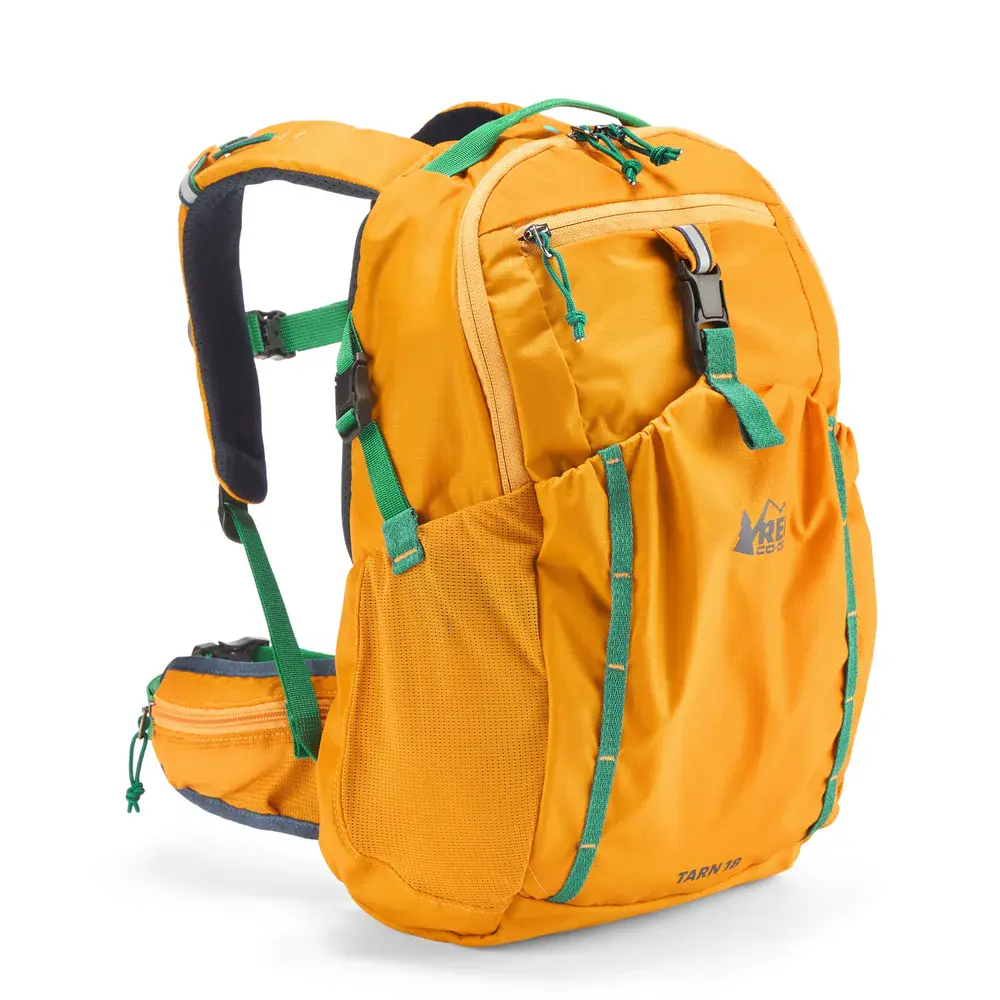 REI Co-op Tarn 18
An 18 L pack with a real hip belt and buckles sized for kids' hands, for grade-schoolers who carry their own water, lunch and layer.
For Tweens Who Keep Growing: Deuter Fox 30
The 30 L Deuter Fox 30 is for children about 43 to 66 inches (110 to 168 cm) tall, with hip fins and a back length adjustable from about 11 to 16.5 inches (28 to 42 cm). At 2.5 lb (1,150 g) empty, it suits older kids on long days.
Best For
Tweens and young teens, roughly 43 to 66 inches (110 to 168 cm) tall, on long day hikes with water, lunch, layers and a rain jacket. It also suits a family that wants one pack to last several years.
Why It Stands Out
It brings adult-style adjustment to a body that’s still growing. Deuter’s VariQuick back length moves over about 5.5 inches (14 cm), with pull-forward hip fins and stabilizer straps that pull the load closer to the body.
Owners at REI and CampSaver say it adjusts easily and grows with the child.
Key Features and What They Mean
- Adjustable back length (VariQuick). The pack follows your child’s back for several years, which is the case for its price.
- Hip fins and stabilizer straps. Once the load grows, the hips take part of it. One REI owner says, “The waist band and chest band did their work.”
- Recommended load of 6.6 to 13.2 lb (3 to 6 kg). That’s Deuter’s range, and it lines up with 10% only for a child of about 66 to 132 lb, so a lighter child’s load stays below it.
- Hydration compatible up to 3 L. Room for a reservoir if your child prefers a tube, keeping in mind that each liter adds about 2.2 lb.
- Lid pocket, stretch side pockets, zip-out divider and an SOS label. Places for a hat, a bottle and a jacket, plus the label.
- Aircontact back. Deuter describes it as a breathable back pad.
Deuter names it the Fox 30, while REI lists it as the Fox 30 + 4, with a collar that expands to 34 L, a 10 to 17 inch torso and an internal aluminum frame. The torso and frame figures are REI’s.
Deuter’s kids’ page says the Fox line is for ages 8 and up, but height and back length are the better guide. In the few owner reviews, an almost-8-year-old, 51 inches and about 60 lb, fit on the smallest setting.
Another REI owner says “This pack fit him perfectly” about a boy 4 ft 10 in and 70 lb. A third owner bought it for a 5-year-old as a pack to grow into.
Where It Falls Short
The catch is weight and price. At 2.5 lb empty, the pack alone is about 40% of a 60-pound child’s 6 lb budget at 10%, which is why it suits older, bigger kids.
Thirty liters also invites overpacking. One REI owner reports the side-pocket mesh starting to tear, a single report so far.
That much for a pack they’ll outgrow? The back adjusts over about 5.5 inches, and owners buy it to grow into. Even so, one REI owner admits, “Yes, it’s expensive for a kids item.”
Pros and Cons
Pros
A back length that adjusts as your child grows
Hip fins and stabilizer straps for real loads
A stated recommended load range
Cons
The heaviest pick here when empty
The highest price tier here
Who Should Skip It
Skip it for a younger or lighter child, because the empty pack uses too much of a small allowance. It’s also more pack than a child needs for a snack and a bottle.
Verdict
The Fox 30 is the one pack here I’d buy to grow into, for an older child who hikes long days. The adjustable back earns the price, but for a younger or lighter child, 2.5 lb is a lot to carry before anything goes in.
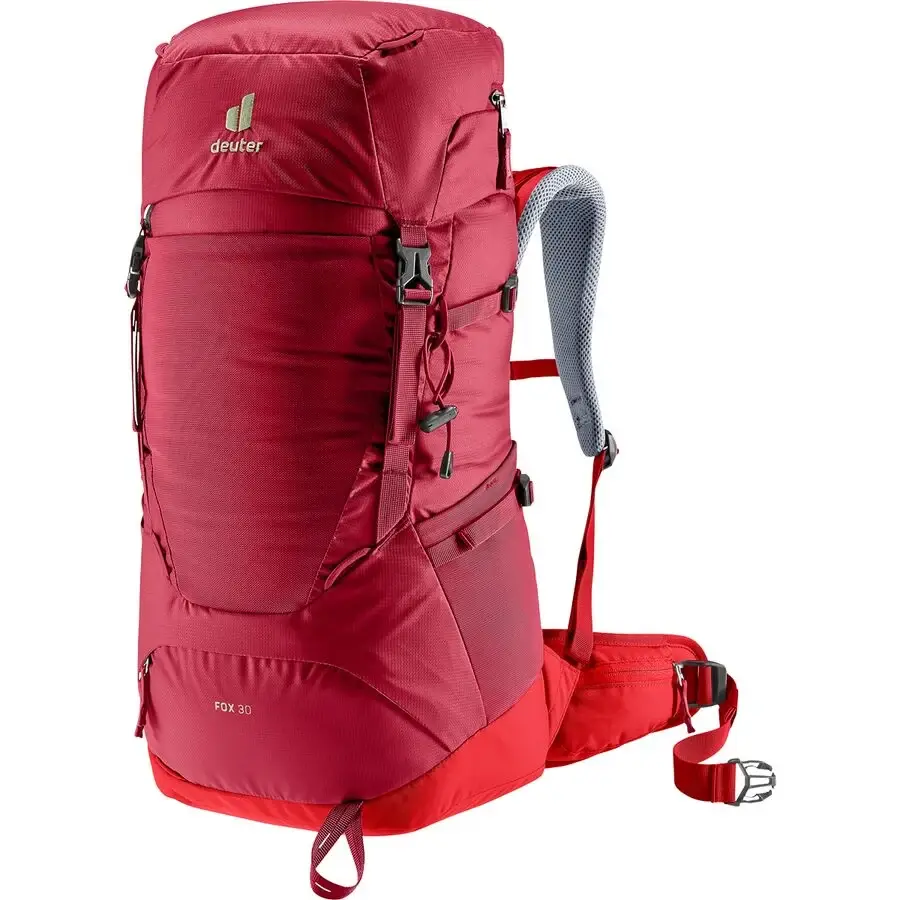 Deuter Fox 30
A 30 L pack with an adjustable back and hip fins, for older kids on long day hikes who need a pack that grows with them.
Try It at Home Before the First Trail
Before the first hike, pack it with exactly what your child will carry, weigh it, and have them wear it around the house. Check that the straps are snug, the pack rides mid-back, and they can reach the bottle and open the buckles alone.
A trial run in the living room catches most of what you’d otherwise find a mile in, and the tags are still on. Here’s the order I’d follow:
- Pack exactly what your child will carry, water included, because an empty pack tells you nothing about how it rides.
- Weigh your child, then weigh the packed pack, and compare it with 10% of their weight.
- Snug both shoulder straps and clip the sternum strap, with the hip belt on the hip bones if the pack has one.
- Look from behind: the pack should sit in the middle of the back, close to the body, not sagging toward the bottom.
- Ask your child to grab their bottle and open a pocket without help, because if they can’t, they’ll be asking you every ten minutes on the trail.
- Let them wear it around the house for a while, up and down the stairs if you have them.
If the number comes in high, take the water out first and carry it in your pack. Before the first hike, weigh the loaded pack on the bathroom scale and compare it with 10% of your child’s body weight.
Founder & Gear Research Editor

Sonia Zannoni
I’m Sonia, the founder of Best Trail Backpacks. I don’t test gear myself. For every pack I cover, I read the manufacturer’s specs and sizing charts and look for what owners report again and again.
Fit comes first, because a pack that doesn’t match your torso and hips will hurt no matter what it cost. My goal is to help you choose a pack that suits your body, your trip and your budget.
About the Founder
