How to Pack a Hiking Backpack for Balance and Comfort
You zip everything up, lift the pack onto your shoulders, and immediately feel it pulling you backward like an anchor tied to your upper back. Sound familiar? That specific kind of misery is almost never about what you packed. It is about where you packed it.
Learning how to pack a hiking backpack correctly takes about ten minutes to understand and maybe two or three trail trips to make automatic. The payoff is immediate: less shoulder fatigue, better footing on uneven terrain, and a pack that feels like part of your body instead of something you are wrestling.
This guide covers the physics of packing, specifically the Zone System, so you can feel the difference on your very next hike.
TL;DR: How to Pack a Hiking Backpack.
Pack heavy gear centered and close to your spine (Zone 2). Put bulky, squishy items at the bottom (Zone 1), light trail gear at the top (Zone 3), and immediate-access essentials in your outer pockets (Zone 4) to maintain your center of gravity and prevent shoulder strain.
The Cheat Sheet
Before the details, here is the short version. Pin this and revisit it every time you pack.
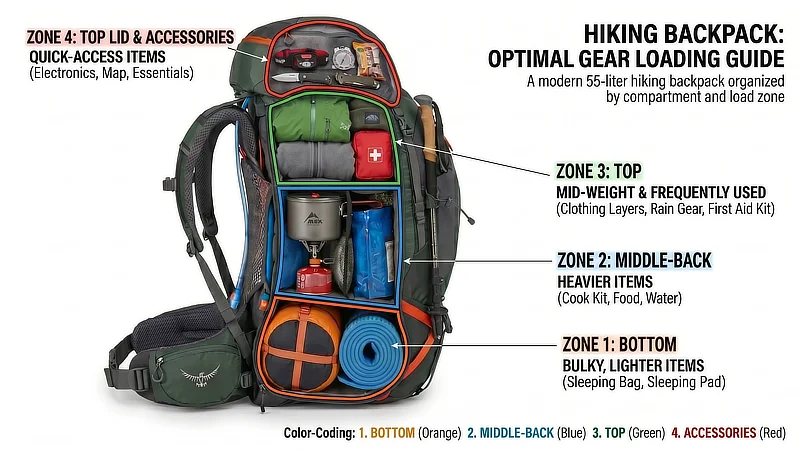
Zone
Where
What Goes Here
Why
Zone 1
Bottom compartment
Bulky, squishy items (sleeping bag)
Creates a shock-absorbing base for heavier gear to rest on
Zone 2
Core / back panel
Dense, heavy items (water bladder, food, stove)
Most critical zone; keeps weight centered and close to your body
Zone 3
Top of main compartment
Bulky items you need on the trail (fleece, lunch)
Light but accessible; prevents top-heaviness on uneven terrain
Zone 4
Hip belt and outer mesh pockets
Immediate-access items (snacks, phone, rain shell)
No stopping to dig; keeps the hike moving
Zone 1
Where: Bottom compartment
What Goes Here: Bulky, squishy items (sleeping bag)
Why: Creates a shock-absorbing base for heavier gear to rest on
Zone 2
Where: Core / back panel
What Goes Here: Dense, heavy items (water bladder, food, stove)
Why: Most critical zone; keeps weight centered and close to your body
Zone 3
Where: Top of main compartment
What Goes Here: Bulky items you need on the trail (fleece, lunch)
Why: Light but accessible; prevents top-heaviness on uneven terrain
Zone 4
Where: Hip belt and outer mesh pockets
What Goes Here: Immediate-access items (snacks, phone, rain shell)
Why: No stopping to dig; keeps the hike moving
The Golden Rule: Keep Heavy Gear Close to Your Spine
Your spine is your body’s central column. When a heavy object sits close to it, your legs and core bear the weight the way they are designed to. When that same object rides away from your back, hanging out in a side pocket or buried against the outer shell, your upper back, neck, and shoulders start compensating. By mile three, you will likely feel the strain.
Think of it this way: hold a full water bottle against your chest and walk around, then hold it at arm’s length. Same weight, very different effort. Packing follows the same principle, meaning heavy items belong tight against the back panel, centered vertically in the pack.
While the Zone System is essential for heavy multi-day loads, the same physics apply to simple day hiking. For a short day hike, your pack might only carry a water bottle, a light jacket, and lunch.
Even in a 20-liter daypack, letting your water roll around at the bottom of the bag or slide to the outer edge makes the pack pull away from your shoulders. For overnight treks, the volume of gear increases, making strict zone packing critical to prevent physical fatigue over high mileages.
The physics of load distribution are widely recognized by outdoor educators. For a visual walkthrough of these zones, you can refer to the REI Expert Advice guide on packing a backpack for additional structural support.
Before we break down each zone, this REI video is worth watching because it shows the same packing logic visually: soft gear low, heavy gear close to your spine, and quick-access items where you can actually reach them.
Left-to-Right Balance
Most hikers obsess over how high or low gear sits in the pack. Fewer think about side-to-side balance. But if you stuff all your dense gear to the left, you will feel a constant leftward lean, especially on switchbacks and scrambles.
The fix is simple: when you are loading heavy items, check that the weight feels roughly even across both sides of the pack. You do not need a scale. Just lift the loaded pack by one strap and notice whether it wants to swing to one side. If it does, adjust before you leave the parking lot.
Before you can balance your load, you need a pack that actually fits your frame. If your harness is slipping or the hip belt rides too high, check out our guide on how to measure your torso for a backpack to ensure your pack matches your body’s measurements.
Field Notes: If you are carrying a water bladder, it usually slots into a dedicated sleeve against the back panel. That is not accidental. It is the ideal heavy-item position. Use that sleeve, not a side pocket.
Zone 1: The Bottom of Your Pack (The Foundation)
The bottom compartment of a hiking backpack is not wasted space. It is structural. Think of it the way a builder thinks about a foundation: what you put here sets the stability for everything stacked above it.
Squishy, compressible items live in Zone 1. Your sleeping bag is the classic example. It compresses to fill the space, it does not shift around, and it creates a soft, stable shelf that heavier gear can rest on without throwing off the pack’s shape.
The key rule for Zone 1: avoid putting dense or heavy items here, and keep things you might need on the trail in higher zones. Putting heavy gear at the bottom pulls the pack downward and backward, causing the harness to sag and forcing your shoulders to carry weight your hips should be handling. This zone is not for snacks, tools, or rain gear. Its only job is to create a cushioned base.
If you are struggling to fit your sleeping bag and tent inside the main compartment, you might be carrying a pack that is too small for your trip. See our guide on how to choose a backpack size to find the right volume for your hiking style.
Field Notes: If you are day hiking without a sleeping bag, a puffy jacket or a fleece rolled loosely into the bottom works the same way. The goal is a soft, stable base, not dead space at the bottom of the pack.
Zone 2: The Core (The Heavy Lifters)
Zone 2 is the most important real estate in your pack. This is the middle section, tight against the back panel, the area that sits closest to your spine and closest to your hips. Whatever goes here has the most direct influence on how the pack feels to carry.
Dense, heavy items belong in Zone 2: your water bladder or heavy water bottles, your food for the day, your stove, fuel canister, and any camera gear. These items have real mass. Placing them here allows the pack’s suspension system to transfer the weight more effectively down to your hips, relieving your shoulders of the primary load.
Filling the Gaps (Tetris for Hikers)
Heavy gear is rarely perfectly cube-shaped. There will be gaps between your water bladder and your food bag, or between your stove and the pack’s inner wall. Those gaps matter.
Soft items (like a neck gaiter, a lightweight rain jacket, or a packed lunch in a flexible bag) fit into those spaces and do two important things. They stop heavy items from shifting during the hike, and they fill out the pack’s shape so it rides cleanly against your back.
An incompletely filled Zone 2 is a loose Zone 2. A loose Zone 2 means your heavy gear can move around with every step, which can repeatedly throw off your balance.
Trail Story: Many hikers learn the importance of the center of gravity the hard way on steep climbs. When a heavy three-liter water bladder rides horizontally across the top of the gear instead of in the vertical sleeve against the spine, the water can slosh with every upward step.
That shifting weight pulls the shoulders backward and forces the lower back to compensate. Moving the weight into a dedicated vertical sleeve close to the spine usually stabilizes the load and makes the pack feel easier to control.
Field Notes: Pack your densest item first, flush against the back panel. Then build outward toward the outer shell. If it rocks when you place it, stuff something soft around it before moving on.
Field Notes: If you are carrying a bear canister, which is a hard-sided, wildlife-proof container required for food storage in some wilderness areas, it usually goes into Zone 2 or lower Zone 3, centered against your spine.
Pack your soft items tightly around the rigid cylinder so it does not roll or dig into your back.
Zone 3: The Top of Your Pack (Quick Deploy Gear)
Zone 3 sits in the upper portion of the main compartment. By the time you reach this zone, your heaviest gear is already settled into the core. What goes here should be bulky but relatively light: your fleece or mid-layer, your lunch, a small camp towel, or an extra layer you will not need until you stop.
The temptation is to keep loading this zone with heavier items to use the space, but you should resist that. Top-heavy packs are unstable. Every time the trail tilts or you step over an obstacle, that extra weight high up in the pack tries to pull you sideways or backward.
The other reason to keep Zone 3 light: these are usually the items you will reach for mid-hike. You want a fleece when the temperature drops, and your lunch when you stop at a viewpoint. If they are buried under heavy gear, you will need to unpack half the bag to get to them.
Field Notes: Roll your mid-layer loosely rather than compressing it into a tight ball. A loose roll fills the space naturally and is faster to grab when you stop and need it.
Zone 4: The Outer Pockets (Immediate Access)
Zone 4 is everything outside the main compartment: hip belt pockets, front mesh stretch pockets, side water bottle pockets, and the lid pocket on top. These spots are for the things you reach for without stopping.
Snacks for the trail, your phone, a lip balm, sunscreen, trekking pole tips, and almost always, your rain shell. While strapping light, bulky gear like a foam sleeping pad to the bottom exterior of your pack is a common solution, try to limit exterior lashings. Overloading the outside of your pack with heavy dangling gear can throw off your balance and snag on branches.
Trail Story: In sudden mountain weather, having a rain shell buried at the bottom of a pack is a recipe for soaked gear and frustration. When a clear sky turns to rain, dumping the contents of a main compartment onto the wet ground is the last thing you want to do.
Keeping the outer shell in an easily accessible external stretch pocket lets you grab and wear it in seconds without opening the main pack body.
The logic for Zone 4 is simple. If getting to something requires stopping, opening the main compartment, and digging, it costs you time and breaks your hiking rhythm. If it is in an outer pocket, you grab it mid-stride. Plan Zone 4 around what you will need without stopping.
Field Notes: Hip belt pockets are underused by most beginners. They are ideal for a phone, a small snack, and trail cash, things you want on your body, not buried in your pack.
The Shake Test: Checking Your Balance Before Hitting the Trail
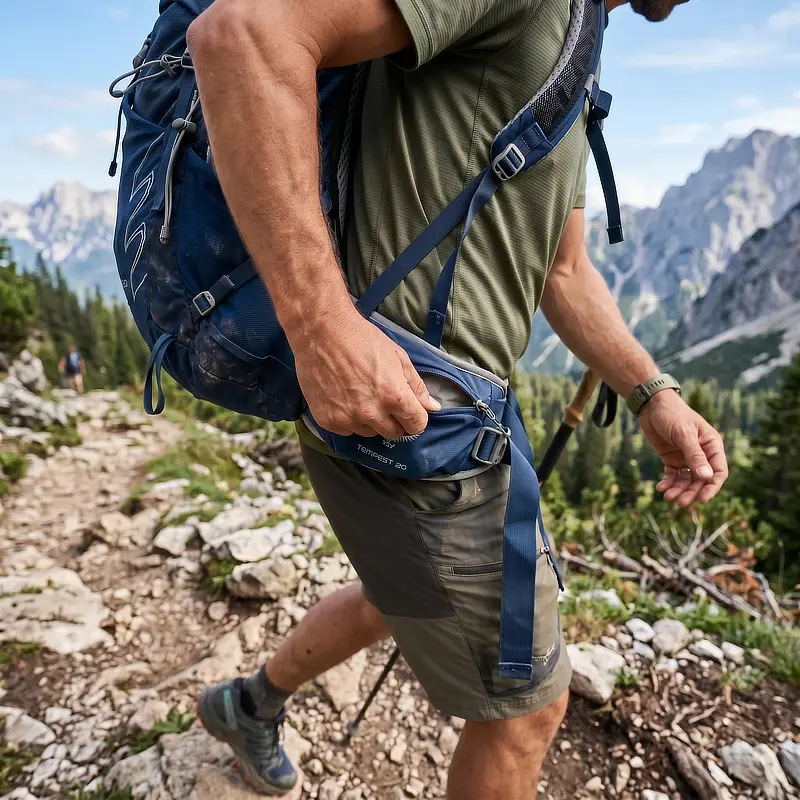
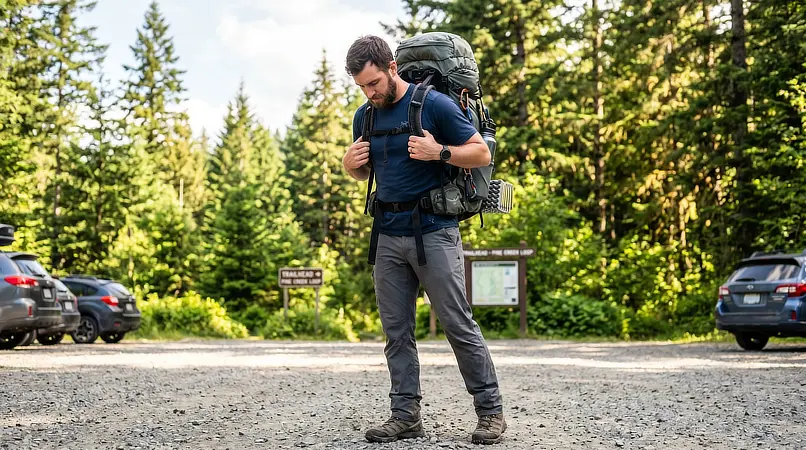
Before you walk away from your car, do one thing: put the pack on properly. First, buckle and snug the hip belt. Next, tighten the shoulder straps to bring the pack close to your back. Adjust the load lifters, the small straps at the top of the shoulder harness that pull the upper pack closer to your body, if your pack has them. Finally, buckle and lightly snug the sternum strap, which is the small chest strap connecting your shoulder straps.
Then do a quick shoulder check. If the hip belt is doing its job, your shoulders should feel guided by the straps, not crushed under the full weight of the pack. If the straps feel pinned down or your collarbones feel loaded, loosen slightly, re-snug the hip belt, and adjust again.
Once the harness is secure, slowly twist your torso left and right.
A well-packed bag moves with you. A poorly packed one shifts independently. You will feel it sloshing or pulling to one side when you twist. If that happens, take the pack off. Identify the loose or off-center item and fix it. It takes five minutes.
Those five minutes in the parking lot are worth more than any adjustment you can make mid-trail when you are already tired and just want to keep moving.
Skipping the shake test to save a few seconds in the parking lot often leads to trailside frustration. A loose camp stove canister or a hard-edged item thudding against a shoulder blade can turn a scenic hike into an annoying gear struggle.
Finding a quiet spot to unpack and pad a shifting item on a narrow trail wastes far more time than taking five seconds to twist and adjust before leaving the trailhead.
Field Notes: If you can feel a hard edge or a single heavy object pressing into your back after packing, that item needs something soft between it and the back panel. Even a rolled buff can make a noticeable difference.
You Already Know More Than You Think
The Zone System is not complicated. It is just a framework for what your body is already telling you every time you put on a poorly packed bag. Heavy things close to your spine. Squishy things at the bottom. Light trail gear at the top. Immediate-access items on the outside.
Run the shake test once before every hike, and adjust if something feels off. Over time, the whole thing becomes muscle memory, and you will pack correctly without thinking about it.
If you want to make sure your pack stays in top condition for years to come, take a moment to read our guide on how to clean a hiking backpack before your next big adventure.
If you haven’t sorted out your gear list yet and want to know what to put in those zones, start with our guide on Hiking Essentials for Beginners, and come back here when you are ready to pack it all intelligently.
Editor’s Notes: If the physics of pack zones feel like too much to memorize at first, do not worry. Your body is the best feedback loop you have on the trail. If your shoulders are aching, the load may be sitting too far from your spine, or the hip belt may not be carrying enough weight.
If you are leaning forward to fight the pack, something is probably pulling backward, shifting, or sitting too far from your back. Listen to what your body is telling you, make small adjustments, and packing well will start to feel automatic.
Now I want to hear from you: what’s the one item you used to pack totally wrong before you learned the Zone method? Drop it in the comments. I read every single one, and your answer might save someone else a very sore afternoon.
Founder & Gear Research Editor
Sonia Zannoni
I'm Sonia, the founder of Best Trail Backpacks. I don't test gear myself. For every pack I cover, I compare the published specs and sizing charts, read what independent testers found, and look for what owners report again and again.
Fit comes first, because a pack that doesn't match your torso and hips will hurt no matter what it cost. My goal is to help you choose a pack that suits your body, your trip and your budget, and to tell you plainly where the evidence runs out.
About the Founder
This is such an informative post. You have a lot of really great points. I wish I had this post as a resource when I started blogging.
I am glad that you found value in my post. Thanks for stopping by.
These are great tips for packing a hiking backpack, they’re all obvious yet how many of us skip past them, I know I do.
When I first started hiking I used to fill a large backpack up with goodies I didn’t require which became far too heavy during the walk, leaving you uncomfortable during the day and backache afterwards.
I decided to reduce the size and as you mention with the new backpacks available, most are waterproof which my initial one wasn’t fully. By cutting down the weight due to a small backpack size accomplishes a really pleasurable days walking, travelling light is the key for me. Whenever I take a camera I place that in a bag-belt across my waste, having a light camera eases your journey, you don’t realise it’s there.
Great tips here. Where’s you best place for hiking? Ours is the Lake District in England.
Thanks for your tips,
Simon.
Well, I think that at some point, we are all guilty of carrying a hiking backpack too large for our needs and overpacked, especially as novice hikers! Because as inexperienced backpackers we want to plan for every possible scenario that might happen along the way.
As for my favorite place to go hiking, it’s in Quebec and the place is The Mount Orford at about 45 minutes drive from a town called Sherbrooke. It’s a great place especially in the fall when the foliage is changing colors.