

Ortlieb Atrack Backpack Review: When Rain-Proof Means Actually Rain-Proof
Affiliate Disclosure: Some links on this page are affiliate links. If you buy through one, I may earn a commission at no extra cost to you. Commission never decides which products I recommend. Read the full disclosure.
Most waterproof packs solve half the problem. They keep your gear dry in a shower, but the minute you need something from the bottom, you are wrestling with a roll-top closure or fishing blindly through a compression-stuffed main compartment while the rain keeps falling.
The Ortlieb Atrack backpack, available in 25L, 35L, and 45L, takes a fundamentally different approach. It combines IP67-certified waterproofing with a duffel-style TIZIP zipper that opens the entire pack flat like a suitcase. It is an unusual piece of gear, and whether it works for you depends entirely on how you use a pack in the field.
If you are protecting expensive gear in genuinely hostile water conditions, and you are willing to adapt your workflow to match, the Atrack is one of the most thoughtfully engineered packs in its category. If you need to grab something from your pack every 20 minutes while you are moving, this is not the bag for you. That tradeoff is the whole review.
Wellness Explorer Reality Check: If you are looking for a standard daypack for casual weekend walks, or if you need to grab gear on the go without stopping, skip this pack. Its specialized waterproofing comes with heavy zippers and zero on-body accessibility. This is a specialty tool for wet environments, not a general-purpose daypack.
Trail Story: The Moment a Dry Bag Stops Being Enough
There is a pattern that most paddlers and rain-country hikers recognize after a few seasons: the gear that gets wet is never the gear you expected to get wet. A reliable roll-top keeps out steady rain, but lay a pack down in the bottom of a wet canoe for three hours and the calculus changes. Set it in a river-bank puddle while you make camp, and it changes again.
The appeal of a genuinely submersion-rated bag is not about extreme scenarios. It is about removing the constant low-level calculation of whether your protection is enough for what is actually happening right now. The Atrack is built for people who are tired of running that calculation.
TL;DR: Ortlieb Atrack Backpack Review
Best For: Adventure travelers, paddle athletes, and hikers in high-precipitation environments who need a heavy-duty dry bag that carries with real backpack comfort and organization.
Key Strength: IP67 waterproofing combined with a full-length TIZIP zipper that opens the pack flat like a duffel. This provides total gear visibility and submersion protection in one package.
Main Weakness: The back-panel zipper entry means the main compartment is completely inaccessible while the pack is being worn. You must remove the pack, lay it down, and unzip to retrieve anything.
Bottom-Line Recommendation: If protecting expensive gear from water is the priority and you can adapt to a stop-and-access workflow, the Atrack is well worth the investment. If you reach into your pack while walking, this is not the bag for you.
Buy If:
Skip If:
Price Tier: $$$ ($250 and above)
Educational Deep-Dive: The Anatomy of a Waterproof Hybrid Pack
The Atrack occupies a rare product category: the technical dry bag that carries like a real backpack. Understanding what separates it from a standard rain-cover setup, or a roll-top waterproof pack, explains both why it carries a premium price point and why it will not suit every hiker on every trip.
The IP67 Rating: What It Actually Means
IP67 means dustproof and protected against immersion in up to one meter of water for 30 minutes. For most trail and paddling use, that is exceptional coverage. A pack with this rating does not need a rain cover and does not depend on you closing it fast enough before the downpour hits. The waterproofing is structural, not supplemental.
If you are weighing this against a standard pack, read our backpack rain cover guide to see how traditional rain protection compares.
The TIZIP Zipper System
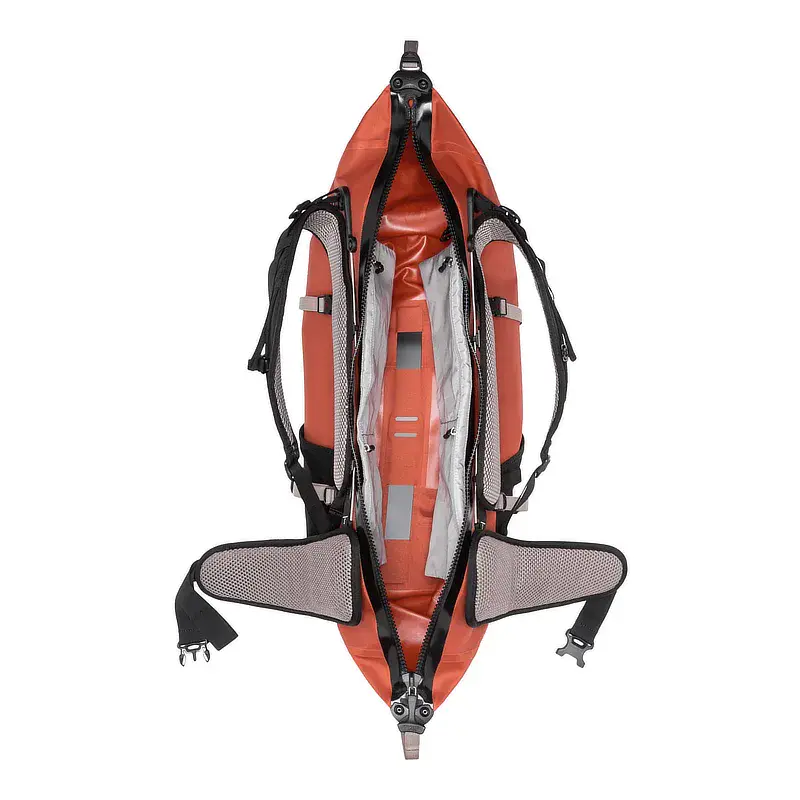
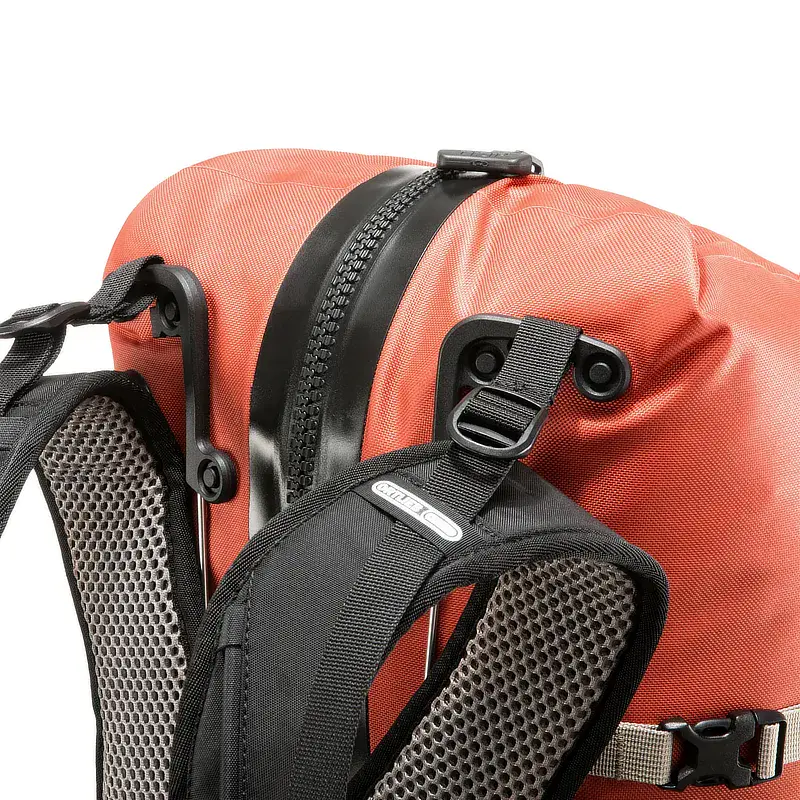
The defining feature here is not the waterproofing itself; it is the TIZIP. This is a waterproof zipper rated for complete submersion, running the full length of the back panel so the pack opens flat like a duffel bag. Every item in the main compartment becomes immediately visible when you lay the pack down.
Four internal zippered pockets add organization that is rare in a fully waterproof bag, directly addressing the common complaint that dry bags turn into a jumbled black hole once sealed.
The access tradeoff is worth naming plainly. The zipper runs along the panel that sits against your back when the pack is worn, which means you cannot reach into the main compartment without removing the pack entirely and setting it down. This is intentional. The back-facing position also makes unauthorized access exceptionally difficult while the pack is being worn, making this a legitimate choice for crowded transit environments.
That layout also has one hidden comfort benefit: you lay the pack face down to open it, so the shoulder straps and back padding stay lifted off the mud. When you put the pack back on, the harness is less likely to smear wet grit across your shirt.
If the back-panel zipper still feels hard to picture, this official Ortlieb video is worth watching before you buy. Pay attention to how the pack opens flat and how the harness stays off the ground during access.
For quick-access alternatives, you can explore our list of the best waterproof daypacks to find styles with traditional lid configurations.
The PS33 Nylon Shell
Ortlieb uses PS33, a polyurethane-coated nylon that is free of PVC and PFAS. It is built for high tear and abrasion resistance, and the German production standard backs up the durability claim without requiring guesswork. The five-year warranty covers materials and workmanship, representing a meaningful indicator of the intended product lifespan at this price tier.
The Suspension System
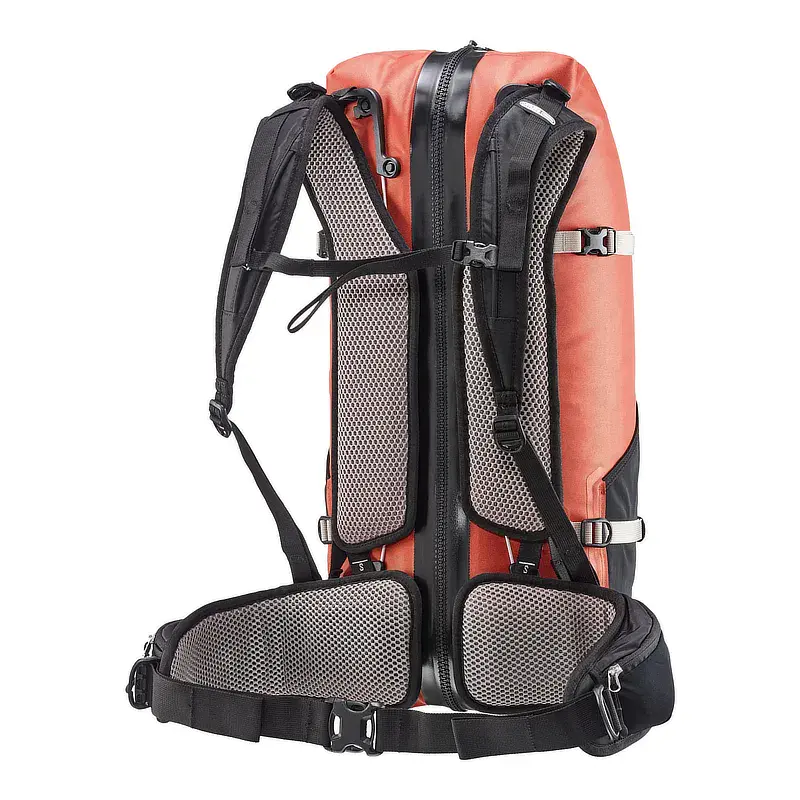
For a pack in this waterproof dry-bag category, the suspension is notably more technical than most competitors offer. The Atrack uses stepless back system adjustment, fitting torso sizes S through L in the 25L and 35L models, and M through XL in the 45L. A wide padded hip belt with two zippered mesh pockets handles load transfer.
Before choosing a size, measure your torso length at home from the C7 vertebra, the bony bump at the base of your neck, to the top of your hip bones, called the iliac crest. The 25L and 35L models fit the S to L range, roughly 13.4 to 18.5 inches, while the 45L fits the M to XL range, roughly 16.5 to 21.7 inches, so capacity and torso fit are linked here.
Ergonomic shoulder straps with a stabilizer strap and sternum strap complete the carry system. The stepless adjustment, rather than discrete size positions, allows genuine fine-tuning for a custom fit across different body proportions.
To adjust the torso length, check behind the back-panel padding for the internal adjustment webbing and sliding shoulder-harness track. Loosen the mechanism, slide the harness to match your torso length, then lock it back into place before loading the pack. This allows you to customize the fit precisely during your initial gear setup, so the pack carries more evenly before you start hiking.
Capacity and Dimensions at a Glance
Size
Weight
Dimensions (H x W x D)
Max Load
25L
50.4 oz / 3.15 lbs
22″ x 10.2″ x 9.8″
22 lbs (10 kg)
35L
51.9 oz / 3.25 lbs
23.2″ x 11″ x 10.6″
28.7 lbs (13 kg)
45L
55.0 oz / 3.44 lbs
24.4″ x 12.6″ x 11.8″
35.3 lbs (16 kg)
25L
Weight: 50.4 oz / 3.15 lbs
Dimensions (H x W x D): 22″ x 10.2″ x 9.8″
Max Load: 22 lbs (10 kg)
35L
Weight: 51.9 oz / 3.25 lbs
Dimensions (H x W x D): 23.2″ x 11″ x 10.6″
Max Load: 28.7 lbs (13 kg)
45L
Weight: 55.0 oz / 3.44 lbs
Dimensions (H x W x D): 24.4″ x 12.6″ x 11.8″
Max Load: 35.3 lbs (16 kg)
Note: Ortlieb issues a firm warning against exceeding these load limits. The manufacturer states that material breakage can occur beyond these thresholds. This is a hard engineering limit, not a conservative guideline.
You can check the current Ortlieb Atrack sizes, colors, and availability directly at Ortlieb before choosing between the 25L, 35L, and 45L models.
Core Review: Performance in Practice
Comfort and Fit
The stepless adjustment system means this is not a one-torso-fits-all situation. Hikers who have been burned by fixed-size suspension on entry-level packs will appreciate that the Atrack allows precise torso tuning rather than forcing a choice between a small and a medium. The padded hip belt transfers load, and the shoulder strap padding is substantial enough for the active travel and trekking use Ortlieb designs this pack for.
The weight is real. The 25L model comes in at 50.4 oz (3.15 lbs). A standard 25L daypack typically weighs between 1.5 and 2.5 lbs. You are carrying roughly a pound of extra overhead for the waterproofing system and specialized zipper. That premium is the price of the protection, and for the right use case, it is a rational trade.
What the TIZIP Actually Changes (and What It Doesn’t)
The TIZIP zipper is the engineering element that separates the Atrack from a standard dry bag with shoulder straps. A conventional roll-top waterproof pack protects gear well but turns the bag into an archaeological dig every time you need something from the bottom. The TIZIP solves that by opening the entire back panel, converting the bag from a top-loading cylinder into a flat, visible layout.
The tradeoff the spec sheet does not show: because the zipper must form a perfect seal when closed, it requires more pulling force than a standard zipper and demands more user attention to ensure it is fully seated. A partially closed TIZIP breaks the IP67 rating. This is not a design flaw; it is the mechanical reality of how submersion-rated zippers work.
Buyers who maintain the zipper properly (see the Maintenance section below) will keep the seal working reliably. Those who treat it like a standard zipper may eventually wonder why their pack is no longer as waterproof as advertised.
Organization and Accessibility
Inside the main compartment, four zippered internal pockets give structure to what would otherwise be an open hold. Two outer mesh side pockets handle quick-access items like water bottles. Daisy chains on the front panel allow gear attachment or connection to Ortlieb’s modular accessory kits for activity-specific setups.
The sealed hydration port maintains the IP67 integrity while still allowing bladder use. One hydration note: standard third-party reservoirs may work for drinking on the move, but Ortlieb’s compatible Hydration System is the safest choice if you want to preserve the pack’s full waterproof performance. The port is part of the waterproof system, not just a casual hose opening, so do not rely on a regular trail bladder hose in submersion conditions unless you have confirmed the seal.
Four external compression straps help stabilize partial loads and reduce the pack’s profile. These are the details that make the Atrack feel like a considered design rather than a dry bag with straps added as an afterthought.
The access limitation bears repeating because it genuinely shapes daily use: the main compartment requires you to stop, remove the pack, and lay it flat. The outer mesh pockets and a small front access area cover immediate needs, but anything in the main hold demands a full pause. For paddlers staging gear at a campsite, this is a non-issue. For a hiker wanting to pull out a camera or snack while walking, this pack will frustrate.
Weight-to-Strength Ratio
The Atrack is not a lightweight pack; it is a protection-first pack. The PS33 nylon and TIZIP zipper carry weight that ultralight competitors do not. If you are counting grams for a multi-day fastpacking trip, this purchase does not make sense.
If you are carrying camera bodies, electronics, medication, or expedition documentation that cannot tolerate moisture, the weight math changes completely.
The manufacturer load limits are structural constraints, not conservative guidelines. Exceeding them risks material failure. Plan your load accordingly before committing to a size.
Who Is This For?
The Ortlieb Atrack makes the most sense for a specific type of user. If you recognize yourself here, it is worth serious consideration.
This Pack Is Built For:
- Paddle athletes (kayakers, canoeists) who need gear kept dry in a wet boat and appreciate the organizational access the duffel-style opening provides.
- Adventure travelers navigating monsoon climates, river crossings, or multi-day rain exposure where a rain cover is not a reliable long-term solution.
- Hikers in high-precipitation regions who are tired of managing a rain cover and want the protection built into the bag itself.
- Urban travelers and commuters who want the anti-theft benefit of a back-facing zipper in crowded transit environments.
- Anyone carrying expensive or sensitive gear (camera bodies, electronics, medical supplies) where moisture damage means a significant financial or safety loss.
Pass On the Atrack if:
- You are an ultralight backpacker where every ounce of base weight matters.
- You need frequent on-the-go access to your main compartment while moving.
- You are primarily a photographer who needs fast gear retrieval mid-hike.
- Your planned use is casual day hiking in dry conditions where the protection overhead adds weight without adding meaningful value.
For a detailed breakdown of how to get the right fit on standard trail models, check out our hiking pack fit guide.
Pros and Cons
Pros
Submersion Protection: IP67 waterproofing eliminates rain covers and survives full immersion, not just heavy downpours.
Duffel-Style Access: The linear TIZIP opening reveals all contents instantly, solving the dig-to-the-bottom problem
Technical Suspension: A genuine technical suspension with stepless torso adjustment and a padded hip belt, rare in dry bags
Cons
Weight Overhead: Significantly heavier than a standard pack of equivalent volume. The 25L model outweighs many 40L hiking packs.
No On-the-Go Access: The back-panel zipper means zero access to the main compartment while wearing it. This is a hard constraint.
High Maintenance: The waterproof TIZIP zipper requires routine cleaning and lubrication to maintain its seal and ease of pull.
Maintenance and Longevity
Cleaning the Shell
PS33 nylon responds well to spot cleaning with a soft cloth and lukewarm water. Avoid submerging the pack in soapy water; prolonged exposure to detergents can degrade the polyurethane coating over time. For heavier soiling, apply a mild soap solution to the exterior with a damp cloth, scrub lightly, and rinse thoroughly. Do not use a washing machine or dryer.
Allow the pack to air dry completely before storing. Moisture trapped inside a sealed waterproof pack promotes mildew, so leave the TIZIP open during the drying process. This is a step that is easy to skip and easy to regret.
TIZIP Zipper Lubrication
The TIZIP is a high-performance waterproof zipper and requires more routine care than a standard zipper. The zipper teeth need periodic lubrication to maintain both smooth operation and the integrity of the waterproof seal. Because a brand-new TIZIP zipper relies on the compression of heavy-duty sealing lips to keep water out, pulling it closed can feel significantly stiffer than a standard zipper. This resistance is a normal part of the waterproof seal mechanism, not a defect.
When closing the TIZIP, use the zipper pull and the end loops or anchor points for counter-tension rather than yanking at an angle. A steady, straight pull helps the slider seat properly without straining the zipper, especially when the seal is new or freshly cleaned.
If your pack includes Ortlieb’s TIZIP lubricant, apply it according to the care instructions. If not, use a TIZIP-compatible lubricant recommended for waterproof zippers to keep the slider gliding smoothly. Work the slider back and forth several times, and wipe away excess.
Stiff zipper operation is the earliest indicator that the zipper needs attention. A TIZIP that has not been maintained can become progressively harder to close fully, and an incompletely closed zipper breaks the IP67 rating. The practical rule is simple: check and lubricate at the start of each season, and again after any extended or heavy-use period.
Between-Season Storage
Store the Atrack loosely stuffed or hanging rather than compressed flat. Extended compression at fold points can stress the waterproof coating over time. Store with the TIZIP open by a few inches for air circulation. Keep it away from direct sunlight and prolonged heat exposure, both of which accelerate polyurethane coating breakdown faster than most users expect.
Buy It If Water Protection Is the Priority
Buy the Ortlieb Atrack if your main concern is keeping expensive or irreplaceable gear dry in conditions where a rain cover or standard waterproofing is not enough. The IP67 rating, TIZIP sealing, and PS33 nylon construction make this a true protection-first pack, not just a standard backpack with better rain resistance.
The tradeoff is access. You need to stop, take the pack off, lay it down, and use the TIZIP deliberately to reach the main compartment. If you want snacks, water, or camera gear while walking, this workflow will get annoying fast.
At the premium $$$ tier, the Atrack makes the most sense for paddlers, rain-country hikers, wet-weather travelers, and anyone carrying gear that cannot get wet. It is harder to justify for casual dry-weather day hikes, ultralight setups, or hikers who care more about quick access than full waterproof security.
The buyer who gets the most from this pack is organized, patient, and prioritizing gear protection over speed of access. The buyer who regrets it is someone who did not fully account for the access workflow before purchasing.
If you are weighing the Atrack against a standard pack-plus-rain-cover setup, or deciding between the 25L and 35L based on your use case, drop a question in the comments.
The size decision has some non-obvious tradeoffs worth working through before you buy. If the Atrack feels too specialized for your hiking style, a comfortable traditional daypack may be the better next step.
Founder & Gear Research Editor
Sonia Zannoni
I’m Sonia, the founder of Best Trail Backpacks. I don’t test gear myself. For every pack I cover, I read the manufacturer’s specs and sizing charts and look for what owners report again and again.
Fit comes first, because a pack that doesn’t match your torso and hips will hurt no matter what it cost. My goal is to help you choose a pack that suits your body, your trip and your budget.
About the Founder

Well, you definitely proved a point that this is the only backpack that we will need.
I like that the Ortlieb Atrack Backpack is 100% waterproof because, as you said, many backpacks available nowadays claim to be waterproof. However, once you find yourself in a heavy rainstorm, you discover, unfortunately, that it is not the case.
Also, very clever of the Ortlieb company to make this Atrack backpack open like a duffel bag!
I will definitely consider the Ortlieb Atrack backpack as a serious contender for my next hiking backpack!
Thank you for this information.
I am glad to see that you agree with me… that the Atrack backpack is the only one you need!
I think that you can’t go wrong by picking the Ortlieb Atrack Backpack as your trail companion for your next hiking excursions! And if you are ready to invest a bit more, you can get awesome accessories to complement the Atrack backpack.
Thank you for your review of Ortlieb Atrack Backpack. I am getting tired of finding the right backpack, and after I used it a few times, I also find something that I do not like and ended up buying a new one, and the cycle goes on.
The only thing that I do not like about this backpack is the weight, but I can live with that. I love the fact that it has many accessories. I am going to check it out.
Even though the Ortlieb Atrack backpack is on the heavier side, it is still an awesome pack. One thing you can do to help with the weight is don’t overpack your backpack! A common mistake made by many hikers out there, including myself!
If you need help to avoid overstuffing your backpack, read my post about how to pack your hiking backpack. I hope it helps. Thanks for stopping by.