Best Hybrid Daypacks: The City-to-Summit Guide
Affiliate Disclosure: I believe in honest, trail-tested gear reviews. When you purchase through links on my site, I may earn a small commission that helps keep Best Trail Backpacks running, at absolutely no extra cost to you. As an Amazon Associate, I earn from qualifying purchases.
You’re doing the two-bag shuffle. I know because I’ve done it too.
There’s the clean messenger bag for the office (it looks great, it destroys your shoulder by noon), and there’s the trusty hiking pack waiting by the door (comfy on the trail, confusing in a coffee shop). And at least once a week, you leave the house carrying your laptop but missing your trail mix, or your water bottle, or your sanity.
There’s a smarter way.
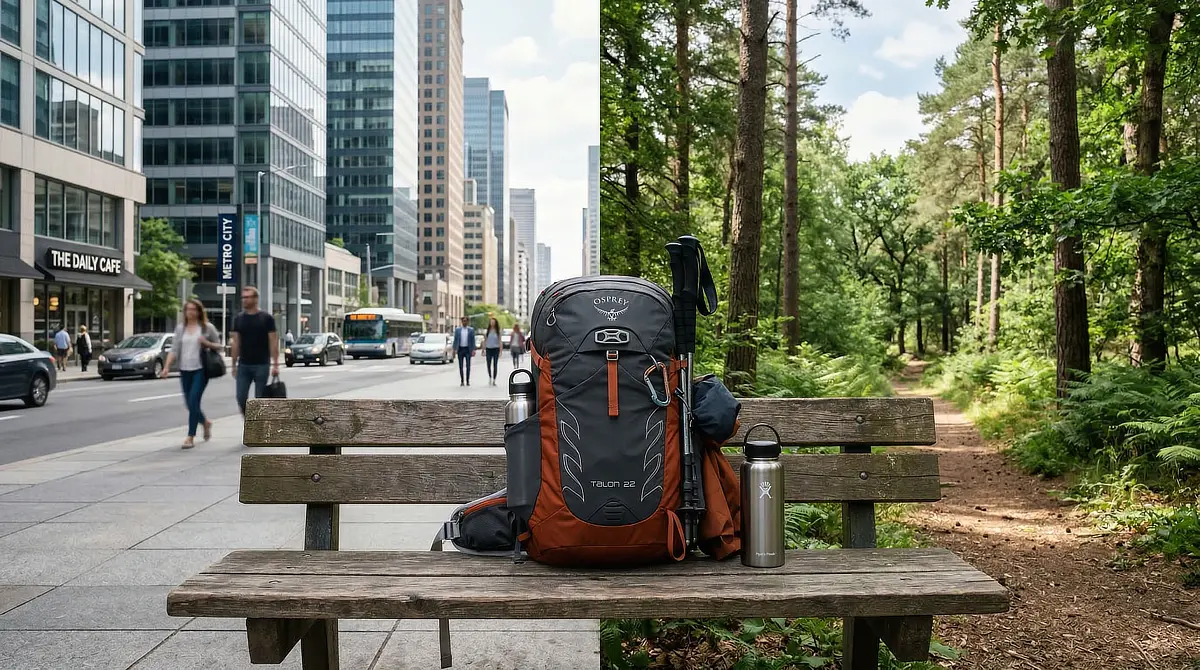
The hybrid daypack is what happens when hiking engineers and city designers finally get in a room together. You get breathable mesh suspension, smart organization for your tech, and a profile that won’t embarrass you at a 9 a.m. meeting. One bag. Always packed. Always ready.
If you’ve been putting off this decision because the options feel overwhelming, this guide to the best hybrid daypacks for hiking and commuting ends the scroll.
TL;DR: The Best Hybrid Daypacks at a Glance
Pack
Best For
Standout Feature
Rating
Price
Pricing Guide: $ = Under $100 | $$= $100 to $250 |$$$= Over $250
Osprey Tropos 32L
Best For: Commuters & Travelers
Standout Feature: AirSpeed Kickstand + Airflow
Rating: 9.5 / 10
Price: $$
TNF Borealis (Women’s) 27L
Best For: Back Health & Everyday Style
Standout Feature: ACA-Certified FlexVent
Rating: 8.7 / 10
Price: $
Gregory Rhune 22L
Best For: Minimalist Style
Standout Feature: AirCushion Mesh, Recycled Fabrics
Rating: 9.0 / 10
Price: $$
Pricing Guide: $ = Under $100 | $$= $100 to $250 |$$$= Over $250
4 Features That Define the Best Hybrid Daypacks
Most bags sold as ‘work-to-weekend’ are just regular backpacks with a laptop sleeve tacked on. That’s not a hybrid. Here’s what separates a genuinely great hybrid daypack from the rest.
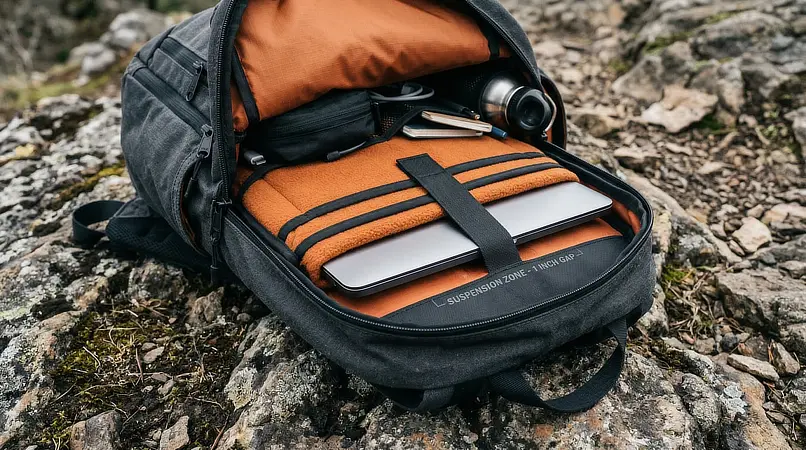
1. The Floating Laptop Sleeve for Drop Protection
A floating laptop sleeve is suspended a few centimeters above the bag’s base rather than sitting directly on the bottom. When you set your bag down hard on a concrete floor (or stumble on a rocky trail), the bag’s base absorbs the impact instead of your laptop screen.
Cheap bags skip this. Your 1,400-dollar laptop is sitting right on the ground. It’s a small engineering detail that makes a very large difference.
Pro Tip: Check whether the sleeve is padded on all sides, not just the back. The best sleeves protect all four corners.
2. Trampoline Suspension to Prevent a Sweaty Back
Standard laptop bags use dense foam padding against your back. It’s firm, it looks tidy in the store, and it becomes a personal sauna on a 15-minute walk.
Trampoline suspension (called AirSpeed by Osprey and AirCushion by Gregory) uses a tensioned mesh panel to hold the bag entirely away from your back. Think of it as a hammock between two poles rather than a foam mattress jammed against your spine. Air moves. You stay dry. Your shirt survives the commute.
3. The Tuckable Hip Belt for Office Discretion
Hip belts transfer weight from your shoulders to your hips, which is where your body actually handles load efficiently. On the trail, this is brilliant. Walking into a client meeting wearing a hip belt is… less brilliant.
Every pack in this guide either offers a removable hip belt or a clean tuck-away design. You clip it on for the trail, fold it away for the office. Simple.
4. Finding the Right Capacity (20L to 32L)
For most hybrid use cases, 20-32 liters is the sweet spot. Under 20L feels cramped the moment you add a rain layer. Over 35L starts to look like you’re moving apartments. The three packs in this guide cover 22L, 27L, and 32L, which means there’s a fit for every type of commute and weekend adventure.
Best Hybrid Daypack Reviews: 3 Top Picks That End the Shuffle
1. Osprey Tropos 32L: The “Kickstand” King
Best For: Commuters and travelers who want serious airflow, a free-standing bag, and tech-forward organization.
If I had to hand someone one bag and say ‘start here,’ the Osprey Tropos would be it. It doesn’t feel like a compromise between your work life and your trail life. It feels like someone actually understood both.


The AirSpeed trampoline back panel is the headline feature, and it earns the attention. The bag is held away from your back on a tensioned mesh frame, creating a continuous airflow channel between you and the pack. On a summer commute or a mid-morning trail, this is the difference between arriving fresh and arriving damp.
The Kickstand That Changes Everything
Here’s a feature you didn’t know you needed: the Osprey Tropos has an integrated kickstand that lets the bag stand upright on its own.
This sounds small until you’ve been fumbling with a slumped-over bag on a train platform at 7 a.m., trying to find your wallet. With the Tropos, you set it down, it stays up, and you dig in. It turns the bag into a portable filing cabinet.
It’s hard to visualize how stable this actually is just by reading about it, so here is exactly how it handles a full load:
The Honest Notes
The Tropos isn’t without its quirks. The internal organization is highly divided, with multiple slim compartments that feel smaller than expected once you’re actually loading the bag. If you’re someone who likes to throw everything into one big open space, you’ll find this slightly frustrating. Also, users over six feet tall with longer torsos have reported that the frame can press into the lower back on very heavy loads.
Pros
Integrated kickstand keeps the bag standing upright automatically.
AirSpeed trampoline mesh completely eliminates sweaty back syndrome.
Incredible tech organization with 7 dedicated pockets.
Cons
The divided internal compartments eat up some of the main 32L volume.
Can press into the lower spine of very tall users carrying heavy loads.
2. The North Face Borealis (Women’s): The Back-Health Pick
Best For: Students, commuters, and anyone prioritizing women’s fit, back health certification, and lasting durability.
If the phrase ‘American Chiropractic Association certified’ means something to you, you already know why the Borealis is worth a look.
For everyone else: ACA certification means the pack’s suspension and load distribution were reviewed by spinal health professionals, not just marketing. That’s a genuine differentiator, and it shows up in real-world use.

The FlexVent suspension system features articulated shoulder straps, a rounded back panel, and soft-touch chemise fabric. The straps curve to follow shoulder anatomy rather than cutting straight across. Buyers with chronic shoulder tension or previous back issues repeatedly call this out as the detail that made the difference for them.
Durability That Outlasts the Trend
The Borealis tends to look new long after it shouldn’t. Multiple verified buyers noted it doesn’t show dirt, the zippers hold up through years of daily use, and the color holds.
One Thing to Know Before You Buy
The North Face markets this bag as free-standing, but in practice, it’s less reliable about staying upright than the Osprey Tropos. If you’re packing it loosely, it’ll topple on you. The Tropos kickstand makes it genuinely self-supporting. The Borealis needs a fuller pack to hold its shape.
Pros
ACA-certified suspension actively protects your back and posture.
Women-specific articulated straps prevent shoulder digging.
Legendary durability; lasts for years without showing heavy wear.
Cons
Will tip over if set on the ground half-empty.
At 27L, it lacks the space for bulky winter layers alongside a laptop.
3. Gregory Rhune 22L: The Minimalist “Anti-Hiker” Choice
Best For: Urban minimalists, sustainability-focused buyers, and professionals who want a tech-forward pack that doesn’t look like it belongs on a trail.
The Gregory Rhune is the pack for the person who has given up explaining to coworkers why they’re wearing a hiking bag to the office.
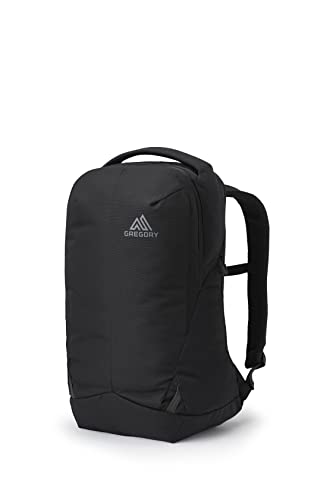
It looks like a premium tech commuter bag. It breathes like a trail pack. And it’s made from recycled materials with a 57% lower carbon footprint than conventional nylon, which matters to a growing number of buyers.
At 22L, it’s the most compact option in this guide, but buyers consistently note that it carries more than it looks like it should, staying slim even when loaded up.
The AirCushion Back Panel
This is where the Gregory Rhune does something the others don’t quite match. The AirCushion foamless back panel uses tensioned mesh for airflow, like the Osprey. But because it has no foam backer and no rigid frame pressing against the fabric, it doesn’t pill, scratch, or abrade the back of expensive work shirts or technical fabrics. If you’ve ever taken off a foam-backed bag and found it’s been slowly destroying your merino wool, you’ll understand why this matters.
One Real Trade-Off
The Rhune doesn’t have external water bottle pockets. If you’re a dedicated hydration tracker who wants your 40-ounce bottle to be accessible without opening the bag, this is a meaningful gap. For everyone else who can access their bottle from the inside, it’s a non-issue.
Pros
Foamless AirCushion mesh prevents pilling on nice office clothing.
Highly sustainable (made entirely from recycled materials).
Extremely clean, minimalist aesthetic for professional environments.
Cons
No external water bottle pockets (must store bottles inside).
22L capacity limits this strictly to day use or minimalist packing.
Final Verdict: Which Hybrid Daypack Is Right for You?
Here’s the honest version: all three of these bags are genuinely good. None of them will embarrass you at a trail head or a client meeting. The difference is in the details.
Go with the Osprey Tropos if the kickstand and maximum airflow are non-negotiable. Go with the TNF Borealis if you want a women’s-specific fit, back health certification, and a pack that survives years of daily use without looking tired. Go with the Gregory Rhune if you want the most sustainable option, the cleanest urban look, and a foamless back that won’t rough up your good shirts.
You’ve done enough research. Pick the one that matches your commute, order it, and finally retire the two-bag shuffle. Which pack caught your attention?
Drop your questions in the comments, and I’ll answer them directly.
GEAR EXPERT & FOUNDER

Sonia Zannoni
With over two decades of experience testing outdoor gear, I cut through the marketing noise to bring you honest, trail-tested reviews. My goal is to help you pack smarter and hike with confidence.
About the Founder