Leave No Trace for Beginners: The Judgment-Free Guide to Trail Etiquette
You get to the trailhead. You are excited. You have your pack, your snacks, and your water. And then a quiet, nagging thought creeps in: What if I do something wrong and someone gives me the look?
You know the look. The seasoned hiker side-eye that says you are clearly a tourist.
Here is what I want you to know before we go any further: Leave No Trace is not a secret code that only experienced hikers understand. It is not a test. And it has absolutely nothing to do with how fancy your gear is or how many miles you have logged. Understanding Leave No Trace for beginners comes down to one simple idea: being a polite guest in a space that does not belong to you or anyone else.
Nature is borrowed. These principles just remind us to return it in good shape.
TL;DR: Leave No Trace for Beginners
Leave No Trace is a framework for protecting the outdoors while you enjoy it. The core rules are simple: pack out all trash (even biodegradable items like fruit peels), stay on the muddy trail to prevent erosion, yield to uphill hikers, give wildlife plenty of space (use the “Rule of Thumb”), pack out your dog’s waste, and use headphones instead of Bluetooth speakers. You do not have to be perfect; you just have to be thoughtful.
Your Quick Leave No Trace Checklist
Rule
What It Means in Practice
Pack it all out
Every wrapper, core, peel, and tissue goes back in your bag. No exceptions.
Stay on the dirt
Walk through mud, not around it. Shortcuts crush plants and widen trails.
The Rule of Thumb
Extend your arm, close one eye, and hold your thumb over the animal. If you can still see it, back up.
Uphill right-of-way
Downhill hikers usually step aside for uphill hikers, unless posted trail rules, horses, safety, or common sense say otherwise.
Manage your dog
Keep pets leashed, and always pack out their waste bags immediately.
Use headphones
Bluetooth speakers on the trail are not a vibe. Earbuds exist for a reason.
Pack it all out
What It Means in Practice: Every wrapper, core, peel, and tissue goes back in your bag. No exceptions.
Stay on the dirt
What It Means in Practice: Walk through mud, not around it. Shortcuts crush plants and widen trails.
The Rule of Thumb
What It Means in Practice: Extend your arm, close one eye, and hold your thumb over the animal. If you can still see it, back up.
Uphill right-of-way
What It Means in Practice: Downhill hikers usually step aside for uphill hikers, unless posted trail rules, horses, safety, or common sense say otherwise.
Manage your dog
What It Means in Practice: Keep pets leashed, and always pack out their waste bags immediately.
Use headphones
What It Means in Practice: Bluetooth speakers on the trail are not a vibe. Earbuds exist for a reason.
What Does “Leave No Trace” Actually Mean?
A lot of beginners hear “Leave No Trace” and picture rangers handing out fines, or hyper-serious outdoorspeople shaking their heads at anyone who dares bring a bag of chips. That is not what this is.
Leave No Trace is a framework of seven guiding principles developed to help people enjoy wild places without degrading them. These principles, managed by the official Leave No Trace organization, provide science-based guidance to reduce our footprint on the trail. Think of Leave No Trace less as a rulebook and more as a framework for paying it forward.
The trails you hike today are beautiful because someone before you made small, thoughtful choices. You make those same choices, so the person hiking behind you gets to experience the same thing. It is not about having the most expensive gear. It is about making mindful decisions to keep trails beautiful, wild, and accessible.
Field Note: Finding the right daypack for beginners is a great place to start if you are dialing in your gear. Building good trail habits, like dedicating a specific pocket for trash, starts before you even reach the trailhead.
The Golden Rule of Trash: If You Carry It In, Carry It Out
Here is a myth worth busting early: the apple core you toss into the bushes is fine because it is natural. It is not. Or rather, it is not as harmless as it sounds.
The biggest mistake new hikers make is tossing fruit peels or nutshells into the woods, assuming they will just decompose. While they are technically natural, they take a surprisingly long time to rot. An orange peel can take up to two years to break down in certain climates.
In the meantime, the smell of food draws wildlife toward human trails, conditioning animals to associate hikers with easy calories.
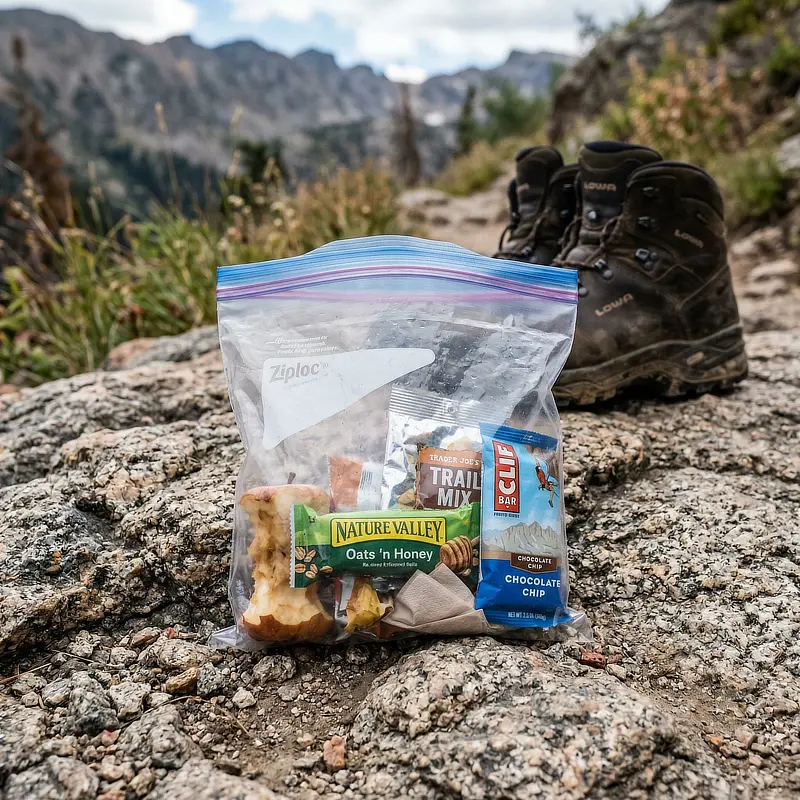
The rule is simple: if you carry it in, you carry it out. A small heavy-duty freezer-style zip-top bag tucked in your pack handles most of it, including wrappers, cores, peels, gum, and even fruit pits. The thicker plastic helps contain crumbs, stickiness, and smells better than a thin sandwich bag.
Trail Story: Finding litter in a remote area always breaks the outdoor magic. A beautiful overlook, lakeshore, or quiet lunch spot feels different when someone has tucked shells, wrappers, or a crushed bottle into the rocks and walked away.
It is a common frustration for hikers because it turns a wild place into cleanup duty. A dedicated ziplock bag makes the fix simple: pack out your own trash, and when it feels safe and reasonable, leave the spot a little cleaner than you found it.
Bathroom Breaks and the “200-Foot Rule”
Nobody wants to talk about this, but everybody needs to know it. If you are on a day hike in a well-trafficked area, use the trailhead facilities before you go. That is the easiest answer. But on longer trails or in remote areas, you will need a plan.
The guidelines are clear:
- Walk 200 feet away from any water source, trail, or campsite. That is about 70 adult-sized paces.
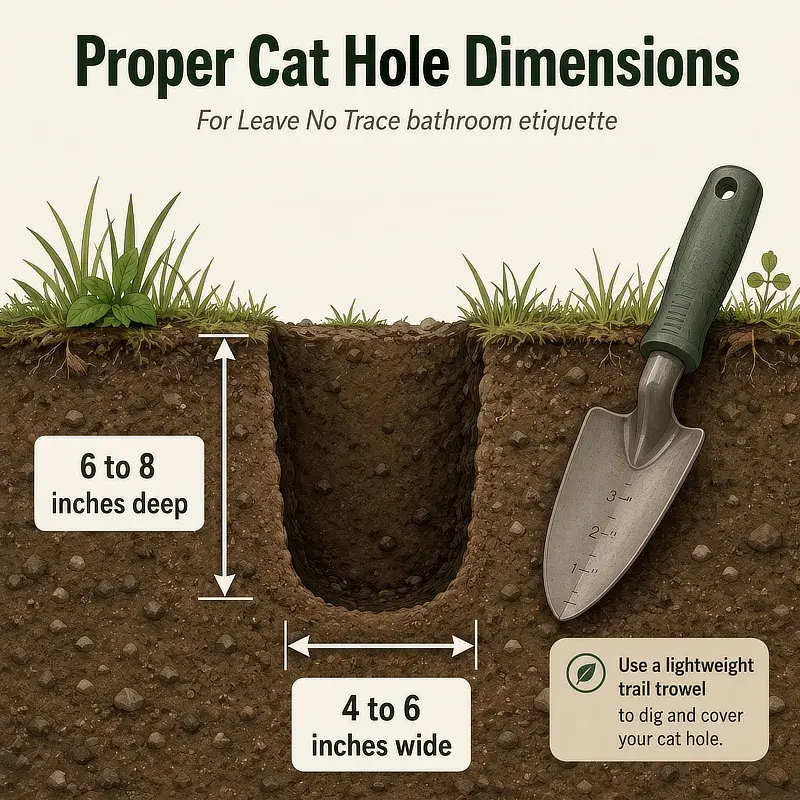
- Dig a cat hole. It should be about 6 to 8 inches deep and 4 to 6 inches wide. A trail trowel is not a heavy garden tool. It is a small, lightweight hand shovel made for digging catholes, and it usually fits easily in an outside pack pocket.
- Pack out your toilet paper. Yes, really. Even toilet paper takes time to decompose, and in dry or high-use areas, it just sits there. A sealed bag inside your trash bag solves this entirely.
Pro tip: Wrap the outside of your toilet paper ziplock bag in duct tape, or use an opaque bag, so you do not have to look at the contents inside your pack.
It is one of those things that sounds unpleasant until the day you find someone else’s tissue blowing across a summit. Then it makes complete sense.
If you want to know more about the gear and techniques for handling business outdoors, check out our practical guide on how to poop in the woods.
Trail Dogs and Leaving No Trace
Bringing your dog on the trail is wonderful, but it comes with extra responsibility. Even if your dog is incredibly friendly, other hikers or local wildlife might not be prepared for an off-leash greeting. Keep your pets leashed unless you are in a designated off-leash area.
The most common Leave No Trace violation involving dogs is the abandoned green poop bag. Leaving a bagged mess by the side of the trail to pick up on your way back is a bad habit because people almost always forget them. Always pack out pet waste immediately.
Staying on the Trail and Why Shortcuts Are a Bad Idea
You come around a corner, and there it is: a wide, brown mud puddle sitting directly in the middle of the path. The temptation to step around it onto the soft-looking green stuff on the edge is almost automatic.
Why We Walk Through the Mud (Not Around It)
That soft-looking green stuff could be moss, lichen, or fragile plant growth that took years to establish. One boot print can break the surface crust and expose bare soil underneath. Multiply that by a hundred hikers making the same choice, and what was once a 3-foot-wide trail becomes a 10-foot-wide scar on the hillside.
Stepping off the path to avoid mud or cutting across a switchback to save time crushes fragile plant life and widens the trail over time. The established dirt path is durable. The edges are not. Walk directly through the difficult section and trust that your boots and your hiking layers were designed for exactly this. Do not step off-trail to save your clothes!
Field Note: Trails are routed specifically to minimize environmental impact. Switchbacks that feel inefficient are designed to prevent straight lines from turning into rushing drainage channels during rainstorms. When you cut a corner, you build an active erosion channel.
Trail Right-of-Way: Who Moves for Who?
Trail traffic has a simple hierarchy, and knowing it makes every encounter smoother. When you step aside to let someone pass, aim for a durable surface like bare dirt, gravel, rock, or an already-worn edge of the trail. The goal is to make room without stepping into fragile plants.
Uphill hikers have the right of way. When you are heading downhill, and you meet someone coming up, you step to the side and let them pass. The reason is practical: climbing takes concentrated effort and momentum. If an uphill hiker has to stop, restart, and rebuild their rhythm, it is genuinely harder on their body and their breathing. Downhill is easier. You are the one who yields.
Bikers yield to hikers on shared-use trails. Horses have the right-of-way over everyone. If you see a horse, step to the downhill side of the trail, stay calm, and let them pass without sudden movements or loud noises.
Trail Story: Even though uphill hikers have the right-of-way, I frequently use these moments as a perfect, socially acceptable excuse to pause. Waving downhill hikers through is a great way to catch your breath on a steep climb without having to admit you are tired. It is a friendly, low-pressure way to interact on the trail and keep everyone moving comfortably.
Passing Slower Hikers
If you are moving faster than the group ahead of you, a simple “on your left” or “coming up behind you” gives them time to move without startling them. You do not need to wait in silence for a mile, hoping they will notice you. Most hikers are happy to step aside for a moment, and a quick “thank you” as you pass goes a long way.
Respecting Wildlife: The “Rule of Thumb” Trick
Seeing wildlife on a hike is one of those moments that can feel almost magical. The instinct is to get closer, to get the photo, or to hold still and see what it does next. But getting too close causes real harm to the animal, and sometimes to you.
Wildlife that gets used to humans is wildlife that eventually has to be relocated or euthanized. Feeding animals is even worse. A bear that associates people with food becomes a danger.
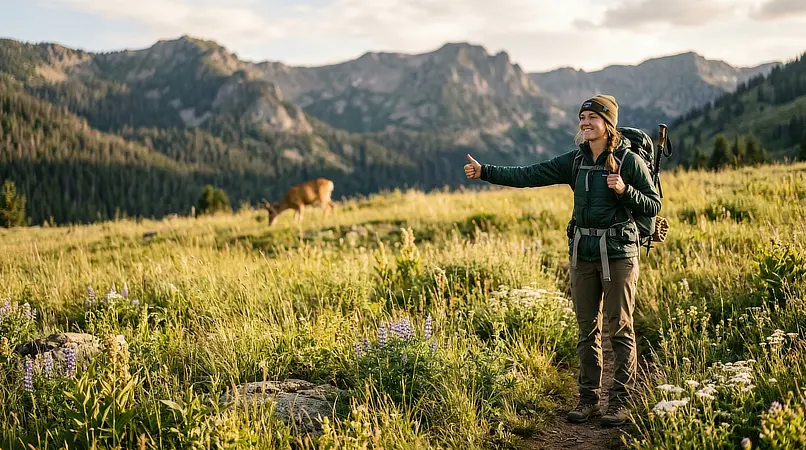
The “Rule of Thumb” trick: Extend your arm fully, close one eye, and hold your thumb up over the animal. If you can still see the animal around or behind your thumb, you are too close. Back away slowly and calmly.
For most wildlife, the general recommended minimum distance is 25 yards (about 75 feet), and 100 yards for predators like bears or wolves. This matches the official National Park Service guidelines for watching wildlife safely. If the animal changes its behavior because of your presence, you are already too close.
Trail Noise: Why Headphones Beat Bluetooth Speakers
Many people walk into the woods specifically to find quiet. Not silence necessarily, but the particular kind of ambient sound that does not include someone else’s playlist.
Using a Bluetooth speaker on the trail disrupts the experience of everyone within earshot. It also startles wildlife in ways that are not visible from where you are standing. If you want to listen to music while you hike, earbuds are the straightforward answer. They let you enjoy your music without making that choice for everyone around you.
Field Note: Loud trail music often ruins wildlife encounters before you even realize they are happening. Birds flush, small animals disappear, and other hikers lose the quiet they came outside to find. Earbuds keep your soundtrack personal while leaving the trail experience intact for everyone else, including the wildlife you may never see.
Phone calls follow the same courtesy logic. If you must take a call, wait until you reach a durable surface like a rock outcropping or a wide clearing. Step aside so others can pass, keep your voice low, and wrap it up quickly. The trail is not a private office.
Final Thoughts: You Don’t Have to Be Perfect
Nobody gets all of this right on their first hike. The goal is not a perfect track record. The goal is to know better, so you do better.
Leave No Trace as a framework works because it is built on small decisions, not grand gestures. Carrying out your trash, staying on the trail, using your headphones, and stepping aside for the uphill hiker are not hard. They just have to become habits. The trails exist because people before us cared enough to protect them. The best way to honor that is to extend the same courtesy forward.
What is one trail habit you struggled with as a beginner? Let me know in the comments below. Whether it was figuring out the right-of-way, remembering to pack an extra trash bag, or dialing in your gear, I would genuinely like to hear about your learning moments out there!
Founder & Gear Research Editor

Sonia Zannoni
I'm Sonia, the founder of Best Trail Backpacks. I don't test gear myself. For every pack I cover, I compare the published specs and sizing charts, read what independent testers found, and look for what owners report again and again.
Fit comes first, because a pack that doesn't match your torso and hips will hurt no matter what it cost. My goal is to help you choose a pack that suits your body, your trip and your budget, and to tell you plainly where the evidence runs out.
About the Founder