Best Daypacks for Beginners: Comfortable Gear That Won’t Overcomplicate Your Weekend
Affiliate Disclosure: Some links on this page are affiliate links. If you buy through one, I may earn a commission at no extra cost to you. Commission never decides which products I recommend. Read the full disclosure.
A four-mile walk through the woods on a Saturday morning doesn’t call for a technical pack with a price to match. It calls for one that fits your back, keeps your water within reach and doesn’t leave your shoulders sore by the time you’re back at the car.
Most beginners overthink this part, and it isn’t their fault: the gear lists online are written for people who already own everything. So I kept this one short.
These are the three best daypacks for beginners I’d shortlist, each matched to a different kind of first hiker, with what it gives up and who should skip it.
TL;DR: Best Daypacks for Beginners
- One bag for work, travel and light trails: the Osprey Daylite Plus, with a 14-inch laptop sleeve and a torso range of 15 to 20 inches on REI’s listing.
- A light, trail-first pack for hikers with a longer back: the Deuter Speed Lite 21, which Deuter sizes for a back of about 17 to 21 inches (44 to 54 cm).
- The lowest price with a real hip belt: the REI Co-op Flash 22, for light loads (one REI staff answer puts a comfortable carry at about 15 pounds).
All three sit in the site’s $ tier, and prices change often, so check the current one before you buy. Here’s how they compare at a glance.
Product Name
Best For
Key Strength
Main Tradeoff
Price Tier
Commute, travel and light trails
Laptop sleeve and the most pockets
Webbing hip belt, so the shoulders carry the load
$
Trail-first hikers with a longer back
Only pick with a hoop frame, at about 1 lb 1 oz
Sized for a 17 to 21 inch back
$
Tight budgets and travel
Hip belt, sternum strap and hydration sleeve at 14 oz
Thin fabric, light loads only
$
Osprey Daylite Plus
Best For: Commute, travel and light trails
Key Strength: Laptop sleeve and the most pockets
Main Tradeoff: Webbing hip belt, so the shoulders carry the load
Price Tier: $
Deuter Speed Lite 21
Best For: Trail-first hikers with a longer back
Key Strength: Only pick with a hoop frame, at about 1 lb 1 oz
Main Tradeoff: Sized for a 17 to 21 inch back
Price Tier: $
REI Co-op Flash 22
Best For: Tight budgets and travel
Key Strength: Hip belt, sternum strap and hydration sleeve at 14 oz
Main Tradeoff: Thin fabric, light loads only
Price Tier: $
Price tiers: $ under $100 | $$ $100 to $249 | $$$ $250 and up
How to Choose the Best Daypack for Beginners
Specs are easy to read, but they don’t tell you how a pack feels two hours in. Three things decide that for a first daypack: how the pack holds its shape, how hot your back gets, and whether the size and fit match your body.
Why Backpack Structure Matters for Comfort
A pack with no structure slumps the moment you set it down half full, and it slumps on your back too. That sounds minor until you’re digging for a snack at the trailhead and everything has sunk into one heap at the bottom.
If a water bottle or a thermos keeps jabbing you between the shoulder blades, there’s nothing firm between your back and your gear. A frame, a stiff sheet or even a foam back panel spreads that pressure across your back, so hard edges stop pushing through.
None of the three packs here is a framed backpacking pack, and that’s fine at day-hike weights.
REI’s listing gives the Deuter a light hoop frame, the Osprey has a mesh-covered foam back panel and the REI pack has a padded back with a removable pad, which is about as much structure as water, food and a layer need.
The Sweaty Back Problem and What Ventilation Can Do
A flat foam panel pressed against your back for two hours on a warm day leaves you with a soaked shirt, and that’s when a first hike starts to feel like work.
Mesh over foam lets some air move between you and the pack, which helps, though it won’t keep you dry on a hot climb.
A suspended mesh panel, where only a stretched sheet of mesh touches your back, breathes better still, and none of these three uses one. All three sit close to your back, so on a hot climb expect some sweat whichever you pick.
The Osprey is the one that leans into airflow. Osprey says its mesh-covered foam back panel adds ventilation, and one REI owner says its mesh straps make it noticeably cooler on hot days than packs that leave you with a sweaty back.
Finding the Right Size and Fit
For day hikes of two to six hours, I’d look at 20 to 25 liters. That’s room for water, food, a warm or waterproof layer and a small first aid kit, without so much space that you fill it with things you won’t use.
If you’re torn between two sizes, I’d go with the smaller one. A lighter pack teaches you what you actually reach for, and that makes your next gear choice a better one.
Packable bags are the exception to that liter range. Some of them are labeled with big capacities, but with no frame or padded back that space is meant for soft things like a sweater, and dense hiking gear makes the bag sag and pull on your shoulders.
Fit matters more than liters, though. All three of these come in one size, each cut for a published torso range.
REI lists 15 to 20 inches for the Osprey and 16 to 21 inches for its own Flash 22. Deuter sizes the Speed Lite 21 for a back of about 17 to 21 inches (44 to 54 cm).
Some daypacks also come in women’s versions or in more than one size, which matters if your torso falls outside these ranges.
Your torso runs from the bony bump at the base of your neck to the top of your hip bones. It’s the number to check, not your height, since two people of the same height can measure quite differently.
All it takes is a flexible tape and a helper, and my guide on how to measure your torso shows where the tape goes.
The 3 Best Daypacks for Beginners
Each of these does one beginner job well. For each one I’ll say who it suits, what it gives up and who should skip it.
The Versatile Everyday Pick: Osprey Daylite Plus (20L)
Best For: Beginners who want one bag for the commute, travel and light weekend trails, with a laptop sleeve.
Key Specs:
- Weight: 1.29 lb (0.585 kg), Osprey’s figure
- Capacity: 20 liters
- Fit: one size, torso 15 to 20 inches (REI’s listing)
- Materials: bluesign approved 300D recycled polyester with a PFC-free water-repellent finish (Osprey)

Why It Stands Out
The Daylite Plus earns its place by doing the most things at once. Osprey describes a mesh-covered foam back panel built for comfort and ventilation, with padded straps and a grab handle built into the harness.
Pockets are where it pulls ahead of the other two. Osprey lists a front pocket with organization and a key clip, a zippered slash pocket, a shove-it pocket for a jacket and two mesh side pockets for bottles.
An REI staff answer on the product page says a 32 oz Nalgene fits those side pockets, snugly. One REI owner who had the older version says the newer pockets are deeper and finally hold a Nalgene without it falling out.
Inside, a padded sleeve holds either a hydration bladder or most laptops up to 14 inches. A hydration bladder is a soft water pouch with a drinking tube, so you can sip without stopping, and on a Monday the same sleeve keeps a laptop safe.
If you travel, the pack clips onto several larger Osprey packs, and its grab handle doubles as a luggage pass-through. REI marks it as carry-on friendly and lists travel as one of its main uses.
Osprey makes it from bluesign approved recycled polyester, which means the mill meets an outside standard for the chemicals it uses, not that the fabric is any tougher.
Owners rate it highly at both stores, with an average above 4.5 stars across more than 500 REI reviews and more than 3,000 Amazon ratings.
If one bag for the office and the trail is exactly what you’re after, my guide to hybrid daypacks for city and trail compares a few more. Each of those trades some trail support for office organization in its own way.
Honest Tradeoffs
The hip belt is a removable 20 mm webbing strap, not a padded belt. REI’s staff note on the product page that it keeps the pack from moving rather than carrying weight, so a heavy load stays on your shoulders.
That makes it a pack for light days. It handles water, snacks and a layer well, but if you have long days with more weight in mind, a pack with a padded belt will carry better.
The one fit complaint that repeats is the top grab handle. Two shorter REI owners, at 5 feet 2 and 5 feet 4, say it rests against the back of the neck, and one of them also found the pack too long for her torso.
So if your torso sits near the bottom of the 15 to 20 inch range, wear it loaded around the house before you cut the tags.
- Pros: one bag for the office and the trail, a 14-inch laptop sleeve and five outside pockets, and it clips onto larger Osprey packs.
- Cons: the webbing belt carries little weight, and the top handle can rest on the neck if your torso is short.
Who Should Skip It: Hikers who plan long days with heavier loads and want a hip belt that carries weight. Anyone whose torso measures under 15 inches.
The Verdict
I’d pick the Daylite Plus if you want one pack for work, travel and light weekend trails. The laptop sleeve, the pockets and a back panel that breathes a little give it more everyday use than the other two.
If the trail is the main job, look at the Speed Lite 21 or the Flash 22 below, which trade the laptop sleeve for trail features.
The Lightweight Trail Pack: Deuter Speed Lite 21
Best For: Beginners with a longer back who want a trail-first pack that stays light.
Key Specs:
- Weight: about 1 lb 1 oz (470 g), Deuter’s figure
- Capacity: 21 liters
- Fit: back length about 17 to 21 inches (44 to 54 cm), body height about 5 feet 7 to 6 feet 5 (170 to 195 cm), Deuter’s figures
- Recommended load: about 4.4 to 11 lb (2 to 5 kg), Deuter’s figure
- Materials: 140D recycled polyamide ripstop, bluepass certified (Deuter)

Why It Stands Out
At about 1 lb 1 oz (470 g), the Speed Lite 21 is the only pack here with a hoop frame. REI’s listing describes a single light plastic (Delrin) hoop around the edge of the back panel, enough to hold the pack’s shape without metal stays.
Deuter built it for the trail, and it shows in the small things. Deuter lists a zippered top pocket with a key clip, a front mesh pocket, two mesh side pockets and a separate wet compartment inside the pack.
The retailer listings add a few more details. REI and Amazon both list a glasses stow on the shoulder strap and say it takes a hydration bladder, and REI lists a safety whistle.
Deuter says the detachable waist belt’s hip fins share the weight between your hips and shoulders. With a recommended load of only about 4.4 to 11 lb there isn’t much to share, so I wouldn’t count on the belt to take much off your shoulders.
Owners rate it 4.6 stars across nearly 500 Amazon ratings. On REI, where many of its two dozen reviews come from people who received the pack free, they mostly praise how light and comfortable it is.
One owner noticed that bottles in the side pockets press into the main compartment instead of bulging outward.
Honest Tradeoffs
Fit is the big one. Deuter sizes this pack for a back of about 17 to 21 inches (44 to 54 cm) and a body height of about 5 feet 7 inches and up (170 to 195 cm).
In CDC height data for US adults, 5 feet 7 inches (170 cm) sits at about the 90th percentile for women, so most women and many shorter hikers fall below the range it was cut for.
REI’s page gives a wider torso range, 15 to 21 inches, and its reviewers rate the fit as running slightly large.
I’d go by Deuter’s own back length. If you’re under 5 feet 7, measure your torso first and compare it with the back length on Deuter’s product page rather than guess.
Keep the load light, too. Deuter recommends about 4.4 to 11 lb (2 to 5 kg), and at that weight the belt mostly keeps the pack steady.
There’s no laptop sleeve, so it’s a poor match for work or school. For that, the Osprey is the better choice.
One REI owner, otherwise happy with it, says the mesh on the back panel roughed up the backs of several shirts within a week. It’s one report rather than a pattern, but worth knowing.
- Pros: light at about 1 lb 1 oz with a hoop frame, a glasses stow and safety whistle, and a separate wet compartment.
- Cons: sized for a 17 to 21 inch back, no laptop sleeve, and a recommended load of only 4.4 to 11 lb.
Who Should Skip It: Hikers whose torso measures under about 17 inches, Deuter’s 44 cm back length. Anyone who needs a laptop sleeve or plans to carry more than about 11 lb.
The Verdict
I’d choose the Speed Lite 21 if the trail is the main job and your back falls in Deuter’s 17 to 21 inch range. It’s the only pick here with a hoop frame and the most trail-specific of the three, from the glasses stow to the safety whistle.
If your back measures shorter than Deuter’s range, look at the Osprey or the Flash 22 instead. A pack cut for a longer back puts the hip belt below the hip bones it should rest on.
The Budget Trail Pick: REI Co-op Flash 22
Best For: Beginners on a tight budget who want a real day-hike harness at the lowest price, plus a bag that packs down for travel.
Key Specs:
- Weight: 14 oz (REI)
- Capacity: 22 liters
- Fit: one size, torso 16 to 21 inches, waist and hips 26 to 42 inches (REI)
- Materials: 70-denier recycled ripstop nylon, bluepass certified, with a water-repellent finish made without PFAS (REI)
Why It Stands Out
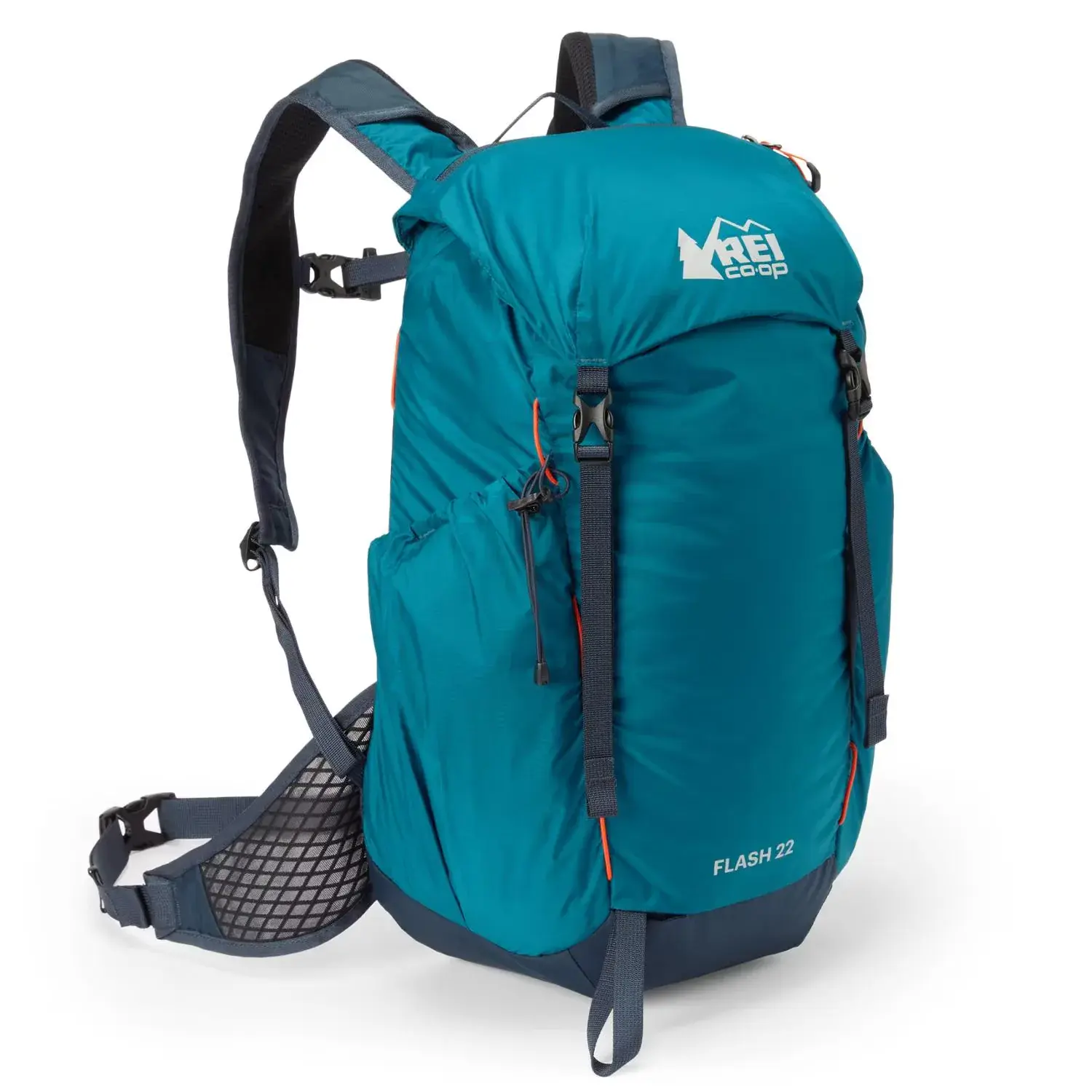
REI’s own Flash 22 costs the least of the three and weighs the least, and it still has the parts that make a daypack feel like a hiking pack.
REI lists a mesh hip belt that tucks away, a detachable sternum strap (the small strap across your chest that keeps the shoulder straps in place), mesh shoulder straps with fold-over padding and a sleeve for a hydration bladder.
The lightly padded mesh back has a pad that slips out to use as a sit pad, which is handy at a muddy lunch spot.
There’s a zippered pocket in the lid, a zippered side pocket for a phone or wallet, two tall side pockets for bottles and a sunglass loop on the left strap.
Owners back up the value side. It averages 4.3 stars across more than 600 REI reviews, and about four in five reviewers give it four or five stars.
If you travel, an REI staff answer on the product page calls it a good under-the-seat personal item, and one REI owner says it fits under an airplane seat. That makes it a decent spare bag for trips as well as your first hiking pack.
Honest Tradeoffs
The fabric is the weak point. Denier measures thread thickness, and the Flash 22’s 70-denier nylon is half the 140 denier Deuter lists for the Speed Lite 21, which is part of why it’s lighter.
Thinner fabric gives way to rock sooner, too. One REI owner who scrambled with it came home with holes, one about an inch long, which the owner plans to patch.
It’s frameless, so it doesn’t carry weight well. REI doesn’t list a maximum load. One staff answer on the product page puts a comfortable carry at about 15 pounds, and another says about 20 if it’s packed well, so I’d plan around 15.
Past that, with no frame to move the weight onto the hip belt, more of it ends up on your shoulders.
The side pockets changed in the current version. Two REI owners who knew the earlier version say the old mesh pockets worked better: one says the new nylon pockets don’t grip bottles as well, and the other that they take one bottle each where the old ones took two.
So plan on a single bottle per side, or a bladder.
- Pros: the lightest and cheapest of the three, a hip belt, sternum strap and hydration sleeve, and a pad that doubles as a sit pad.
- Cons: thin 70-denier fabric that scuffs on rock, and side pockets that take one bottle each.
Who Should Skip It: Anyone carrying more than about 15 pounds or scrambling on rock. Hikers who want two bottles in each side pocket, or whose torso falls outside 16 to 21 inches.
The Verdict
I’d pick the Flash 22 if your budget is tight and your hikes are a few hours with water, snacks and a layer. It’s the cheapest way here to get a hip belt, sternum strap and hydration sleeve, and most of its REI reviewers recommend it.
If you’re hard on gear or carry more, the Speed Lite 21’s 140-denier fabric and hoop frame make it the sturdier choice, as long as your back fits Deuter’s range.
How to Pack Your Beginner Daypack (Without Packing Your Fears)
Beginners tend to pack for every disaster they can imagine, and the just-in-case extras add weight before you’ve even filled a water bottle. The fix isn’t to carry less safety gear. It’s to carry small versions of the right things.
The American Hiking Society’s Ten Essentials are meant for every hike, however short.
For a two-hour trail, that means light versions of each: water, food, a layer, sun protection, first aid, navigation and a few safety items. Here’s the short list:
- Water: The American Hiking Society plans on half a liter per hour in moderate conditions, about 17 ounces, so around a liter for two hours. Take more when it’s hot or steep.
- Food: A snack you’ll actually eat, plus a little extra in case you’re out longer than planned.
- A layer: Something warm or waterproof that packs small. None of these three packs is waterproof, and none comes with a rain cover, so a zip bag around your layer or a backpack rain cover keeps it dry.
- Sun protection: Sunscreen, sunglasses and a hat for open stretches of trail.
- First aid: A small kit with the basics, and enough know-how to use it.
- Navigation: Your phone with the trail map downloaded for offline use, plus a paper map and a small compass as a backup, as the American Hiking Society suggests, because phones fail and batteries run down.
- Light, a whistle and fire: A small headlamp in case the hike runs late, a whistle to signal for help and a lighter or waterproof matches. Osprey lists a whistle on the Daylite Plus sternum strap, and REI lists one on the Speed Lite 21.
- A small knife and an emergency blanket: The same list includes a knife or multi-tool for repairs and first aid, and a lightweight space blanket in case you’re stuck. A small one of each is plenty.
- Footwear: The list starts with shoes that suit the trail. You wear these rather than pack them, so comfortable, broken-in shoes with good grip are the one item to sort out before the bag.
- Wallet basics: ID and some cash if the trailhead charges for parking.
That’s the whole list for a short hike, and you’ll adjust it as you learn what you actually reach for. My guide to what to pack for a first hike goes through each item in more detail.
Put the heaviest things, like water, close to your back and lighter things toward the outside, so the load doesn’t pull you backward. Keep snacks and your layer near the top, where you can reach them without unpacking everything.
Final Verdict: Which Is the Best Daypack for Beginners?
There isn’t one best daypack for beginners, because people starting out don’t all need the same thing. It comes down to what else the pack has to do during the week, how your back measures, and how much you want to spend.
- One bag for work, travel and weekends: the Osprey Daylite Plus, with the laptop sleeve and the most pockets, for torsos of 15 to 20 inches by REI’s listing.
- Trail first, with a longer back: the Deuter Speed Lite 21, the only pick with a hoop frame, sized for a 17 to 21 inch back.
- The lowest price with a real harness: the REI Co-op Flash 22, for light loads of about 15 pounds or less.
If you need a bigger pack for longer days or a first overnight, my roundup of budget packs under $100 covers 20 to 50 liters. The same fit checks apply there.
Before you order, measure your torso and check it against the range for the pack you like.
When it arrives, load it with what you’ll really carry and walk around the house and up the stairs with the tags still on, then send it back inside the return window if it pinches or slides.
Founder & Gear Research Editor

Sonia Zannoni
I’m Sonia, the founder of Best Trail Backpacks. I don’t test gear myself. For every pack I cover, I read the manufacturer’s specs and sizing charts and look for what owners report again and again.
Fit comes first, because a pack that doesn’t match your torso and hips will hurt no matter what it cost. My goal is to help you choose a pack that suits your body, your trip and your budget.
About the Founder