
How to Wash a Down Sleeping Bag Without Ruining It
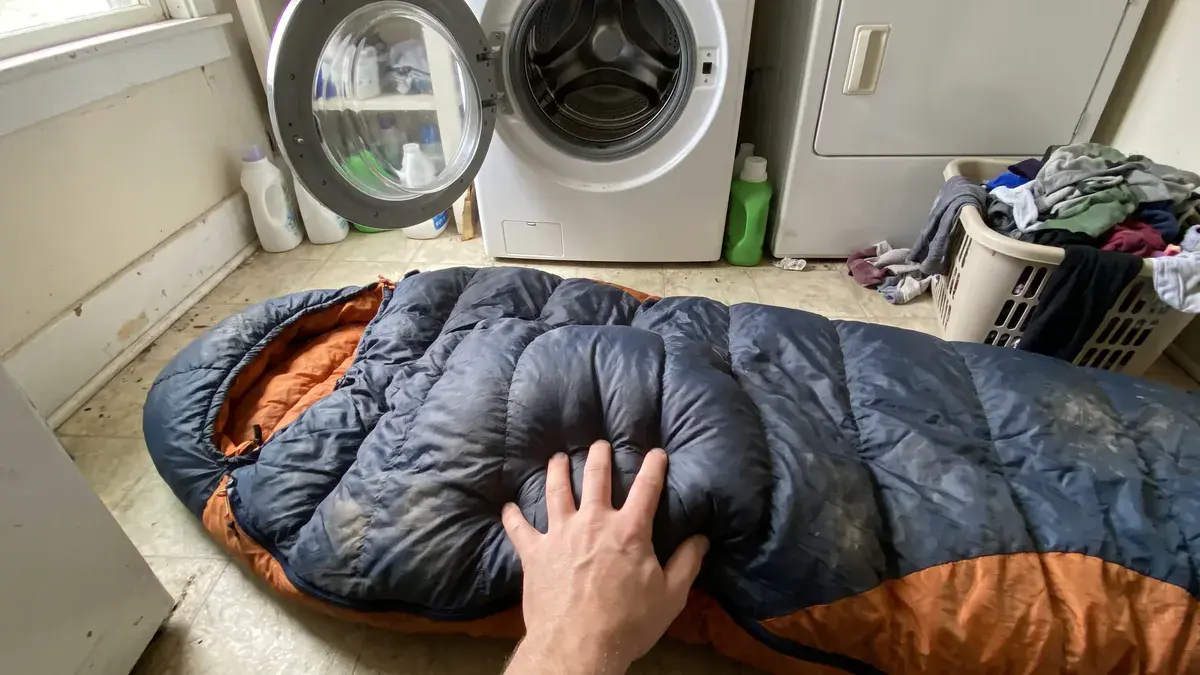
The bag is out of its stuff sack, the hood is shiny with grime, and it still smells like the last trip. Now you’re at the washer, thinking of every story that ended with a flat, lumpy bag.
That’s a fair worry when the bag cost this much and a bag that won’t loft means a cold night. Those stories are real, but they trace back to a few specific mistakes, and nobody explains them when you buy the bag.
You want to know whether it needs a full wash at all, and how to wash a down sleeping bag so the down lofts again. The mistakes behind the flat bags are the wrong machine, the wrong soap, soap left in, and a bag that wasn’t fully dry.
By the end you’ll know whether to spot clean or wash, where to wash it, and how to wash, dry and store it the way the makers describe. Where the makers disagree, your bag’s own care label settles it.
TL;DR: How to Wash a Down Sleeping Bag
- Spot clean the hood and collar and use a liner; save a full wash for when the loft looks flat, grime builds up or a smell won’t air out
- Use a front-loader (or a big laundromat machine), a down-specific wash and extra rinses, and never dry clean
- Dry on low heat for several hours, breaking up clumps by hand, until no lumps remain
- Store it loose in a large breathable sack, never in its stuff sack; your care label settles water temperature and dryer heat
Does Your Down Bag Need a Full Wash Yet?
Most down bags don’t need a full wash after every trip. Wash yours when the loft looks flat, the hood and collar are shiny with grime, or a smell won’t air out. Until then, spot clean the shell and use a liner, which makers say means washing far less often.
Pull the bag out after a season and you’ll often notice it: a dull, slightly sticky hood and a smell that’s still there after a day on the line. That’s body oil and grime working their way into the down.
Feathered Friends, Big Agnes and Sea to Summit describe the same thing. Body oils and dirt cling to the down clusters, so they can’t spread out and trap as much air, and that trapped air is what keeps you warm.
So a bag that’s lost its loft sleeps colder than it should. How warm it should be depends on the bag you chose, and my guide on how to choose a sleeping bag covers the fill and ratings behind that.
Look for these three signals before you commit to a full wash:
- The loft looks flat. The baffles don’t puff up after you shake the bag out the way they used to, because oil is weighing the clusters down.
- The hood and collar are shiny with grime. That’s where your face and neck rest every night, so oil builds up there first.
- A smell stays after airing it out. A day of fresh air clears most trip smells, so one that hangs on is a sign the bag needs more than air.
Quick Tip: Sea to Summit notes that grime shows up first at the hood and neck. Check there before you decide on a full wash, and start any spot clean there too.
If none of the three shows yet, a spot clean usually does the job. REI’s sleeping bag care advice describes a paste of non-detergent soap, worked into the shell at the hood and collar with a toothbrush.
NEMO describes the same method. Pinch the shell fabric and hold it away from the insulation while you scrub, so the down underneath stays out of it.
A liner does even more. Sea to Summit and Big Agnes both say sleeping in one means washing the bag less often, and REI says it keeps the bag cleaner, because the liner takes the oil and sweat that would otherwise reach the bag.
What you bring to bed matters too. Washing up before you crawl in and sleeping in clean clothes keeps body oil out of the bag, and my post on staying clean on the trail has simple ways to do that on a trip.
How often you’ll need a full wash varies a lot between makers. REI says many years can pass with spot cleaning, Western Mountaineering suggests every one to two years, and Rab says at least once a year. NEMO simply says not after every trip.
With that much range, a schedule doesn’t help much. I’d start with a spot clean and a liner, and save the full wash for when the bag tells you it needs one.
One caution: Sea to Summit says that by the time grime shows or the down starts to clump, the bag is already losing some loft, and Feathered Friends says to wash at least once a year. If you sleep in your bag often, a yearly wash is the safer default.
If your bag only needs a spot clean, you can stop here. If it needs a full wash, find its care label before you do anything else.
Washing Won’t Ruin Your Down, but the Wrong Machine or Soap Can
Washing done right doesn’t ruin down. Sea to Summit says quality down can be washed without harm, though REI and NEMO note each wash adds some wear. What makers warn about instead is a top-loader’s agitator, regular detergent, soap left in the down and a bag that isn’t fully dry.
A lot of advice says the opposite: never wash down, or only ever wash it by hand. Sea to Summit traces the belief that washing ruins down to a few common mistakes: regular detergent, down shifting between chambers in a top-loader, and clumps left in the down after washing.
Line that up against the other makers’ warnings, and the problem isn’t washing, it’s a few specific steps done the wrong way. Most of the makers I read endorse a front-loading machine.
What the “never machine wash it” advice really targets is the top-loader. Every maker I read that names a machine warns against a central agitator, and three of them rule out top-loaders entirely. Here’s what they warn about, and why each one matters:
- An agitator twists the bag, which strains the baffles (the sewn chambers that hold the down in place) and pushes down from one chamber into the next.
- Regular detergent and dry-cleaning solvents either strip the down’s natural oils or leave fillers on it that stop it lofting.
- Soap left in the down makes it clump.
- Lifting a waterlogged bag by hand puts the full weight of the water on the baffles, which can tear them.
- High heat in the dryer can melt the thin shell fabric.
- Down that isn’t fully dry stays in lumps.
None of this means you should wash as often as you like. REI and NEMO both point out that each wash adds some wear, which is why I’d wash when the bag shows the signals above rather than on a schedule.
So the fear makes sense, but it’s aimed at the wrong thing. Get the machine, soap, rinse and drying right, and a wash is how the bag gets its loft back.
Home, Laundromat or Wash Service: Where to Wash It
You can wash a down bag at home if your machine is a front-loader with room for the bag to tumble. A few makers also accept a top-loader with no central agitator, but Sea to Summit, Western Mountaineering and Big Agnes say to avoid top-loaders altogether.
If yours is small, use a large laundromat machine or a maker’s wash service. Never dry clean it.
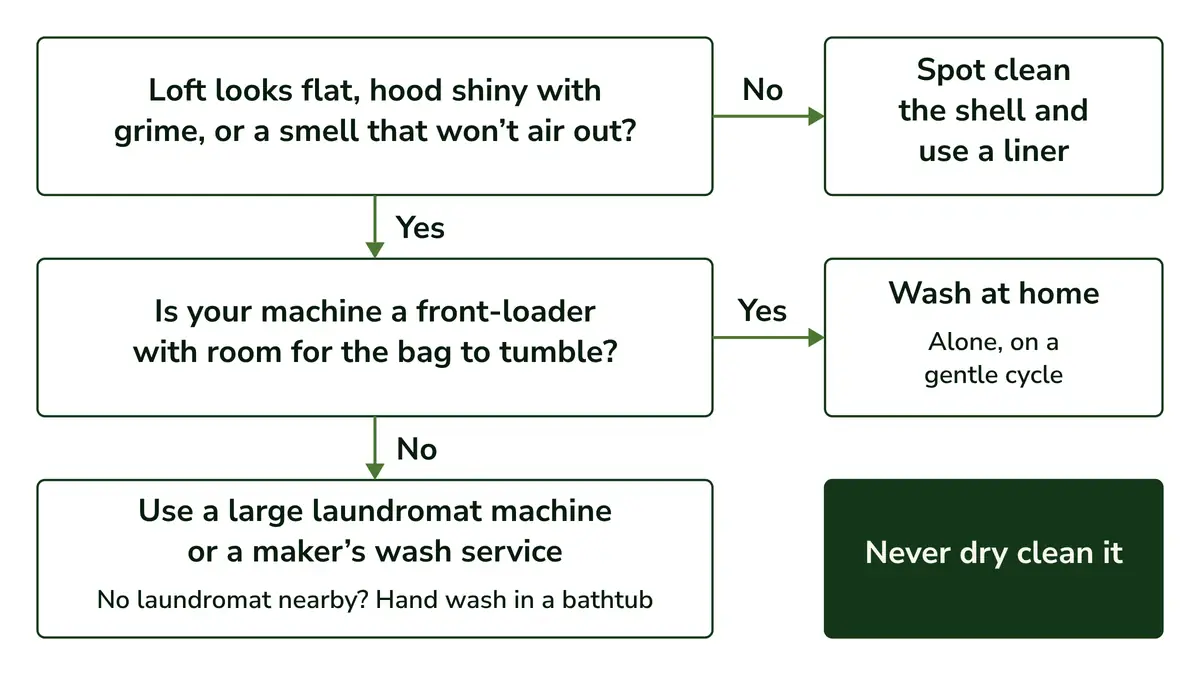
Start with your own machine. REI notes that some small home front-loaders don’t give a bag enough room, and Big Agnes says that if you have to cram the bag in like a stuff sack, the machine is too small to clean it properly.
That’s the usual snag if you have a compact apartment front-loader and a bulky bag. A double-wide bag settles it for you: Big Agnes says it needs an extra-large laundromat machine.
The laundromat is the makers’ usual answer. REI, Big Agnes and NEMO all point to large commercial front-loaders. Wash one bag per load, as Feathered Friends puts it, and take some care with the dryer, which the drying section below covers.
No suitable machine and no laundromat nearby? Western Mountaineering and Sea to Summit both describe hand washing in a clean bathtub: knead the soap through, drain, roll the bag to press the water out, and never lift it while it’s full of water. Then it still needs a large dryer.
Dry cleaning can look like the safe way out, but every maker I read that mentions it says no. Western Mountaineering and REI say the solvents strip the down’s natural oils.
Feathered Friends’ down care guide goes further: down won’t fully recover its loft after even one trip through the dry cleaner.
That leaves a real choice between time and money. Washing at home or at a laundromat costs you an afternoon, most of it drying, and you’ll need to stay with the bag while it dries.
A wash service costs money and shipping time instead. Feathered Friends runs its own, Rab offers Rab Wash through its US service center, and REI partners with Rainy Pass Repairs.
If your machine is small, I’d take the bag to a laundromat rather than squeeze it in. I’d only pay for a service if you’d rather spend money than an afternoon.
How to Wash a Down Sleeping Bag, Step by Step
Read the care label first, because makers disagree on water temperature. Then wash the bag alone on a gentle cycle with a down-specific wash, rinse until no soap remains, and run an extra spin. And don’t lift it while it’s waterlogged, or the weight can tear the baffles.
These steps are for down, and a synthetic bag has its own care label to follow. There’s a second reason to read the label first: some makers, such as Big Agnes, don’t cover damage from improper washing or drying under warranty.
- Read the care label. Makers disagree on water temperature, on whether anything besides a down wash is acceptable, and on dryer heat, so your own label settles those.
Here’s where the down bag makers I read agree, and where your label has the final say.
Care Point
What Most Makers Say
Where They Split
What Decides It
Machine
Front-loader
REI, Feathered Friends and NEMO also allow a top-loader with no agitator; Sea to Summit, Western Mountaineering and Big Agnes rule out top-loaders
Your label and your machine
Soap
Down-specific wash
Big Agnes and Rab allow a mild detergent; Feathered Friends, Sea to Summit and Western Mountaineering don’t
Your label
Water temperature
No majority
Cold (NEMO), warm (Western Mountaineering, Feathered Friends), 40°C (104°F) at most (Sea to Summit), warmest the label allows (Big Agnes)
Your label
Rinsing
At least one extra rinse
How many, up to five or more by hand (Western Mountaineering)
No soap left
Dryer heat
Low
Medium allowed for Big Agnes’s own down gear
Your label
Air drying
Not the first choice
Feathered Friends strongly against, REI allows it
Your patience
Dry cleaning
Never
No split
No split
How often
When the signals show
Many years (REI) to at least yearly (Rab)
The three signals
Storage
Loose and breathable, never compressed long term
No split
No split
Machine
What Most Makers Say: Front-loader
Where They Split: REI, Feathered Friends and NEMO also allow a top-loader with no agitator; Sea to Summit, Western Mountaineering and Big Agnes rule out top-loaders
What Decides It: Your label and your machine
Soap
What Most Makers Say: Down-specific wash
Where They Split: Big Agnes and Rab allow a mild detergent; Feathered Friends, Sea to Summit and Western Mountaineering don’t
What Decides It: Your label
Water temperature
What Most Makers Say: No majority
Where They Split: Cold (NEMO), warm (Western Mountaineering, Feathered Friends), 40°C (104°F) at most (Sea to Summit), warmest the label allows (Big Agnes)
What Decides It: Your label
Rinsing
What Most Makers Say: At least one extra rinse
Where They Split: How many, up to five or more by hand (Western Mountaineering)
What Decides It: No soap left
Dryer heat
What Most Makers Say: Low
Where They Split: Medium allowed for Big Agnes’s own down gear
What Decides It: Your label
Air drying
What Most Makers Say: Not the first choice
Where They Split: Feathered Friends strongly against, REI allows it
What Decides It: Your patience
Dry cleaning
What Most Makers Say: Never
Where They Split: No split
What Decides It: No split
How often
What Most Makers Say: When the signals show
Where They Split: Many years (REI) to at least yearly (Rab)
What Decides It: The three signals
Storage
What Most Makers Say: Loose and breathable, never compressed long term
Where They Split: No split
What Decides It: No split
When the makers disagree, I’d go with your bag’s own label over any single rule, mine included.
- Use a down-specific wash. Feathered Friends lists Nikwax Down Wash, Granger’s Down Wash and Gear Aid Revivex Down Cleaner as examples. Sea to Summit explains why regular detergent is a problem: its fillers and optical brighteners stick to the down and stop it lofting.
Skip fabric softener, bleach and additives such as oxygen powder. Big Agnes allows a very small amount of regular liquid detergent (never powder) and Rab a non-biological one (a detergent without enzymes, which Rab says can harm the down), but the others don’t, so check your label first.
- Run the bag alone on a gentle cycle. Use the gentle or delicate setting, with the water temperature your label gives. One bag per load leaves it room to move through the water.
If your machine has no delicate cycle suited to wool, Sea to Summit says to hand wash the bag instead.
- Rinse until no soap remains. Most makers call for at least one extra rinse cycle. REI says at least two rinses, or a second full cycle with no soap, and Western Mountaineering’s care page says hand washing often takes five or more.
Extra rinses take longer, but soap left in the down is one of the two main causes of a clumpy bag.
- Spin it, then handle it gently. An extra or longer spin cuts drying time, as Western Mountaineering notes. Never wring the bag.
At the end of the cycle the bag sits in the drum heavy and swollen with water, and that’s the moment to slow down. Sea to Summit warns that lifting it now can tear the baffles or shift the down between chambers.
Quick Tip: Before you lift the bag out, make sure the spin has taken out as much water as possible, as Sea to Summit advises. Then support its whole weight as you move it, rather than hauling it out by one end, as Feathered Friends stresses.
Once the bag is out of the machine, the step that decides how well it lofts is still ahead.
How to Dry It Until the Down Lofts Again
Drying matters more than washing, Western Mountaineering says. Dry the bag on low heat in a large dryer, breaking clumps apart by hand between cycles, until no lumps remain. Makers give two to four hours of drying, and any lump means the down is still wet.
That lump test is the most useful thing to know. Down that isn’t completely dry stays clumped, so a bag can feel dry on the outside while the clusters inside are still damp.
Here’s the method most makers describe, and why each part matters:
- A large dryer, so the bag has room to tumble and the clumps can break up.
- Low heat for most bags. Big Agnes allows up to medium for its own down gear, so your label decides. Never use high heat, which NEMO warns can melt the shell fabric.
- Regular check-ins. Feathered Friends works in hour-long intervals and Big Agnes says every 20 to 30 minutes. Each time, take the bag out and pull apart any clumps by hand.
- Clean tennis balls or dryer balls, added when the bag is nearly dry, as REI suggests, to help break up the clumps as it tumbles.
- No dryer sheets, which Sea to Summit rules out because they can weaken the shell’s water-repellent finish and the lining’s wicking.
It’s tempting to add tennis balls and leave the dryer to it. Western Mountaineering says they help but are no substitute for breaking up the clumps yourself, so plan to stay nearby.
Quick Tip: Before you load a laundromat dryer, check the drum for burrs and sharp edges, as Western Mountaineering advises, and keep an eye out for hot spots while it runs. Then set it cooler than you think, because Sea to Summit warns that laundromat thermostats are often imprecise.
Set aside the afternoon. Big Agnes and Rab give 2 to 4 hours of drying, REI at least 2 to 3, and Feathered Friends puts the whole wash and dry at 3 to 5 hours or more.
Feathered Friends says not to be afraid to add extra drying time, and one owner reviewing a down wash on Backcountry mentions ending up with clumps after cutting the drying short.
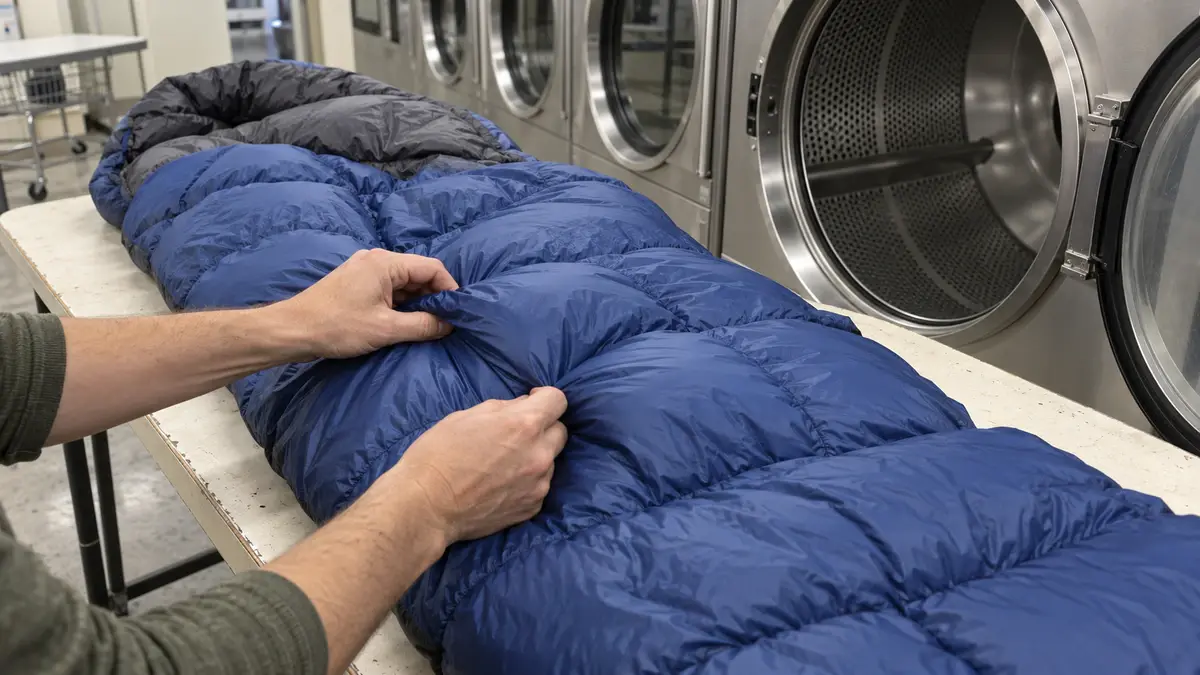
In practice that often means standing at the laundromat folding table, pressing along each baffle for the small, damp lumps that tell you the bag needs another round.
Air drying is the slow fallback. REI allows it, laid flat outside with the clumps broken up by hand as it dries. Feathered Friends strongly discourages it, because it takes a very long time and the down doesn’t loft well.
If your label calls for it, Western Mountaineering and Feathered Friends describe an optional spray-on DWR (a water-repellent finish for the shell), set with low heat after washing. Big Agnes warns never to use a wash-in waterproofer on its treated down.
Still Flat and Clumpy? Two Causes, Two Fixes
If the bag seems dry and is still flat or clumpy, makers name two causes. Lumps usually mean the down is still wet inside, so keep drying. If it’s truly dry and still clumps, soap is likely left in it, and Big Agnes says to rewash it with no soap.
Maybe your first wash came out of the dryer in flat balls of down. That’s discouraging after hours of drying, but both causes have a fix.
The down is still wet. The shell can feel dry while the clusters inside are still damp. Western Mountaineering, Big Agnes and Feathered Friends all say the same thing: keep drying on low heat and keep breaking up the clumps by hand.
Soap is still in the down. If the bag is fully dry and still clumps, Big Agnes says to rewash it with no soap. That’s the rinse step from earlier, done again with nothing added.
How to Store a Clean Down Bag So It Stays Lofted
Store the bag fully dry and loose, in a large breathable cotton or mesh sack or hung up, never long term in its stuff or compression sack. Feathered Friends says long compression damages down clusters and cuts loft for good, and REI warns watertight bags trap condensation and invite mildew.
The usual habit is the bag going straight back into its stuff sack and onto a closet shelf until next season, and that’s the one to break.
Make sure it’s completely dry before it goes anywhere. The makers’ reason is mildew: a damp bag that’s stored away can grow it.
Then give it room. Western Mountaineering, Feathered Friends, REI, Big Agnes and Rab all say to store a down bag loose, in a large breathable sack, or hung up. Long compression is the problem, because it damages the down clusters and, Feathered Friends says, cuts the loft for good.
Skip watertight storage bags too. REI warns they trap condensation, which brings the mildew problem right back.
You don’t need a special product for this. I’d use an old cotton duvet cover, which does the same job as the large breathable cotton sack the makers describe.
The stuff sack is for the trail. Compress the bag for the trip, then take it out again as soon as you’re home.
Before your next trip, find your bag’s care label and note its water temperature and dryer heat. Then save the wash for a day when you have an afternoon free to dry it properly.
Founder & Gear Research Editor

Sonia Zannoni
I’m Sonia, the founder of Best Trail Backpacks. I don’t test gear myself. For every pack I cover, I read the manufacturer’s specs and sizing charts and look for what owners report again and again.
Fit comes first, because a pack that doesn’t match your torso and hips will hurt no matter what it cost. My goal is to help you choose a pack that suits your body, your trip and your budget.
About the Founder
