
Best Hydration Packs for Hiking, Matched to How Long You’re Out
Affiliate Disclosure: Some links on this page are affiliate links. If you buy through one, I may earn a commission at no extra cost to you. Commission never decides which products I recommend. Read the full disclosure.
You bought a hydration pack so you’d stop digging for a bottle, filled the bladder at the trailhead, and then the fleece wouldn’t go in. It ended up tied to the outside, or left in the car.
Most people pick by the number in the pack’s name and the water it holds, and that isn’t careless. Pack names mix total volume with gear space, and almost nobody says how much room a full reservoir leaves, or how much water your hike needs.
So the real question behind the best hydration packs for hiking is which one carries the water your usual hike needs and still fits a layer and lunch, without hauling a big pack around a two-hour loop. Sometimes the answer is a bladder in the daypack you already own.
You’ll work out the liters your hike needs, see what each pack leaves for gear, and leave with one pick matched to your hike length and torso, or a plan to add a bladder instead of buying a second pack.
TL;DR: Best Hydration Packs for Hiking
- Short to half-day hikes on a budget: CamelBak Cloud Walker 18, with a 2.5 L reservoir, room for a rain layer and a 15 to 19 inch torso range.
- Everyday half-day to full-day hikes with a light kit: Osprey Skarab 22 (men’s) or Skimmer 20 (women’s), with the reservoir in the box.
- Long or hot days with water, layers and lunch on your hips: Osprey Manta 24 or Mira 24, the heaviest of the three.
- Already own a daypack with a reservoir sleeve, or need 3 liters: add a bladder instead of buying a new pack.
The Best Hydration Packs for Hiking at a Glance
Three packs cover most day hikes. The CamelBak Cloud Walker 18 handles short hikes at the lowest price here, and the Osprey Skarab 22 or Skimmer 20 handles everyday half-day to full-day hikes.
On long or hot days, the Osprey Manta 24 or Mira 24 earns its extra weight with a padded hip belt and a mesh back.
The table has five rows because each men’s and women’s version gets its own row, sorted from the shortest hike to the longest.
Product Name
Best For
Key Strength
Main Tradeoff
Price Tier
Short to half-day hikes, torsos 15 to 19 in
2.5 L reservoir and room for a rain layer at the lowest tier
Waist strap only, 15.5 L of gear space
$
Everyday half-day to full-day hikes, men’s fit
Reservoir included, wide top opening
Webbing hipbelt that carries no weight
$$
Everyday hikes, women’s fit, shorter torsos
Reservoir included, wide top opening
Loose side pockets, per REI owners
$$
Long or hot days, men’s fit
Mesh back and padded hip belt, rain cover included
Heaviest here, 3.4 lb empty by Osprey
$$
Long or hot days, women’s fit, torsos 15 to 20 in
Same mesh back and hip belt in a women’s fit
Heaviest here, 3.28 lb empty by Osprey
$$
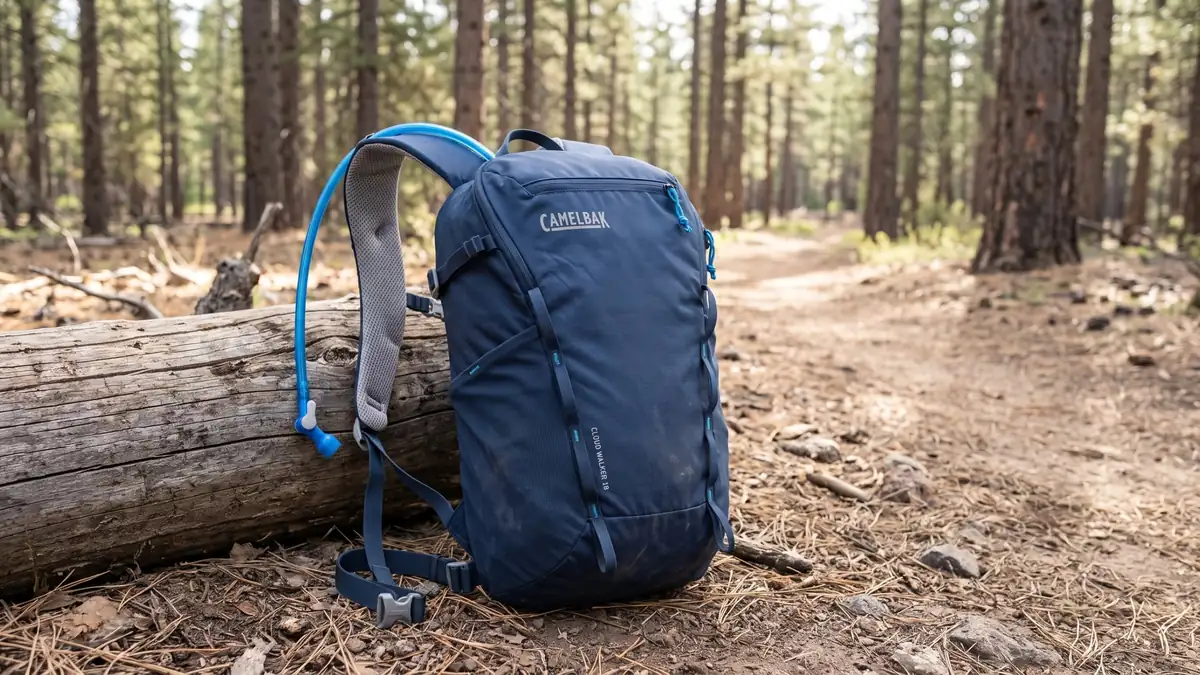
CamelBak Cloud Walker 18
Best For: Short to half-day hikes, torsos 15 to 19 in
Key Strength: 2.5 L reservoir and room for a rain layer at the lowest tier
Main Tradeoff: Waist strap only, 15.5 L of gear space
Price Tier: $
Osprey Skarab 22
Best For: Everyday half-day to full-day hikes, men’s fit
Key Strength: Reservoir included, wide top opening
Main Tradeoff: Webbing hipbelt that carries no weight
Price Tier: $$
Osprey Skimmer 20
Best For: Everyday hikes, women’s fit, shorter torsos
Key Strength: Reservoir included, wide top opening
Main Tradeoff: Loose side pockets, per REI owners
Price Tier: $$
Osprey Manta 24
Best For: Long or hot days, men’s fit
Key Strength: Mesh back and padded hip belt, rain cover included
Main Tradeoff: Heaviest here, 3.4 lb empty by Osprey
Price Tier: $$
Osprey Mira 24
Best For: Long or hot days, women’s fit, torsos 15 to 20 in
Key Strength: Same mesh back and hip belt in a women’s fit
Main Tradeoff: Heaviest here, 3.28 lb empty by Osprey
Price Tier: $$
Price tiers: $ under $100 | $$ $100 to $249 | $$$ $250 and up
If you already know how long your usual hike runs, skip to the pick that matches it. If you don’t, the next section works it out with you.
I’ve sorted these by hike length instead of naming one winner, because the right pack for a two-hour loop is the wrong one for a hot eight-hour day.
How to Choose a Hydration Pack for the Hikes You Actually Do
Start with your hike, not the pack. How long you’re usually out sets how much water you need, and the water sets the reservoir size.
Then check what’s left for a layer, how the pack carries about 5.5 pounds of water, whether your torso fits its range, and how warm it runs on your back.
Those five checks follow in that order, with pack weight and price folded into them. Each heads off a familiar mistake: the pack that can’t take your fleece once the bladder is full, or the big pack you lug around a short loop because it held the most water.
How Much Water Your Usual Hike Needs
Plan on about half a liter of water an hour in moderate conditions. That’s the American Hiking Society’s guideline, and at that rate a 2.5 liter reservoir, the size all three picks carry, covers about five hours of hiking.
Take the hike you do most often and time it, start to finish, breaks included. A three-hour loop at half a liter an hour comes to about 1.5 liters. A six-hour day comes to about 3 liters, which is more than any pick in this guide holds.
That number matters because the reservoir is the limit of your day. Unless you know of a safe place to refill along the way, what you carried from the trailhead is all you have.
The pack also has to hold everything else a day hike needs besides water, so the liters are only the first half of the choice.
Here’s how long each common reservoir size lasts at the two rates in this guide.
Conditions
Guideline
2 liters
2.5 liters
3 liters
Moderate temperatures and terrain
Half a liter an hour (American Hiking Society)
About 4 hours
About 5 hours
About 6 hours
Hot, dry day
About a quart an hour (NPS, Saguaro National Park)
About 2 hours
About 2.5 hours
About 3 hours
Moderate temperatures and terrain
Guideline: Half a liter an hour (American Hiking Society)
2 liters: About 4 hours
2.5 liters: About 5 hours
3 liters: About 6 hours
Hot, dry day
Guideline: About a quart an hour (NPS, Saguaro National Park)
2 liters: About 2 hours
2.5 liters: About 2.5 hours
3 liters: About 3 hours
Hot Days Change the Math
Heat roughly doubles the water. The National Park Service at Saguaro National Park advises drinking about a quart an hour on hot, dry days, so a 2.5 liter reservoir lasts about two and a half hours.
The same park’s advice is to start early and stay off the trail from 10 am to 4 pm in summer, drink often, and turn back when half your water is gone. It also suggests sports drinks or salty snacks to replace what you sweat out.
That turn-back rule makes sense once you picture the afternoon. The reservoir that covered your spring loop is half empty before the halfway point, because you’re losing water about twice as fast, and the walk back takes as long as the walk out.
Big Bend National Park’s hiking advice adds that thirst shouldn’t be your only guide. It also warns that drinking a lot without salty food can be as dangerous as dehydration and may lead to hyponatremia.
Big Bend describes hyponatremia as low sodium in the blood from drinking too much water, with symptoms that can look like heat exhaustion. That’s why the salty snacks aren’t optional on a hot day.
This is also where the Manta and Mira’s mesh back and padded hip belt start to earn their weight, as you’ll see further down. Hiking in heat is a bigger subject than one section can hold, so this one sticks to what heat does to your water.
The Size in the Name Isn’t Your Gear Space
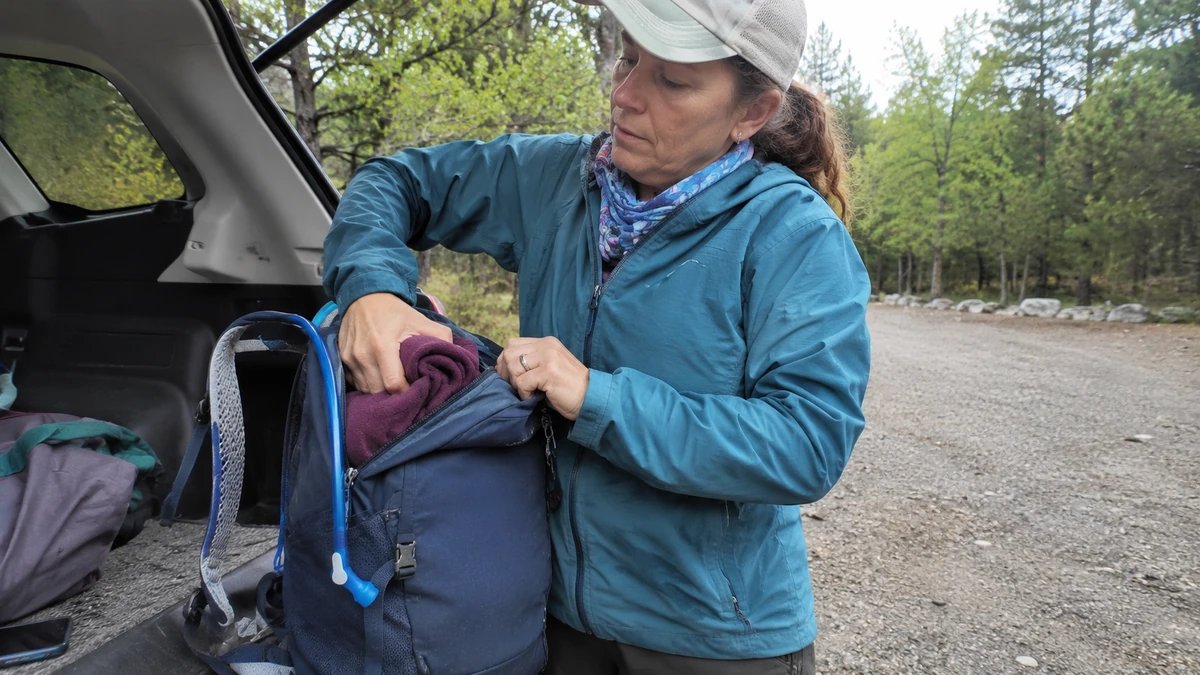
The number in a pack’s name isn’t always the room you get for gear. The Cloud Walker 18’s spec sheet lists 15.5 liters of gear space, and a full reservoir takes room inside the pack too.
What matters is whether your fleece or rain shell, lunch and first aid kit still fit once the bladder is full.
Retailers add to the confusion. REI lists the Cloud Walker 18 at 17.9 liters, which appears to be its total volume rather than the space left for your things.
The pack I left out of this guide shows how far apart the two can be. The CamelBak Fourteener’s name says 26, CamelBak’s own gear figure is 23 liters, and one owner on REI says the main compartment feels very small once the 3 liter reservoir is full.
Start with the layers you’d actually carry on your usual hike, because a thin rain shell rolls up small and a fleece doesn’t.
Then do the real check at home, inside the return window: fill the bladder, slide it in, and pack your layer, lunch and first aid kit before the tags come off.
A Waist Strap or a Padded Hip Belt: Who Carries the Water Weight
Water weighs about a kilogram per liter, so a full 2.5 liter reservoir adds about 5.5 pounds (2.5 kg) before food and layers.
A webbing strap at the waist only stops the pack from swinging. A padded hip belt on a frame moves that weight onto your hips, which matters more the longer you’re out.
That 5.5 pounds counts toward how heavy your pack should be for your body and your hike, so it isn’t a small extra.
The Cloud Walker 18, Skarab 22 and Skimmer 20 use a webbing strap, which stops the bounce on rough ground while the load still hangs from your shoulders. The Manta 24 and Mira 24 put a padded hip belt on a frame, rated by Osprey for 10 to 30 pounds.
Here’s the real tradeoff. More water on your back means more weight and more sweat under the pack.
The pack that carries it best is also the heaviest empty: 3.4 pounds for the Manta 24 and 3.28 for the Mira 24 by Osprey’s figures, against 1.367 pounds for the Skarab 22. It’s also the most expensive of the three.
Check Your Torso Against Each Pack’s Range
A pack fits when its torso range includes your torso length. REI lists 15 to 19 inches for the Cloud Walker 18, 17 to 22 inches for the Skarab 22 and Manta 24, 15 to 18 for the Skimmer 20 and 15 to 20 for the Mira 24.
Those ranges are REI’s figures, because neither maker’s current pages give one. You’ll need your own number first, and measuring your torso at home only takes a few minutes.
If your torso is on the short side, this is the check that rules packs out fastest. A 16 inch torso fits the Cloud Walker, the Skimmer and the Mira, and falls below the Skarab and the Manta, which is why the women’s versions matter here.
Here are the fit numbers for all five versions side by side. Sizes and weights are the makers’ figures unless a cell says otherwise.
Pack
Pack size
Empty weight
Torso range
Waist support
CamelBak Cloud Walker 18
15.5 L of gear space (spec sheet)
1 lb 2 oz (CamelBak; retailers list more)
15 to 19 in (REI)
Removable webbing strap
Osprey Skarab 22
22 L
1.367 lb
17 to 22 in (REI)
Removable 20 mm webbing hipbelt
Osprey Skimmer 20
20 L
1.65 lb (Osprey; REI lists 1 lb 4.3 oz)
15 to 18 in (REI)
Removable 20 mm webbing hipbelt
Osprey Manta 24
24 L
3.4 lb
17 to 22 in (REI)
Padded hip belt with two pockets
Osprey Mira 24
24 L
3.28 lb
15 to 20 in (REI)
Padded hip belt with two pockets
CamelBak Cloud Walker 18
Pack size: 15.5 L of gear space (spec sheet)
Empty weight: 1 lb 2 oz (CamelBak; retailers list more)
Torso range: 15 to 19 in (REI)
Waist support: Removable webbing strap
Osprey Skarab 22
Pack size: 22 L
Empty weight: 1.367 lb
Torso range: 17 to 22 in (REI)
Waist support: Removable 20 mm webbing hipbelt
Osprey Skimmer 20
Pack size: 20 L
Empty weight: 1.65 lb (Osprey; REI lists 1 lb 4.3 oz)
Torso range: 15 to 18 in (REI)
Waist support: Removable 20 mm webbing hipbelt
Osprey Manta 24
Pack size: 24 L
Empty weight: 3.4 lb
Torso range: 17 to 22 in (REI)
Waist support: Padded hip belt with two pockets
Osprey Mira 24
Pack size: 24 L
Empty weight: 3.28 lb
Torso range: 15 to 20 in (REI)
Waist support: Padded hip belt with two pockets
Foam Against Your Back or Mesh That Leaves a Gap
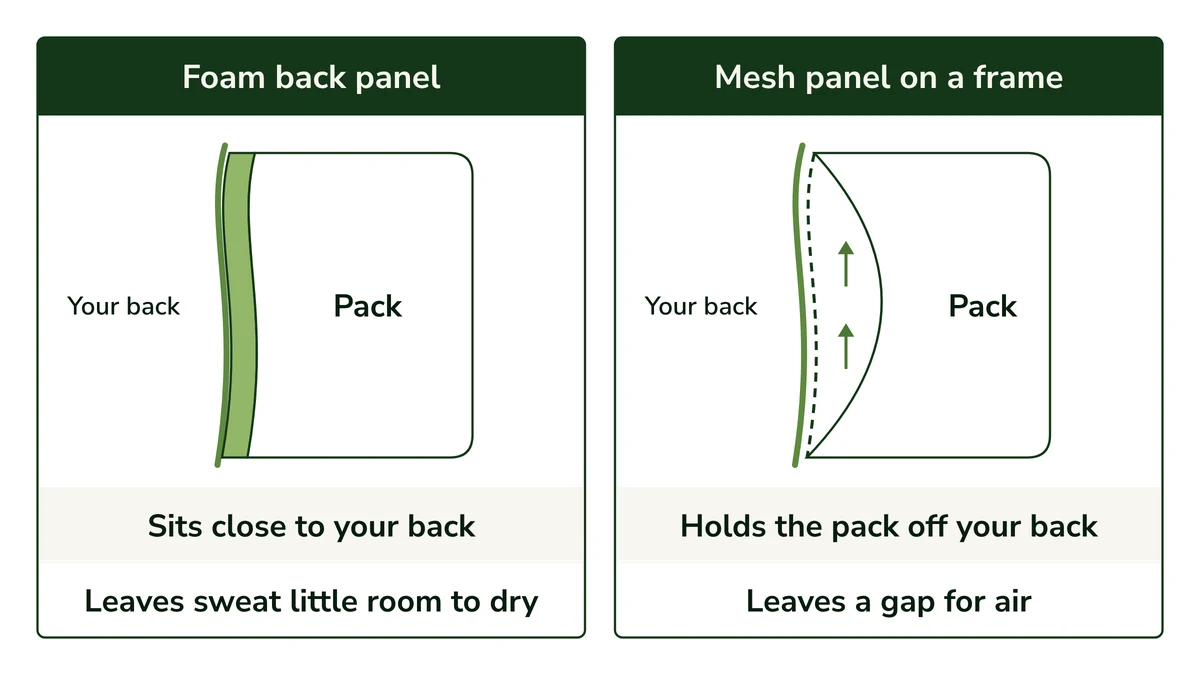
A foam back panel sits close to your back, which keeps the pack steady but leaves sweat little room to dry. A trampoline mesh panel on a frame holds the pack off your back and leaves a gap for air.
On hot days that gap is the main reason to carry the heavier pack.
Sweat dries where air can reach it. The Cloud Walker’s Air Support panel and the Skarab and Skimmer’s AirScape foam both ride close to your back, while the Manta and Mira’s AirSpeed system stretches mesh across a perimeter frame so the pack sits a little away from you.
CamelBak describes its panel as built for ventilation, and Osprey calls the AirScape back breathable. Those are the makers’ words, and the owners I read don’t say either way. The mesh back is different: Manta and Mira owners on REI, across both versions, say it lets their back breathe.
I’d only pay the extra weight for that gap if your hikes run long or hot, or your shirt is usually soaked an hour in. On a cool two-hour loop, a foam back does the job and keeps the pack lighter.
Best for Short Hikes on a Budget: CamelBak Cloud Walker 18
The Cloud Walker 18 pairs a 2.5 liter reservoir with room for a rain layer and snacks at the lowest price tier here.
It fits torsos of 15 to 19 inches and has a removable waist strap rather than a padded belt, so it suits short to half-day hikes with a light load.
Best For
Short to half-day hikes on maintained trails, for a torso between 15 and 19 inches. It’s the pick when you want a 2.5 liter reservoir and a rain layer on your back without moving past the lowest price tier in this guide.
Why It Stands Out
It’s the cheapest way here to carry 2.5 liters and still have room for a layer. The owners I read on REI and on CamelBak’s own site describe fitting a jacket, or a rain jacket and rain pants, plus snacks and a first aid kit.
The water holds up for that kind of hike too. Three of those owners say they rarely or never ran out, and one says they “have yet to run out of water.”
Key Features and What They Mean
- Crux 2.5 liter (85 oz) reservoir: about five hours of drinking at half a liter an hour, and REI lists a shut-off switch on the bite valve, which stops drips when you set the pack down.
- Air Support back panel with Body Mapping: CamelBak describes the channels as built for ventilation, but the panel still rides against your back rather than holding the pack off it.
- Removable waist strap, not a padded belt: CamelBak calls it a removable waist strap for added stability. It steadies the pack on rough ground and comes off on easy trails, but it carries no weight.
- Side stretch pockets with compression straps: a bottle at your side, and a half-empty pack cinched down so it doesn’t sag.
- Zippered phone pocket and an exterior zip pocket: your phone and snacks without opening the main compartment.
- Trekking pole carry: somewhere to stow your poles on a road walk or a scramble.
The spec sheet lists 15.5 liters of gear space, and CamelBak lists a weight of 1 lb 2 oz without saying whether that includes the reservoir. Retailers list it heavier, up to 1 lb 13 oz at REI, so treat CamelBak’s figure as CamelBak’s.
Fit reports are few. Owners at 5’2″ and 5’5″ were happy with it, the taller of the two saying the straps “didn’t dig into my shoulders,” and a 6’1″ owner had no fit complaint.
This is the 2022 design, still the current one, now sold in newer colors.
Where It Falls Short
The waist strap is only a strap. One owner wanted more cushioning on the shoulders and had a sore back even with a light load, which is one person’s report, but it fits what a strapped, frameless pack does.
The space is snug. One owner says the bladder takes some of the capacity, and with 15.5 liters to start with, you’ll feel a full reservoir.
The reservoir has two reports against it on one REI page: a seal one owner found finicky to close, and a leak on another owner’s first day. That isn’t a pattern, but it’s a reason to fill it and check the cap at home first.
Stock was thin when I checked on 4 November 2026, with a past-season banner on CamelBak’s site and several colors sold out.
Pros
A 2.5 liter reservoir with a shut-off on the bite valve, by REI’s listing
Room for a rain layer and snacks, by owner reports
The lowest price tier in this guide
CamelBak’s lifetime guarantee on manufacturing defects
Cons
A webbing waist strap only, with no padded belt to take the weight
CamelBak and retailers disagree on its weight and capacity
Who Should Skip It
Skip it if you need a padded hip belt to carry the weight, or if your torso is over 19 inches.
It’s also the wrong pack if you carry more than a light layer, lunch and first aid, or you’re out longer than about five hours in moderate conditions with nowhere to refill.
Verdict
For short hikes and a tight budget, this is the one I’d pick, especially if your torso sits between 15 and 19 inches.
You get the full 2.5 liters and room for a rain layer at the lowest price here, which covers a hike of two to four hours. What you accept is a strap that only steadies the pack and gear space that gets snug once the bladder is full.
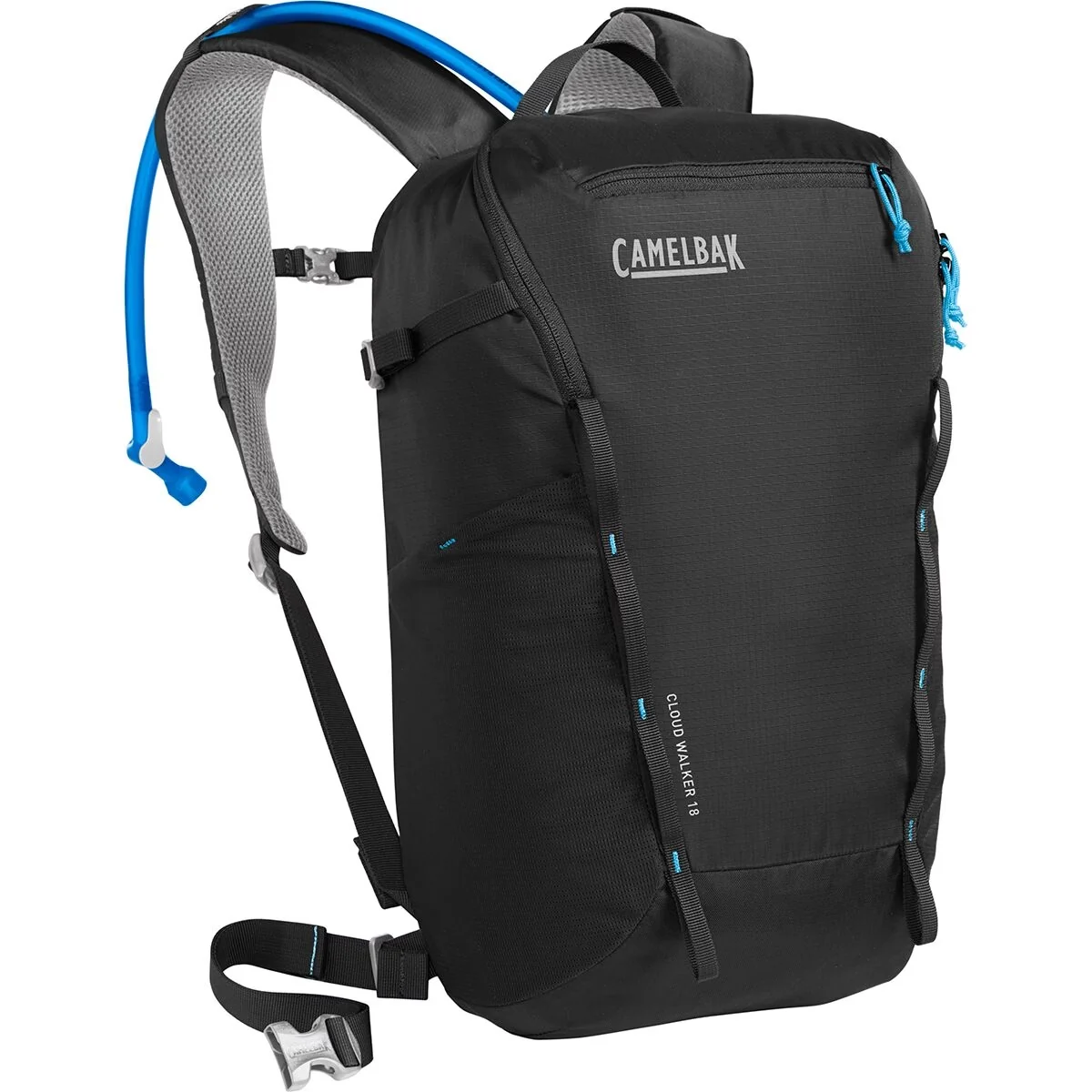 CamelBak Cloud Walker 18
A 2.5 liter reservoir and room for a rain layer at the lowest price here, for short hikes and torsos of 15 to 19 inches. The waist strap steadies the pack but carries no weight.
The Everyday Pair: Osprey Skarab 22 and Skimmer 20
Osprey’s everyday pair comes with a 2.5 liter reservoir in the box, a wide top opening and a 5 to 20 pound load range. The Skarab 22 is the men’s version and the Skimmer 20 the women’s.
Two Skimmer owners on REI call it comfortable for a full day, though its side pockets let bottles slip out.
Older listings for these two still show different specs, so the figures here are Osprey’s for the current design.
Best For
Everyday half-day to full-day hikes with a light kit. It suits you if you want a simple top-loader with the reservoir included, in a men’s or a women’s fit.
Why It Stands Out
Comfort is the comment that keeps turning up, mostly from Skimmer owners on REI, and one Skarab owner says it was comfortable after 10 days on Arizona trails. One Skimmer owner calls it “Plenty big enough for an all day hike.”
That holds up in what owners say they carry: layers, poles, lunch, a towel and a first aid kit. And the Hydraulics LT 2.5 liter reservoir comes in the box, so there’s nothing else to buy before your first hike.
Key Features and What They Mean
- Included 2.5 liter reservoir: water without stopping, and a retailer lists a quarter-twist on/off switch on the bite valve, so no drips in the car.
- Magnetic bite valve attachment on the sternum strap: the hose clips back where you can reach it.
- Wide-mouth top-zip opening: you can see the whole main compartment, so a jacket goes in and comes out easily.
- Zippered slash pocket at the top of the back panel: a spot for your phone, keys or sunglasses.
- Front daisy chain and compression straps with pole capture: a jacket or poles on the outside, and a half-empty pack cinched down.
- AirScape foam back panel: it sits close to your back for stability, and Osprey calls it breathable.
- Removable 20 mm webbing hipbelt and a 5 to 20 pound load range: no padding and no pockets, so it’s built for water, a layer, lunch and first aid, not overnight gear.
Osprey lists the Skarab 22 at 1.367 pounds.
Men’s vs Women’s Fit
Osprey says the pair is designed for a body-specific fit, with the women’s version cut for shorter, narrower and more curved bodies. The features, fabrics and load range are the same.
The torso ranges come from REI, since Osprey’s pages give none: 17 to 22 inches for the Skarab and 15 to 18 for the Skimmer. REI lists 25 to 50 inches at the waist and hips for both.
Osprey lists the same back on both: open mesh over bumped EVA foam on an Atilon framesheet.
REI marks the Skimmer as fitting slightly large based on reviews, though one petite owner found it fit her well. Its weight is unsettled: Osprey lists 1.65 pounds and REI lists 1 lb 4.3 oz.
Where It Falls Short
The Skimmer’s side pockets are the complaint that keeps coming up. Three of the eight REI reviews say bottles and other things fall out when you bend over, and one owner puts it bluntly: “the side water bottle pockets are pretty much useless.”
A Skarab owner also wished the side pockets had closures. The magnet splits opinion: one owner calls it brilliant, and another says the valve doesn’t stay on it.
The webbing hipbelt steadies the pack but carries no weight, so a full day’s load still sits on your shoulders.
The reservoir is worth a check at home. Osprey’s Hydraulics LT 2.5 liter sold on its own averages 3.9 out of 5 from 88 REI reviews, with 14 one-star ratings.
The critical review I could read describes a leaking top, and the listing may cover more than one version of the reservoir. Take it as a reason to test yours before a hike, not a verdict.
Pros
The reservoir comes included
Comfortable for a full day, by Skimmer owners on REI
A men’s and a women’s version
Osprey’s All Mighty Guarantee, which repairs or replaces the pack for any functional damage or defect (the included reservoir has its own warranty through HydraPak)
Cons
Loose side pockets on the Skimmer, by owner reports
A webbing hipbelt with no padding and no pockets
Who Should Skip It
Skip it if you rely on side pockets for your bottles, especially on the Skimmer. It’s also not the pair for a padded, weight-carrying hip belt or belt pockets, for overnight trips, or for a torso outside REI’s ranges.
Verdict
For most day hikes with a light load, this is the pair I’d start with: the Skarab 22 for a torso of 17 to 22 inches, and the Skimmer 20 for 15 to 18.
Skimmer owners on REI find it comfortable for a full day, and the reservoir is already in the box.
Just carry any backup bottle inside the pack rather than in the side pocket, and save the heavier packs for the days that need them.
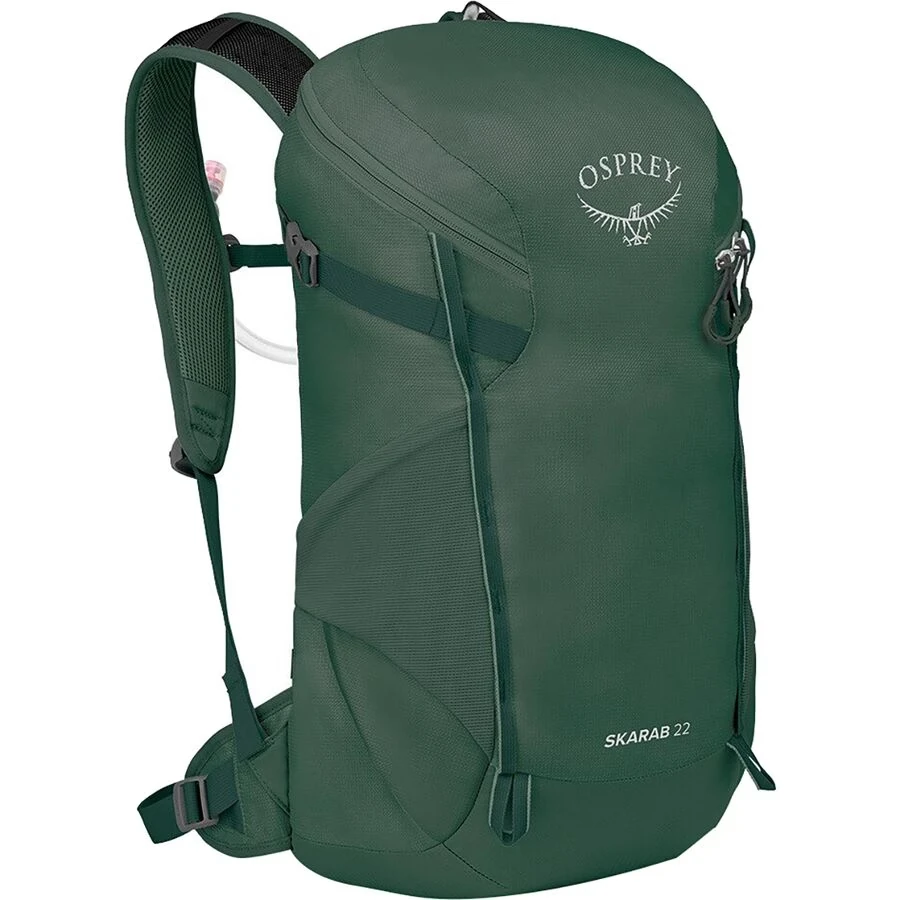 Osprey Skarab 22
The men's everyday pack, with the 2.5 liter reservoir in the box and a wide top opening, for light half-day to full-day hikes and torsos of 17 to 22 inches.
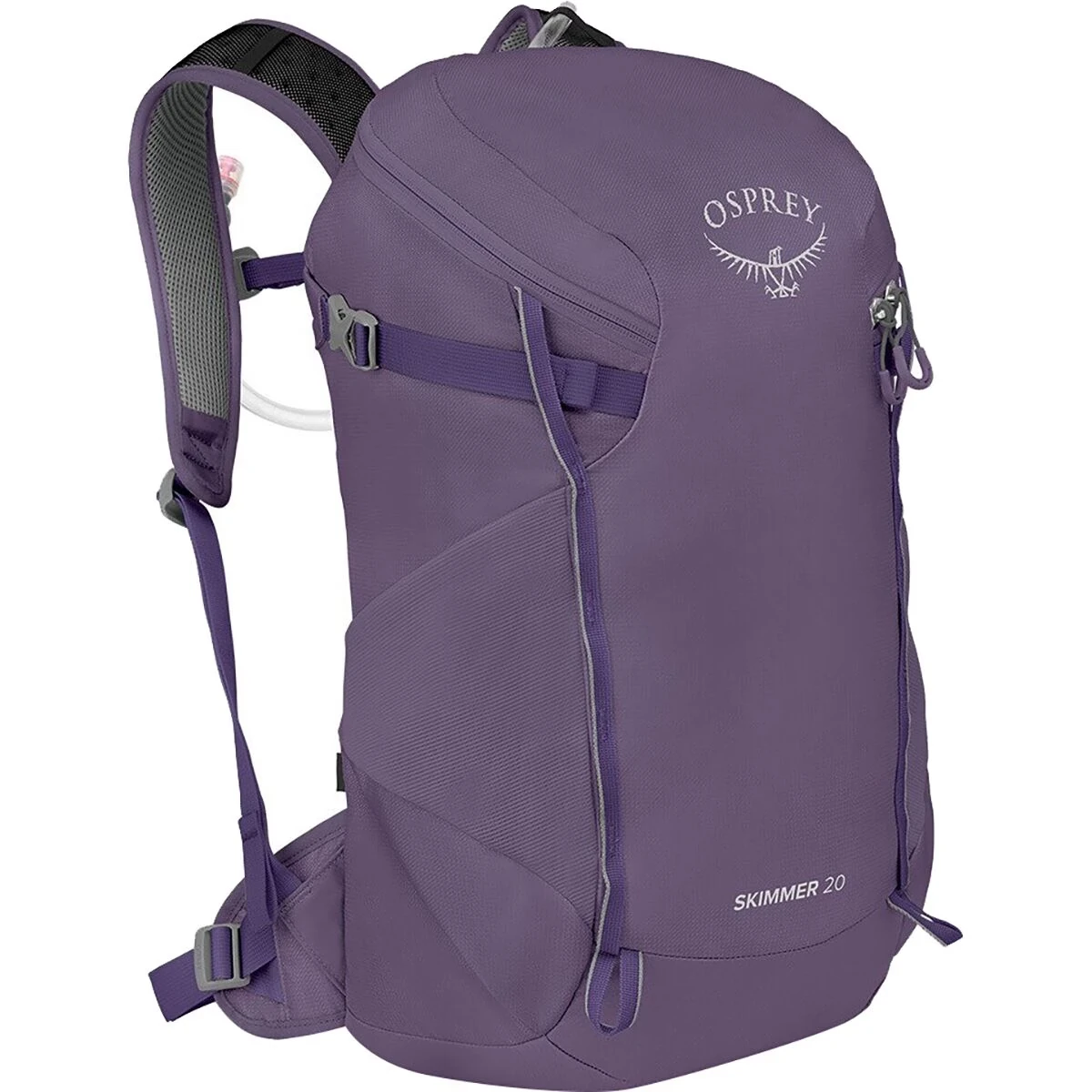 Osprey Skimmer 20
The women's everyday pack, for torsos of 15 to 18 inches, with the reservoir in the box. Carry a backup bottle inside, since owners say the side pockets let things slip out.
For Long or Hot Days: Osprey Manta 24 and Mira 24
The Manta 24 and Mira 24 are built for long or hot days, with a trampoline mesh back on a perimeter frame, a padded hip belt rated for 10 to 30 pounds, a 2.5 liter reservoir and a rain cover included.
The cost is weight, about 3.3 to 3.4 pounds empty by Osprey, and the highest price of the three.
These are the Spring 2026 versions. The Mira 24 replaces the Mira 22, and older units of both are still sold new at some stores with different figures, so check the name and capacity before you buy.
Best For
Long or hot day hikes, with water, layers and lunch carried on your hips. It’s the pick for sweaty backs, for shorter women on the Mira with its 15 to 20 inch torso range, and for anyone who wants a rain cover in the box.
Why It Stands Out
The AirSpeed back is the reason to buy it. A LightWire perimeter frame tensions a mesh back panel so the pack sits off your back, and the padded hip belt is rated for 10 to 30 pounds, so the water weight lands on your hips.
Owners on REI back both points across both versions.
One owner of the new Manta 24 says the suspension “lets your back breathe.” An owner of the new Mira 24 adds, “The hip belt takes off a lot of the weight.”
Key Features and What They Mean
- Hydraulics LT 2.5 liter reservoir with Quick Connect, in its own sleeve: you can refill without pulling out your layers and lunch first.
- Padded full-yoke harness with load lifters and an adjustable torso: load lifters are short straps at the top of the shoulder straps that pull the load in toward your back, and one size covers a 5 inch torso range, so set it to your number before the first hike.
- Two zippered hipbelt pockets: snacks and a phone within reach while you walk.
- Front shove-it pocket, U-zip front pocket and dual-access side pockets: a jacket stuffed on the outside, and bottles you can reach from the top or the side.
- Panel access with a wide dual zip: the main compartment opens wide, so you aren’t digging from the top.
- Rain cover in a base pocket: nothing extra to buy for a passing shower.
Osprey lists the Manta 24 at 3.4 pounds and the Mira 24 at 3.28 pounds.
One catch on the reservoir sleeve: Backcountry’s product notes say the reservoir can be tight to slide in when the main compartment is already full. Filling it first, then packing, avoids the wrestle.
Men’s vs Women’s Fit
Osprey’s spec pages list the same features, fabrics and 10 to 30 pound load range for both. What changes is the fit.
The ranges come from REI: a 17 to 22 inch torso on the Manta and 15 to 20 on the Mira, with hip belts of 30 to 50 inches and 28 to 50 inches. Osprey doesn’t give either range.
Shorter women have the most to go on. Owners of the previous Mira 22 at 5’2″ and 5’3″ say it fits, and one owner of the new Mira 24 is 5’4″. REI marks the Mira 24 as fitting slightly large based on reviews.
One owner of the new Manta 24, at 5’8″ and 200 to 225 pounds, says the weight distribution is excellent when loaded. That’s a single report, but a useful one if you’re built along those lines.
Where It Falls Short
Weight is the honest cost. Empty, these weigh two to two and a half times as much as the other Osprey pair, they’re the most expensive packs here, and one owner of the previous Mira 22 found it “a bit on the heavy side for long day hikes.”
Two small irritations show up in owner reviews. The hipbelt pockets are hard to close while you’re wearing the pack, by one owner’s report, and owners of both versions say the magnet on the bite valve keeps popping loose.
The reservoir has a few one-off reports on the previous version: a plastic taste that didn’t go away, a spill, and a bite valve that failed. None of that is a pattern, but none of it supports calling the reservoir leak-free either.
Owner data on the Spring 2026 versions is still thin. Some colors sell out, so check the color you want before you plan around one.
Pros
A mesh back that owners say lets your back breathe
A padded hip belt that takes the load off your shoulders
A separate reservoir sleeve and a rain cover included
Cons
The heaviest and most expensive pick here
Hipbelt pockets that one owner found hard to close while wearing the pack, and a magnet that slips
Who Should Skip It
Skip it if you’re counting ounces, or if you need hipbelt pockets you can zip while walking, since one owner found them hard to close. And if you’re after a small, minimal pack for short hikes, this one carries more frame than you need.
Verdict
When your hike is long or hot enough that the water weight and a sweaty back are the real problems, this is the pair I’d choose: the Mira 24 for a 15 to 20 inch torso, the Manta 24 for 17 to 22.
The mesh back and the padded belt are exactly what owners praise. When that isn’t your hike, the extra weight buys you nothing, and the Skarab or Skimmer will carry a light day just as well.
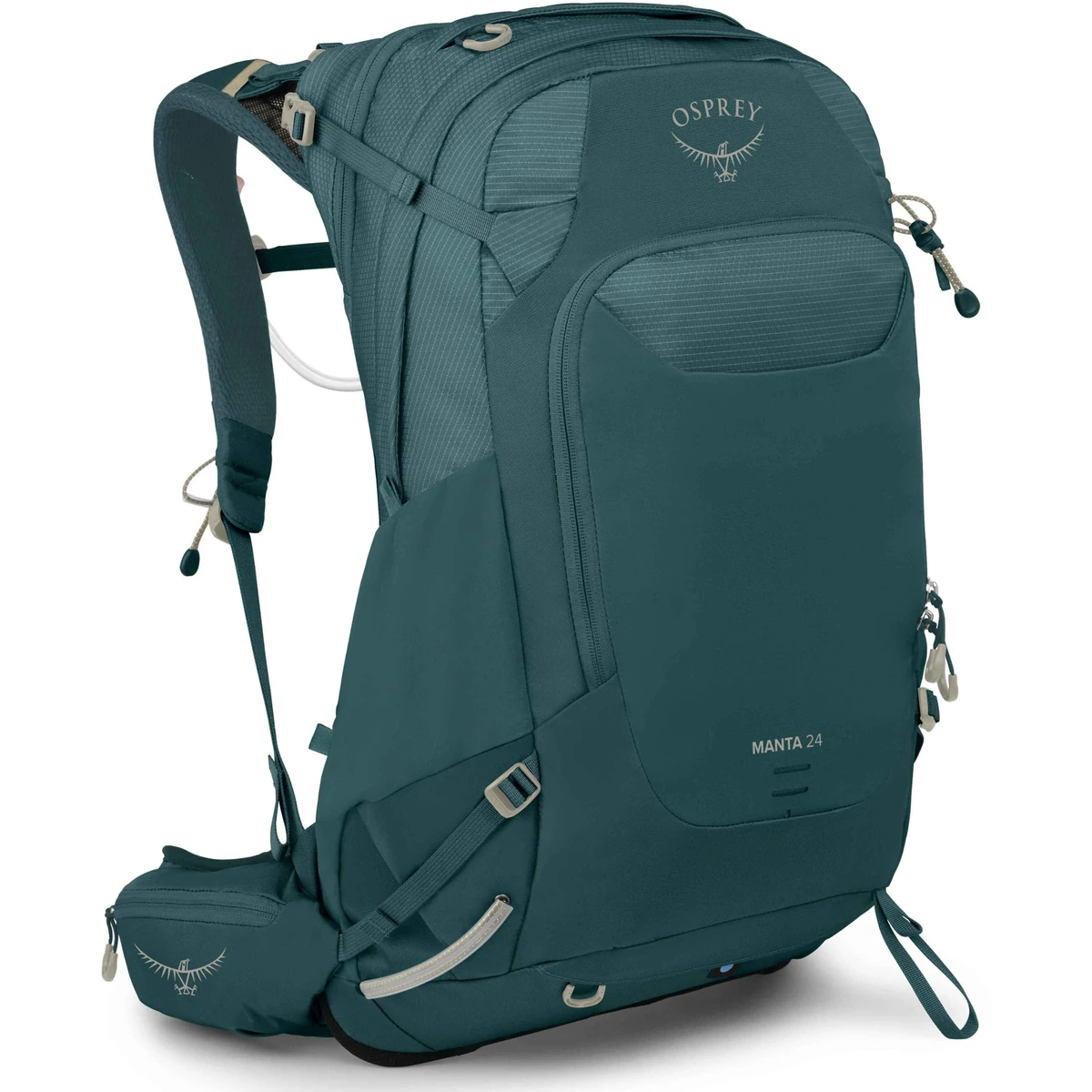 Osprey Manta 24
A mesh back that holds the pack off you and a padded hip belt that takes the water weight, for long or hot days and torsos of 17 to 22 inches. It's the heaviest pick here.
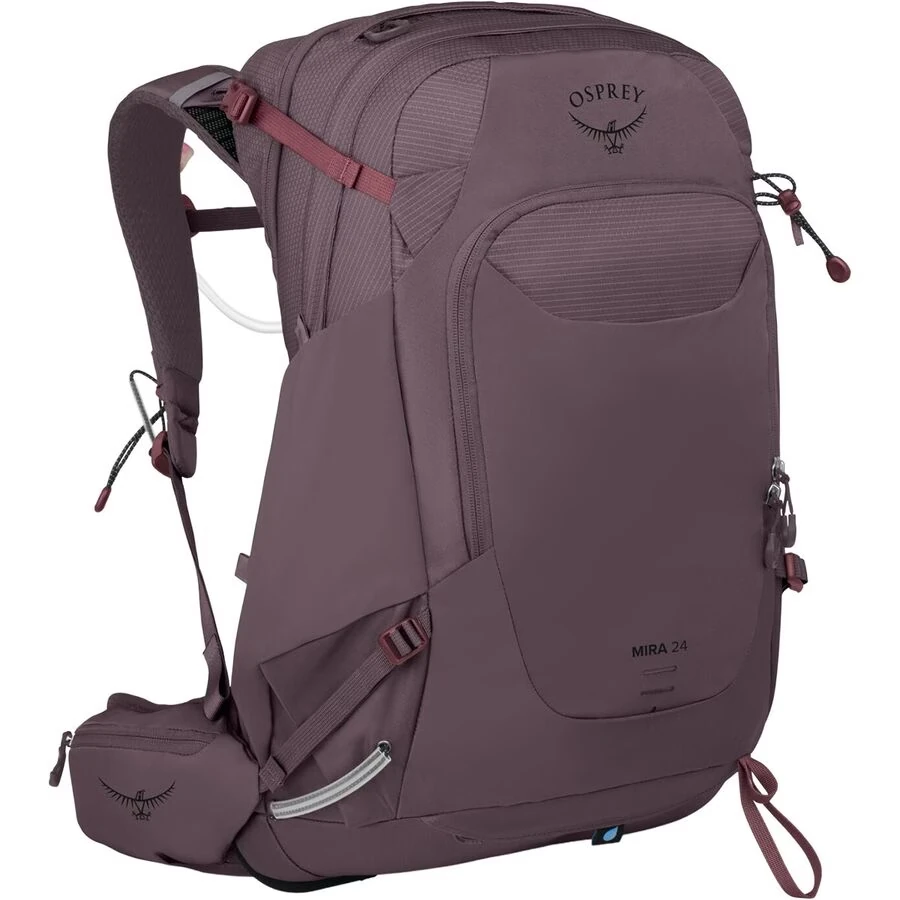 Osprey Mira 24
The women's fit of the Manta, for torsos of 15 to 20 inches, with the same mesh back, padded hip belt and rain cover in the box.
A Hydration Pack, a Bladder in Your Own Pack, or Bottles?
You don’t always need a new pack. If your daypack already has a reservoir sleeve and a hose port, a bladder may do the job.
If you need 3 liters, every pick here comes with a 2.5 liter reservoir, so a 3 liter bladder in a daypack with a padded hip belt is the simpler route. Bottles still work if you don’t mind stopping to drink.
Here’s how I’d split it:
- Buy one of the picks above if you want a small pack built around the water, because the reservoir and the pack are sized for each other.
- Add a bladder if your daypack already fits you and has a sleeve, since fit is the hard part and you’ve already solved it.
- Stick with bottles if you like seeing what’s left and stopping to drink doesn’t bother you.
Why Not Just Carry Bottles?
A reservoir puts a tube at your shoulder, so you can sip without stopping or taking the pack off. With the water right at your shoulder, it’s easier to sip a little and often.
It has its costs. REI lists Osprey’s Hydraulics LT 2.5 liter reservoir at 5.9 oz, and a bladder hides how much water is left. Check it at a break, and turn back at half, as the Saguaro advice above says.
It also needs cleaning a hydration bladder properly and letting it dry fully after each hike, which a bottle mostly spares you.
If you’d rather see your water and don’t mind stopping, bottles are a fine answer, and the right hiking water bottle also makes a good backup next to a bladder.
Adding a Bladder to the Daypack You Already Own
Look for three things in the pack you own:
- A reservoir sleeve with a hanger, so the bladder stays upright and doesn’t slump to the bottom when it’s half empty
- A hose port, so the tube can reach your shoulder without the zipper pinching it
- Room for the size you need, 2 or 3 liters, matched to your hike with the table above
Before your first hike, slide the full reservoir into the sleeve at home, since some sleeve openings are tight even for the pack maker’s own reservoir. And follow the reservoir maker’s own care rules from the first fill.
If your hike needs 3 liters, a 3 liter bladder in one of the daypacks with a padded hip belt carries it well, because the belt takes those 6.6 pounds or so of water off your shoulders. The picks here all ship with 2.5 liters.
Packs worn at the waist, including hip packs with a reservoir, are a different design and aren’t covered here.
Before you buy anything, time your usual hike and multiply by half a liter an hour, or about a quart on hot, dry days. Measure your torso and match both numbers to the tables above.
And check the daypack you already own for a reservoir sleeve first, because it might only need a bladder.
Founder & Gear Research Editor

Sonia Zannoni
I’m Sonia, the founder of Best Trail Backpacks. I don’t test gear myself. For every pack I cover, I read the manufacturer’s specs and sizing charts and look for what owners report again and again.
Fit comes first, because a pack that doesn’t match your torso and hips will hurt no matter what it cost. My goal is to help you choose a pack that suits your body, your trip and your budget.
About the Founder
