
Benefits of Hiking for Everyday Hikers: What the Research Shows, and What It Can’t Promise
One list tells you a hike is serious cardio. The next says it’s no better than a walk around the block, and a third says the trees will boost your immune system. They can’t all be right, and none of them says which one to believe.
That confusion isn’t your fault. Most of these lists copy each other and never say which claims come from real studies, so a strong finding and a weak one sound exactly the same.
What you came for is simpler: which benefits of hiking actually hold up, and whether the hiking you can fit in (for a lot of people, Saturdays only) is enough to count.
By the end you’ll know which benefits rest on solid evidence, which ones don’t, and how much hiking a week the evidence supports, so you can build a habit you’ll keep instead of chasing one big hike.
TL;DR: Benefits of Hiking
- A hike at a normal pace counts as moderate exercise, and a steady hike on rougher, hillier trail with a daypack can reach vigorous, so it counts toward the weekly 150 minutes the US guidelines set.
- The best-supported benefits (heart, blood pressure, blood sugar, mood, sleep) come from being active. Time in nature adds a smaller, less certain layer, mostly for stress.
- Aim for a weekly habit you keep, not one big hike: in the large studies, how the week’s time was split mattered less than reaching it.
- Leave out the claims about trees boosting your immune system and hiking as a treatment, because the evidence doesn’t support them.
How to Tell a Real Benefit From One Copied Off Another List
Most lists put a federal guideline and a one-afternoon study side by side. Three questions sort them: what kind of study backs the claim, whether the benefit comes from moving or from being outdoors, and what it can’t promise. The strongest benefits hold up, and a few popular ones don’t.
Three tabs of benefit lists that disagree leave you with nothing to go on, because each one sounds equally sure of itself. I put every claim on these lists through the same three questions, and they’re simple enough to use on any list you find.
- What kind of evidence backs it? A guideline built on many reviews of the research carries the most weight. A trial that compares people who hiked with people who didn’t comes next. A survey can only show a link, because it can’t separate the hiking from everything else in people’s lives.
- Does it come from being active or from being in nature? Most of what hiking does for your body comes from moving, the same as brisk walking or cycling would. A smaller set of findings is about the outdoor setting itself, and it helps to keep the two apart.
- What can’t it promise? Every study has an edge: one walk, a small group, healthy volunteers, one season. Knowing that edge tells you how much weight a claim can carry.
You’ll see the words “linked with” a lot below, and they matter. A survey can show that people who spend time outside tend to report better health, but not that the time outside caused it, because healthier people may simply go out more.
The lists say strong and weak claims at the same volume, so these questions are how the rest of this post sorts them. Here’s how the common claims come out, in the order the post works through them.
Benefit
Comes From
Evidence Behind It
What It Can’t Promise
Heart, blood pressure and blood sugar
Being active
Federal guidelines built on systematic reviews, plus one small hiking study
That a single hike changes your risk
Mood and anxiety
Being active
A review of 97 systematic reviews
That hiking treats depression or anxiety
Sleep
Being active
Federal guidelines, plus two small hiking trials
A big effect from hiking alone
Bones
Being active
Federal guidelines
A specific gain in bone density from hiking
Stress and a busy head
Being in nature
Small trials and studies following the same people over time
Lasting effects, or a treatment
Blood pressure near green space
Being in nature
A review of 143 studies, mostly associations
That green space causes it
Balance and falls
Mixed exercise programs, not walking alone
Federal guidelines
That trail walking alone prevents falls
Immune boost from trees
Unsettled
Small, short studies
Any benefit you can count on
Heart, blood pressure and blood sugar
Comes From: Being active
Evidence Behind It: Federal guidelines built on systematic reviews, plus one small hiking study
What It Can’t Promise: That a single hike changes your risk
Mood and anxiety
Comes From: Being active
Evidence Behind It: A review of 97 systematic reviews
What It Can’t Promise: That hiking treats depression or anxiety
Sleep
Comes From: Being active
Evidence Behind It: Federal guidelines, plus two small hiking trials
What It Can’t Promise: A big effect from hiking alone
Bones
Comes From: Being active
Evidence Behind It: Federal guidelines
What It Can’t Promise: A specific gain in bone density from hiking
Stress and a busy head
Comes From: Being in nature
Evidence Behind It: Small trials and studies following the same people over time
What It Can’t Promise: Lasting effects, or a treatment
Blood pressure near green space
Comes From: Being in nature
Evidence Behind It: A review of 143 studies, mostly associations
What It Can’t Promise: That green space causes it
Balance and falls
Comes From: Mixed exercise programs, not walking alone
Evidence Behind It: Federal guidelines
What It Can’t Promise: That trail walking alone prevents falls
Immune boost from trees
Comes From: Unsettled
Evidence Behind It: Small, short studies
What It Can’t Promise: Any benefit you can count on
The Benefits of Hiking With the Strongest Evidence: What Moving Does for You
A normal-paced hike is moderate exercise, and a harder, hilly one can reach vigorous, so it counts toward the US weekly guidelines. That’s where its best-supported benefits come from: lower risk of heart disease, high blood pressure and type 2 diabetes, better sleep, and fewer anxiety and depression symptoms.
Why a Hike Counts as Real Exercise
You may have been told that hiking is just walking and doesn’t really count as cardio. The numbers say otherwise, and they come from the reference researchers use to rate how hard different activities are.
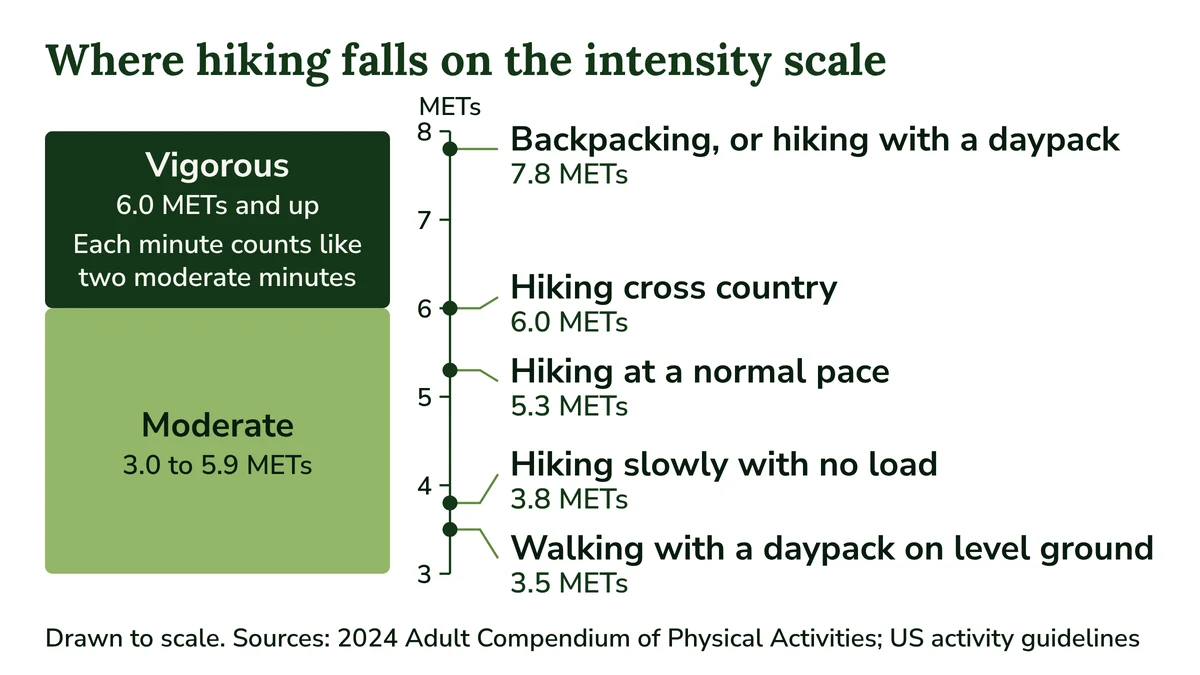
That reference, the 2024 Adult Compendium of Physical Activities, measures effort in METs. A MET is how hard an activity works your body compared with sitting still. Here’s how it rates hiking:
- Hiking slowly with no load: 3.8 METs, which is moderate
- Hiking at a normal pace through fields and hillsides: 5.3 METs, also moderate
- Hiking cross country: 6.0 METs, the start of vigorous
- Backpacking, or hiking with a daypack: 7.8 METs, well into vigorous
The Physical Activity Guidelines for Americans treat 3.0 to 5.9 METs as moderate and 6.0 and up as vigorous. So a normal-pace hike is moderate activity, which is the “because” behind a hike counting as exercise.
The same Compendium lists walking with a daypack on level ground at only 3.5 METs, still moderate. So it’s the trail and the climbing that push a hike into the vigorous range, not the pack itself.
Quick Tip: If you’re short on time, a harder hike on climbing trail counts for more. When most of it is at that vigorous effort, each minute counts like two moderate minutes under the US guidelines.
The same guidelines ask adults for 150 to 300 minutes of moderate activity a week, or 75 to 150 of vigorous, plus muscle strengthening on 2 or more days. The World Health Organization sets the same 150-minute baseline, so the number holds wherever you hike.
Hiking covers the aerobic part of your week. The strength part still needs its own time.
Heart, Blood Pressure and Blood Sugar
This is where the evidence is strongest. The US guidelines, built on systematic reviews, find strong evidence that regular activity lowers the risk of dying early from any cause, cardiovascular disease, high blood pressure, type 2 diabetes and unhealthy blood fats.
Part of the reason shows up within a single session. Blood pressure can drop for a while afterward, and your body responds better to insulin, the hormone that moves sugar out of your blood. Repeat that week after week and it adds up.
Isn’t this just the benefits of exercise? Mostly, yes, and that’s good news: the evidence for being active is the strongest there is, and a hike is a way of being active that many people actually look forward to.
There’s also a hiking-specific example. In a 2021 study in Scientific Reports, Drexel and colleagues followed 102 sedentary adults who hiked downhill three to five times a week for two months, taking a cable car back up.
Their bodies handled blood sugar better on three lab measures, including fasting blood sugar, while a smaller group of 25 who didn’t hike showed no such change.
It was an intervention study with a small comparison group, not a randomized trial. I’d read it as one encouraging example of the general rule, not as proof that every hiker will see the same result.
Mood and Anxiety
The mood evidence is about activity in general, and there’s a lot of it. A 2023 review in the British Journal of Sports Medicine by Singh and colleagues pulled together 97 systematic reviews, covering 1,039 trials and 128,119 people.
They found that physical activity, including walking, had medium effects on symptoms of depression, anxiety and distress compared with usual care. That’s activity rather than hiking or nature in particular, and it measures symptoms, not a cure.
The US guidelines add a shorter-term effect you may already have noticed: anxiety tends to drop for a while right after a session of activity.
Sleep and Bones
Sleep is a quieter benefit, and it holds up. The US guidelines find that more active adults sleep better, and that moderate to vigorous activity improves sleep quality.
One hiking paper points the same way. In the second of two small randomized studies published in BMC Public Health in 2023, people given free entry to a winter hiking challenge plus traction cleats went out more often and slept longer.
Their stress didn’t measurably change. Both studies were small, in one region, over one season.
Bones are part of the picture too. The guidelines report that activity improves bone health and can slow the loss of bone density that comes with age. There’s no reliable figure for how much hiking alone does that, so I’d count it as a general benefit of staying active.
So when a list says hiking is good for your heart, your mood and your sleep, it’s right, for the plain reason that hiking is exercise. The next question is what the trail adds that a gym can’t.
What Time Outdoors Adds on Top of the Exercise
Time in nature seems to add something a treadmill doesn’t, mostly for stress. In small studies, a walk in a natural area eased rumination more than a city walk, and regular short visits lowered a stress hormone. A large review links green space with lower blood pressure, mostly through associations.
Maybe your head is still replaying the work week when you start up the trail, and it’s quieter by the time you turn around. One study fits that feeling well.
Bratman and colleagues, in PNAS in 2015, had healthy adults take a 90-minute walk in a natural area or along a busy street. Afterward, the nature walkers ruminated less, meaning they went over the same worry again and again less often.
Activity also dropped in a brain area linked to rumination, and the street walkers showed no such change. It was a small randomized experiment with one walk, so it points to a possible reason the trail feels good, not a treatment.
A second study looked at regular visits. Hunter, Gillespie and Chen followed 36 city dwellers for 8 weeks as they spent 10 minutes or more in nature at least 3 times a week. Their cortisol, a stress hormone measured here in saliva, fell beyond its normal daily drop.
It fell most efficiently over 20 to 30 minutes, and sitting or walking during the visit made no difference. The group was small and there was no separate control group, so it’s a lead worth knowing rather than a settled answer.
The widest view comes from Twohig-Bennett and Jones, who reviewed 143 studies of green space and health in 2018. More green space was linked with lower cortisol, heart rate and diastolic blood pressure (the lower number), and with lower rates of type 2 diabetes and death from cardiovascular disease.
The authors themselves flag poor study quality and wide differences between the studies. Most of it shows associations, and people who live near green space may differ from other people in ways the studies can’t fully account for.
Put together, I’d count the nature part as a real bonus on top of the exercise rather than the main reason the habit works. It’s smaller and less certain than the activity evidence, but it’s the part a treadmill can’t give you, mostly for stress and a busy head.
Four Hiking Claims That Don’t Hold Up the Way the Lists Say
A few popular claims go further than the studies behind them. Trees boosting your immune system rests on small, short studies. Ten thousand steps isn’t a proven target, trail walking alone isn’t shown to prevent falls, and while being active can ease low mood, hiking isn’t a treatment.
Many lists also quote precise percentages for cholesterol, leg muscle and calories on uneven trail, and say the benefits fade after three to six months. The calorie figure is the only one I could trace to a study.
In that small lab study (Voloshina and colleagues, Journal of Experimental Biology, 2013), 11 people walking on an uneven treadmill surface used about 28 percent more energy than on a smooth one. That’s a lab result, not a trail measurement.
For the cholesterol and leg muscle figures and the three-to-six-months line, I couldn’t find a study at all, so they’re not in this post.
The four claims below come up most often, and each one goes through the same three questions from the start of this post.
“The Trees Boost Your Immune System”
This claim usually points to phytoncides, natural compounds that trees release into the air. The evidence rests mainly on small Japanese studies of 3-day forest trips and on lab work with cells, which is a long way from a weekend day hike.
A 2021 systematic review found positive signals but weak study designs and open questions about how much exposure would matter. Another review reports inconsistent results.
My read is that it’s early and unsettled. It’s interesting research, but it isn’t a benefit to count on when you decide whether to go.
“It Only Counts if You Hit 10,000 Steps or Climb a Mountain”
The 10,000-step goal sounds official, but the research doesn’t back it as a target. Paluch and colleagues, in Lancet Public Health in 2022, found the lower risk of death that comes with more steps leveled off at about 6,000 to 8,000 a day for adults 60 and older.
For younger adults it leveled off at about 8,000 to 10,000. Those are observational findings, so they show a link rather than a cause, and they make 10,000 look more like a round number than a finish line.
The climb-a-mountain part doesn’t hold up either. The US guidelines say some physical activity is better than none and that bouts of any length count, so a modest trail close to home counts.
“Hiking on Rough Ground Trains Your Balance”
Uneven ground feels like it should train your balance. The US guidelines found that programs mixing several kinds of exercise are the most successful at reducing falls and the injuries that come with them.
They also found that low-intensity walking on its own doesn’t seem to reduce fall-related injuries and fractures. I couldn’t find a study showing that trail walking on uneven ground works as balance training by itself, though it may help as part of a mix.
That’s why the guidelines tell older adults to include balance training on purpose, rather than counting on the trail to provide it.
Quick Tip: If balance is what you’re after, pair your hikes with balance and strength exercises, because the US guidelines found mixed programs work best for reducing falls.
“Hiking Can Stand In for Treatment”
Plenty of people say the trail is what keeps their head straight, and some say hiking saved them. That feeling is sincere and common, and nothing in the research takes it away from you.
The research measures something narrower, though. The mood studies track symptoms, mostly from activity in general, compared with usual care. None of them tested hiking as a replacement for that care.
You may have seen headlines saying exercise beat counseling or medication. Those headlines came from a university press release about the Singh review above, which compared activity with usual care and drew mostly on mild to moderate symptoms. It isn’t a reason to stop a treatment that’s working.
The US guidelines say adults with a health condition or symptoms should be under the care of a health care provider. Hiking can be part of your week alongside that care, and the evidence doesn’t support it taking that care’s place.
How Often to Hike: A Weekly Habit, Not One Big Day
The evidence points to a weekly amount you keep up, not one big hike. US guidelines set 150 minutes of moderate activity a week, and a large English survey linked 120 minutes a week in nature with better reported health. How people split the time mattered less than reaching it.
The guidelines’ range is 150 to 300 minutes of moderate activity a week, or 75 to 150 of vigorous, preferably spread through the week. The CDC’s example is 30 minutes a day on 5 days, and it says smaller chunks count too.
A second number comes from White and colleagues, who surveyed about 20,000 adults in England for a 2019 study. People who spent 120 minutes or more a week in nature were more likely to report good health and high life satisfaction. Those with 1 to 119 minutes weren’t.
In that survey, one long visit or several short ones gave similar results. It was a snapshot, people reported their own time and health, and the authors call 120 minutes a tentative threshold.
If Saturday is the only day you can get out, you might wonder whether that counts. Khurshid and colleagues, in JAMA in 2023, looked at 89,573 adults who wore a wrist tracker for a week.
Reaching 150 minutes with most of it on 1 or 2 days was linked with a similarly lower risk of heart attack, heart failure, atrial fibrillation (an irregular heartbeat) and stroke as spreading it out. It’s observational, but a Saturday hiker who reaches the weekly amount doesn’t look shortchanged.
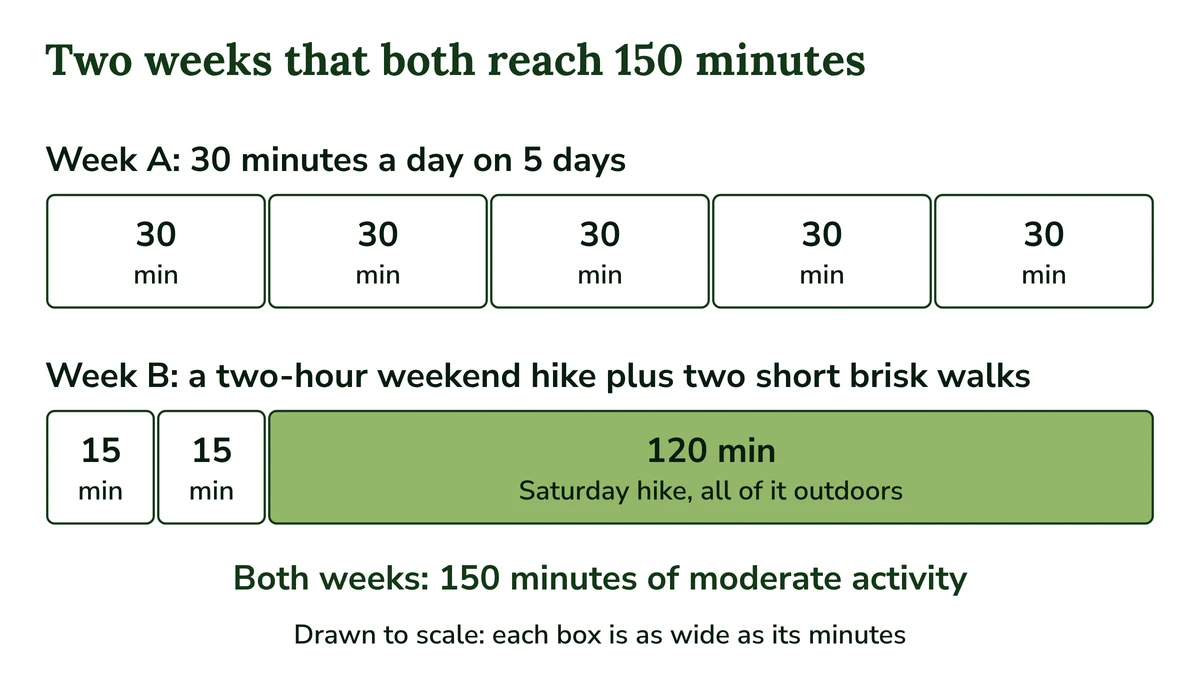
What the evidence rewards is a weekly amount you keep up week after week. A single big hike every month or two isn’t what any of these studies measured, and the guidelines still prefer spreading activity through the week, so both points stand.
Here’s how the arithmetic works for a weekend hiker:
- A two-hour weekend hike gives you 120 minutes outdoors on its own, the amount the English survey pointed to.
- At a normal pace, those two hours also cover 120 of your 150 moderate minutes, so a couple of short brisk walks during the week finish it.
- On a harder hike over rougher, hillier trail, when most of it is at that vigorous effort, each minute counts double, so about 75 minutes reaches the weekly minimum.
I hike on a regular weekly rhythm myself. Starting from scratch, I’d plan one longer hike a week and fill the rest with short walks. That gives you the outdoor time the survey points to, the minutes the guidelines set, and some of the spreading out they prefer.
If you have a health condition, check with your health care provider first, and if you’re coming back after a long break, build up from shorter hikes.
Quick Tip: Count a normal week first. Add up the minutes you already spend walking briskly outdoors, then see how far one weekend hike takes you toward 150.
So pick one longer hike for this weekend that brings your week closer to 150 minutes. Before you go, check the hiking essentials for beginners so your pack holds what a first day hike needs and nothing it doesn’t.
Founder & Gear Research Editor

Sonia Zannoni
I’m Sonia, the founder of Best Trail Backpacks. I don’t test gear myself. For every pack I cover, I read the manufacturer’s specs and sizing charts and look for what owners report again and again.
Fit comes first, because a pack that doesn’t match your torso and hips will hurt no matter what it cost. My goal is to help you choose a pack that suits your body, your trip and your budget.
About the Founder
