
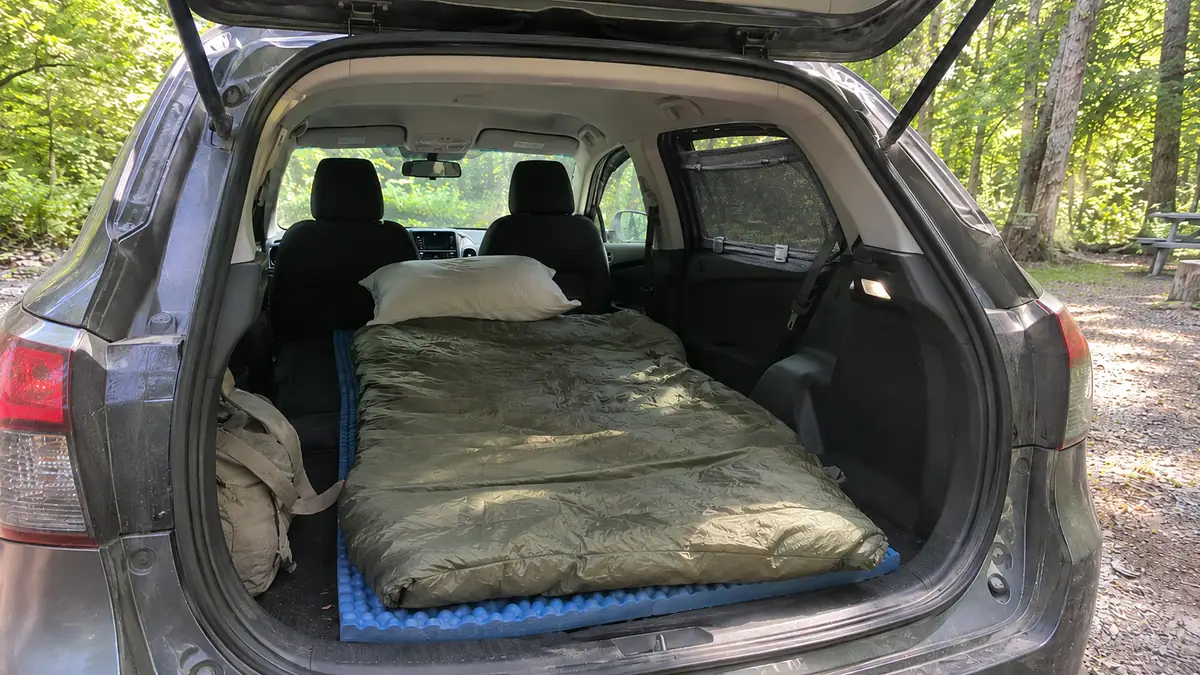
Car Camping Sleep Setup: How to Sleep Warm, Dry and Comfortable Beside or Inside Your Car
The next fix on your mind is probably a thicker air mattress, or maybe a propane heater. You bought the tall air bed so everyone would sleep like at home, and by 3 a.m. the cold came right up through it.
Everyone woke up stiff, with the tent walls or car windows wet. It’s a fair guess that a taller bed is warmer, and plenty of drive-in campers make it. A bed that feels great on a bedroom floor sits on much colder ground at camp, so this isn’t on you.
What you want is a car camping sleep setup that keeps everyone warm, dry and comfortable with the gear you already have, before you spend on more.
Here’s what to put under and on the bed you own, how to set up a level, dry spot in the tent or the car, and the one rule about the engine and heaters that keeps everyone safe. Your next night should go a lot better.
TL;DR: Car Camping Sleep Setup
- Much of the cold comes up from below. A tall air bed is one big pocket of moving air, so a thicker one won’t fix it. Put a closed-cell foam pad under it and an insulating layer on top first.
- Sleep level: park or pitch on flat ground, or keep your head higher than your feet.
- Let air in and keep wet things out: open tent vents or crack a car window with mesh over the gap, so condensation doesn’t soak your bedding.
- Engine off and no fuel-burning heater while anyone sleeps, in the car or in a tent beside it.
What Keeps a Car Camping Sleep Setup Warm, and What Drains the Heat
On a cold night at a drive-in site, much of the chill comes up from below. Any surface cooler than your body pulls warmth out of you, so the ground, the car floor or the air under a cot keeps drawing heat away unless something insulating sits in between.
That’s why the sleeping bag felt fine at bedtime and the cold crept in from underneath later. REI’s sleeping pad advice treats the pad as the barrier against exactly that cold. If I were sorting out a cold night, I’d look under the bed before I’d blame the bag.
Here’s what the rest of this post judges a setup by, and why each one matters:
- Insulation underneath. How much sits between you and the cold below decides most of how warm you stay.
- A flat, level bed. A slope slides you toward the low end and keeps waking you up.
- Air in, damp air out. Without a way for moist air to leave, condensation ends up on your bedding and the glass.
- Nothing burning near sleepers. An engine or fuel-burning heater running near anyone asleep is a carbon monoxide risk, covered in the last section.
- Space in the car. Every extra pad or cot takes room you may need for food, clothes and everyone’s bags.
Plenty of car camping for beginners advice ends at the packing list. The decision here is narrower: for your own bed and your own spot, what to add or change before you buy anything.
Why a Thicker Air Mattress Isn’t a Warmer One
Height on an air bed is comfort, not warmth. The ground and the night air cool the air inside, and REI notes that air mattresses may lack insulation. Check the box or listing for an R-value, an insulation rating, and treat a bed with none as giving little insulation.
It makes sense to think a taller bed is warmer. Thickness is sold as comfort, and a tall bed feels like home. If you bought one so the family would sleep well and woke up shivering at 3 a.m., that’s the gap between a bedroom and a campsite.
I’ve slept on an air mattress at a drive-in campsite myself, and I slept cold on it too.
Here’s what’s going on. An air bed is one big open chamber, and the air inside keeps circulating. It carries your warmth down to the cold underside and brings cooler air back up under you.
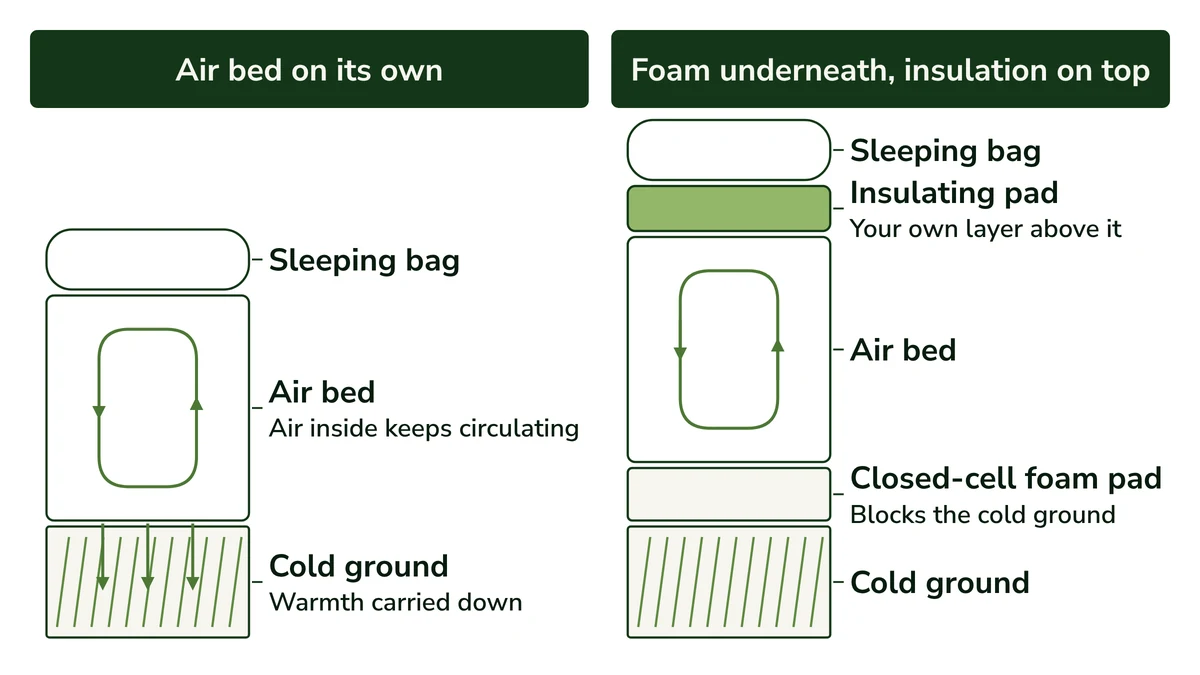
So why not just buy a thicker air mattress? Making the bed taller doesn’t stop that circulation, so the cold still reaches you. I’d put the effort into what goes under and on the bed you have first, and that usually costs less than a new bed.
Same Bed, Three Fixes: What Goes Under and On an Air Bed, a Cot or a Pad
You can usually fix the bed you already own. An air bed gets closed-cell foam under it and an insulating layer on top, and a cot gets a pad on top, since it may lack insulation.
A sleeping pad can simply go thicker, because weight doesn’t matter when you drive. I’d add the cheapest layer first, because a foam pad you can roll up goes straight at where the cold comes from.
Each fix costs something in the car, though. A pad on top of an air bed is one more thing to pack, and a cot or a thick pad takes space and setup time.
Air Bed: Foam Underneath, Insulation on Top
If an air bed is what you own, slide a closed-cell foam pad under it: the thin, dense kind that rolls up and costs little. REI’s pad guide says a closed-cell foam pad under another pad adds insulation and cuts the moisture that condenses underneath in cold conditions.
Then put something insulating between your body and the air bed, such as a foam or self-inflating pad on top. The top of the bed sits on all that cooled air, so you want your own layer above it.
Insulation ratings add up when you layer pads, as REI explains. Which ratings suit your coldest night is its own question, and I cover it in how to choose a sleeping bag and pad.
Quick Tip: Put the closed-cell foam under the air bed rather than on top of it. Underneath, it blocks the cold ground and cuts the damp that collects below the bed, which is where REI’s pad guide places it.
Cot: Cover the Cold Air Below
A cot gets you off the ground, but it can sleep cold on cold nights: you’re lying over open air, and nothing between you and that air stops it from drawing heat away. REI says cots may lack insulation as well, so it’s worth checking the specs on yours.
The fix is a pad on the cot, between you and that open air. The tradeoff is real: a cot takes space in the car and time to set up, which you feel most on a one-night trip.
Sleeping Pad: Go Thicker When You Drive
When size and weight don’t matter, REI says a thicker, larger pad that puts comfort first is fine, and self-inflating pads often suit car camping. On cold nights, REI’s sleeping tips add a closed-cell foam pad underneath for extra insulation.
If you sleep on your side and bottom out on a thin pad, or share a tent with someone and hate a pad that crinkles every time you roll over, my picks of quiet pads for side sleepers are matched to that sleep position.
The tradeoff is space. Thicker pads pack bigger, and room in the car goes fast once the family’s gear is in.
Here’s how the three fixes line up for the bed you already own.
Bed You Have
What Goes Under It
What Goes On It
The Tradeoff
Air bed
A closed-cell foam pad
An insulating pad
One more thing to pack
Cot
Nothing (the cold air under it is the problem)
A pad on the cot
Takes car space and setup time
Sleeping pad
A closed-cell foam pad on cold nights
Your sleeping bag
Thicker pads take more car space
Air bed
What Goes Under It: A closed-cell foam pad
What Goes On It: An insulating pad
The Tradeoff: One more thing to pack
Cot
What Goes Under It: Nothing (the cold air under it is the problem)
What Goes On It: A pad on the cot
The Tradeoff: Takes car space and setup time
Sleeping pad
What Goes Under It: A closed-cell foam pad on cold nights
What Goes On It: Your sleeping bag
The Tradeoff: Thicker pads take more car space
Find your bed in the table and start with the cheapest change in its row before you buy anything new.
Tent Beside the Car or a Bed Inside It: Setting Up Your Spot
Start with flat ground wherever you sleep, because a slope slides you to the low end. Park or pitch level, or keep your head higher than your feet. Pitch a tent well away from the car, and sleeping inside it takes a flat surface and your campground’s permission.
I’d choose between the two setups with the same checks from the start: insulation under you, a level bed, airflow and space. A car with a flat cargo floor saves pitching a tent, while a tent usually gives a family more room to spread out.
Level Ground and a Real Pillow
If you all slid to the low end of the tent overnight, the ground was doing it. REI’s sleeping tips say to pitch on a flat surface cleared of sticks, rocks and pinecones, and its tips for sleeping in your car say to park on a flat, shaded spot.
Bring a real pillow, too. The one you sleep on at home or a camp pillow both work, and REI suggests either, since at a drive-in site you aren’t carrying it anywhere.
Quick Tip: If you have to park on a slope, REI suggests positioning the car so your head is above your feet. The same goes for a tent on uneven ground.
The Tent Beside the Car, With the Whole Family
Pitch the tent well away from the car rather than tucked against it for shelter. The reason is carbon monoxide, and it’s in the last section below.
Every sleeper, kids included, needs their own insulation under them. Two people sharing an air bed still need the foam below it and an insulating layer above, because the cooled air inside reaches both of them.
If the dog’s coming too, plan where your dog sleeps at camp before the first night, so nobody is up at midnight sorting it out.
Sleeping Inside the Car
To sleep inside the car, you need a flat surface. The same REI tips suggest lying with your head toward the front, because the rear wheel wells take up space and the front gives you more elbow room.
Don’t count on the car being warmer than a tent. REI says cars can get as cold as tents at night, so bring an insulated blanket or a temperature-rated sleeping bag. Since nothing has to be carried, heavier and cushier mats, pillows and blankets are fine.
Check your campground’s rules before you plan on sleeping in the car. In Yosemite, for example, the National Park Service allows camping or sleeping in vehicles only in designated campsites. Your own campground’s page is the one that counts.
Once the bed is set, the next two things are the window gap and the engine, in that order.
Wet Tent Walls and Dripping Windows: Stopping Condensation in Both
Condensation works the same way in tents and cars. Your breath and anything wet you bring in add moisture, and it settles on cold fabric or glass. The fix matches: let fresh air in through vents or a cracked window, and keep wet things out of where you sleep.
If the windows were dripping by morning, every breath helped do that. REI’s guides on tent condensation and on sleeping in your car both point to your breathing and the wet things you bring inside, and the tent guide adds the humidity already in the air.
Won’t a cracked window make you colder? It lets in some cold air, but a sealed car fogs up and stays damp. I’d rather have a slightly cooler car than wet bedding and dripping glass.
In the tent, REI’s condensation advice comes down to a few habits:
- Open opposing vents for cross ventilation, so damp air has a way out the other side.
- Ventilate early, often and fully, before the walls are already wet.
- Roll up the rainfly doors unless rain starts, to let more air move through.
- Pitch on dry ground, preferably under trees, and keep wet gear out of the tent so it doesn’t add moisture.
In the car, REI’s tips for sleeping in your car cover the same ground:
- Crack a window or the sunroof just enough that a person or animal can’t get in, with mesh over the gap to keep bugs out.
- Dry wet clothes before bed, so they don’t add moisture to the air inside.
- Keep a squeegee handy to wipe the glass in the morning.
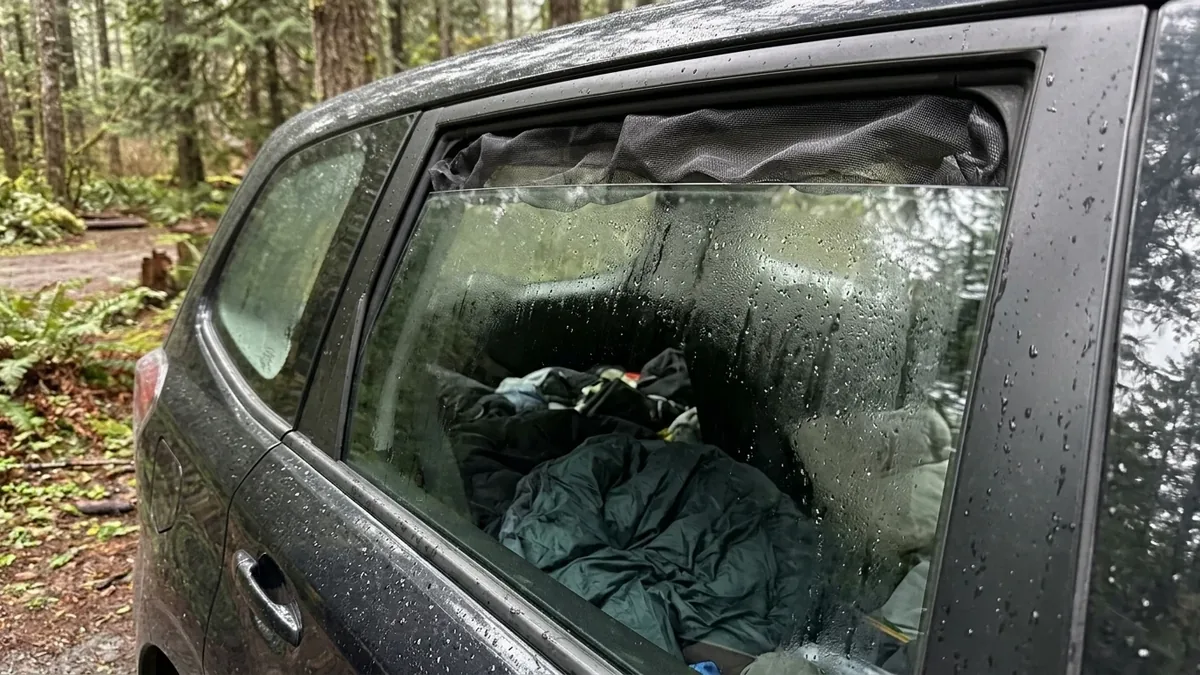
Quick Tip: Cut the mesh 2 to 3 inches wider than the window gap, so bugs can’t slip in at the edges, as REI suggests.
Once you’re home, dry a sleeping bag that got damp from condensation all the way before you store it. If it’s down, the steps for drying and storing a down bag keep that damp from turning into mildew.
Engine Off, No Fuel Heaters: The Carbon Monoxide Rule for Both Setups
Never run the engine or a fuel-burning heater while anyone is asleep, in the car or in a tent beside it, because both make carbon monoxide. The Consumer Product Safety Commission’s camping guidance says fuel-burning heaters never belong in a tent, camper or vehicle while you sleep.
The CPSC’s warning centers on enclosed areas such as tents, campers and vehicles. It says the same of fuel-burning lanterns, counts stoves among the camping sources of carbon monoxide, and notes that the risk is higher at altitude.
The part that’s easy to miss is the tent beside the car. The New York State Department of Health’s camper checklist says to pitch your tent far from any car or generator, and never to have an idling car near a sleeping area.
The same checklist warns that carbon monoxide can’t be smelled or seen, and that deadly amounts can build up in an enclosed space within minutes. It keeps stoves, grills, space heaters and generators outside and far from where people sleep.
For the sleeping area itself, the checklist asks for fresh air coming in, a vent for stale air going out and a check before bed.
What about running the engine for a few minutes to warm up before bed? No. At a campsite, someone in the tent beside the car may already be asleep, which is exactly the idling car near a sleeping area the checklist rules out.
In the car, it’s easy to doze off with the engine still running, which REI warns against. The CDC’s winter storm guidance limits the engine and heater to about 10 minutes an hour, and it’s written for someone stranded who has to stay awake.
I understand the pull when the kids are cold and the car is right there. That guidance was never meant to heat a car at camp, so the warmth has to come from what’s under and on the bed.
Know the signs, because they’re easy to mistake for a cold or the flu. The CPSC lists headache, dizziness, weakness, nausea, vomiting, sleepiness and confusion, and says to see a doctor if anyone develops cold or flu-like symptoms while camping.
If anyone feels this way in the tent or the car, get everyone out into fresh air right away and call 911, as the New York State Department of Health checklist advises.
So before you replace anything, go back to the bed you already own. Much of that 3 a.m. cold starts underneath, and a layer of foam is a smaller fix than a new mattress.
Before you buy a thicker mattress, check the box or listing of the one you have for an R-value, and if there isn’t one, put a closed-cell foam pad under it on your next trip.
Founder & Gear Research Editor

Sonia Zannoni
I’m Sonia, the founder of Best Trail Backpacks. I don’t test gear myself. For every pack I cover, I read the manufacturer’s specs and sizing charts and look for what owners report again and again.
Fit comes first, because a pack that doesn’t match your torso and hips will hurt no matter what it cost. My goal is to help you choose a pack that suits your body, your trip and your budget.
About the Founder
