
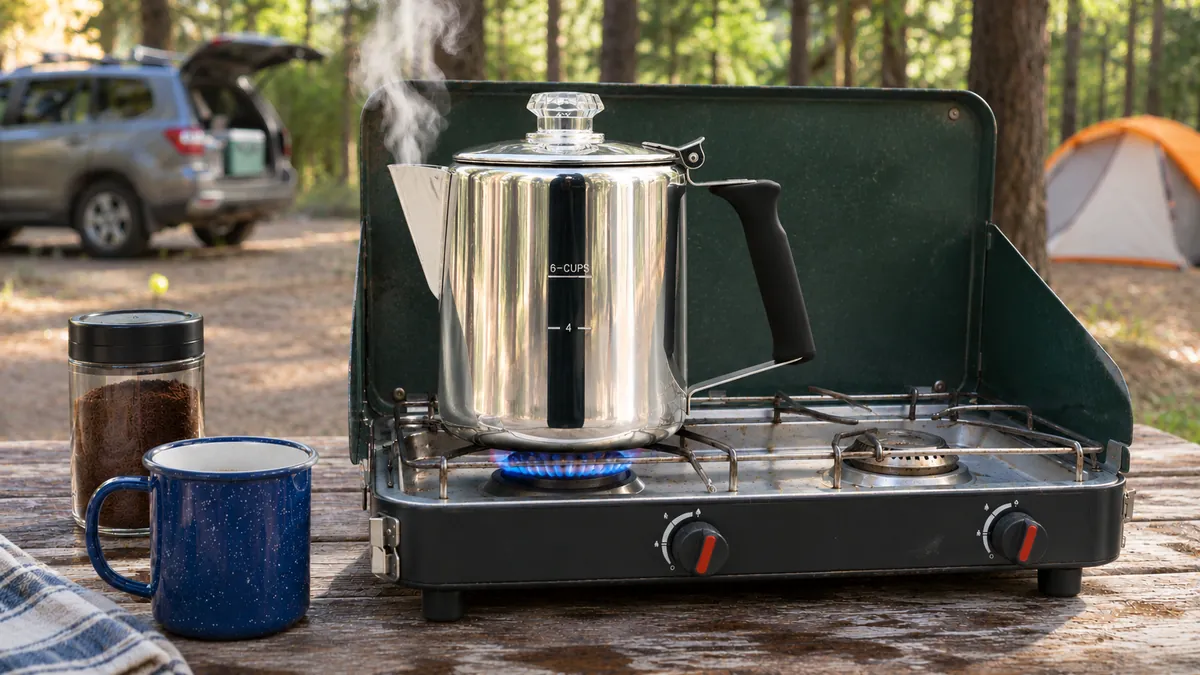
Best Camping Coffee Makers for Car Camping and Backpacking Mornings
Affiliate Disclosure: Some links on this page are affiliate links. If you buy through one, I may earn a commission at no extra cost to you. Commission never decides which products I recommend. Read the full disclosure.
It’s the first cold morning of the trip, the stove is finally going, and the “6 cup” pot fills two mugs. The third person stands there holding an empty one while you start the whole thing over.
That’s not on you. Percolator cup counts are small cups, and the lists you’ve been reading crown one “best overall” press without saying how many mugs it pours, whether it goes on the stove, or what you scrape out of it afterward.
What you came for is simpler: which camping coffee maker suits the way you camp. That comes down to how many people are drinking, whether a car or your back is carrying the gear, and what stove and grinder you already have.
So here are five picks matched to who’s drinking and what’s carrying the load, each with the mugs it really makes, what it needs, what it weighs and what goes home wet. That way you can buy one that fits and not buy again.
TL;DR: Camping Coffee Maker
- Car camping for three or four: the GSI Glacier Stainless Percolator, one steel pot that heats and brews (the 9 cup, 1.3 L, for three; the 12 cup, 1.8 L, for four).
- Two people on one burner: the Stanley Boil + Brew 32 oz, which boils, brews and presses in the same pot.
- Solo and counting ounces: the Sea to Summit Frontier UL (2 oz, folds flat, no filters) or the AeroPress Go (a cup owners call smooth and the least wet mess, at 11.4 oz).
- Espresso at camp: the Wacaco Nanopresso, if you’ll bring boiling water and an extra-fine grind. Happy with instant? You can skip all five.
Here are the five picks side by side, sorted by the kind of camper each one suits.
Product Name
Best For
Key Strength
Main Tradeoff
Price Tier
Car camping groups: the 9 cup for three, the 12 cup for four
One steel pot heats and brews, nothing to shatter
Heaviest, more stove time, a basket of wet grounds
$
Two people on one burner
Boils, brews and cooks in one steel pot
Spilly pour; the nylon insert can’t stay on the heat
$
Solo backpackers counting ounces
2 oz, folds flat, no filters
One cup at a time; fiddly mesh to clean
$
Solo campers who want the least mess
Grounds come out as a puck
One mug per press; 11.4 oz with filters
$
Espresso drinkers at camp
Espresso with no power
One 80 ml shot per fill; extra-fine grind and hand pumping
$
GSI Glacier Percolator (9 or 12 cup)
Best For: Car camping groups: the 9 cup for three, the 12 cup for four
Key Strength: One steel pot heats and brews, nothing to shatter
Main Tradeoff: Heaviest, more stove time, a basket of wet grounds
Price Tier: $
Stanley Boil + Brew 32 oz
Best For: Two people on one burner
Key Strength: Boils, brews and cooks in one steel pot
Main Tradeoff: Spilly pour; the nylon insert can’t stay on the heat
Price Tier: $
Sea to Summit Frontier UL
Best For: Solo backpackers counting ounces
Key Strength: 2 oz, folds flat, no filters
Main Tradeoff: One cup at a time; fiddly mesh to clean
Price Tier: $
AeroPress Go
Best For: Solo campers who want the least mess
Key Strength: Grounds come out as a puck
Main Tradeoff: One mug per press; 11.4 oz with filters
Price Tier: $
Wacaco Nanopresso
Best For: Espresso drinkers at camp
Key Strength: Espresso with no power
Main Tradeoff: One 80 ml shot per fill; extra-fine grind and hand pumping
Price Tier: $
Price tiers: $ under $100 | $$ $100 to $249 | $$$ $250 and up
Already know how you camp? Jump straight to your section: car camping groups, solo, or espresso.
How to Choose a Camping Coffee Maker for the Way You Camp
Three questions sort out most of this: how many people you’re brewing for, whether a car or your back carries it, and what it needs before it works. Then weigh the cleanup, what goes home wet, and the warranty. Better coffee usually costs weight, stove time and wet grounds.
Picture the line at one stove on a cold morning, with everyone wanting coffee at the same time. Whatever you packed sets the pace. That’s why I’d weigh group size and how the gear travels first, because those two rule most picks in or out before anything else matters.
How Many Mugs You Need, Not the Number on the Box
Count the mugs you pour on a normal morning, not the box’s cup count. Percolator cups are small, so owners say GSI’s 6 cup pours about two mugs. The Stanley’s 32 oz pot also makes about two, and the solo picks make one cup or one shot at a time.
That gap trips up a lot of people. About a dozen owners say GSI’s 6 cup comes out at roughly two mugs, or about 24 oz, and one sent it back for the 12 cup. Another called the 6 cup the “perfect size for two large cups.”
The reason is the unit. A percolator “cup” is about 5 oz: GSI’s liters work out to roughly 150 ml per cup, well under the 12 oz or so a camp mug holds. So the number on the box runs well ahead of what you actually pour.
That’s why liters are the better number to read. GSI lists the 9 cup at 1.3 L against 0.9 L for the 6 cup, so the 9 cup holds a bit under half again as much.
Owners describe the 6 cup, not the 9. Going by the liters, though, two mugs from the 6 cup points to about three from the 9 cup, so four people with big mugs are better off with the 12 cup at 1.8 L.
The Stanley’s pot holds 32 oz, and owners describe it as about two mugs (“Great for 2 cups of coffee,” one wrote). The Frontier, the AeroPress Go and the Nanopresso each make one cup or one shot per brew, so two people means two rounds.
Car or Your Back: Weight and Packed Size
If the car carries it, weight barely matters and a steel pot rides loose in the bin. On your back, ounces add up: the Frontier weighs 2 oz and folds flat, the AeroPress Go weighs 11.4 oz packed in its own mug, and the percolator weighs 1 lb 9 oz.
In a car, the bigger worry is breakage: you don’t want glass bouncing around in the back. None of these five has a glass body, which is one reason the two steel pots suit a camp bin so well.
On your back, here’s how the five compare, as each maker lists them:
- Sea to Summit Frontier UL: 2.0 oz (55.7 g), folding to 4 x 4 x 1 in, so it slides into a pot.
- AeroPress Go: 11.4 oz (323 g), packed inside the mug you’ll drink from.
- Wacaco Nanopresso: 11.9 oz (336 g), before the grinder or espresso-grind coffee it needs.
- Stanley Boil + Brew: 0.9 lb, and it doesn’t collapse, though one owner fits a small stove and fuel canister inside it.
- GSI Glacier Percolator, 9 cup: 1 lb 9 oz, and it doesn’t collapse either.
On a first overnight, the coffee maker competes with everything else for space and weight. Whether the AeroPress Go’s extra 9.4 oz over the Frontier is worth it depends on the rest of your load, the same trade you make item by item when you’re lightening your backpacking pack.
My own view is that coffee is a comfort worth a few ounces on a solo trip. I’d still weigh it against the whole pack rather than on its own, because a light maker doesn’t help much if it pushes you to cut something you’ll miss more.
What Each Maker Needs Before It Works
The percolator and the Stanley sit on the stove and heat their own water. The Frontier and the AeroPress Go need only hot water. The Nanopresso can’t heat water, so it needs boiling water and an extra-fine grind, and Wacaco says full pressure takes about 13 kg of pumping force.
Here’s each method in one line, so you know what you’re choosing between:
- Percolator (GSI): brews in its own pot on the stove.
- Boil-in-the-pot press (Stanley): boils the water, then you press.
- Pour-over (Frontier): hot water poured through a steel mesh.
- AeroPress (AeroPress Go): hot water pushed through a paper micro-filter.
- Hand-pump espresso (Nanopresso): boiling water pumped through an extra-fine grind.
The steps, the water temperature and the grind for each are in my guide on how to brew each method, so here I’ll stick to what each one asks of you.
If pour-over sounds too finicky before you’ve had any coffee, that’s a fair worry. The two steel pots need a stove under them and nothing else. The Frontier and the AeroPress Go need hot water from any stove, and only the AeroPress Go uses paper filters, one per brew.
The Nanopresso asks the most. It needs boiling water, coffee ground extra-fine and tamped firmly, and about 13 kg of pumping force by Wacaco’s own figure. That’s the effort people usually mean when they call it fussy.
Cleanup and What You Carry Home Wet
Each one leaves something wet: a basket of grounds from the percolator, grounds in the Stanley, grounds stuck in the Frontier’s mesh, a puck and a paper filter from the AeroPress Go, or a small puck from the Nanopresso.
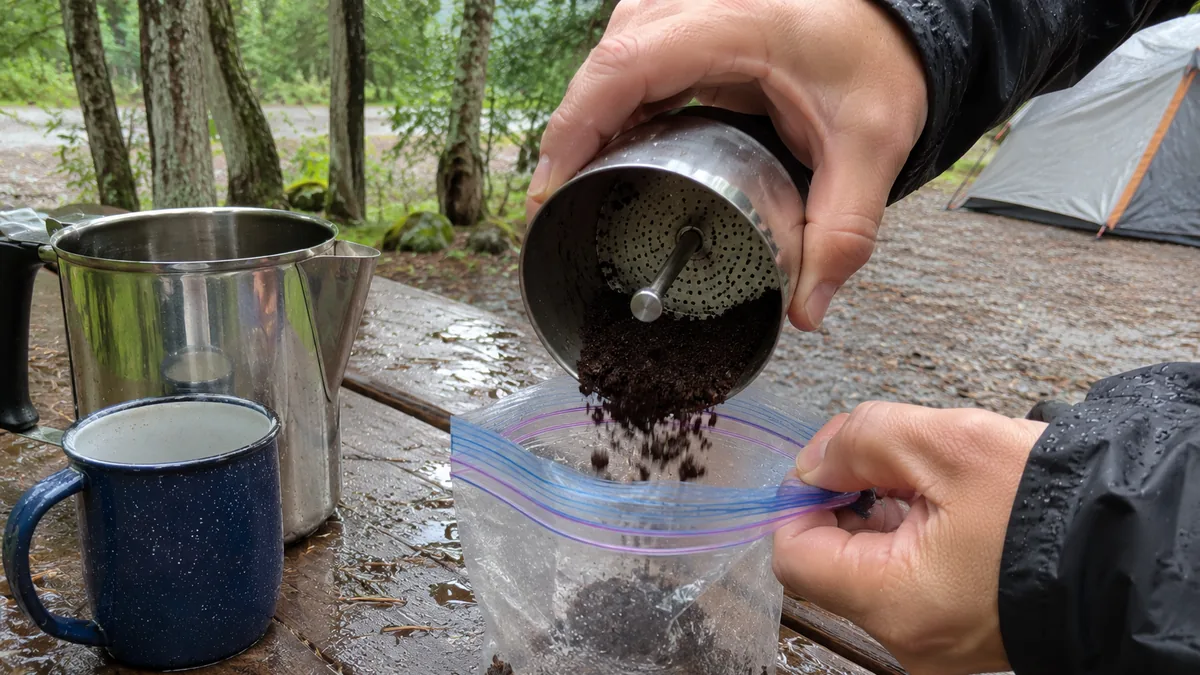
Think about where that cleanup happens: a cold picnic table, not much water to spare, and a wet basket or mesh to scrape before anyone can pack up. Whatever comes out goes home in a bag, so the shape of the waste matters as much as how much there is.
If cleanup is the part that would send you back to instant, here’s what owners say about three of the picks:
- Stanley: owners keep calling it easy to clean, with one pot to rinse.
- Frontier: a few owners who weren’t part of a promotion say the mesh is the fiddly part.
- AeroPress Go: owners on REI say the puck drops into the trash and a quick rinse does the rest.
Durability, Warranties and the Cup Owners Describe
GSI gives the percolator a lifetime warranty, Sea to Summit gives the Frontier a lifetime guarantee, and AeroPress and Wacaco each give one year. Stanley’s cover for this pot is unclear. On the cup, owners call the AeroPress Go very smooth, and some call percolated coffee strong.
GSI’s warranty covers material and workmanship defects, with repair or replacement at GSI’s discretion. AeroPress warrants its coffee makers for one year against defects in materials and workmanship.
Stanley’s lifetime warranty is written for its vacuum drinkware and food containers, and its pages don’t say whether it covers this pot, so I wouldn’t count on it.
Where owners say things break tells you more than any warranty line:
- GSI percolator: the plastic knob falling out or not staying screwed in is the most repeated complaint, and a smaller group say the lid hinge pin slides out.
- Stanley: owners split on the folding wire handles, with some calling them flimsy and several others calling the pot sturdy.
- Frontier: one owner says the mesh keeps popping out of the silicone.
GSI calls its percolator ultra-rugged, and owners back that up for the steel body. The plastic knob and the lid hinge are where their reports of trouble land.
On the cup, I’ll only pass on what owners say. AeroPress Go owners on REI describe it as “Very smooth.” Some GSI owners call percolated coffee strong or a little burnt, and Nanopresso owners on Wacaco’s site report good crema.
When Instant or Cowboy Coffee Is Enough
If instant or cowboy coffee makes you happy at camp, skip all five. Each step up buys something specific: grounds kept out of the cup, a smooth cup by owners’ accounts, or espresso. Each also costs weight, stove time and cleanup, and the group picks cost the most.
Here’s what each step up actually adds. All five keep the grounds out of your mug, which cowboy coffee doesn’t. The AeroPress Go adds a cup owners call smooth and grit-free, and the Nanopresso adds espresso, which nothing else here makes.
The tradeoff runs one way. The two picks that serve a group are the heaviest and leave the most wet grounds, while the lightest picks make one cup at a time, so nothing here is light, quick and big all at once.
If a friend told me instant makes them happy at camp, I’d tell them to keep their money and their pack space. These five are for the camper who already knows instant is the thing they’d change, and wants to know what changing it will cost.
Here’s how the five picks line up on the criteria above, using each maker’s figures and the owner mug counts where owners give one.
Pick
Makes
Weight
Needs
What Goes Home Wet
GSI Glacier Percolator, 9 cup
1.3 L (owners say cup counts run small)
1 lb 9 oz
A stove
A basket of grounds
Stanley Boil + Brew 32 oz
32 oz pot, about two mugs (owners)
0.9 lb
A stove
Grounds in the pot
Sea to Summit Frontier UL
One serving, about 30 g of coffee
2.0 oz (55.7 g)
Hot water
Grounds in the mesh
AeroPress Go
Up to 8 oz per brew
11.4 oz (323 g) packed
Hot water, a paper filter
A compact puck and a filter
Wacaco Nanopresso
80 ml per shot
11.9 oz (336 g)
Boiling water, extra-fine grind
An 8 g puck
GSI Glacier Percolator, 9 cup
Makes: 1.3 L (owners say cup counts run small)
Weight: 1 lb 9 oz
Needs: A stove
What Goes Home Wet: A basket of grounds
Stanley Boil + Brew 32 oz
Makes: 32 oz pot, about two mugs (owners)
Weight: 0.9 lb
Needs: A stove
What Goes Home Wet: Grounds in the pot
Sea to Summit Frontier UL
Makes: One serving, about 30 g of coffee
Weight: 2.0 oz (55.7 g)
Needs: Hot water
What Goes Home Wet: Grounds in the mesh
AeroPress Go
Makes: Up to 8 oz per brew
Weight: 11.4 oz (323 g) packed
Needs: Hot water, a paper filter
What Goes Home Wet: A compact puck and a filter
Wacaco Nanopresso
Makes: 80 ml per shot
Weight: 11.9 oz (336 g)
Needs: Boiling water, extra-fine grind
What Goes Home Wet: An 8 g puck
For Car Camping Groups of Three or Four: GSI Outdoors Glacier Stainless Percolator
The GSI Glacier Stainless Percolator suits car campers making coffee for three or four. It’s one heavy-gauge steel pot that heats and brews, with no glass to break. Owners say cup counts run small, so go by the liters, and the plastic knob is what they lose.
I’m recommending the Silicone Handle line: the 9 cup (1.3 L, 8.8 x 5.1 x 7.7 in, 1 lb 9 oz) for three, or the 12 cup (1.8 L) for four. The same line also comes as a 3 cup (0.4 L) and a 6 cup (0.9 L).
If you brew over a campfire, look at GSI’s older bail-handle Glacier percolator (8 to 36 cup) instead, since GSI states campfire use only for that line. One REI owner says its 14 cup sits badly on backpacking stoves and the handle gets hot.
Who This Percolator Is For
Car campers making coffee for three or four on a one-burner or two-burner stove. It also suits anyone who wants a single steel pot that does the heating and the brewing, so the morning is one pot on the stove and everyone holding out a mug.
Why It Stands Out
One steel pot brews for the whole group, and there’s nothing on it that can shatter. Across the owner reviews I read, the steadiest theme is heavy, well made steel that’s easy to clean.
Owners use it at home and during power outages as well as at camp, and more than a hundred REI reviewers have rated the 6 cup. One owner was “pleased with the heft,” which is the right way to see this pot: weight you accept in exchange for steel.
Key Features and What They Mean at Camp
- One pot heats and brews: there’s no kettle to pack, and one less thing on the picnic table.
- 18/8 stainless steel, no glass body: it can ride loose in a camp bin.
- Silicone handle: GSI says it stays cool to the touch, so you can pour without a towel, and owners mostly agree.
- PercView knob: you watch the coffee darken through the clear top to judge strength, which is how you avoid perking it too long.
- Hinged lid: it stays attached, so it can’t get left on a rock.
GSI’s product page lists each size in liters and calls this line a stovetop coffee maker. Its care and warning notes are worth reading before the first trip.
- Hand wash it in warm, soapy water and dry it thoroughly, with no abrasive cleaners.
- Don’t overfill it or let it boil dry.
- Never open the lid or pull off the PercView top while it’s heating.
Owners add one more rule. A handful say a fine grind lets grounds through or clogs the basket, and the fix is the one an owner put plainly: “use coarse grind coffee.”
Where It Falls Short
It makes less than the cup count suggests. Go by the liters (1.3 L for the 9 cup) rather than the number on the box, as the buying guide above lays out.
The plastic knob is the part owners lose. Several say it falls out or won’t stay screwed in (“knob doesn’t stay in”), and one says it melted when the bulb came off. A smaller group say the lid hinge pin slides out or the lid bends.
It’s also the heaviest pick here. It heats the whole pot and then perks for a few minutes, so it sits on the burner longer than boiling water for one cup. When it’s done, you’re left with a basket of wet grounds to deal with.
One more thing: a retailer lists this silicone-handle version as campfire safe, but GSI’s own page calls it a stovetop pot. I’d go by the maker and keep it off the fire.
Pros
Brews for a group in one pot, so you’re not making coffee mug by mug.
All steel with nothing to shatter, which is what you want loose in a camp bin.
A lifetime warranty from GSI against material and workmanship defects.
Cons
The cup counts run small, so it’s easy to buy a size too small.
The plastic knob is the part owners lose.
Who Should Skip It
- Backpackers: at 1 lb 9 oz, with nothing that collapses, it’s the heaviest pick here.
- Anyone who wants a light, bright cup: some owners call percolated coffee strong or a little burnt.
- Anyone with only fine pre-ground coffee: owners say it slips through or clogs the basket.
- Anyone brewing over a campfire: the bail-handle line above is the one GSI rates for that.
My Read
For a group at a car campsite, this is the one I’d pick if you go by the liters (the 9 cup for three, the 12 cup for four) and keep the grind coarse. It’s the only pick here that brews for a group in one steel pot.
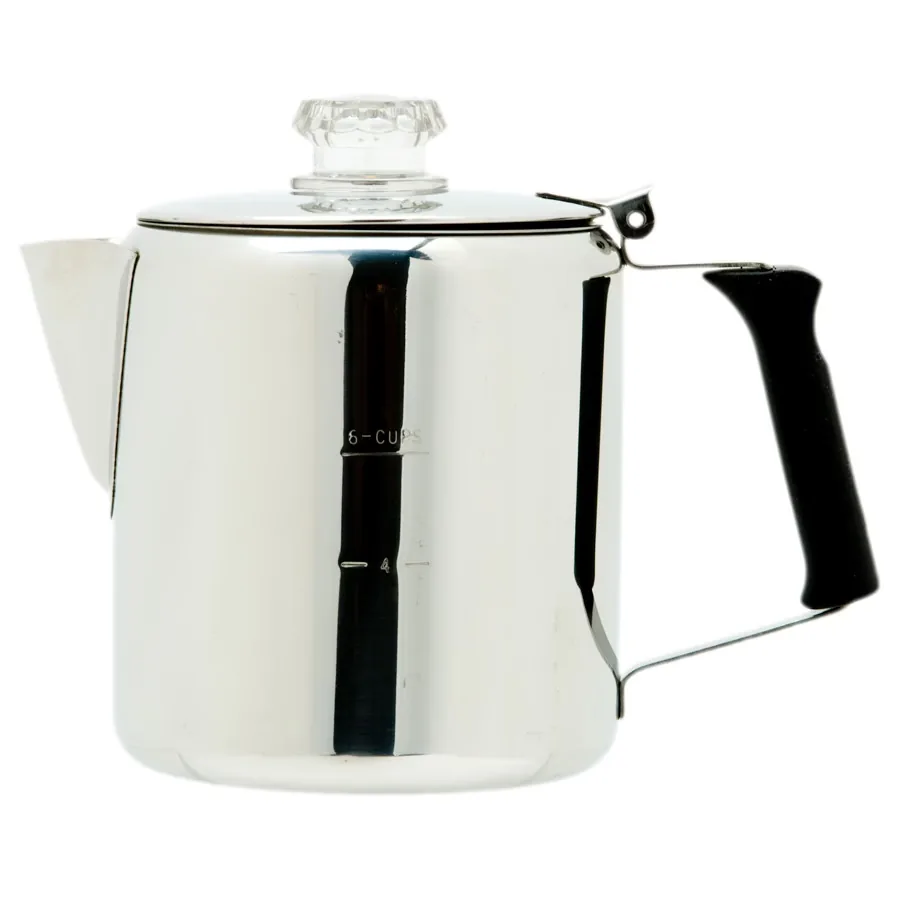 GSI Glacier Stainless Percolator
One steel pot that heats and brews for a car camping group, with nothing to shatter. Go by the liters: the 9 cup for three, the 12 cup for four, and keep the grind coarse.
Stanley Boil + Brew French Press: One Pot for Two People on One Burner
The Stanley Adventure All-In-One Boil + Brew is a 32 oz steel pot with a press insert: boil, brew and press in one pot, then heat oatmeal in it. It suits two people on one burner. Owners say it pours messily, and the nylon insert must come out before heating.
The model here is the Adventure All-In-One Boil + Brew French Press in the 32 oz size (SKU 10-02345-008), in 18/8 stainless steel. Stanley lists it at 0.9 lb and 4.25 x 4.25 x 7.64 in.
Best For
Two people on one burner, whether that’s car camping or a short paddling or motorcycle trip. It also suits anyone who’d rather the press and the pot be the same item, so there’s one less thing to pack and wash.
The Case for It
You boil and brew in one steel pot that also cooks breakfast. Dozens of owners have weighed in, and most come back to easy cleanup and good coffee. One sums up the point of the design: “No need for a kettle.”
How It Works at Camp
The pot is the kettle. You boil water in it, add grounds and push the press insert down, so there’s no separate kettle to carry and no glass to break.
It packs small for what it does. One owner fits a fuel canister and a small stove inside it, so the coffee kit can take up the room of one pot.
The pot doubles for food, too. Owners heat soup or oatmeal in it, which matters when one burner is doing everything. If you’re planning the rest of the trip around that single burner, my one-burner camp meal plan is built around the same idea.
It holds 32 oz, which owners describe as about two mugs, and Stanley lists it as dishwasher safe for when you get home.
If you’re thinking a glass press makes the same coffee, it might, but a glass press can’t go on the stove and wants a flat table. This one heats its own water and rides loose in a bin.
The Honest Part
It spills when you pour fast. Several owners describe coffee dribbling out between the pot and the press insert, or as one put it, “spills when you pour.”
Take the press insert out before the pot goes on the flame. It’s nylon, which can’t take a burner the way the steel pot can, and one owner says theirs melted when it was left in over the heat.
Owners split on the folding wire handles. Some call them flimsy, and one says a handle broke off a full pot after 13 months, while several others call the pot sturdy.
A few owners also say it’s hard to press with a finer grind or a lot of coffee in the pot. And it isn’t insulated, so coffee cools in the steel, which is why a few owners pour it straight into a vacuum bottle.
Pros
No kettle and no glass, so there’s less to pack and nothing to break.
Doubles as a cooking pot for soup or oatmeal on the same burner.
Room inside for a small stove and canister, by one owner’s account.
Cons
A spilly pour if you go fast.
The nylon press insert can’t stay on the heat.
Look Elsewhere If
- You’re making coffee for four or more: you’d brew twice, so take the percolator instead.
- You’re a gram-counting backpacker: at 0.9 lb, it’s heavy next to the solo picks.
- You want coffee kept hot in the pot: owners say it cools, since it isn’t insulated.
The Bottom Line
For two people sharing one burner, this is the pick that saves you packing a kettle. Pour slowly and take the nylon insert out before it goes on the heat, and one pot covers both coffee and breakfast.
 Stanley Adventure All-In-One Boil + Brew 32 oz
Boil, brew and press in one steel pot, then heat breakfast in it. The pick for two people on one burner, if you pour slowly and take the nylon insert out before heating.
The Lightest Pick for Solo Backpackers: Sea to Summit Frontier UL Pour Over
The Sea to Summit Frontier UL is a collapsible pour-over that weighs 2 oz and folds to about an inch, with a built-in steel mesh, so there are no filters to carry. It brews one serving at a time, and a few owners say cleaning the mesh is the chore.
This is the Frontier Ultralight Collapsible Pour Over (retailers call it the Frontier UL Collapsible Pour Over), in one size, which retailers list in Bone White.
If you count every gram and don’t mind paper filters, GSI’s Ultralight Java Drip is lighter still: GSI says it weighs less than half an ounce, takes #2/#4 equivalent filters and nests under a standard fuel cartridge. I didn’t read owner reviews for it, so that’s the maker’s word only.
Ideal For
Solo backpackers and first overnights who want real coffee without carrying paper filters. If your pack already has a pot and a stove, this adds 2 oz and almost no space.
What Sets It Apart
It packs flat and needs no filters. Owners say it’s light, packs flat and makes good coffee (“takes up no space,” one wrote). Most of that praise comes from reviews collected as part of a promotion, though, so I’d weigh it accordingly.
Key Features and What They Mean
- 2.0 oz (55.7 g), folding to 4 x 4 x 1 in and opening to 4 x 4 x 4 in: it slides into a pot or a lid pocket.
- Steel mesh instead of paper: nothing to restock and nothing but grounds to pack out. With no paper to throw away, though, the mesh is what you clean.
- A base that sits on most mug and wide-mouth bottle rims: you can brew straight into a bottle, one serving of about 30 g of coffee at a time.
- Dishwasher safe: by Sea to Summit’s account, and it stows inside the brand’s Frontier Collapsible Kettle if you already own one.
Sea to Summit’s product page lists the 55.7 g packed weight, the one-serving capacity and the steel mesh molded into the cone.
Where It Falls Short
It makes one cup at a time, so two people means two rounds and two rinses.
Cleaning the mesh is the chore. On Backcountry, where most reviews were collected in a promotion, three of the six that weren’t say grounds stick in the mesh. One called it “very inconvenient to clean,” and another added “Messy, too.”
One of those owners also says the mesh keeps popping out of the silicone. Sea to Summit calls the Frontier easy to clean, while a few owners found the mesh harder going.
One owner drops a standard #4 cone paper filter into it to make cleanup easier. That’s one person’s habit, and it brings back the paper you’d buy this to avoid.
Pros
2 oz and flat, so it costs almost nothing in weight or space.
No filters to buy or carry.
A lifetime guarantee from Sea to Summit.
Cons
One cup per brew.
The mesh is fiddly to clean when water is short.
Not the Right Fit If
- You’re brewing for a group: it makes one serving per round.
- You want the lightest possible kit: the Java Drip above is lighter, if you’ll carry filters.
- You hate rinsing grounds out of mesh: at camp you’ll be doing it with very little water.
Verdict
If every ounce counts and you’ll put up with a rinse at camp, this is the one I’d pack. Instant is lighter and has no cleanup, which is true. What the Frontier asks in return is about 2 oz for fresh-ground coffee.
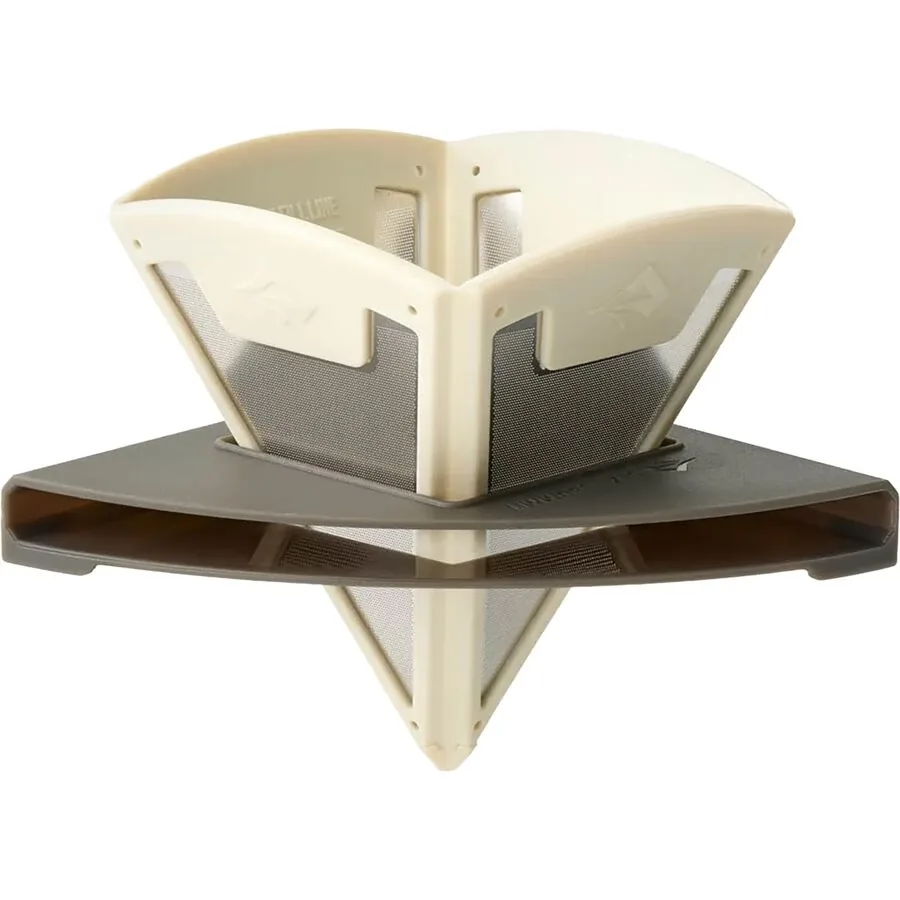 Sea to Summit Frontier UL Pour Over
A 2 oz pour-over that folds flat and needs no paper filters, for solo backpackers counting every ounce. It makes one cup at a time, and the mesh needs a rinse at camp.
AeroPress Go: A Smooth Solo Cup With the Least Mess to Pack Out
The AeroPress Go packs into its own 15 oz mug and brews up to 8 oz at a time. REI owners describe smooth coffee and fast cleanup, because the plunger pushes out the grounds as a puck. At 11.4 oz packed and one mug per press, it’s a solo pick.
This is the AeroPress Go, also sold as the AeroPress Go Travel Coffee Press.
For car camping or road trips, AeroPress lists the Go Plus at 10 oz per brew (1 to 2 cups), with a double-wall vacuum-insulated steel tumbler, at 1 lb 4 oz packed. It gives no hold time for the tumbler, and next to the Go it’s too heavy for backpacking.
Who This Press Is For
Solo campers and first overnights who want a smooth, grit-free cup, by owners’ accounts, with the least wet mess to deal with. It also suits anyone who’ll use it at home between trips. It’s the only one of these five I’ve used myself, and I use mine at home.
Why It Stands Out
The grounds come out as a puck, so there’s almost nothing to rinse. That makes it the cleanest cleanup of the five.
Hundreds of REI reviewers have weighed in, though many received free product through REI’s sampling program. Their pattern is consistent: the puck goes in the trash, a quick rinse does it, and everything nests back in the mug.
Two short phrases sum up what they say: “Very smooth” and “Easy cleanup.”
Key Features and What They Mean
- Everything packs inside its own 15 oz mug: the mug is also the carry case, so it’s one item in the pack and you drink from the case.
- Up to 8 oz per brew: or up to three servings of espresso-style concentrate per press, topped up with water or milk.
- A paper micro-filter per brew: owners describe a smooth cup with no grit, and the holder carries up to 20 filters.
- Food-safe, BPA- and phthalate-free polypropylene with a silicone seal: the mug and solid-color lids are top-rack dishwasher safe.
AeroPress’s help center describes the concentrate servings and lists the whole kit at 11.4 oz (323 g) fully packed, filters included.
If plastic bothers you, that’s worth knowing up front. AeroPress lists the materials as BPA- and phthalate-free polypropylene and silicone, and if you’d rather carry no plastic at all, the steel picks above are the better match.
The Main Limitation
It makes one mug per press. Owners on REI say it reliably makes one concentrated cup, and one found it too weak when stretched to two.
AeroPress says it brews one to three cups. Going by owners, that holds up only if you count small espresso-style servings rather than mugs.
It’s also heavier: 11.4 oz packed against 2 oz for the Frontier, plus paper filters to carry. A couple of smaller gripes come up too, a mug lid that fits loosely and, for one REI owner, “Too many components.”
Its warranty is shorter, too: one year from AeroPress, against the lifetime cover GSI and Sea to Summit give.
Pros
The least wet cleanup of the five.
Packs into its own mug, which you drink from.
Owners describe a smooth cup.
Cons
One mug per press.
Heavier than the Frontier, with filters to carry.
Skip It If
- You’re making coffee for two or more at once: you’d be pressing round after round.
- You count grams: 11.4 oz against the Frontier’s 2 oz is a real difference on your back.
My Read
For the solo camper who cares more about an easy cleanup and a cup owners call smooth than about ounces, this is my pick. If weight matters more than either, the Frontier is the better trade.
 AeroPress Go Travel Coffee Press
Packs into its own mug and pushes the grounds out as a puck, so cleanup is a quick rinse. A solo pick: one mug per press, at 11.4 oz packed.
For Espresso Drinkers Who Will Carry a Grinder: Wacaco Nanopresso
The Wacaco Nanopresso makes espresso with a hand pump and no power: 8 g of extra-fine coffee and 80 ml of boiling water per shot, at up to 18 bar by Wacaco’s figure. It suits espresso drinkers who’ll carry a grinder or espresso-grind coffee. Groups should skip it.
This is the Nanopresso Portable Espresso Maker.
If you already grind your own coffee for espresso, Wacaco’s Picopresso is the step up. Wacaco lists it at 12.35 oz (350 g), with 18 g of coffee per shot and an ultra-fine grind required.
Best For
Espresso drinkers who’ll carry 11.9 oz (336 g) plus a fine grind to camp. It fits car campers and van travelers better than backpackers, because the grinder or pre-ground espresso coffee adds to the load.
What Sets It Apart
It makes espresso with no power, from boiling water and a pump, which none of the other four can do. Owner reviews on Wacaco’s own site (over a thousand of them) describe it as portable, easy to use and good on crema.
One owner says it “never disappoints” on hiking and camping trips. Keep in mind where those reviews live, which I come back to below.
Key Features and What They Mean
- Hand pump, no battery: it works anywhere you can boil water.
- An 80 ml water tank and 8 g of coffee per shot (16 g with the add-on basket), at up to 18 bar by Wacaco’s figure: one espresso per fill, or an Americano if you top it up with hot water.
- A built-in espresso cup: one less mug to pack, but a small one.
- 6.14 x 2.8 x 2.44 in (156 x 71 x 62 mm): small enough to tuck into a camp kitchen bin.
- Rinse the parts, wipe the rest and dry them separately: it isn’t dishwasher safe. Wacaco calls it easy cleaning, but it’s still a several-part device to take apart at camp.
It doesn’t heat water, which is why Wacaco’s instructions call for boiling water if you want a hot shot.
Where It Falls Short
You get one small shot at a time, and each one takes work. Wacaco calls for an extra-fine grind tamped firmly, and says full pressure takes about 13 kg of force (roughly 29 lb, approximate), with two hands recommended.
The shot may not be as hot as a café’s. One owner says so, which fits Wacaco’s own instruction to use boiling water.
The reviews I could read for it were all on Wacaco’s own site, and all positive. That means I couldn’t check for a pattern of complaints, so treat the praise as one-sided.
Is it a gadget? For most campers, yes, and they should skip it. It earns its place only for the reader who wants espresso, because that’s the one thing the other four can’t make.
Pros
Real espresso with no power.
Compact, with its own cup.
A one-year warranty from Wacaco.
Cons
One 80 ml shot per fill.
Needs an extra-fine grind and real hand strength.
Who Should Skip It
- Anyone making coffee for a group: it makes one 80 ml shot per fill.
- Anyone without a grinder or espresso-grind coffee: Wacaco calls for an extra-fine grind.
- Anyone with weak hands or wrists: Wacaco puts full pressure at about 13 kg of force.
The Bottom Line
This one is only for the camper who won’t give up espresso and doesn’t mind slow, one-shot-at-a-time mornings. If that’s you, nothing else here does the job. If it isn’t, skip it.
 Wacaco Nanopresso Portable Espresso Maker
Espresso at camp with a hand pump and no power, from boiling water and an extra-fine grind. One small shot at a time, and it takes real hand strength.
Still Torn? How to Choose Between the Two Closest Pairs
If you’re stuck between the car camping picks, count the drinkers: three or four points to the GSI percolator, two to the Stanley. Between the solo picks, take the Frontier to save ounces and skip filters, or the AeroPress Go for the least wet mess and a smooth cup.
The car camping pair comes down to the people around the stove. The Stanley is the better fit for a couple because it cooks too, but once a third mug shows up you’re brewing twice, and that’s where the percolator starts to make more sense.
The solo pair is ounces against cleanup. I’d take the Frontier if the pack is already tight and you’re fine rinsing a mesh, and the AeroPress Go if you’d rather carry an extra 9.4 oz than scrape grounds out of a cone with cold fingers.
Before you buy, count the mugs you pour on a normal camp morning and match that number to the pick’s real capacity, not the number on the box.
Founder & Gear Research Editor
Sonia Zannoni
I’m Sonia, the founder of Best Trail Backpacks. I don’t test gear myself. For every pack I cover, I read the manufacturer’s specs and sizing charts and look for what owners report again and again.
Fit comes first, because a pack that doesn’t match your torso and hips will hurt no matter what it cost. My goal is to help you choose a pack that suits your body, your trip and your budget.
About the Founder
