
How to Waterproof Hiking Boots and Trail Shoes: Clean, Dry and Re-Treat by Material
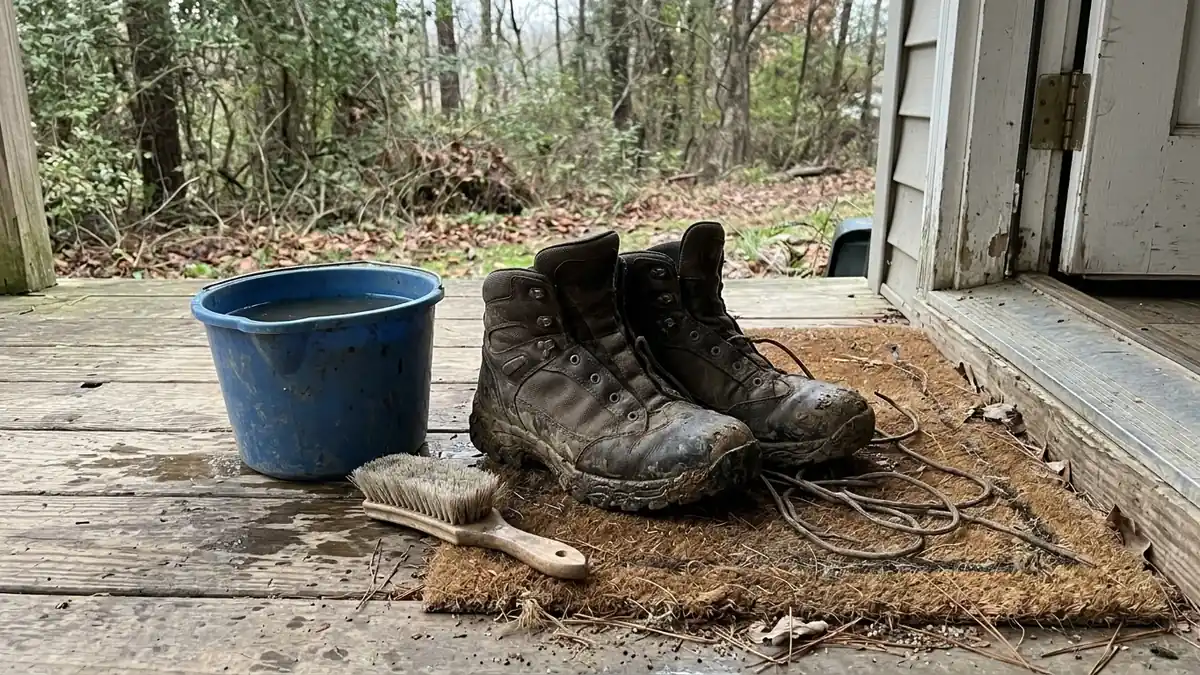
The toes of your boots go dark in the first stretch of wet grass instead of shedding the water, and by the second hour your socks feel damp. These boots cost real money, and they’re still wearing last trip’s mud.
This happens to almost every pair sooner or later, and it doesn’t mean the boots are failing or that you did something wrong. The finish on the outside wears with use, and dirt hides what’s left of it.
So you want to know how to waterproof hiking boots like yours, or whether they need it at all. And if they do, which kind of product suits the upper and the lining without ruining the leather or the waterproof layer inside.
Start with a quick check that tells you whether a clean is enough. Then follow the clean, dry and re-treat steps for your exact material, each one from the maker who says it, so you buy the right thing once, or nothing at all.
TL;DR: How to Waterproof Hiking Boots
- Clean the boots and let them dry fully, then drip water on the upper. If it beads and rolls off, cleaning was all they needed (that’s Gore’s own check).
- If it soaks in, re-treat with the type made for your upper: a cream or a thin wax on smooth leather if your boot maker allows it, a water-based treatment for nubuck and suede, a spray for fabric. Mesh shoes with no membrane only get cleaned and dried.
- Gore-Tex boots still need their outer re-treated, because the membrane is inside and the outer finish is what wears.
- Skip oil, grease and direct heat: LOWA, Hanwag and Gore all rule them out. Where makers disagree (wax on membrane boots), your boot maker’s care page decides.
Do Your Boots Need Waterproofing, or Just a Good Clean?
Most boots tell you when they need treatment. Clean them, let them dry completely, then drip a little water on the upper: if it beads and rolls off, the finish still works and the clean was enough. If it soaks in and darkens the material, it’s time to re-treat.
This bead test is Gore’s own check. Once the footwear is completely dry, Gore says to drop water on it and see whether it beads and runs off. Its footwear care page ties re-treating to the same signal: re-apply a water repellent once water no longer beads.
The clean has to come first. Nikwax says dirt attracts water and masks the water repellent, so a boot can wet out just because it’s dirty. Wash the dirt off and the beads may come back, which means some of you won’t need to buy anything.
Picture that toe box darkening in wet grass, with last trip’s mud still on the boots. You can’t tell yet whether the finish is worn or just buried, and the bead test after a clean is what tells you. That’s why I’d test before buying anything.
Smooth leather gives you a second signal. Hanwag says it needs wax when it feels dry, brittle or cracked, so run a hand over the leather as well as watching the water.
Brand-new boots are their own case. LOWA says new boots need no extra care before the first wear, though it adds that they benefit from being re-treated. If yours just came out of the box, breaking in new boots matters more right now than any treatment.
You’ll also find makers giving different intervals for re-treating, and I’ve set them side by side further down. Because they don’t agree, the bead test is a better guide to when than the calendar.
That water test is the first question. After it, the choice rests on four things: what the upper is made of, whether a membrane sits inside, what your boot maker’s care page says, and what the treatment’s label says. The diagram below lays out the route.
Quick Tip: Run the bead test only once the boots are fully dry, not straight after a rinse. Gore describes the check on completely dry footwear, so wait until the boots are dry all the way through.
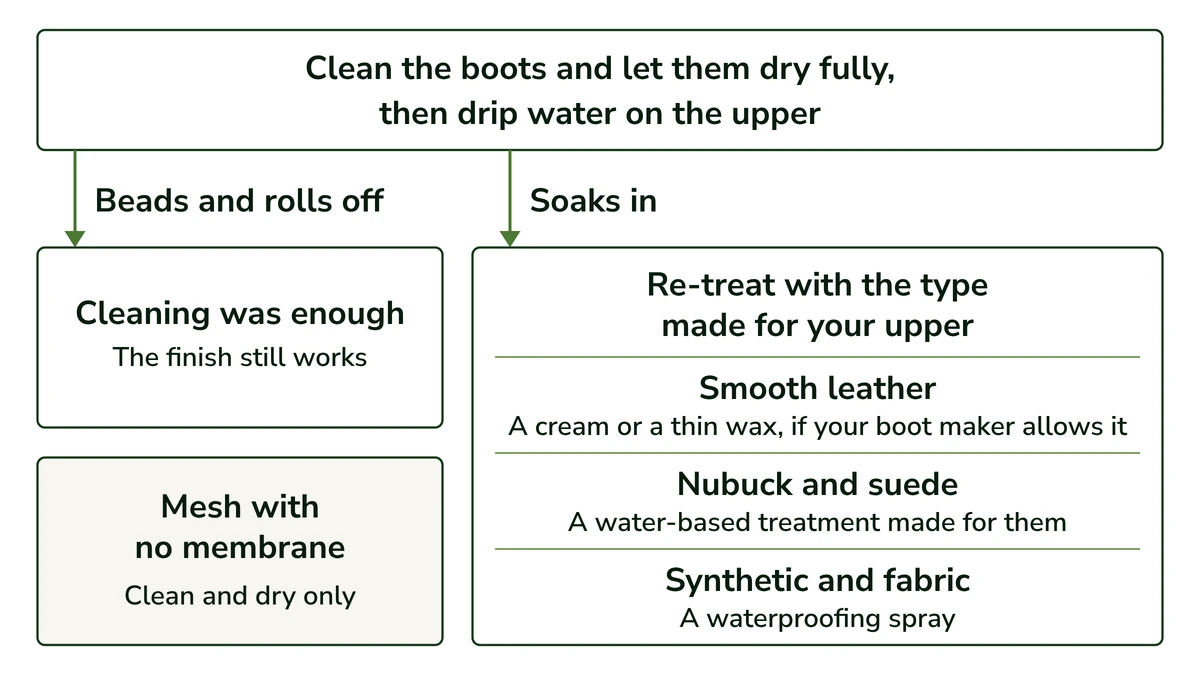
So before you buy any treatment, clean the boots and run the bead test.
The Gore-Tex Myth: Why Membrane Boots Still Need Their Outer Re-Treated
A Gore-Tex or other waterproof membrane sits inside the boot. What wears is the water-repellent finish on the leather or fabric outside it, and once that outer soaks up water, sweat vapor can’t escape, so your feet feel damp though nothing leaked. Gore itself tells owners to re-treat.
“My boots are Gore-Tex, so they never need waterproofing” is an easy thing to believe, since the label says waterproof. LOWA calls it a big myth. The lining sits inside, LOWA explains, and has nothing to do with caring for the leather or fabric outside.
LOWA goes further and says poor leather care makes the membrane ineffective. That’s a boot maker telling you the outer still needs looking after.
So a re-treat restores the outer’s water repellency and leaves the membrane alone. REI notes that membrane areas need only cleaning.
The membrane’s construction, and the PFAS question around it, are covered in my boot-choosing guide, which explains how a waterproof membrane works.
Why does a worn outer matter if nothing leaks? Nikwax explains that a wetted-out outer stops moisture vapor escaping, so feet feel clammy and socks get damp.
That’s how boots that never leaked can still leave your socks wet after a rainy day. Long hours in damp socks are also one of the causes covered in my guide to preventing blisters.
Gore doesn’t treat its own membrane as a reason to skip care: it tells owners to re-apply a water repellent once water stops beading. Salomon says a spray re-activates the outer’s water repellency on a Gore-Tex-type shoe.
Danner makes the same point for leather. It says boots with a Gore-Tex liner are waterproof, but that treating the leather prevents water spots between the leather and the liner.
So I’d look after the outer the same way whether or not the tongue says Gore-Tex. The makers who build those boots ask you to.
How to Clean Hiking Boots Before You Re-Treat Them
Take out the laces and insoles, knock off the mud before it dries and brush off the rest. Rinse with lukewarm water and a soft brush or sponge. Start with water alone, add a mild cleaner only if your boot maker allows it, and skip the washing machine.
If the mud on your boots has been drying since a trip two weekends ago, the steps don’t change. You’ll just spend longer on the brushing. Here’s the order, with the maker behind each step:
- Laces out, insoles too. Gore says to remove the laces, and the insoles if they come out, then shake out the grit. With them out, the water and the brush can reach the tongue and the inside.
- Mud off before it dries. Salomon advises knocking mud off before it dries, then brushing off whatever is loose, so the rinse only has fine dirt left to deal with.
- Rinse and brush. Gore, Hanwag and LOWA all use lukewarm or warm water, Hanwag under running water, and Salomon uses a soft brush or sponge. Hanwag also wipes the inside with a sponge.
- Soap only if your boot maker allows it. Gore says a little liquid detergent, and LOWA a mild shoe cleaner if the boots are heavily soiled. Hanwag advises against soap, which it says can damage leather and waterproofing, and keeps a leather cleaner for when nothing else works.
- No washing machine, no bleach. Gore, Hanwag, LOWA and Salomon all rule out the washing machine, and Gore rules out bleach.
Nikwax adds a warning of its own: it says conventional cleaners can leave a residue that attracts water and masks the repellent. That’s Nikwax’s claim about other companies’ products, so weigh it as such.
With the makers split on soap, I’d start with the step all of them agree on, which is water and a brush. Reach for a cleaner only if that leaves dirt behind and your boot maker’s page allows one.
Either way, the boots go into re-treating clean, because a treatment over dirt sits on the dirt that was masking the finish to begin with.
Quick Tip: Knock the mud off on the day you get home, while it’s still soft. Salomon advises getting it off before it dries.
How to Dry Wet Boots Without Heat
Dry boots slowly at room temperature, somewhere shady and airy, tongues open and insoles out. Heat from a radiator, fire, sun or car can shrink leather and weaken the bond that holds the sole. Stuff them with paper towel, change it a few times, and allow up to two days.
Wet boots at the end of a trip, a heater right there, another hike in the morning: it’s tempting to leave them by the heat or in the car overnight. Here’s why the makers say not to.
Hanwag’s boot cleaning guide says heat makes leather brittle, weakens the bonding and shrinks the leather, so the boot may no longer fit. Nikwax adds that drying too quickly can crack leather and make bonded soles peel.
Hanwag rules out the sun, a fire and a radiator, and LOWA adds the bathroom, a heater or oven, and the car.
Here’s where the makers say the boots should go instead:
- Somewhere shady and airy, with the tongues pulled open and the insoles out (Hanwag, Salomon), so air can reach the inside.
- At room temperature and low humidity, where a fan can help (REI).
- Insoles back in only when fully dry (Salomon), so you’re not sealing damp in again.
Hanwag says drying can take up to two days. If your next trip is close, plan the drying around it rather than hoping the boots are ready by morning.
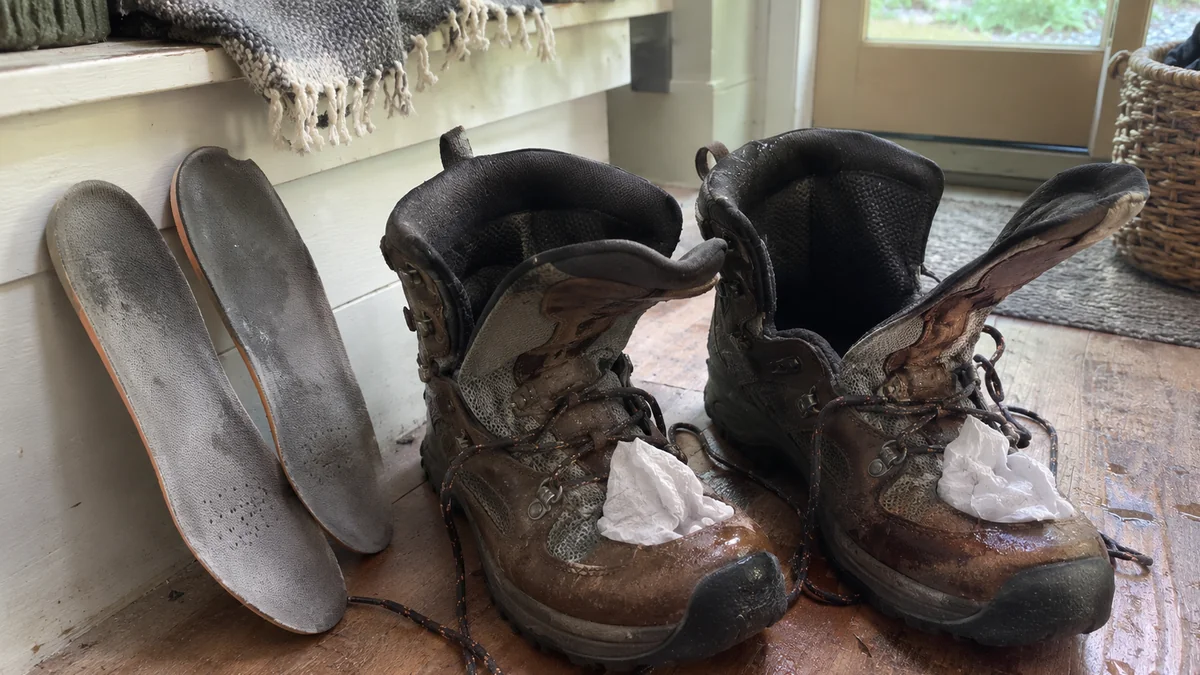
For the stuffing, Hanwag uses paper towel changed several times a day, and it warns that newsprint can damage Gore-Tex membranes. LOWA and Salomon say newspaper is fine. Paper towel fits every one of these makers’ instructions, so it’s the safe choice if you’re unsure.
Boot dryers are where the advice gets mixed. Gore says convection-style boot dryers work well, while Hanwag and LOWA rule out heat sources, and a dryer that blows heated air is one. That’s Gore’s statement, not my recommendation, so check your boot maker’s page before you plug one in.
It comes down to speed against the leather and the glue. Every maker here chooses slow, because the fit and the sole bond are what a fast dry puts at risk.
Quick Tip: Stuff the toes with paper towel and swap it a few times a day. It’s what Hanwag uses, even on Gore-Tex boots, where it warns against newsprint.
How to Waterproof Hiking Boots by Upper Material
Match the treatment to the upper. Smooth leather takes a cream or a thin wax if your boot maker allows it; nubuck and suede, a water-based treatment made for them, which can darken them a little; synthetic and fabric, a spray. Mesh shoes with no membrane only need cleaning.
Two things decide the treatment: what the outer is made of, and whether a membrane sits inside. REI’s guide to waterproofing boots notes that treatments are usually made either for full-grain leather or for rough leathers like suede and nubuck, which is why the material comes first.
The table sums up the treatment type the makers name for each upper, what to expect from it, and what to leave out.
Upper
Treatment type the makers name
What to expect
Leave out
Smooth leather
Cream, or a thin wax on clean, dry leather if your boot maker allows it
A slight shine, not greasy
Oil, grease, heavy coats
Nubuck and suede
A water-based treatment made for them
Slightly darker, with a smoother nap (the soft, fuzzy surface) that a suede brush restores
Regular shoe polish
Synthetic and fabric
A waterproofing spray, or a combination product for fabric and leather
Water beads again
Wax
Mesh with no membrane
None: clean and dry only
Stays breathable, not waterproof
Expecting a spray to make it waterproof
Smooth leather
Treatment type the makers name: Cream, or a thin wax on clean, dry leather if your boot maker allows it
What to expect: A slight shine, not greasy
Leave out: Oil, grease, heavy coats
Nubuck and suede
Treatment type the makers name: A water-based treatment made for them
What to expect: Slightly darker, with a smoother nap (the soft, fuzzy surface) that a suede brush restores
Leave out: Regular shoe polish
Synthetic and fabric
Treatment type the makers name: A waterproofing spray, or a combination product for fabric and leather
What to expect: Water beads again
Leave out: Wax
Mesh with no membrane
Treatment type the makers name: None: clean and dry only
What to expect: Stays breathable, not waterproof
Leave out: Expecting a spray to make it waterproof
Smooth (Full-Grain) Leather: Condition Only When It Needs It
Treat smooth leather when it looks or feels dry, brittle or cracked, which is Hanwag’s signal, or when water no longer beads after a clean. Otherwise a clean may be all it needs.
Hanwag’s method is a thin coat of wax on clean, dry leather, buffed until slightly shiny rather than greasy. There’s no need to heat the wax first, Hanwag says, because heated wax soaks in too deep and costs breathability.
LOWA’s US guide uses its Active Cream after cleaning and drying. How often is a point the makers split on, so it’s in the table below.
Nikwax describes its Waterproofing Wax for Leather as a water-based product that can go on wet or dry leather and may darken it.
I treat my own hiking boots regularly and have re-treated them; they were mostly leather. For your pair, though, your boot maker’s instructions are the ones to follow.
Heavier treatments are where the tradeoff shows. LOWA says oils and fats close the leather’s pores, so boots lose stability and breathability and the adhesives can loosen. REI says too much conditioner makes boots too soft, which costs you support.
Hanwag adds that grease and oil clog the pores and reduce breathability, especially in Gore-Tex boots. Gore itself recommends a water-based pump spray for its footwear. LOWA adds a caution for leather Gore-Tex boots that see hard use: a spray alone isn’t enough care for the leather.
Wax on a membrane boot is another matter, and the makers split on it, as the section below sets out.
Nubuck and Suede: Expect Them to Darken a Little
For nubuck and suede, use a water-based treatment made for them. Nikwax says its Nubuck & Suede Proof keeps the texture and goes on clean, wet footwear, and Hanwag says its Care Sponge suits nubuck and suede.
If your nubuck boots came out of a treatment darker and smoother than they went in, it’s easy to think you’ve ruined them. By Hanwag’s account, you haven’t.
Wax makes nubuck slightly darker and smoother each time without affecting function, Hanwag says, and a suede brush brings back the nap. LOWA says the same of its Active Cream on nubuck and suede: it can darken them and slightly flatten the nap.
One thing to leave on the shelf: LOWA’s US guide says no regular shoe polish on nubuck or split leather.
Synthetic and Fabric Uppers: Spray, Not Wax
Synthetic and fabric uppers take a spray. Hanwag says synthetic uppers don’t need wax and a waterproofing spray is enough, and Gore recommends a water-based pump spray for its footwear.
Plenty of boots mix the two, with leather panels on a fabric body. Nikwax says its Fabric & Leather Proof is made for fabric and leather combination footwear and goes on clean, wet footwear.
Mesh Trail Shoes Without a Membrane: Clean and Dry Only
“I sprayed my shoes and they still got wet” usually comes down to the shoe, not the spray. Mesh lets water through by design, and with no membrane behind it, there’s nothing waterproof for a treatment to restore.
Not sure whether yours have a membrane? The tongue label or the product page will say Gore-Tex, GTX or waterproof if they do.
Decathlon says a treatment can’t make a non-waterproof shoe waterproof; it only restores water repellency on footwear that’s already waterproof. So these shoes get the cleaning and drying steps above, and nothing more.
Where the Boot Makers Disagree, and the Few Things They All Rule Out
LOWA, Hanwag and Gore rule out oil and grease on leather, and no maker suggests direct heat or machine washing. They split on wax for membrane boots, wet or dry application, and how often. Your boot maker’s page settles the first, the label the second, the bead test the third.
Thin coats beat heavy ones. LOWA’s US boot care guide puts it plainly: “To maintain breathability, avoid over-applying treatments.” Hanwag says to apply wax sparingly.
Where they split, the table sets out what each maker says and what settles it for your boots.
Question
What the makers say
What settles it
Wax on membrane leather boots
Gore: no waterproofing waxes. LOWA’s US warranty list: no wax-based products. Hanwag: a thin wax, including on Gore-Tex boots. LOWA’s EU page: a wax cream such as its Active Cream, which it calls essential on Gore-Tex boots
Your boot maker’s care page
Wet or dry when you apply
REI and LOWA: slightly damp. Nikwax sprays: wet. Hanwag: dry
The treatment’s label
How often
LOWA spray: when water stops beading, or about every 3 to 4 months. LOWA cream on Gore-Tex boots: every 6 months. Hanwag wax: every two or three trips, sooner after a wet hike. Decathlon spray: once or twice a year
The bead test
Wax on membrane leather boots
What the makers say: Gore: no waterproofing waxes. LOWA’s US warranty list: no wax-based products. Hanwag: a thin wax, including on Gore-Tex boots. LOWA’s EU page: a wax cream such as its Active Cream, which it calls essential on Gore-Tex boots
What settles it: Your boot maker’s care page
Wet or dry when you apply
What the makers say: REI and LOWA: slightly damp. Nikwax sprays: wet. Hanwag: dry
What settles it: The treatment’s label
How often
What the makers say: LOWA spray: when water stops beading, or about every 3 to 4 months. LOWA cream on Gore-Tex boots: every 6 months. Hanwag wax: every two or three trips, sooner after a wet hike. Decathlon spray: once or twice a year
What settles it: The bead test
Won’t more wax make them more waterproof? Not by the makers’ account. Heavy coats clog the pores the leather breathes through, which is why LOWA and Hanwag both warn against over-applying, and REI adds that too much conditioner softens boots until they lose support.
There’s a warranty side to this, too. LOWA’s US care guide lists no oil, fat or wax-based products and no heat among its warranty don’ts, so a general “wax your leather boots” tip could run against a boot maker’s warranty terms. That’s why your boot maker’s care page comes first.
Even LOWA’s own pages read differently: its US warranty list rules out wax-based products, while both its US and EU pages recommend its Active Cream, which the EU page calls a wax cream. So go by the page for your model, not the brand’s name alone.
Resoling is the other reason to think before you wax. REI says wax residue can stop a new sole’s adhesive from bonding, so it advises avoiding wax-based treatments on boots you plan to resole.
The word wax on a label doesn’t tell you what’s inside, either. Nikwax’s Waterproofing Wax for Leather, for one, is a water-based product.
When two guides tell you opposite things about wax on the same boots, I wouldn’t settle it with a general rule, mine included. I’d follow your boot maker’s page for your model first, then the treatment’s label.
Before you buy a treatment, find your boot maker’s care page for your exact model and check what it says about wax and heat.
Founder & Gear Research Editor

Sonia Zannoni
I’m Sonia, the founder of Best Trail Backpacks. I don’t test gear myself. For every pack I cover, I read the manufacturer’s specs and sizing charts and look for what owners report again and again.
Fit comes first, because a pack that doesn’t match your torso and hips will hurt no matter what it cost. My goal is to help you choose a pack that suits your body, your trip and your budget.
About the Founder
