
Best Compass for Hiking: 5 Reliable Picks for Peace of Mind
Affiliate Disclosure: Some links on this page are affiliate links. If you buy through one, I may earn a commission at no extra cost to you. Commission never decides which products I recommend. Read the full disclosure.
Your phone has the trail map, there’s a power bank in the lid pocket, and someone still told you to carry a compass. Then you start shopping and land on a wall of mirrors, clinometers, global needles and declination screws, with no idea which of them you’d ever use.
That hesitation makes sense. Most compass pages are written for orienteers and search and rescue teams, not for someone who wants a dependable backup on day hikes and a first overnight.
So here’s a plain answer to the best compass for hiking, matched to the trails you actually walk. I compared five well-known models on the features that change how you use them and on what owners report after buying, so you can choose one and skip what you don’t need.
TL;DR: Best Compass for Hiking
- Most day hikers: the Suunto M-3 G, a light baseplate compass with adjustable declination and a needle Suunto balances to work anywhere.
- Marked trails on a budget: the Suunto A-30 NH, the simplest, lowest-cost backup for the northern hemisphere.
- Off-trail navigation: the Suunto MC-2 G, with a mirror for sighting distant landmarks.
- Whichever you choose: practice with a paper map before you need it.
Best Hiking Compasses at a Glance
Here’s how the five compare. All five sit in the under $100 tier, so the real differences are in the features.
Product Name
Best For
Key Strength
Main Tradeoff
Price Tier
Off-trail navigation and travel abroad
Mirror sighting, clinometer and global needle
Heavier and pricier than a baseplate compass
$
A northern hemisphere mirror compass
Clinometer, rubber map feet, recycled materials
Balanced for one magnetic zone; few owner reviews yet
$
Most day hikers
Adjustable declination and global needle at 1.69 oz
No mirror for long sightings
$
Beginners on marked trails
Simple, light, luminous markings
Fixed declination scale; northern hemisphere only
$
Declination without a tool
Global needle, mirror cover, clinometers
Owners report a fiddly declination adjuster
$
Suunto MC-2 G
Best For: Off-trail navigation and travel abroad
Key Strength: Mirror sighting, clinometer and global needle
Main Tradeoff: Heavier and pricier than a baseplate compass
Price Tier: $
Silva Terra Expedition S
Best For: A northern hemisphere mirror compass
Key Strength: Clinometer, rubber map feet, recycled materials
Main Tradeoff: Balanced for one magnetic zone; few owner reviews yet
Price Tier: $
Suunto M-3 G
Best For: Most day hikers
Key Strength: Adjustable declination and global needle at 1.69 oz
Main Tradeoff: No mirror for long sightings
Price Tier: $
Suunto A-30 NH
Best For: Beginners on marked trails
Key Strength: Simple, light, luminous markings
Main Tradeoff: Fixed declination scale; northern hemisphere only
Price Tier: $
Brunton TruArc 15
Best For: Declination without a tool
Key Strength: Global needle, mirror cover, clinometers
Main Tradeoff: Owners report a fiddly declination adjuster
Price Tier: $
Price tiers: $ under $100 | $$ $100 to $249 | $$$ $250 and up
How to Choose a Hiking Compass Without Overcomplicating It
Most people overthink this. If you stick to well-marked park trails, you don’t need a compass built for surveying. You need a few core features, so you’re not comparing specs that will never change your hike.
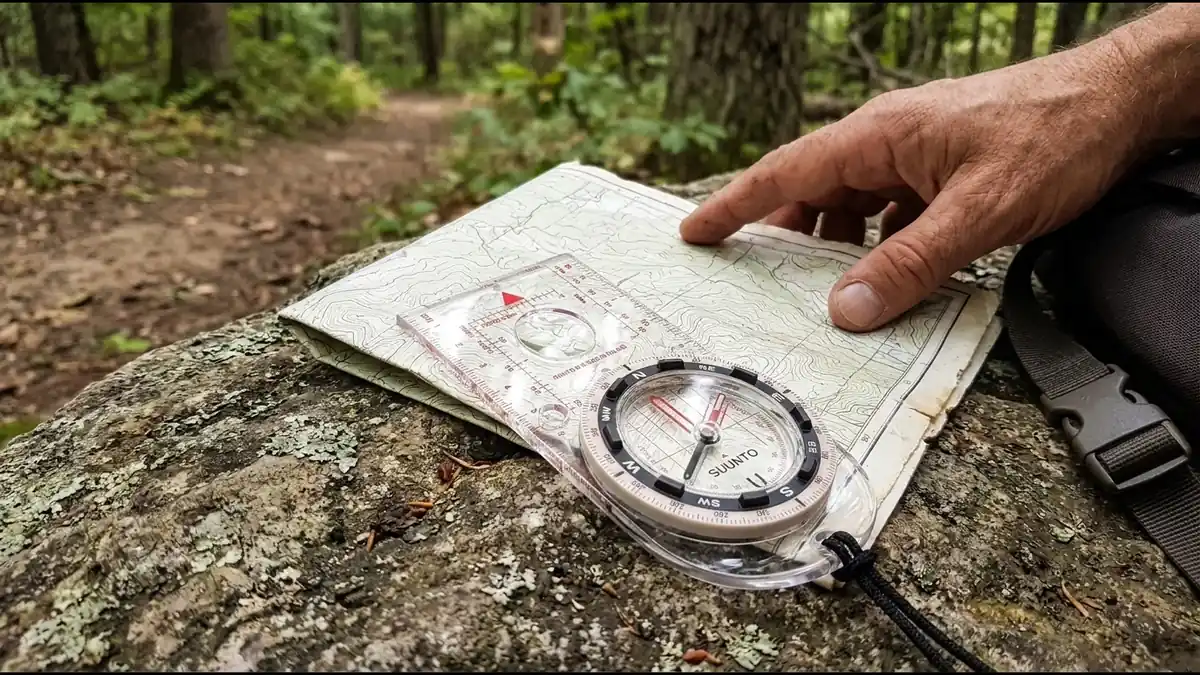
A compass works with a paper topographic map, not instead of one. Your phone’s offline map is useful, but a printed map doesn’t need a charge, and the compass needs the map to tell you which way to walk.
If you’d like the whole setup for marked trails, my guide on how to avoid getting lost while hiking covers the phone, the paper map and the compass together.
If you’re new to topographic maps, the U.S. Geological Survey explains how to download or order topo maps, many of them free to download. Outside the US, your national mapping agency, such as Ordnance Survey in the UK or Natural Resources Canada, offers the same kind of maps.
For areas you hike often, a regional trail map on waterproof paper is worth carrying.
If map and compass work still feels abstract, REI’s short video below walks through the basics with a real compass and map.
Baseplate vs. Mirror Compass
A bearing is simply the direction from where you stand to where you want to go, read in degrees on the compass dial.
A baseplate compass sits flat on your map, which makes it easy to plot a route and take a bearing. A mirror compass adds a hinged lid with a mirror and a sighting notch, so you can aim at a distant landmark and read the dial at the same time.
For marked trails, a baseplate is all you need. A mirror earns its extra weight off trail, because sighting at eye level lets you line up a far landmark more precisely than reading the compass at your waist.
Declination Adjustment: Fixed vs. Adjustable
Your needle points to magnetic north, but your map is drawn to true north. The angle between the two is called declination. It depends on where you hike, and it shifts slowly over the years.
Here’s why it matters: a 5-degree error puts you about 460 feet (140 m) off your line after one mile. When you’re tired and looking for a junction or a campsite before dark, that gap is real.
A compass with adjustable declination lets you set your area’s offset once, and every bearing after that already includes the correction. A fixed compass leaves the correction to you, usually with a printed scale inside the capsule.
You can look up your area’s declination for free with NOAA’s declination calculator. Write the number on a strip of tape on your map or compass case, so it’s there when you need it.
Global Needle vs. Hemisphere-Specific
Earth’s magnetic field doesn’t run flat along the ground. Its lines tilt down into the earth more steeply the closer you get to a magnetic pole, so a compass needle has to be balanced for the part of the world where it’s used.
A needle balanced for North America can tilt and give a less accurate reading far south of the equator, as Silva explains. Suunto’s global needles let the magnet tilt separately from the needle, so the needle stays level anywhere, even with the compass tilted up to about 20 degrees.
If all your hiking is in the US or Canada, a northern hemisphere compass is fine. If you plan to hike in South America, southern Africa or Australia, a global needle is the safer buy.
Weight and Size
The five compasses here run from about 1.1 oz to 3.2 oz, so weight barely changes your pack. Size matters more, because a compass that fits a hip belt or shirt pocket is one you’ll actually take out at a junction.
Storage and Care
Suunto rates its compasses for storage between -22°F and 140°F (-30°C to 60°C), so a sunny dashboard isn’t the place to leave one.
Keep it away from strong magnets too. Silva’s support pages note that phones, car keys and car speakers can reverse a needle’s polarity, so the red end points the wrong way, and Silva says it’s becoming more common as we carry more electronics.
Before a trip, lay the compass flat and check that the needle swings freely and settles on the same direction each time. You want to find a sluggish or reversed needle at home, not at a trail junction.
The Features You Can Skip
A clinometer measures slope angle. Avalanches are possible on slopes steeper than 30 degrees, according to Avalanche.org’s guide to avalanche terrain, so it matters for winter travel in steep terrain and much less on a summer trail.
Even then, a clinometer reading is one small part of avalanche safety. It doesn’t replace avalanche training, a beacon, probe and shovel, or checking the local avalanche forecast.
Luminous markings help at dusk, but a headlamp does most of that work. For most hikers the short list is a reliable needle, adjustable declination and a needle balanced for where you hike.
Top 5 Compasses for Backpacking and Hiking
1. Suunto MC-2 G: The Mirror Compass for Off-Trail Bearings
Best For: Hikers who navigate off trail, travel above tree line or hike abroad, and want one compass that does it all.
 Suunto MC-2 G USGS Mirror Compass
A mirror compass with a global needle, clinometer and adjustable declination, for hikers who navigate off trail or travel abroad.
Why It Stands Out
The MC-2 G is a mirror compass with a sighting notch and hole, so you can aim at a distant ridge or tree and read the dial in the mirror at once. When the trail disappears, that’s how you hold a precise line across open ground.
Suunto adds a liquid-filled clinometer for slope angles, adjustable declination and a global needle. Suunto says its global needles are steadier while you move and settle faster when you stop, which helps when you check a bearing on the go.
Design & Usability Analysis
Suunto lists it at 2.65 oz (75 g), heavier than a baseplate compass but light for a mirror model. Luminous markings on the bezel and the direction-of-travel arrow help in low light, and the USGS version carries scales that match US topo maps.
Declination is set with a small correction tool that comes on the lanyard. Keep the lanyard on the compass, because without the tool you’re stuck with whatever setting you last dialed in.
On Amazon, where the MC-2 G listing has about 590 ratings, many owners report readings within about 2 degrees of their other compasses and like the build. Opinions on durability and value for the price are more mixed.
One thing to check before you buy: Suunto sells the MC-2 in northern hemisphere and global versions under very similar names, and Amazon’s main MC-2 listing opens on a northern hemisphere version. Look for the G in the model name, which marks the global needle.
Pros
A mirror and sighting hole for precise bearings on distant landmarks
A global needle Suunto balances to work anywhere
A built-in clinometer for slope angles in winter or steep terrain
Cons
Costs more than the baseplate picks
Heavier and bulkier than a baseplate compass
More features than marked trails call for
The Verdict
The MC-2 G is my pick if you plan to leave the trail, because the mirror and global needle cover precise sighting and travel anywhere. On marked weekend trails it’s more compass than you need, and the M-3 G below does the everyday work for less weight and money.
Buy This If:
- You navigate off trail or above tree line and need precise bearings.
- You hike outside North America, especially south of the equator.
- You want a clinometer for slope angles.
Skip This If:
- You only hike well-marked trails.
- You want the lightest compass you can carry.
2. Silva Terra Expedition S: Mirror Sighting With Recycled Materials
Best For: Northern hemisphere hikers who want a full-featured mirror compass and care about how it’s made.
 Silva Terra Expedition S
A northern hemisphere mirror compass with a clinometer and a built-in declination adjuster, made partly from hemp and recycled plastics.
Why It Stands Out
The Terra Expedition S is the mirror compass in Silva’s Terra line, which uses REVO, a material made from hemp fibers and recycled plastics, for the lid, grip ring and graduation ring. Silva says REVO has up to 90% lower carbon emissions than ordinary plastic.
The feature list matches a serious mirror compass: mirror sighting with a sighting hole, a clinometer for slope angle, a built-in declination adjuster, luminous markings and a magnifying lens.
Design & Usability Analysis
Silva fits silicone rubber feet under the baseplate to keep it from sliding on the map while you plot a bearing, and a rubber grip that Silva describes as easy to handle.
Silva’s US distributor lists it at 3.03 oz (86 g), with 29% recycled material. The version sold in North America is marked MN, which means Silva balances it for the northern magnetic zone, so it isn’t the compass for trips far south of the equator.
Owner feedback is thin so far. The Terra listing on Amazon has only a couple dozen ratings, too few for a clear pattern.
Pros
Mirror sighting with a sighting hole for precise bearings
A clinometer and a built-in declination adjuster
Lid, grip ring and graduation ring made with hemp and recycled plastics
Cons
Balanced for the northern magnetic zone only
Few owner reviews so far
More compass than marked trails call for
The Verdict
Choose the Terra Expedition S if you want a mirror compass for the northern hemisphere and recycled materials are your tiebreaker. If you might travel south of the equator, the MC-2 G covers you, and if you mostly hike marked trails, a baseplate compass is enough.
Buy This If:
- You want mirror sighting and a clinometer for northern hemisphere hiking.
- Recycled materials tip the choice between two good compasses.
Skip This If:
- You need a global needle for travel.
- You want a compass with a long record of owner reviews.
3. Suunto M-3 G: The Everyday Pick for Most Hikers
Best For: Day hikers and first-overnight hikers who want an accurate, light compass that’s simple to set up.
 Suunto M-3 G Compass
A light baseplate compass with adjustable declination and a global needle, the one I'd point most day hikers to.
Why It Stands Out
The M-3 G sits between the bare-bones A-30 and the mirror models. It’s a baseplate compass with adjustable declination, a global needle on a jewel bearing, luminous markings and a small clinometer that Suunto lists in its specs.
The capsule is liquid filled, which damps the needle so it settles instead of swinging. Suunto lists a 20-degree tilt margin, so the needle still reads when you aren’t holding the compass perfectly level.
Design & Usability Analysis
Suunto lists the M-3 G at 1.69 oz (48 g), light enough for a shirt pocket or a hip belt pocket. The lanyard snaps off when you want the compass flat on the map, and a magnifying lens on the baseplate helps with small map detail.
It carries both metric and imperial scales, including 1:24,000, the scale of the standard USGS 7.5-minute topo maps.
On Amazon, where the M-3 listing has about 270 ratings, owners describe it as a precise instrument and find the declination easy to set with the small included tool. Feedback on how easy the markings are to read is more mixed.
Pros
Adjustable declination you set once for your area
A global needle on a jewel bearing
Light at 1.69 oz (48 g)
Cons
No mirror for long-distance sighting
Declination is set with a small included tool, like the MC-2 G
Some owners find the markings harder to read
The Verdict
This is the compass I’d point most readers to. It covers what matters on day hikes and first overnights, adjustable declination and a needle balanced for anywhere, without the weight or cost of a mirror you may never use. Skip it only if you need precise off-trail sighting.
Buy This If:
- You want one compass for day hikes and first overnights.
- You want adjustable declination without the bulk of a mirror.
Skip This If:
- You navigate off trail and need mirror sighting.
4. Suunto A-30 NH: The Simple Backup for Marked Trails
Best For: Beginners, scouts and weekend hikers who want a light, low-cost backup on marked trails.
 Suunto A-30 NH USGS Compass
A simple, light baseplate compass with luminous markings and a fixed declination scale, a low-cost backup for marked trails.
Why It Stands Out
The A-30 keeps things simple on purpose. There’s no mirror, no clinometer and no adjustable declination, just a compact baseplate compass with a steel needle on a jewel bearing, a magnifying lens and luminous markings for low light.
That covers what most weekend hikers on marked trails need from a backup. With fewer parts to learn, it’s an easy first compass to practice with.
Design & Usability Analysis
Suunto lists it at 1.13 oz (32 g). The version linked here is the NH USGS model, balanced for the northern hemisphere, with scales that match US topo maps.
Instead of an adjustable setting, the A-30 has a fixed declination scale printed inside the capsule. You line the needle up with your area’s declination mark rather than the orienting arrow (the outlined arrow you’d normally use).
There’s no mental math, but you do need to remember which mark is yours.
On Amazon, where the A-30 listing has about 800 ratings, owners say it’s simple, accurate and good value, and like how the luminous markings glow at night. The main complaint is the one you’d expect: the declination is fixed and can’t be adjusted.
Pros
Simple and quick to learn
Very light at 1.13 oz (32 g)
Luminous markings for low light
Cons
A fixed declination scale instead of an adjustable one
Balanced for the northern hemisphere only
No mirror or clinometer
The Verdict
The A-30 NH is the right first compass if you hike marked trails and want a dependable, inexpensive backup, though its printed declination scale takes a little practice at home. If you hike in several regions, spend a bit more on the M-3 G.
Buy This If:
- You want a light, low-cost backup for marked day hikes.
- You want a compass with as little to learn as possible.
Skip This If:
- You change hiking regions often and want adjustable declination.
- You plan to hike south of the equator.
5. Brunton TruArc 15: Tool-Free Declination and a Global Needle
Best For: Hikers who want a mirror compass with a global needle and a declination setting they can change without a tool.
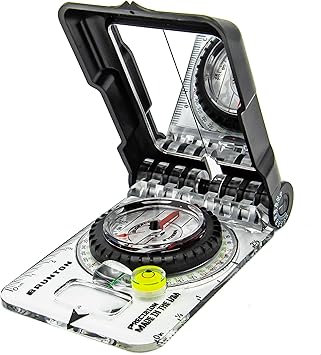 Brunton TruArc 15
A mirror compass with a global needle and a declination setting you change by hand. Owners report the adjuster can be fiddly, so check it at home.
Why It Stands Out
The TruArc 15 combines a global needle, a sighting mirror, clinometers and tool-free declination adjustment. Brunton says the needle tilts up to 20 degrees for use worldwide, and the declination is set by hand, so there’s no small tool to lose.
Brunton also fits what it calls an EverNorth magnet, designed to resist demagnetization over time. Even so, keep it away from phones, magnetic clasps and speakers, as you would any compass.
Design & Usability Analysis
The mirror is built into a cover that folds over the dial, and Brunton adds a map magnifier and a magnified readout for the bearing. Brunton lists it at 3.2 oz, the highest listed weight in this guide, and makes it in Riverton, Wyoming.
On Amazon, where it has about 160 ratings, owners find it accurate and sturdy and like the magnified readout. The complaints are specific: owners report the declination adjuster is hard to use, and one describes the needle tilting even when the compass is level.
Pros
Declination set by hand, with no tool to carry
A global needle Brunton says works worldwide
A mirror cover that protects the dial when closed
Cons
Owners report a fiddly declination adjuster
Some needle balance complaints
The highest listed weight in this guide
The Verdict
On paper the TruArc 15 has the most convenient features here, but the owner reports make it a cautious pick. If tool-free declination matters most, buy it with an easy return policy and check the needle at home. Otherwise the MC-2 G covers the same ground with stronger owner feedback.
Buy This If:
- You want to change declination without a tool.
- You want a global needle and mirror sighting in one compass.
Skip This If:
- You want the most consistent owner feedback.
- You count every ounce in your pack.
Which Compass Actually Fits Your Hiking?
There isn’t one best compass for every hiker, so match it to how you hike:
- Mostly marked trails, on a budget: the Suunto A-30 NH.
- Day hikes and first overnights, with one compass that does it all: the Suunto M-3 G.
- Off-trail travel or trips abroad: the Suunto MC-2 G.
- A northern hemisphere mirror compass with recycled materials: the Silva Terra Expedition S.
- Tool-free declination and a global needle, bought with a good return policy: the Brunton TruArc 15.
A compass only helps once you know how to use it. When yours arrives, my guide on how to use a compass when hiking walks through the three basic steps with a map, without the math anxiety.
Then take the compass and a printed map to a local park. Orient the map once, then pick a landmark you can see, take its bearing, and walk to it and back. Ten minutes of practice close to home makes it a tool you’ll trust.
Founder & Gear Research Editor

Sonia Zannoni
I’m Sonia, the founder of Best Trail Backpacks. I don’t test gear myself. For every pack I cover, I read the manufacturer’s specs and sizing charts and look for what owners report again and again.
Fit comes first, because a pack that doesn’t match your torso and hips will hurt no matter what it cost. My goal is to help you choose a pack that suits your body, your trip and your budget.
About the Founder
