
Hot Weather Hiking: When It’s Too Hot, How Much Water to Carry and When to Go
It’s the night before your hike, and the forecast for the trailhead says 91°F. One site tells you that’s fine with an early start, another says to stay home, and a third gives you a cutoff that doesn’t match either of them.
If that leaves you unsure, you haven’t missed a rule everyone else knows. The advice contradicts itself because there isn’t one safe number to find, so feeling stuck the evening before is a normal place to be.
What you need for hot weather hiking is a way to judge this hike, tomorrow: how hot is too hot on that trail, how much water to carry, and when to go. And underneath that, you want to know whether you’d spot trouble in time.
By the end, you’ll be able to read tomorrow’s forecast and make one of three calls (go as planned, change the plan or stay home), carry water that fits the hours you’ll be out, and know which signs mean turn back and which mean call for help.
TL;DR: Hot Weather Hiking
- There’s no safe hiking temperature to look up: check the heat index for your hours on the trail (higher in full sun), the HeatRisk level and any heat alert, then go, change the plan or stay home.
- Fit doesn’t mean adapted: getting used to heat takes 7 to 14 days and fades after a week or more away, so the first hot hike of the year carries more risk.
- Plan on more water than usual (about a quart an hour on hot, dry days in park guidance), sip often, eat salty snacks, and don’t go past 48 ounces (about 1.4 liters) an hour.
- Confusion, passing out or a body temperature of 103°F (39.4°C) or higher points to heat stroke: call 911 (or your local emergency number) and cool the person.
How Hot Is Too Hot to Hike? Read the Forecast, Not a Single Number
The National Weather Service and the CDC don’t give a safe hiking temperature, because heat tolerance differs from person to person. Instead, the weather service offers three tools: the heat index (which assumes shade), HeatRisk (which weighs how unusual the heat is for your area and season) and heat alerts.
Ask other hikers how hot is too hot and you’ll hear very different answers. Each of them is describing their own body on their own trails, which is why the weather services say no single threshold works for everyone.
The heat index is how hot it feels once humidity is added to the air temperature. Humidity matters because sweat cools you as it evaporates, and damp air slows that down.
The National Weather Service (NWS) uses this example in its heat forecast tools: 96°F at 65% humidity feels like 121°F. The index also assumes shade and a light wind, and full sunshine can raise it by up to 15°F (about 8°C).
So on a mostly exposed trail, the “feels like” number on your app is the low end of what you’ll walk through. I’d also read the hourly forecast for your hours out rather than the day’s high, which may arrive after you’re back at the car.
Quick Tip: Look at the hourly heat index for the hours you’ll be on the trail, and remember it assumes shade. Add to it for the exposed stretches, since the NWS says full sun can raise it by up to 15°F.
HeatRisk is the NWS tool closest to the question you’re asking. It weighs how unusual the heat is for your location and the time of year, how long it lasts, and whether nights bring relief.
It has five levels, from 0 (green) to 4 (magenta). The NWS describes it as experimental and as a supplement to the official alerts, not a replacement. At the top three levels, its advice reads like a planning guide:
- Level 2 (orange): reduce time in the sun during the warmest part of the day and move outdoor plans to cooler times, which for a hike usually means an earlier start.
- Level 3 (red): consider canceling outdoor activities during the heat of the day or moving them to the coolest hours, so a midday hike becomes a dawn hike or no hike.
- Level 4 (magenta): strongly consider canceling outdoor activities, which is as close as the tool comes to saying stay home.
If you’re deciding about tomorrow, pull up the HeatRisk map for your trailhead now and keep it open as you read.
HeatRisk covers the US only. Outside the US, use your national weather service’s heat warnings and its hourly feels-like forecast the same way: for your hours on the trail, raised for full sun.
Heat alerts are the official layer on top. A Heat Advisory means dangerous heat is expected. An Extreme Heat Watch means conditions are favorable for extremely dangerous heat, though its timing is still uncertain, and an Extreme Heat Warning means extremely dangerous heat is expected or already happening.
The conditions that trigger an advisory vary by local weather office, so there’s no national number to memorize.
Those three readings (the heat index raised for sun, the HeatRisk level and any alert) are the first part of the night-before check further down. The next part is about you rather than the forecast.
Fit and Used to the Heat? Why That Doesn’t Settle It
Fitness helps, but it doesn’t protect you from heat illness. The CDC says people who exercise on hot days are more likely to get dehydrated and sick. NIOSH’s outdoor worker guidance says heat tolerance takes 7 to 14 days to build and may fade after a week or more away.
If you sit at a desk all week and hike on weekends, the first warm Saturday of the year can feel easy. Your legs are strong and your lungs are fine, so the heat seems like a detail rather than the main thing to plan around.
The trouble is that fitness and heat tolerance are different things. The CDC counts people who exercise on hot days among those more likely to become dehydrated and get heat-related illness, so being active in the heat is part of the risk rather than protection from it.
What protects you is something the body builds over time, which the guidance calls acclimatization. NIOSH, the CDC’s workplace safety institute, says in its guidance on getting used to heat that it takes 7 to 14 days of gradually more time in the heat.
A few days away don’t undo it, NIOSH says, but a week or more away may cause a significant loss, and it’s often regained in 2 to 3 days. Fit people appear to keep it better.
So fitness helps you hold on to heat tolerance once you have it, but it doesn’t build it for you. These figures come from guidance written for people who work outdoors in heat, not from studies of hikers, so read them as a rough timeline rather than a schedule.
This is also why the first hot weekend of the year is different from the tenth. HeatRisk compares the forecast with what’s normal for that place and date.
The NWS’s own example is a hiker from a northern climate visiting the desert Southwest in April, not yet used to the 80s or 90s. That hiker should watch for orange or higher days, the NWS says.
A CDC-authored study at Grand Canyon National Park found 90% of heat illness cases happened while hiking, with the highest rates in May.
The honest answer to “I’m fit” is that you’re fit for what your body is used to right now. On a first hot outing of the year, or after a week or more away from heat, start slowly and build your pace, as the CDC advises for exercise in heat.
Go, Change the Plan or Stay Home: Making the Hot Weather Hiking Call
Decide the night before, using the forecast for your hours out. A heat alert or high HeatRisk, an exposed trail without water, a hike that can’t beat the hottest hours, or a body not yet used to heat each push you toward going earlier, shorter, shadier or not at all.
Each change has a cost. An early start avoids the hottest hours, but it means an early alarm and a shorter window, so the whole hike has to fit inside it.
The water that makes a long hot hike possible also adds weight, about 2.2 pounds (1 kg) for every liter you carry. That’s worth knowing before you decide a longer route is fine as long as you bring more.
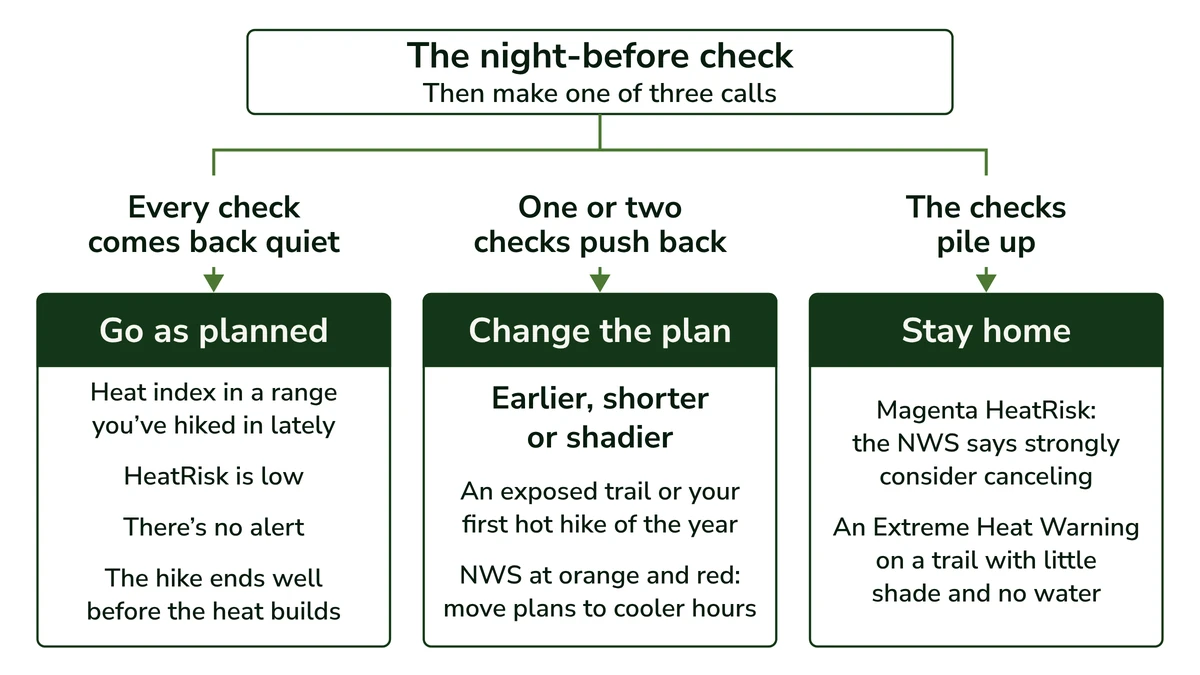
The Night-Before Check
Here’s what I’d check, with the reason each one belongs on the list:
- The heat index for your hours out, raised for full sun, because the app number assumes shade and an exposed trail can feel up to 15°F hotter.
- The HeatRisk level for your location, because it counts early-season heat and warm nights that a single temperature misses.
- Any Heat Advisory, Extreme Heat Watch or Extreme Heat Warning, because these are the official signal that dangerous heat is coming or likely.
- How much of the trail is shaded or exposed, and whether there’s water on it, because shade lets you rest out of the sun and a stream lets you soak a hat and cool down.
- How used you are to heat right now, because that tolerance builds over 7 to 14 days and fades after a week or more away.
- Whether the hike fits before the hottest hours, because a start that looks early on paper doesn’t help if you’re still climbing at midday.
- How easy it is to turn back early, because an out-and-back can be cut short anywhere, while a long loop commits you once you’re past the halfway point.
Then make one of three calls. None of them comes from a temperature cutoff, because there isn’t a trustworthy one.
Go as planned when every check comes back quiet: the heat index for your hours is in a range you’ve hiked in lately, HeatRisk is low, there’s no alert, and the hike ends well before the heat builds. My line here is all of them, not most of them.
Change the plan when one or two checks push back, such as an orange or red HeatRisk day, an exposed trail or your first hot hike of the year. The NWS advice at orange and red is to move plans to cooler hours, and I’d make that my default.
Stay home when the checks pile up. A magenta HeatRisk day, where the NWS says to strongly consider canceling outdoor activities, is a stay-home day for me, and so is an Extreme Heat Warning on a trail with little shade and no water.
Earlier, Shorter or Shadier: Changing the Plan
Timing is the easiest change to make. The National Park Service advises planning activities before 10 am or after 4 pm, with a cooler backup plan.
Grand Canyon goes further for its own trails and strongly discourages inner canyon hiking from 10 am to 4 pm. Both are park guidance for park conditions, so treat the hours as a starting point for your trail rather than a clock that fits every hike.
Evenings aren’t automatically cool, either. Some hikers find a late start stays hot well into the evening, and HeatRisk counts whether nights bring relief for that reason. The clock only helps once you’ve checked what the hourly forecast says about those hours.
Shorter or shadier changes the math in a different way. A route with tree cover and water along it lets you rest often in shade, as the NPS recommends, and a shorter hike means fewer hours to carry water for and fewer hours in the sun.
I hike in summer heat myself, and I’ve changed a plan in these ways: an earlier start, a shorter hike and looking for a trail with more shade.
The earlier start has one catch, though. It only works if the whole hike fits before the heat peaks, which means knowing how long your hike will really take, breaks and the climb included, rather than going by distance alone.
When Heat Is the Reason to Turn Back
Say you’re an hour from the car, half your water is gone and your head is starting to pound. Part of you doesn’t want to “waste” the drive, especially if the trailhead was a long way from home.
The drive isn’t wasted, though. Turning around at that point is the plan doing its job, and on a hot day I’d turn back for any one of these reasons:
- Half your water is gone. Rangers at Arches and Canyonlands National Parks advise turning around at that point. The walk back needs at least as much water as the walk in, and on a hot day it usually comes later and hotter, so treat half as the latest point to turn, not a target.
- The first warning signs are starting, such as a headache, dizziness, cramps or unusual tiredness. The signs section below covers what each one can point to and what to do.
- The clock is reaching the hot hours with a long way still to go, because the heat will keep climbing while you walk out.
If you already set a turnaround time for your hikes, these are the heat reasons to add to it.
Help can also take longer to reach you on a hot day. Grand Canyon says help may be delayed in summer heat, which is why “how easy is it to turn back” sits on the night-before list.
How Much Water to Carry on a Hot Hike (and Why More Isn’t Always Safer)
Start from about half a liter an hour in moderate conditions and plan on more in heat: park guidance for hot, dry days is about a quart an hour. Sip small amounts often, eat salty snacks, and stay within the CDC guidance limit of 48 ounces (1.5 quarts) an hour.
The fear behind most hot-day water questions is running dry, and it pushes some hikers to drink as much as they can. I’d rather plan water by the hours you’ll be out than by guesswork, because hours are something you can count the night before.
How Much Is Enough
The baseline for moderate conditions is about half a liter an hour, the planning figure REI Expert Advice gives and the one my guide to hiking essentials for beginners uses. That guide also covers the signs of dehydration.
Heat raises that number. The National Park Service at Saguaro puts hot, dry days at about a quart an hour, and CDC guidance for outdoor workers, from NIOSH, suggests about a cup (8 ounces) every 15 to 20 minutes.
Those two land close together. A cup every 20 minutes is three cups, or 24 ounces, an hour, and a cup every 15 minutes is four cups, or 32 ounces. That works out to three quarters of a quart to a full quart an hour.
To get your own number, multiply by the hours you’ll be out. A quart is just under a liter, so four hours at a quart an hour comes to a little under 4 liters, which weighs a little over 8 pounds (just under 4 kg).
The Upper Limit and Why Salt Matters
More water isn’t always safer. NIOSH’s hydration guidance sets an upper limit of 48 ounces (1.5 quarts, about 1.4 liters) an hour, because too much fluid lowers the salt in your blood.
Big Bend National Park warns that drinking too much without enough salty food can be as dangerous as dehydration. The condition is called hyponatremia, and it can mimic early heat exhaustion, which makes it easy to mistake for not drinking enough.
Big Bend’s treatment is salty food, electrolyte sports drinks sipped slowly and rest in the shade, with immediate help if the person’s mental alertness drops.
Salty snacks matter for the same reason, since the NPS notes they replace the electrolytes you lose in sweat. NIOSH adds that regular meals usually cover salt and that salt tablets aren’t recommended, so the salty snacks you were going to eat anyway are doing real work.
Carrying It and Keeping It Cool
NIOSH says small, frequent drinks work better than large ones spaced far apart. That means your water needs to sit where you can reach it while you walk, not at the bottom of the pack.
Once you know how many liters a hot hike needs, my guide to hydration packs matched to your hike length shows which packs carry that much and how long each reservoir lasts in heat.
Warm water is easy to skip on a hot day, which undoes the point of carrying it. The post on water bottles for hiking compares an insulated bottle that keeps water cold with lighter bottles.
Quick Tip: Sip about a cup every 15 to 20 minutes rather than gulping a lot at each stop. NIOSH guidance says small, frequent drinks work better than large, infrequent ones.
What to Wear When It’s Hot: Light, Loose and Covered
Wear lightweight, loose, light-colored clothing, as the CDC and the National Park Service advise, and cover up against the sun. Sweat cools you as it evaporates, which is why wetting your hat or shirt helps you cool down. In very dry heat, even a damp cotton shirt can help.
On a hot morning it’s tempting to reach for a tank top, because long sleeves feel wrong when you’re already warm standing at the trailhead.
Light colors and a loose cut are the CDC and NPS advice, and sun protection is part of the same NPS list. Since sweat does its cooling by evaporating, the NPS also points out that getting wet helps, which makes a soaked hat or shirt useful on a hot trail.
Long sleeves are the real tradeoff. A light, loose long-sleeved shirt keeps the sun off your arms, but you may feel warmer in it at first. On an exposed trail I’d still pick the sleeves, because the sun is the part of the heat you can actually block.
Cotton is the one fabric where heat changes the usual advice. On a very dry, hot day, a damp cotton shirt cools you instead of chilling you, and my guide to how hiking layers work explains why cotton chills you once the day cools.
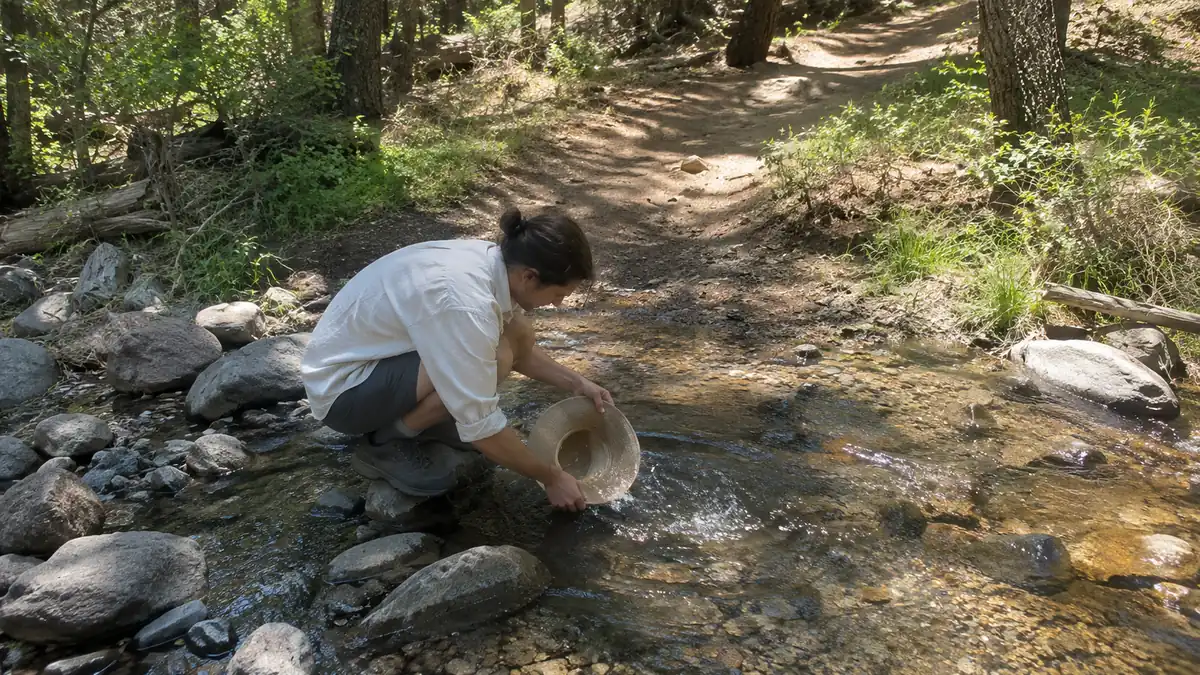
Quick Tip: When the trail crosses a stream, soak your hat or a bandana before you move on. The NPS says getting wet helps you cool down.
Heat Exhaustion or Heat Stroke? The Signs and What to Do
Heat exhaustion brings heavy sweating, cold, clammy skin and a fast, weak pulse: get cool, loosen clothes and sip water. Heat stroke (confusion, passing out or a temperature of 103°F or higher) is an emergency: call 911 (or your local emergency number), cool the person and give nothing to drink.
On the trail, the person you’re most likely to notice this in is your hiking partner, and the change can be quiet. They go silent, fall behind, or start answering a little oddly, and that last one matters most.
The CDC’s advice for exercise in heat is to watch a partner and have them watch you. I can’t tell you what’s happening to a particular person, but I can lay out the signs as the CDC lists them, so you know which ones mean get help now.
Heat Cramps: The Early Warning
The CDC describes heat cramps as muscle pain or spasms with heavy sweating during intense exercise. On a hot climb, they’re worth treating as an early warning rather than something to push through.
The CDC’s steps are to stop, move somewhere cool, drink water or a sports drink, and wait for the cramps to pass before going on. Get medical help if the cramps last more than an hour, or if the person is on a low-sodium diet or has heart problems.
Telling Heat Exhaustion From Heat Stroke
This side-by-side follows the CDC’s heat-related illness sheet, so you can see where the two overlap and where they split.
What you notice
Heat exhaustion
Heat stroke
Skin
Cold, pale, clammy
Hot, red, dry or damp
Sweating
Heavy
Skin can be dry or damp, so sweating doesn’t rule it out
Pulse
Fast, weak
Fast, strong
Head and mind
Headache, dizziness, fainting
Headache, dizziness, confusion, passing out
Stomach
Nausea or vomiting
Nausea
Body temperature
No figure given on the CDC sheet
103°F (39.4°C) or higher
What to do
Move somewhere cool, loosen clothes, cool wet cloths or a cool bath, sip water
Call 911, move somewhere cooler, cool with cool cloths or a cool bath, give nothing to drink
When to get help
Right away if vomiting, getting worse or lasting longer than 1 hour
Right away: it’s an emergency
Skin
Heat exhaustion: Cold, pale, clammy
Heat stroke: Hot, red, dry or damp
Sweating
Heat exhaustion: Heavy
Heat stroke: Skin can be dry or damp, so sweating doesn’t rule it out
Pulse
Heat exhaustion: Fast, weak
Heat stroke: Fast, strong
Head and mind
Heat exhaustion: Headache, dizziness, fainting
Heat stroke: Headache, dizziness, confusion, passing out
Stomach
Heat exhaustion: Nausea or vomiting
Heat stroke: Nausea
Body temperature
Heat exhaustion: No figure given on the CDC sheet
Heat stroke: 103°F (39.4°C) or higher
What to do
Heat exhaustion: Move somewhere cool, loosen clothes, cool wet cloths or a cool bath, sip water
Heat stroke: Call 911, move somewhere cooler, cool with cool cloths or a cool bath, give nothing to drink
When to get help
Heat exhaustion: Right away if vomiting, getting worse or lasting longer than 1 hour
Heat stroke: Right away: it’s an emergency
One row is easy to misread. Many people expect heat stroke to mean dry skin, but the CDC lists heat stroke skin as hot, red, dry or damp, so a person who’s still sweating can still have heat stroke.
Confusion and passing out are the signs that change what you do. Heat exhaustion needs medical help right away too if the person vomits, gets worse, or it lasts longer than an hour, according to the CDC.
Hyponatremia can blur the picture, since Big Bend notes it can look like early heat exhaustion. Either way, a drop in alertness means getting help.
If It’s Someone Else on the Trail
If a partner or another hiker shows these signs, the NPS steps are to stop, move them into shade, and call 911 or flag down a ranger.
Then cool them. The NPS advises splashing or soaking them with water, if you have it, and fanning them, and the CDC sheet adds cool, wet cloths. If it looks like heat stroke, give them nothing to drink, as the CDC sheet says.
A lot of what goes wrong on a hot hike starts long before anyone needs to call 911: the forecast read for the wrong hours, the start that was a little too late, or the water planned for a cooler day.
That’s the useful part, because every one of those is something you can sort out the evening before, at home with the forecast open.
Tonight, before you set the alarm, check the hourly heat index and the HeatRisk level for your trailhead and decide which of the three calls fits.
Founder & Gear Research Editor
Sonia Zannoni
I’m Sonia, the founder of Best Trail Backpacks. I don’t test gear myself. For every pack I cover, I read the manufacturer’s specs and sizing charts and look for what owners report again and again.
Fit comes first, because a pack that doesn’t match your torso and hips will hurt no matter what it cost. My goal is to help you choose a pack that suits your body, your trip and your budget.
About the Founder
