
Beginner Backpacking Trips in Canada: Short First Overnights and How to Book Each Campsite
Your pack is half full and the weekend is picked. Then the park’s booking page opens, and it’s all permit areas, a reservation launch at 8 am, a reservation that turns out not to be a permit, and a note that the bear cable at your site might be broken.
It’s easy to assume the walk is the hard part of beginner backpacking trips in Canada. On the routes here the walk is often shorter than a usual day hike, and what stops people is the booking and the campsite rules.
Getting stuck at this point is common. Canada’s parks are run by different agencies with different booking systems, and none of their pages explains the others, so not following them on the first read doesn’t mean you aren’t ready.
What you want is a short list where the campsite is reserved, the car is close if something goes wrong, and the booking step is clear.
So here are five short first overnights in five provinces, picked by the same criteria and laid side by side. Each one comes with how and when to book it, so you can choose one and book the right thing on the right day.
TL;DR: Beginner Backpacking Trips in Canada
- For the shortest walk with food lockers waiting, Elbow Lake in Alberta, 1.3 km (0.8 mi) in, and Frontenac in Ontario, with a locker at every site, ask the least of a first night. Kejimkujik in Nova Scotia lets you pick a site from 5 minutes to 1.5 hours in.
- A reservation isn’t always the whole job. Kejimkujik still needs a permit picked up before you walk in, and Yoho needs a backcountry permit for any overnight, with reservations that opened in January in 2026 (the date changes every year).
- Fires and drinking water aren’t a given. Yoho bans fires across its whole backcountry, and none of the five official pages lists drinking water at camp, so bring a way to treat it.
- Never slept outside before? A drive-in campsite is the better first night.
Want the five side by side first? The at-a-glance table opens the route section below.
What Makes a Short Route Right for a First Night Out
A good first overnight keeps the car close and takes the hardest skills off the table. I compared routes on six things: a reservable campsite, a short walk with little climbing, water near camp, food storage in place, a booking step you can get right, and a season that fits.
Here’s why each of those matters on a first night:
- Distance and climb to camp. A short walk means the car is close if a pole snaps or the weather turns. Little climbing matters because an overnight pack is heavier than a day pack. Where a park doesn’t publish an elevation figure, I say so.
- A designated site you can reserve. A tent pad is waiting before you leave the car, so you’re not hunting for flat ground at dusk.
- Water at or near camp. Water is heavy, so a source near camp means carrying less of it. None of the five official pages lists drinking water at camp, though, so a way to treat water goes in every pack.
- Food storage already in place. A locker or a pole means you don’t have to hang a food bag between two trees, the one bear-country skill most beginners haven’t practiced.
- A booking step you can get right. One site opens 90 days ahead, one five months ahead, one on a single January morning. Knowing which, and what you carry in with you, is what gets you past the trailhead with the right paperwork.
- A season that fits. A road that hasn’t opened or a trail still under snow ends the plan before it starts.
Think about standing at a trailhead and wondering what happens if the tent leaks at midnight. Knowing the car is 30 minutes away, not half a day, takes a lot of the fear out of that question.
I put distance and food storage first because those two decide how a bad night plays out. A short walk makes walking out a real option, and a locker means you don’t have to learn a bear hang in the dark.
If backcountry rules read like a second language right now, that’s normal on a first read. My advice for a first night is to start at an easy, bookable site with lockers, not one where you hang your own food.
You’ll notice a few famous names missing. Garibaldi Lake is already covered as a first overnight in my list of the best hikes in North America, and Lake Agnes and Cape Breton’s Skyline appear there as day hikes, so I’ve left all three out here.
The five that made it sit in five provinces (Alberta, British Columbia, Ontario, Quebec and Nova Scotia), run by four agencies: Alberta Parks, Parks Canada, Ontario Parks and Sépaq. I picked each one from its agency’s official pages, and every figure below comes from the agency that runs the route.
One tradeoff runs through all five. A site a short walk from a parking lot is easy for everyone to reach, so expect company. The mountain valley on this list asks for more in return: a January booking, a stove instead of a fire, and stricter rules.
What the Campsite Gives You, and What It Doesn’t
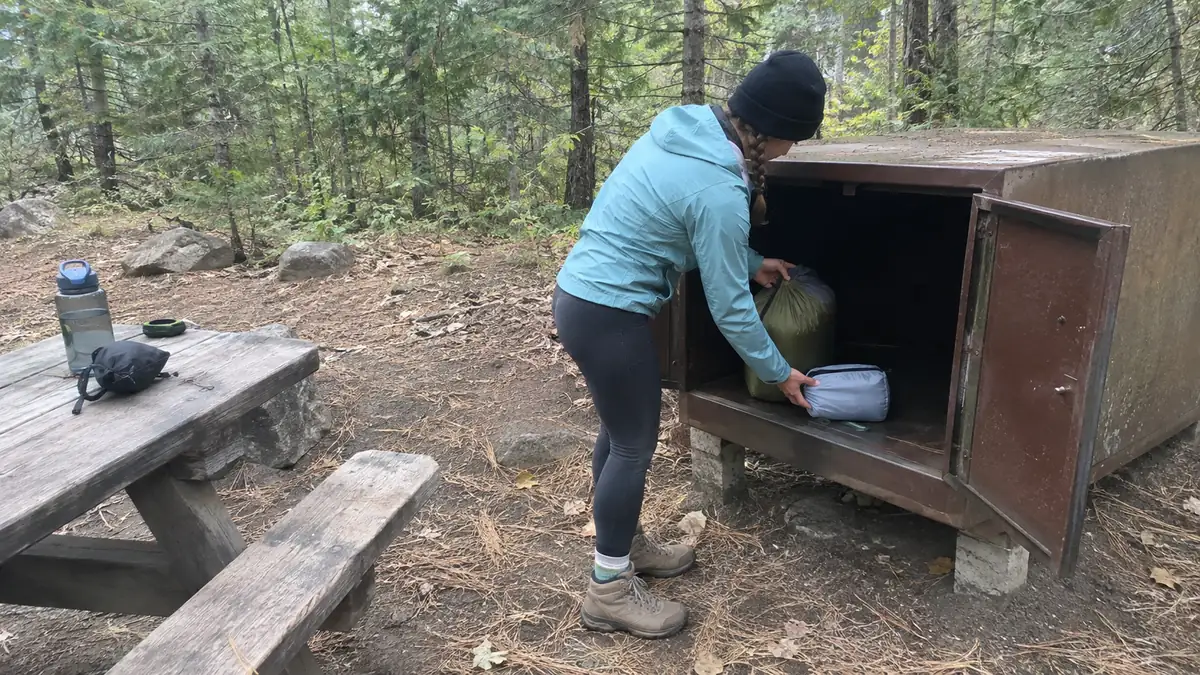
A reserved backcountry site doesn’t come with a set kit. Elbow Lake and Frontenac give you food lockers, L’Équerre has food poles, and Kejimkujik’s bear cables may be broken. Yoho bans fires across its backcountry, and none of the five official pages lists drinking water at camp, so treat yours.
It’s natural to picture a reserved site as a package: tent pad, locker, fire ring, tap. A designated tent spot is there at all five (a tent pad at four of them, a marked lot at L’Équerre).
The rest changes, and the two things people most often assume, a campfire and food storage that works, are the two that vary most.
Here’s what each route gives you for food storage:
- Elbow Lake: secure food storage lockers, so there’s no food hang to learn.
- Frontenac: a food locker at every site. Ontario Parks’ blog gives the inside as 30 by 15 by 20 inches, so you can check your food bag will fit.
- L’Équerre: food poles at the site.
- Laughing Falls, in Yoho: food lockers, bear poles or cables, though Parks Canada doesn’t say which one this campground has.
- Kejimkujik: bear cables at each tent site for hoisting food, which Parks Canada warns may be broken.
Yoho’s rule is a good habit anywhere: toiletries, garbage and cooking gear go in with the food, and no food is left behind. Keep that in mind when you pack the small kit for staying clean on your first nights out, since toothpaste and sunscreen count.
Now imagine arriving at Kejimkujik in the evening, food bag in hand, and finding the cable won’t hoist. Parks Canada’s own note on the cables is short: “We recommend that you come prepared.”
Coming prepared means knowing the fallback. Parks Canada’s bear country guidance is to store food and anything with a smell in bear-resistant storage where it’s provided, or suspend it between two trees at least 4 m (13 ft) off the ground and 1 m (3 ft) from the trunks.
The same guidance says to cook at least 100 m (330 ft) downwind of where you sleep and to keep food smells out of the tent. Both keep the smells that draw a bear away from the spot where you’re asleep.
So do you need to learn a bear hang before your first night? Not at Elbow Lake or Frontenac, where lockers are provided.
At Kejimkujik, know the Parks Canada fallback in case the cable is broken. If you’ve never hung a food bag, I’d start where there’s a locker.
Quick Tip: If a cable or locker isn’t usable, Parks Canada’s fallback is to hang food between two trees at least 4 m (13 ft) up and 1 m (3 ft) out from the trunks. Practice it once at home or at a drive-in site before you need it.
Fires vary even more than food storage:
- Laughing Falls, in Yoho: no fires anywhere in Yoho’s backcountry, so a stove is the only way to cook. One-pot meals for one burner keep a stove-only night simple.
- Kejimkujik: a permit is required for campfires, and firewood is no longer provided, so you buy it at the Visitor Centre or kiosk. Most sites have a fire box, but sites 17, 41, 42 and 43 don’t.
- Frontenac: you can collect dead, fallen wood or buy firewood at the park office, but never bring firewood from home. Check the park’s alerts page for fire bans before you go.
- L’Équerre: a fireplace on the site, with wood provided.
- Elbow Lake: the campground page doesn’t say whether fires are allowed, and it prohibits using dead wood on the ground as firewood.
The firewood-from-home rule has a reason behind it. Wood carried in from somewhere else can bring pests such as Hemlock Woolly Adelgid into the park, which is why Frontenac sells firewood at the office instead.
Water is the gap all five share. Parks Canada’s rule in Yoho is to boil, filter or chemically treat all water before drinking, Sépaq describes the water near L’Équerre as non-drinking, and Kejimkujik’s packing list says to bring water or a filtration system.
Alberta Parks and Ontario Parks don’t say either way on the pages for Elbow Lake and Frontenac. So whichever route you pick, a way to treat water goes in the pack.
Every route has privies or pit toilets, which covers camp itself. For the walk in, and anywhere between the privy and the trail, going to the bathroom in the woods is worth reading up on before your first night.
Here’s what each campsite provides, side by side.
Route
Food storage
Fires
Water
Toilet
Elbow Lake
Secure food storage lockers
Not stated on the page; no dead wood from the ground
The lake; treatment not stated
Pit or vault toilets
Kejimkujik
Bear cables at each site (may be broken)
Campfire permit; buy firewood; no fire box at sites 17, 41, 42, 43
Bring water or a filter
Pit privy at each site
Frontenac
Food locker at every site
Dead, fallen wood or office firewood; check fire bans
Not stated
Privy at each site
Laughing Falls
Food lockers, bear poles or cables
None in Yoho’s backcountry
Boil, filter or treat all water
Dry toilets
L’Équerre
Food poles
Fireplace, wood provided
Non-drinking water near the site
Pit toilets nearby
Elbow Lake
Food storage: Secure food storage lockers
Fires: Not stated on the page; no dead wood from the ground
Water: The lake; treatment not stated
Toilet: Pit or vault toilets
Kejimkujik
Food storage: Bear cables at each site (may be broken)
Fires: Campfire permit; buy firewood; no fire box at sites 17, 41, 42, 43
Water: Bring water or a filter
Toilet: Pit privy at each site
Frontenac
Food storage: Food locker at every site
Fires: Dead, fallen wood or office firewood; check fire bans
Water: Not stated
Toilet: Privy at each site
Laughing Falls
Food storage: Food lockers, bear poles or cables
Fires: None in Yoho’s backcountry
Water: Boil, filter or treat all water
Toilet: Dry toilets
L’Équerre
Food storage: Food poles
Fires: Fireplace, wood provided
Water: Non-drinking water near the site
Toilet: Pit toilets nearby
Five Beginner Backpacking Trips in Canada, Route by Route
These five routes sit in Alberta, Nova Scotia, Ontario, British Columbia and Quebec, and each ends at a site you reserve ahead. They run from Kejimkujik sites minutes from the parking lot to an 8 km (5 mi) walk at L’Équerre, from the simplest first night to the biggest step.
The order starts with the shortest possible walks. At the first two, you can reach a site in 1.3 km (0.8 mi) or less (at Kejimkujik, by picking sites A to D or site 1), and the last is a full 8 km.
Here’s how the five compare on distance, climb and season.
Route
Province and agency
Distance to camp
Climb
Season
Elbow Lake
Alberta, Alberta Parks
1.3 km (0.8 mi)
125 m (410 ft)
June 15 to November 29
Kejimkujik
Nova Scotia, Parks Canada
0.21 to 5 km (0.1 to 3.1 mi), by site
Not published
Victoria Day weekend to end of October
Frontenac
Ontario, Ontario Parks
About 20 minutes to more than 3 hours on foot
Not published
Year-round
Laughing Falls
British Columbia, Parks Canada
4.5 km (2.8 mi)
125 m (410 ft)
Road open mid-June to mid-October
L’Équerre
Quebec, Sépaq
8 km (5 mi)
Not published
April 24 to October 31 (2026)
Elbow Lake
Province and agency: Alberta, Alberta Parks
Distance to camp: 1.3 km (0.8 mi)
Climb: 125 m (410 ft)
Season: June 15 to November 29
Kejimkujik
Province and agency: Nova Scotia, Parks Canada
Distance to camp: 0.21 to 5 km (0.1 to 3.1 mi), by site
Climb: Not published
Season: Victoria Day weekend to end of October
Frontenac
Province and agency: Ontario, Ontario Parks
Distance to camp: About 20 minutes to more than 3 hours on foot
Climb: Not published
Season: Year-round
Laughing Falls
Province and agency: British Columbia, Parks Canada
Distance to camp: 4.5 km (2.8 mi)
Climb: 125 m (410 ft)
Season: Road open mid-June to mid-October
L’Équerre
Province and agency: Quebec, Sépaq
Distance to camp: 8 km (5 mi)
Climb: Not published
Season: April 24 to October 31 (2026)
1. Elbow Lake, Alberta: The Shortest Walk, With Lockers Waiting
Elbow Lake Backcountry Campground in Peter Lougheed Provincial Park is 1.3 km (0.8 mi) from the Elbow Pass Day Use Area, with 125 m (410 ft) of climbing on an old road Alberta Parks calls steep. It has 15 tent pads and food lockers, and booking opens 90 days ahead.
- Distance and climb: 1.3 km (0.8 mi) one way and 125 m (410 ft) of gain, by the campground page (the trail report gives 1.4 km and 120 m). The campground page rates the trail easy, while the trail report calls it “a steep trail (old road)”.
- Water: the lake. Alberta Parks doesn’t say whether to treat it, so bring a way to treat it anyway.
- Food storage: secure food storage lockers.
- Fires: the page doesn’t say whether fires are allowed, and it prohibits using dead wood on the ground as firewood, so plan on a stove.
- Sites: 15 tent pads, up to 6 people and 1 tent per site, with pit or vault toilets.
- What to book and when: reservations open 90 days before arrival, on the booking line at 1-877-537-2757. It’s $12 Canadian per person per night (2026), plus a Kananaskis Conservation Pass to park.
- Season: open June 15 to November 29, and closed December 1 to June 14, when Hwy 40 has no vehicle access.
- Main hazard: the steep old-road grade, and horses, which use the trail. The trail report puts it plainly: “Watch for horses on the trail.”
Every figure here comes from Alberta Parks’ Elbow Lake campground page and its trail report, so check the page again in the month you go.
If the old-road grade feels steep in the first few minutes with a full pack, that’s the climb Alberta Parks describes, and the whole walk is only 1.3 km.
Who it suits. I’d send the most nervous first-timer in the Rockies here. The car stays close, the lockers take the food hang off your list, and the walk is short enough that turning back is a real option if something goes wrong.
Who should skip it. Skip it if you’re hoping for solitude: a short walk from a highway day-use area is easy for everyone to reach, so expect neighbors. It won’t suit trips outside June 15 to November 29 either, or a plan built around a campfire.
2. Kejimkujik, Nova Scotia: Pick Your Distance, Then Pick Up Your Permit
Kejimkujik’s sites from the Big Dam Lake parking lot let you choose your walk: sites A to D take 5 to 15 minutes, site 3 is 3.2 km (2 mi) and site 17 is 5 km (3.1 mi). Even with a reservation, you need a permit before you walk in.
- Closest sites: one way from the Big Dam Lake parking lot, Parks Canada lists sites A to D on Big Dam Lake at 0.21 to 0.64 km (0.1 to 0.4 mi), about 5 to 15 minutes, and site 1 at 1.3 km (0.8 mi), about 30 minutes.
- Farther sites: site 3 is 3.2 km (2 mi), about an hour, and site 17 is 5 km (3.1 mi), about 1.5 hours.
- Reaching a site: only the sites on Parks Canada’s table are reachable by land. No elevation is published.
- Water: Parks Canada’s packing list says to bring water or a filtration system.
- Food storage: bear cables at each tent site for hoisting food, which Parks Canada warns may be broken.
- Fires: most sites have a fire box, except sites 17, 41, 42 and 43. A permit is required for campfires, and you buy firewood at the Visitor Centre or kiosk.
- Sites: a pit privy at each, up to 6 people per site (10 at site C), and no more than 2 consecutive nights per site.
- What to book and when: reserve through the Parks Canada Reservation Service, then have your permit issued before you enter the backcountry. The permit holder must be 18 or older.
- Season: Victoria Day weekend (mid-May) to the end of October, with no camping from November to Victoria Day.
- Main hazard: deadfall and washed-out paths are possible, cell coverage is limited or absent, and the park’s safety section names ticks.
Parks Canada’s Kejimkujik backcountry camping page has the full distance table and the permit steps.
Now picture realizing the day before that you’ll reach the park after the Visitor Centre has closed. Parks Canada’s answer is to call 902-682-2772 ahead of time so your permit is issued before you arrive, since there’s no in-person check-in after hours.
Who it suits. I’d point a first-timer in the Maritimes here, or anyone who wants to pick a walk by minutes. You can start with a 5-minute carry to a site on Big Dam Lake and save the 1.5-hour walk to site 17 for a later trip.
Who should skip it. Skip it if you can’t reach the Visitor Centre during its hours or phone ahead for the permit, or if a possibly broken cable would worry you. And if you want a fire, don’t pick site 17, which has no fire box.
3. Frontenac, Ontario: Lockers at Every Site, Open All Year
Frontenac Provincial Park, near Kingston, has 54 campsites in 19 clusters, all reached on foot, each with a food locker, fire pit and privy. Ontario Parks gives hike times, not distances, from about 20 minutes to more than three hours, and you book a site up to five months ahead.
- Distance and climb: hike times only, about 20 minutes to more than three hours depending on the site. Ontario Parks publishes no per-site distance and no elevation.
- Water: the camping page doesn’t describe a water source, so bring a way to treat water.
- Food storage: a food locker at every site, 30 by 15 by 20 inches inside, per the Ontario Parks blog.
- Fires: a fire pit at each site. Collect dead, fallen wood or buy firewood at the park office, never bring it from home, and check the alerts page for fire bans.
- Sites: a tent pad or platform, a picnic table (except site 16) and a privy at each. Sites are close together, and Ontario Parks says you can usually see your neighbors.
- What to book and when: a specific site, online or by phone, up to five months ahead, with an interior camping permit. There’s no check-in: go straight to your site with your confirmation, electronic or printed.
- Parking: if you’ll park at Big Salmon Lake, Arab Lake or the Office lot, select “Yes” for parking in the park when you book.
- Season: the backcountry is open all year. Big Salmon Lake Road closes at 4:00 p.m. on the second Sunday in November until mid-to-late April, and then you park at the Office lot.
- Main hazard: limited cell service (there’s a signal booster at the office self-serve station), and in late fall and winter the road closure adds walking time.
The site details are from Ontario Parks’ Frontenac camping page. The locker size, firewood, parking, road closure and signal booster details are from Ontario Parks’ own blog guide to Frontenac, and the fees are in the booking section below.
Who it suits. I’d send a first-timer in eastern Ontario here who wants a locker, no check-in and a backcountry that stays open all year. Pick a cluster with a short hike time for the first night and leave the three-hour sites for later.
Who should skip it. Skip it if privacy matters to you, because Ontario Parks says you can usually see your neighbors. And if you need an exact distance before you commit, you won’t get one here, only hike times.
4. Laughing Falls, British Columbia: A Mountain Valley With Stricter Rules
Laughing Falls Backcountry Campground in Yoho National Park is 4.5 km (2.8 mi) from the Takakkaw Falls parking lot, with 125 m (410 ft) of climbing listed. It’s in bear country with no fires allowed, every overnight needs a backcountry permit, and most sites need a reservation July to September.
- Distance and climb: 4.5 km (2.8 mi) one way and 125 m (410 ft) of gain, from the Takakkaw Falls parking lot at the end of Yoho Valley Road, 17 km (10.6 mi) northeast of Field. The 4.5 km is from Parks Canada’s day hikes page, and its backcountry page lists 8.8 km round trip.
- Water: Parks Canada’s rule is “Boil, filter or chemically treat all water before drinking.” The page doesn’t say where the water source at camp is.
- Food storage: Yoho’s backcountry has food lockers, bear poles or cables, and Parks Canada doesn’t say which one Laughing Falls has. All food, garbage, toiletries and cooking gear go there, and no food is left behind.
- Fires: none, anywhere in Yoho’s backcountry. Bring a stove.
- Sites: tent pads, dry toilets and communal picnic tables. Up to 4 people and 1 tent per pad, no more than 3 consecutive nights, and groups of up to 10 people and 5 tents.
- What to book and when: a backcountry permit for any overnight, any time of year. In 2026 reservations launched Monday, January 26, at 8 am MT, and that date changes every year.
- Season: Yoho Valley Road is open mid-June to mid-October, and Parks Canada warns that many passes and higher trails stay snowbound until late June. No trailers are allowed on the road, and vehicles over 7 m (23 ft) must reverse at the switchbacks.
- Main hazard: bear country. Carry bear spray, stay 100 m (330 ft) from bears and other carnivores and 30 m (100 ft) from elk, deer and moose, and plan around the short road season and late snow.
The campground details come from Parks Canada’s Yoho backcountry page, and the distance and road details from its Yoho day hikes page. The fees are in the booking section below.
Who it suits. I’d send someone here who’s comfortable with 4.5 km and a stove-only night, can plan months ahead, and wants a mountain valley for a first night out.
Who should skip it. Skip it if you decide trips at short notice in summer, if you want a campfire, or if you’re planning before the road opens in mid-June.
This is where the tradeoff from the start lands. The easiest sites ask little of you and come with company. Laughing Falls asks for a January booking, a stove and bear-country habits, and gives you a mountain valley 4.5 km in.
5. L’Équerre, Quebec: The Longest Walk, With a Bike or Water Option
The L’Équerre rustic campsites in Parc national des Hautes-Gorges-de-la-Rivière-Malbaie are 8 km (5 mi) in by footpath, bicycle or water, the longest approach here. They have food poles, nearby pit toilets, a fireplace with wood and non-drinking water, and the 2026 season runs April 24 to October 31.
- Distance and climb: 8 km (5 mi) by footpath, by bicycle or by water. Sépaq doesn’t publish an elevation or name the starting point on its site page, so confirm where you start when you book.
- Water: non-drinking water near the site, from the river, so bring a way to treat it.
- Food storage: food poles.
- Fires: a fireplace on the site, with wood provided, and a picnic table.
- Sites: pit toilets nearby, up to 6 people with no more than 4 adults, small and medium tents only, and no pets on the site.
- What to book and when: Sépaq online or at 1-800-665-6527, with the Équerre package by phone. Sites start at $41.85 per night, per site (2026).
- Season: April 24 to October 31, 2026. Sépaq already lists April 23 to October 31 for 2027.
- Main hazard: Sépaq doesn’t name one. The things to plan for are the distance, the longest of the five, and the untreated river water.
Sépaq’s L’Équerre campsite page has the site details. It doesn’t list a park entry fee, so ask about that when you confirm your starting point.
Who it suits. I’d point a first-timer in Quebec here who’s fine with a longer walk, or who would rather reach camp by bike or by water. It also suits a group of up to 6 sharing one site.
Who should skip it. Skip it if 8 km is too far for a first night, if your dog comes everywhere with you, or if you like a booking date to plan around, since Sépaq doesn’t publish one on the page.
Reservation, Permit, Check-In: How Booking Works at Each Agency
Four agencies run these routes, each with its own booking. Alberta Parks opens Elbow Lake 90 days ahead, Ontario Parks opens Frontenac sites up to five months ahead with no check-in, Sépaq books online or by phone, and Parks Canada needs a permit in Yoho and a pickup at Kejimkujik.
Three different things can hide behind the word “booking,” and it helps to keep them apart:
- The reservation holds your site.
- The permit is permission to camp in the backcountry. Sometimes the reservation is the permit, and sometimes it isn’t.
- The check-in or pickup is where you collect the permit in person. Some parks have none.
Here’s how each agency handles those three:
- Alberta Parks (Elbow Lake): reservations open 90 days before arrival, by phone at 1-877-537-2757, in the East Kananaskis permit area. You also need a Kananaskis Conservation Pass to park.
- Parks Canada, Yoho (Laughing Falls): a backcountry permit for any overnight, at reservation.pc.gc.ca or 1-877-737-3783. In 2026 reservations launched January 26 at 8 am MT, they’re required for most sites July to September, and same-day permits may be available at a Visitor Centre.
- Parks Canada, Kejimkujik: the same reservation system as Yoho, with a non-refundable reservation fee plus camping fees paid by credit card. The permit has to be issued before you walk in, and the permit holder must be 18 or older.
- Ontario Parks (Frontenac): site-specific reservations up to five months ahead and an interior camping permit, with no check-in. Select parking in the park if you’ll use one of its lots.
- Sépaq (L’Équerre): online or by phone, with the Équerre package by phone. No booking window is published.
Every date here is the 2026 one, and they change by year, so check the agency’s page before you plan around it.
Aiming at Yoho can mean an alarm on a January morning and the booking page open at 8 am Mountain Time, which is 10 am Eastern Time (Ontario and Quebec). If you’ll arrive at Kejimkujik after the Visitor Centre has closed, call 902-682-2772 before you go.
What a night costs, where the agency publishes it. All fees are in Canadian dollars, as each agency lists them:
- Yoho: Parks Canada’s Yoho fees list a backcountry pass at $15.00 per person per night, a backcountry reservation at $12.75 per permit and daily admission at $12.25 per adult. Those prices run from January 1, 2026 until the next scheduled increase on January 1, 2028.
- Elbow Lake: $12 per person per night (2026), plus the Kananaskis Conservation Pass, whose price isn’t on the campground page.
- Frontenac: under the 2026 to 2027 schedule (April 1, 2026 to March 31, 2027), $12.43 per adult ($11.00 plus $1.43 HST), $5.65 for ages 6 to 17 and $9.94 for Ontario seniors. The page doesn’t say whether that’s per night, and the reservation fee isn’t on it.
- L’Équerre: from $41.85 per site per night (2026). The site page doesn’t list a park entry fee.
- Kejimkujik: a non-refundable reservation fee plus camping fees, with neither amount on the park’s backcountry page.
If I had to pick the most forgiving booking for a first-timer, it would be Frontenac. Five months of lead time, a specific site and no check-in mean the confirmation on your phone is the whole job.
So what if you book the wrong thing? It depends on the system, and at Frontenac the confirmation is your pass in.
At Kejimkujik the reservation alone isn’t enough, because the permit still has to be issued before you walk in. In Yoho, the permit is what you carry.
Here’s the booking side of all five in one place.
Route
Book with
Booking opens
Before you walk in
Elbow Lake
Alberta Parks
90 days before arrival
Kananaskis Conservation Pass to park
Kejimkujik
Parks Canada
Not published on the park page (check the reservation site)
Permit issued at the Visitor Centre or by phone
Frontenac
Ontario Parks
Up to five months ahead
No check-in; go straight to your site
Laughing Falls
Parks Canada
January 26 at 8 am MT in 2026 (changes yearly)
Carry your backcountry permit
L’Équerre
Sépaq
Not published
Confirm the starting point with Sépaq
Elbow Lake
Book with: Alberta Parks
Booking opens: 90 days before arrival
Before you walk in: Kananaskis Conservation Pass to park
Kejimkujik
Book with: Parks Canada
Booking opens: Not published on the park page (check the reservation site)
Before you walk in: Permit issued at the Visitor Centre or by phone
Frontenac
Book with: Ontario Parks
Booking opens: Up to five months ahead
Before you walk in: No check-in; go straight to your site
Laughing Falls
Book with: Parks Canada
Booking opens: January 26 at 8 am MT in 2026 (changes yearly)
Before you walk in: Carry your backcountry permit
L’Équerre
Book with: Sépaq
Booking opens: Not published
Before you walk in: Confirm the starting point with Sépaq
Quick Tip: Save your permit or confirmation on your phone and on paper before you lose signal. Yoho accepts a screenshot or paper, and Frontenac accepts the confirmation electronic or printed.
Should You Car Camp First?
A drive-in campsite is the better first step if you’ve never slept outside, you’re testing a new sleep setup, or your kids may need the car. After a night or two beside the car, these routes are the next step, with the car 8 km (5 mi) or less away.
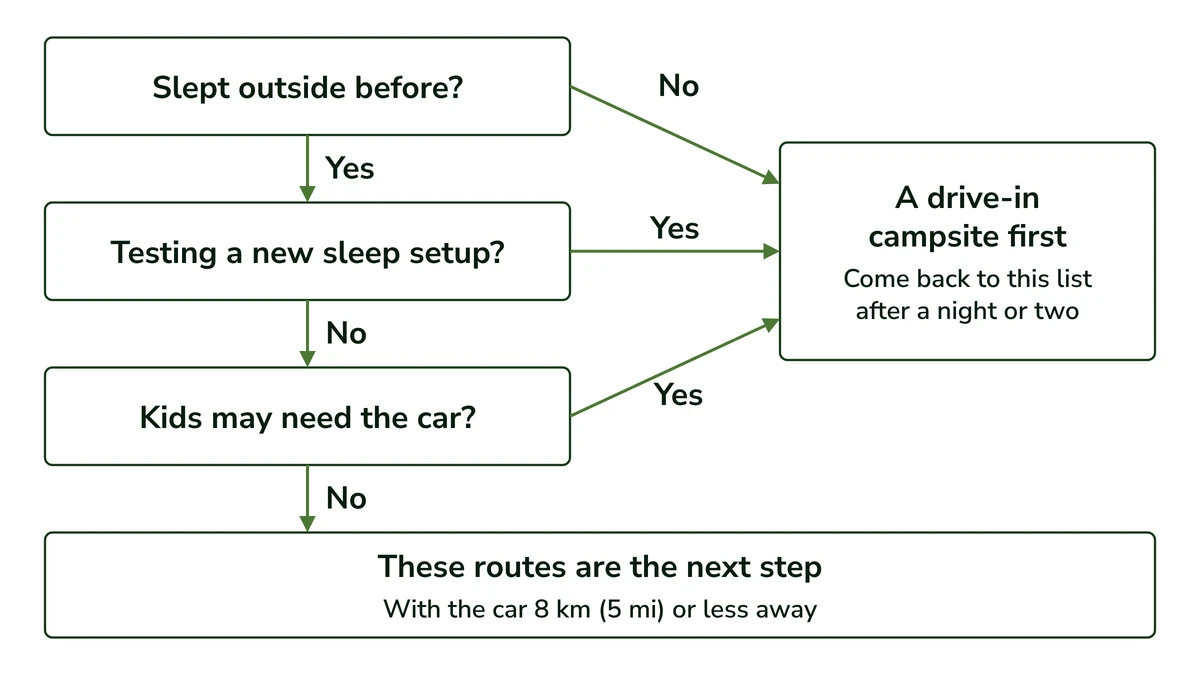
For those readers it’s simply the better choice. A night beside the car shows you how your sleep system holds up through a whole night and what you forgot to pack, and getting either wrong costs nothing when the car is right there.
Think about lying awake at 2 am because the pad is too thin. At a drive-in site, the fix is a few steps away.
On the short-walk options above (Elbow Lake, the closest Kejimkujik sites, a near Frontenac cluster), the car is minutes away rather than hours, which is why they work as the next step.
I’d send anyone who has never slept outside to a drive-in site first, along with anyone trying a new pad or bag and families whose kids may need the car. Start with a car camping sleep setup, and come back to this list after a night or two.
What to Check Before You Book Your First Night
Before you book, check that your pack and sleeping bag suit that season, that your packing list covers a night out, and that someone at home has your trip plan, since cell service is limited at Frontenac and Kejimkujik. Then recheck the route’s official page in the month you go.
It’s the night before, everything is laid out on the floor, and you’re wondering what’s missing. These are the checks that matter most for the five routes above.
An overnight needs more room than a day pack, because the tent, sleep system and stove all have to fit. If you’re choosing a pack, start with backpacking packs matched to your torso.
If money is tight and your torso measures 15 to 19.5 inches, the Teton Scout 55L is a budget pack for first overnights that’s worth a look before you spend more.
The sleep system has to match the season, too. Elbow Lake stays open until November 29, Frontenac all year, and Yoho’s higher trails can hold snow into late June, so your bag and pad have to suit the night, not the date on the calendar.
That’s the part how to choose a sleeping bag and pad walks through, including the pad that keeps the bag warm on a cold night.
For the packing list, start from what to pack for a day on the trail, then add the overnight pieces this post has already named: a stove, a way to treat water, and at Kejimkujik, a backup plan for food storage.
Cell service is limited at Frontenac (there’s a booster at the office self-serve station) and limited or absent at Kejimkujik. So leave a trip plan with someone at home who knows where you’re going and when to expect you back.
If I had to keep only one of these checks, it would be the trip plan, because on two of these routes your phone may not be able to tell anyone where you are.
Last, open the route’s official page again in the month you go, because dates, fees and closures change by year.
Pick the one route that fits your distance, your province and your season, open its official page, and put this year’s booking date in your calendar. If you’ve never slept outside, book a drive-in site first and come back to this list after.
Founder & Gear Research Editor
Sonia Zannoni
I’m Sonia, the founder of Best Trail Backpacks. I don’t test gear myself. For every pack I cover, I read the manufacturer’s specs and sizing charts and look for what owners report again and again.
Fit comes first, because a pack that doesn’t match your torso and hips will hurt no matter what it cost. My goal is to help you choose a pack that suits your body, your trip and your budget.
About the Founder
