How to Choose Hiking Socks: Fiber, Cushion and Height Matched to Your Boots and Trail
You pulled on thick “hiking” socks for comfort, and the boots that used to fit now pinch while your toes go cold. Or you went thin, and the heels wore through before the season ended. Either way your feet finish hot, damp or sore.
That’s normal, and it isn’t your fault. Sock labels never say which boots or hikes a pair is for, the makers don’t agree on sizing, and one pair can cost what a multipack of gym socks does.
What you need is a clear way to choose hiking socks for your footwear and your hikes, and an honest answer on whether the pricier pairs earn their price.
By the end you’ll be able to pick the height, the cushion and the fiber, in that order, know how many pairs to pack, and keep a good pair going for more than one season.
TL;DR: How to Choose Hiking Socks
- Match the height to your footwear’s collar, so the cuff sits above it and the collar has fabric to rub against instead of skin.
- Choose cushion by your footwear, your load and the weather, and try your footwear on in the socks you’ll hike in, because a thicker sock can change the size you need.
- Skip cotton. After that, staying dry and a good fit matter more than merino against synthetic.
- Pack one dry spare for a day hike, and a fresh pair a day plus a camp pair for an overnight, then wash them the way the label says.
Start With the Collar: Which Sock Height Goes With Your Shoes or Boots
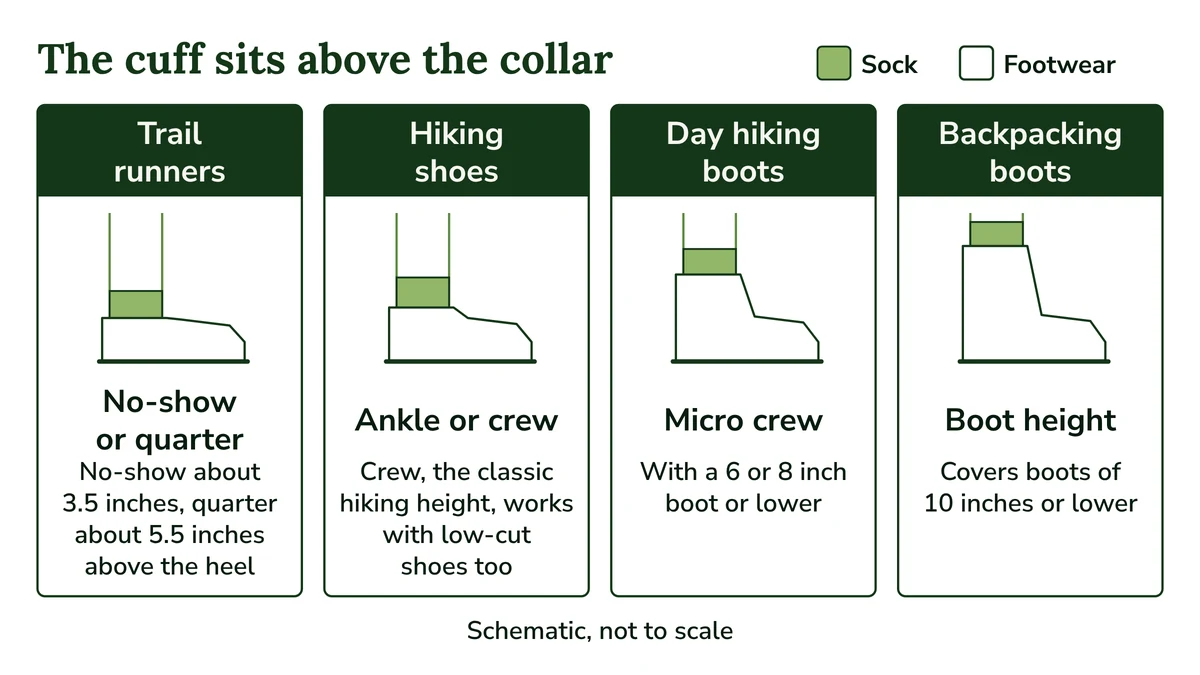
Pick your sock height from your footwear’s collar, not the label, since a collar rubs any skin the sock leaves bare. Darn Tough’s guide puts a no-show about 3.5 inches above the heel and a quarter about 5.5 inches, and matches taller heights to 6, 8 and 10 inch boots.
Height comes first because every other choice happens inside the shoe or boot the sock has to clear. If your low socks creep down into your trail shoes by the first mile, the cuff sits too close to the collar, and each step drags it under your heel.
In boots it shows up differently: a red line rubbed just above your ankle, where the collar meets bare skin. The collar flexes with every step, and with no fabric between it and your leg, all of that friction lands on you.
REI’s rule of thumb is simple: the higher the cuff of your footwear, the taller the sock. Here’s how that maps onto the four footwear types, using the inch figures in Darn Tough’s guide to sock heights:
- Trail runners: REI keeps no-show socks for low-cut footwear like these, and an ankle height such as Darn Tough’s Quarter gives the cuff more room above the collar.
- Hiking shoes: an ankle height suits most low hiking shoes, and REI notes that crew, the classic hiking height, works with low-cut shoes too.
- Day hiking boots: Darn Tough pairs its Micro Crew with a 6 or 8 inch boot or lower, so measure your collar against that.
- Backpacking boots: Darn Tough’s Boot height covers boots of 10 inches or lower, and its Over-the-Calf is meant for cold-weather expeditions in taller boots. REI puts knee-high socks mainly in mountaineering.
Once the height is set, the other choices fit inside it. Cushion decides how much of the space in your footwear the sock fills, and fiber decides how it handles sweat.
Quick Tip: Put on the shoes or boots you’ll hike in and check where the collar sits before you shop. That’s the height your sock has to clear.
How Much Cushion You Need, and Why Thicker Isn’t Always Warmer
Cushion follows your footwear, your load and the weather. Light suits warm days and low shoes, medium suits most hiking and backpacking in moderate to cold weather, and heavy is for long, rough, cold trips. Thicker isn’t automatically warmer: a sock that fills the boot can leave toes cold.
Cushion is the padding knitted into the sole and around the foot. It earns its place under a heavy pack on rocky ground, where every step lands harder, but it also adds heat and takes up room inside your footwear.
If your boots felt fine all summer and turned tight the week you switched to thick winter socks, you’ve met the catch. A boot packed tight has no room left for warm air, or for your foot to move.
Darn Tough warns that full cushion heavyweight socks too thick for your boots can leave toes cold. REI adds that thicker socks are warmer but can also make your feet sweat.
That extra bulk changes fit as well. Human Performance Resources by CHAMP, a US Department of Defense program, advises finding your sock before you buy boots, because added bulk may change the shoe size you need.
So try your footwear on in the socks you’ll hike in. The fit checks themselves are in my guide on how to choose hiking boots that fit.
Matching Cushion to Your Footwear and Load
REI’s guide sorts cushion into four levels, and each one lines up with a kind of hike:
- None, for hot weather, where any padding mostly adds heat.
- Light, for warm conditions and low shoes, where there’s little room to spare.
- Medium, for most hiking and backpacking in moderate to cold conditions, where some padding under a pack helps and the extra warmth is welcome.
- Heavy, for long trips, rough ground and cold, though REI notes it’s often too thick and warm for warm-weather trips.
Where the padding sits matters as much as how much there is. Darn Tough’s Cushion socks put terry loops underfoot, around the toes and behind the heel, while its Full Cushion runs them through the whole foot and leg.
More cushion gives you more padding under a heavy load, but it also brings more heat and less room in the boot. With a light daypack on smooth trails, I’d stay at the light or medium end.
A Summer Pair and a Cold-Weather Pair
Darn Tough also sorts its socks by weight: Lightweight for spring or summer, Midweight year-round, and Heavyweight, made only in Full Cushion, for rugged cold trips.
If you’re worried wool will be too hot in summer, Darn Tough’s answer is its Lightweight socks, and REI points to light cushion for warm conditions. A 2021 lab trial by West, Havenith and Hodder also found foot temperature and comfort were similar across cotton, wool, polyester and Coolmax socks.
That trial was small, though: ten women running on a treadmill at 23 degrees C (about 73 degrees F). It doesn’t tell you about a hot climb with a pack, but it gives no sign that a thin wool sock runs hotter than the others in mild conditions.
A cold-weather pair works only if your boot has room for it. If the thicker sock makes the boot tight, the boot is now too small for that sock, and the warm air you were counting on gets squeezed out.
Merino or Synthetic Hiking Socks? Why Getting Cotton Out Matters More
Cotton has the weakest case of any fiber: in a 29.6 km (about 18.4 mile) trial, hikers in cotton socks had far more skin lesions, such as blisters, than those in technical socks. Once cotton is out, staying dry and a good fit matter more than merino against synthetic.
The idea that a sock is a sock is easy to believe, especially for a short hike. Wear cotton gym socks on a long day, though, and you’ll likely finish with hot, damp feet.
Cotton soaks up sweat and holds it against your skin. Darn Tough points out that the trapped water adds friction, and the Camino survey below linked wet socks to more blisters.
Leave cotton out of your hiking socks for the same reason it stays out of the rest of your clothes, which I go through in hiking layers explained.
What the Trail Studies Found
In a 2019 trial of hikers’ socks by Pérez Pico and colleagues, 109 hikers set out on a 29.6 km (about 18.4 mile) route in either cotton or technical socks.
Over the first 14.5 km (about 9 miles), 36.4% of hikers in cotton socks had skin lesions such as blisters, against 6.6% in technical socks. Over the rest of the route it was 54.8% against 21.1%, and the authors advise technical socks.
That was a single hike on a single route, so it can’t answer every question. The gap is still wide enough to take cotton off the list.
The second study looked at more than cotton. Chicharro-Luna and colleagues surveyed 203 hikers on the French route of the Camino de Santiago in Spain, who had walked about 250 km (about 155 miles) on average.
Wet socks were linked to 1.94 times the blister risk, while no fiber in the socks, cotton included, was related to blisters. It’s a survey, not a trial, but since cotton holds sweat it fits the first study: dryness and fit matter more than the fiber on the label.
Merino and Synthetic, Side by Side
With cotton gone, the choice is a real tradeoff, and most hiking socks are blends anyway. Darn Tough lists nylon and elastane for reinforcement, and its synthetic socks use Coolmax and Thermolite.
Here’s how merino blends and synthetic socks compare on the points that matter, with the source for each:
What You’re Weighing
Merino Blends
Synthetic
Where It Comes From
Warmth when damp
Absorbs moisture vapor before it feels wet; more warmth for its weight than many synthetics
Once wet, tends to feel colder when you slow down
Darn Tough (maker claim)
Drying
Usually blended with synthetics to dry faster
Polyester wicks and dries quickly; dries fast on the surface
REI guide, Darn Tough
Durability
Usually blended with nylon and elastane for strength
Nylon adds durability; spandex keeps the shape
REI guide, Darn Tough
Odor
Resists odor, by the maker’s claim
Polyester held more odor than wool in one shirt-fabric trial
Darn Tough (maker claim); McQueen 2008; research is mixed
Cost
Often costs more per pair
Often costs less per pair
Described in words, no prices
Warmth when damp
Merino Blends: Absorbs moisture vapor before it feels wet; more warmth for its weight than many synthetics
Synthetic: Once wet, tends to feel colder when you slow down
Where It Comes From: Darn Tough (maker claim)
Drying
Merino Blends: Usually blended with synthetics to dry faster
Synthetic: Polyester wicks and dries quickly; dries fast on the surface
Where It Comes From: REI guide, Darn Tough
Durability
Merino Blends: Usually blended with nylon and elastane for strength
Synthetic: Nylon adds durability; spandex keeps the shape
Where It Comes From: REI guide, Darn Tough
Odor
Merino Blends: Resists odor, by the maker’s claim
Synthetic: Polyester held more odor than wool in one shirt-fabric trial
Where It Comes From: Darn Tough (maker claim); McQueen 2008; research is mixed
Cost
Merino Blends: Often costs more per pair
Synthetic: Often costs less per pair
Where It Comes From: Described in words, no prices
Odor is where the claims get shaky, because the research is mixed. A 2008 wear trial on shirt fabric by McQueen, Laing and colleagues found more odor from polyester than from wool or cotton.
A 2024 lab study, reported by the University of Alberta, found wool and synthetics took up more odor compounds than cotton. Neither was a hiking sock trial, so treat any odor promise as the maker’s claim.
When a Cheaper Synthetic Pair Is Enough
For warm-weather day hikes, or if you hike now and then, I’d start with a synthetic or blended pair that fits and stays dry. That covers what the studies point to, and it often costs less to replace.
For what it’s worth, the socks I’ve hiked in were synthetic, worn with boots, which is the footwear I lean toward.
Merino earns its higher price when the weather turns cool, when your days are slower, and when you hike often enough to wear a pair out and use a guarantee. Slower days matter because Darn Tough says wet synthetics tend to feel colder once you slow down.
So is the pricey pair worth it? For a frequent hiker in cool weather, often yes. For a few summer day hikes a year, a cheaper pair that fits will do the job.
Getting the Size Right When the Size Charts Disagree
Size hiking socks by each maker’s own chart, then confirm the fit in the footwear you’ll hike in. Between sizes, Darn Tough says size up, while REI’s guide says size down. A sock that fits sits snug, with the heel pocket on your heel, and doesn’t wrinkle or slip.
Say the large feels tight across your instep and the medium looks short on the chart. Which way you go depends on whose socks you’re buying, because the charts work differently.
Darn Tough sizes by shoe size, with each size covering 2 to 3 shoe sizes, and says to size up if you’re between. Check which chart you’re reading, too: Darn Tough lists men’s and women’s sock sizes separately, so the same letter covers different shoe sizes.
REI’s guide to hiking socks sizes by foot length rather than shoe size, and says to size down. So follow the chart of the maker whose pair you’re buying, not a general rule. Then let the fit on your foot have the last word.
REI describes a good fit as snug, with the heel cup sitting on your heel. Too big and the sock wrinkles and rubs; too small and it presses on your foot and slips.
Confirm the size inside the footwear you’ll hike in. If your boots are new, keep wearing that same pair of socks while you’re breaking in new hiking boots, so the fit you get used to is the fit you’ll hike in.
Quick Tip: Check the heel pocket first. If it sits above your heel or bunches behind it, the size is wrong, whatever the chart says.
How Many Pairs to Pack for a Day Hike and a First Overnight
For a day hike, wear one pair and carry one dry spare. For a first overnight, pack a fresh pair for each day plus a dry pair for camp. No authority gives an exact count, so this follows dermatologists’ advice to change socks daily and whenever they get wet.
Picture a stream crossing that tops your boots, or a sweaty climb at midday, and nothing dry to change into. Socks get wet from both sides, and a wet sock is the condition the Camino survey linked to more blisters.
The American Academy of Dermatology’s advice on preventing athlete’s foot is to change socks every day, and more often when they get wet.
For a day hike, that means one spare pair, kept dry in a bag, along with the rest of what to pack for a day hike.
For a first overnight, pack a fresh pair for each hiking day plus one dry pair that stays in camp. Changing into it in the evening is part of staying clean on your first nights out, and it gives your hiking socks a chance to air out.
These counts are my call, not a rule. I’d rather carry one pair too many than finish a wet day with nothing dry, since a spare pair of socks weighs very little.
What to do with a damp sock on the trail, whether liners help, and how to handle a hot spot all belong to preventing blisters when hiking, so I’ve kept them there.
Washing and Guarantees: Making a Good Pair Last More Than One Season
A good pair lasts longer washed the way its label says, because makers differ on water temperature and dryer heat. Guarantees differ too: Darn Tough’s needs no receipt, while Feetures asks for a photo of each pair and the purchase date, so check the terms early.
It’s frustrating to find the heels worn thin and a hole at the toe after one season. Darn Tough’s explanation is that trail use wears socks faster than everyday wear, through friction, debris, compression and sweat.
Follow the label for washing, because the makers don’t agree on water temperature or dryer heat:
- Darn Tough: inside out, cold water, a gentle cycle and a mild, neutral-pH detergent, then tumble dry low or air dry. No bleach and no dry cleaning.
- Smartwool: recommends air drying, laid flat, or tumble dry low if you use the dryer, and says to check the label.
- Wigwam: inside out, in warm water up to 120 F (50 C), with no bleach and no fabric softener, then the lowest dryer heat or laid flat.
A guarantee changes the math on a pricey pair, because what matters is the cost per season, not per pair. The terms below are what each maker’s page said when I read them on 25 November 2026, and they can change.
Darn Tough’s Unconditional Lifetime Guarantee covers socks that rip, tear or lose their fit, including inadvertent damage, with no receipt or registration. You send them back clean through an online form, get a replacement credit by email, and the replacement ships free. Seconds, irregulars and altered socks are excluded.
Feetures’ Lifetime Guarantee covers holes, thinning, stretching or shrinkage, but asks for a photo of each pair and the original purchase date. You pay return shipping, and the credit comes as a feetures.com gift card.
Laundry losses, pet damage and the like are excluded. Feetures handles claims for US purchases on its own site and sends buyers elsewhere to their local distributor.
Quick Tip: Keep a note of where and when you bought a pricey pair, since some guarantees ask for the purchase date. Wash the socks before you send them back.
Is the guarantee real? On paper, yes, but I’d treat it as part of the price rather than a promise that every claim goes through. It only counts in a pricey pair’s favor if you keep the details and actually send a worn pair back.
Before you buy the next pair, put on the footwear you’ll hike in, note where the collar sits and your shoe size, and take both to the maker’s own chart.
Founder & Gear Research Editor

Sonia Zannoni
I’m Sonia, the founder of Best Trail Backpacks. I don’t test gear myself. For every pack I cover, I read the manufacturer’s specs and sizing charts and look for what owners report again and again.
Fit comes first, because a pack that doesn’t match your torso and hips will hurt no matter what it cost. My goal is to help you choose a pack that suits your body, your trip and your budget.
About the Founder