
Best Backpacking Sleeping Bags for First Overnights: Down and Synthetic Picks
Affiliate Disclosure: Some links on this page are affiliate links. If you buy through one, I may earn a commission at no extra cost to you. Commission never decides which products I recommend. Read the full disclosure.
The bag you’re eyeing says 20°F in its name, and the forecast low for your first night sits in the mid 30s. That looks like plenty of margin, until you remember the friend who shivered all night in a bag “rated” colder than the night got.
So which number do you trust? It catches a lot of first-time buyers, and it isn’t your fault. On many men’s and unisex bags, the number in the name isn’t the comfort figure at all, and it’s easy to miss.
What you’re after is a backpacking sleeping bag that keeps you warm on the coldest night you expect, light and small enough to carry, at a price you can live with. You’d also like a straight answer on whether paying more for down buys warmth or just a lighter label.
By the end you’ll know which rating to read, you’ll see in ounces and liters what down actually buys at the same warmth, and you’ll have the one bag that fits your body, your trip and your budget.
TL;DR: Backpacking Sleeping Bag
- Cold or side sleepers who want down: NEMO Disco 15, read by its comfort rating. The women’s version is the warmer bag, not just a smaller cut.
- The cheapest way into down, or its synthetic twin for less: Kelty Cosmic Down 20 and the Cosmic Synthetic 20. Plan around about 30°F, not 20.
- Side sleepers on damp trips: NEMO Forte 20. Tight budgets or broad builds: REI Co-op Trailmade 25, and a couple of owners say to size up.
- Warm sleepers on summer trips who want the lightest bag: Mountain Hardwear Bishop Pass 30, a 40°F comfort bag despite the 30 in its name.
Here are the six picks side by side, with who each one suits and the tradeoff that comes with it.
Product Name
Best For
Key Strength
Main Tradeoff
Price Tier
Down on a tighter budget
Down’s packed size at the lowest down price
Seam and zipper complaints; no ISO figure from Kelty
$$
Cold and side sleepers who want down
Room to sleep on your side, plus chest vents
Highest price tier; most reviews on NEMO’s own site
$$$
Warm sleepers on summer trips
Lightest bag here, under 2 lb
40°F comfort rating; few owner reviews
$$$
Budget first overnights in damp weather
Lowest list price of the six
About twice its down twin’s packed space; few reviews
$$
Side sleepers on damp trips
The Disco’s shape and vents in synthetic
Heaviest men’s Regular of the six
$$
Tight budgets and broad builds
Six sizes, including wide cuts
Two owners say it runs small; bulky
$$
Kelty Cosmic Down 20
Best For: Down on a tighter budget
Key Strength: Down’s packed size at the lowest down price
Main Tradeoff: Seam and zipper complaints; no ISO figure from Kelty
Price Tier: $$
NEMO Disco 15
Best For: Cold and side sleepers who want down
Key Strength: Room to sleep on your side, plus chest vents
Main Tradeoff: Highest price tier; most reviews on NEMO’s own site
Price Tier: $$$
Mountain Hardwear Bishop Pass 30
Best For: Warm sleepers on summer trips
Key Strength: Lightest bag here, under 2 lb
Main Tradeoff: 40°F comfort rating; few owner reviews
Price Tier: $$$
Kelty Cosmic Synthetic 20
Best For: Budget first overnights in damp weather
Key Strength: Lowest list price of the six
Main Tradeoff: About twice its down twin’s packed space; few reviews
Price Tier: $$
NEMO Forte 20
Best For: Side sleepers on damp trips
Key Strength: The Disco’s shape and vents in synthetic
Main Tradeoff: Heaviest men’s Regular of the six
Price Tier: $$
REI Co-op Trailmade 25
Best For: Tight budgets and broad builds
Key Strength: Six sizes, including wide cuts
Main Tradeoff: Two owners say it runs small; bulky
Price Tier: $$
Price tiers: $ under $100 | $$ $100 to $249 | $$$ $250 and up
If you already know your coldest night, the rating table in the next section lists every bag’s comfort figure, so find the one that covers it and jump straight to that pick.
How to Choose a Backpacking Sleeping Bag for Your First Night Out
Choosing a backpacking sleeping bag for a first overnight comes down to five checks: a comfort rating that covers your coldest night, a weight and packed size your pack can take, a fill that suits your climate and budget, a shape that fits how you sleep, and a fair price.
Every verdict further down uses these same five checks, in this order. Most of the confusion sits in the first one. The listing in front of you says 20°F, the forecast says mid 30s, and it’s fair to wonder why that isn’t the end of the story.
Start From the Coldest Night, Then Read the Comfort Rating
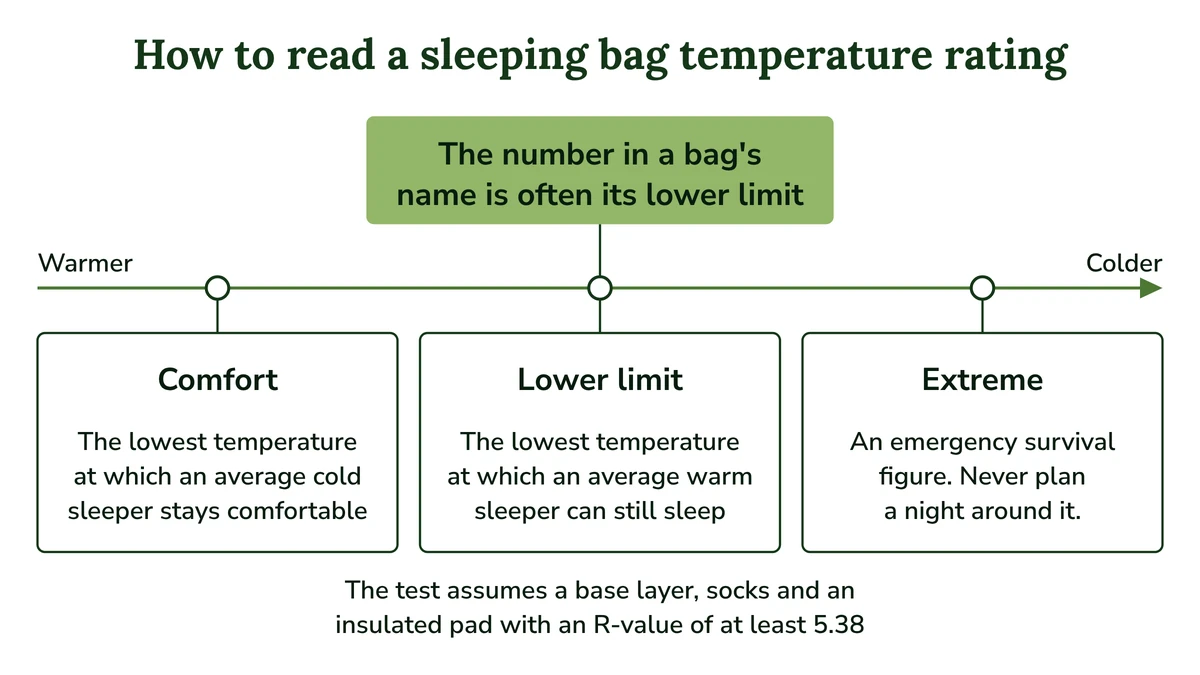
The number in a bag’s name is often its lower limit, the lowest temperature for an average warm sleeper. If you sleep cold, match the comfort rating to your coldest night instead. Both figures come from one standard lab test, which assumes a base layer, socks and an insulated pad.
Brands decide which figure goes in the name. As REI explains on its listings, some brands name men’s bags for the lower limit, women’s bags for the comfort figure, and nongendered bags for something in between.
Every men’s and unisex bag here is named at or near its lower limit, apart from the Trailmade 25, which sits between its two figures. So a men’s or unisex bag called 20 is often a 20°F bag only for someone who sleeps warm.
Here’s what each rating means, in one line apiece:
- Comfort: the lowest temperature at which an average cold sleeper stays comfortable. This is the number to plan around if you tend to feel the cold.
- Lower limit: the lowest temperature at which an average warm sleeper can still sleep. It’s a sleeping figure, set for people who run warm.
- Extreme: an emergency survival figure. Never plan a night around it.
Those three lines are enough to shop with. The full story of how sleeping bag ratings work, along with fill power and fit, is in my guide to choosing a sleeping bag.
Plenty of people read these ratings as survival numbers, and that’s where a lot of cold nights start. The lower limit is still a sleeping figure, just for someone who runs warm. The survival number is the extreme rating, which is why it’s the one to ignore.
That’s likely what happened to the friend who froze. A men’s bag named for its lower limit, slept in by someone who runs cold, can feel chilly well above the number on the label, because that number was set for a warmer sleeper.
The test assumes a base layer, socks and an insulated pad with an R-value of at least 5.38. R-value is the pad’s resistance to cold coming up from the ground, and the higher the number, the warmer the pad.
Your body crushes the fill underneath you, so the pad does most of the work against the cold ground. If you sleep on your side, start with the sleeping pads for side sleepers I compared.
Because the brands here publish figures from the same test standard, ISO 23537, a comfort rating from NEMO and one from REI Co-op mean the same thing. That only works comfort to comfort, though, and the label number isn’t always either one.
Here’s the women’s label trap in numbers. The men’s NEMO Disco 15 is rated 27°F at comfort, while the women’s sits at 17°F with 9 more ounces of down, under the same 15 in the name. Kelty’s women’s bags carry more fill too, with no ISO figure published.
This table lines up the number in each bag’s name against its ISO figures, and shows where each figure comes from.
Bag
Number in the name
ISO comfort
ISO lower limit
Where the figures come from
Kelty Cosmic Down 20 (unisex)
20°F
31 to 32°F
21°F
REI and Backcountry listings (Kelty gives only its own rating)
Kelty Cosmic Synthetic 20 (unisex)
20°F
32°F
22°F
Backcountry listing, possibly the previous version
NEMO Disco 15 men’s
15°F
27°F
16°F
NEMO
NEMO Disco 15 women’s
15°F
17°F
4°F
NEMO
NEMO Forte 20 men’s
20°F
29°F
18°F
NEMO
NEMO Forte 20 women’s
20°F
21°F
9°F
NEMO
Mountain Hardwear Bishop Pass 30
30°F
40°F
30°F
REI listing
REI Co-op Trailmade 25
25°F
31°F
20°F
REI Co-op (maker)
Kelty Cosmic Down 20 (unisex)
Number in the name: 20°F
ISO comfort: 31 to 32°F
ISO lower limit: 21°F
Where the figures come from: REI and Backcountry listings (Kelty gives only its own rating)
Kelty Cosmic Synthetic 20 (unisex)
Number in the name: 20°F
ISO comfort: 32°F
ISO lower limit: 22°F
Where the figures come from: Backcountry listing, possibly the previous version
NEMO Disco 15 men’s
Number in the name: 15°F
ISO comfort: 27°F
ISO lower limit: 16°F
Where the figures come from: NEMO
NEMO Disco 15 women’s
Number in the name: 15°F
ISO comfort: 17°F
ISO lower limit: 4°F
Where the figures come from: NEMO
NEMO Forte 20 men’s
Number in the name: 20°F
ISO comfort: 29°F
ISO lower limit: 18°F
Where the figures come from: NEMO
NEMO Forte 20 women’s
Number in the name: 20°F
ISO comfort: 21°F
ISO lower limit: 9°F
Where the figures come from: NEMO
Mountain Hardwear Bishop Pass 30
Number in the name: 30°F
ISO comfort: 40°F
ISO lower limit: 30°F
Where the figures come from: REI listing
REI Co-op Trailmade 25
Number in the name: 25°F
ISO comfort: 31°F
ISO lower limit: 20°F
Where the figures come from: REI Co-op (maker)
Weight and Packed Size: What Your Pack Has Room For
Weight and packed size matter only because you carry the bag. In a regular size the six run from under 2 pounds to about 3.5, and the bulkiest synthetic takes roughly twice the room of its down twin. Packed size decides whether it fits your sleeping bag compartment.
If you’ll drive to the site and never carry the bag more than a few steps, none of this matters much, and a roomier bag may sleep better. My guide to a car camping sleep setup covers that kind of trip.
Across the six picks, the lightest Regular is the Mountain Hardwear Bishop Pass 30 at 1 lb 12.6 oz, by Mountain Hardwear’s figures. The heaviest is the NEMO Forte 20 men’s Regular at 3 lb 5 oz minimum (3 lb 8 oz packed).
Packed size is the number people overlook. A bag that won’t fit the bottom compartment ends up strapped to the outside, where branches and rain can get at it, or stuffed into the main body, eating the space you’d planned for food and layers.
It helps to know where the sleeping bag goes in a well-packed pack before you compare sizes. Ultralight bags and quilts cut weight further, but none made this list, because they ask more of your sleep setup than a first overnight needs.
Shape, Size and Zippers for How You Sleep
Shape and girth decide whether you can sleep the way you like. A close mummy cut saves weight but leaves less knee room, while NEMO’s spoon shape widens at the elbows and knees. Wide and long sizes suit broad shoulders and tall hikers, and vents widen the range.
If you sleep on your side, you know the problem: you roll over and the whole bag rolls with you, hood twisted across your face. A narrow mummy turns with you because there’s no room to turn inside it.
Length and girth are the numbers to check. Each maker lists a “fits up to” height and a shoulder girth, measured around the bag. NEMO and REI Co-op offer wide sizes for broad shoulders and larger builds, and long lengths cover tall hikers.
Zippers, hoods and vents decide how wide a range of nights one bag can handle:
- A locking slider or footbox vent lets you open the feet on a mild night without unzipping the whole side, so the bag stays comfortable on nights warmer than its rating.
- Chest vents, like NEMO’s Thermo Gills, let heat out near your core while the side zip stays closed against the cold.
- A draft collar and a draft tube along the zipper stop warm air from puffing out at your neck and side every time you shift.
Keep your own height, shoulders and sleeping position in mind as you read on. They decide who should skip each pick below.
Down or Synthetic Sleeping Bag? What the Twin Bags Show
At about the same warmth, down mostly buys pack space. Kelty’s synthetic twin weighs 6 ounces more and takes roughly twice the room, NEMO’s 10 ounces more and about 1.6 times the room. Both synthetics cost less at list price, and NEMO says the Forte stays warm even when wet.
You’ve probably heard both sides of this: down costs too much for a beginner, or synthetic is too heavy to carry. Two of the picks come as pairs from the same maker in each fill, so the numbers can settle it.
NEMO’s pair shares one shape, while Kelty’s pair differs in cut as well as fill. In the table below, the Kelty liters are worked out from the stuff-sack sizes Kelty lists and the NEMO liters are NEMO’s own compressed volumes, so compare within each pair.
Bag
Fill
ISO comfort / limit
Weight (Regular)
Packed size
Kelty Cosmic Down 20
550 fill down
31°F / 21°F (REI)
2 lb 7 oz
8 x 13 in stuffed (about 11 L)
Kelty Cosmic Synthetic 20
CirroLoft ECO synthetic
32°F / 22°F (Backcountry, possibly the previous version)
2 lb 13 oz
9.5 x 18 in stuffed (about 21 L)
NEMO Disco 15 men’s
650 fill RDS down
27°F / 16°F
2 lb 11 oz minimum
6.7 L compressed
NEMO Forte 20 men’s
Zerofiber 800 PCR synthetic
29°F / 18°F
3 lb 5 oz minimum
10.6 L compressed
Kelty Cosmic Down 20
Fill: 550 fill down
ISO comfort / limit: 31°F / 21°F (REI)
Weight (Regular): 2 lb 7 oz
Packed size: 8 x 13 in stuffed (about 11 L)
Kelty Cosmic Synthetic 20
Fill: CirroLoft ECO synthetic
ISO comfort / limit: 32°F / 22°F (Backcountry, possibly the previous version)
Weight (Regular): 2 lb 13 oz
Packed size: 9.5 x 18 in stuffed (about 21 L)
NEMO Disco 15 men’s
Fill: 650 fill RDS down
ISO comfort / limit: 27°F / 16°F
Weight (Regular): 2 lb 11 oz minimum
Packed size: 6.7 L compressed
NEMO Forte 20 men’s
Fill: Zerofiber 800 PCR synthetic
ISO comfort / limit: 29°F / 18°F
Weight (Regular): 3 lb 5 oz minimum
Packed size: 10.6 L compressed
For the NEMO pair, every figure is the maker’s own, from NEMO’s Disco spec page and its Forte equivalent. For the Kelty pair, the weights and stuffed sizes are Kelty’s, and the ISO figures are the retailers’.
That corrects a common belief that down always weighs far less, since in these pairs it saves 6 to 10 ounces. That’s real, but a sleeping bag is only one of the big four items, the heaviest things you carry. Together they move your total more than one bag’s fill.
The packed-size gap is where down earns its price. A synthetic bag that takes roughly twice the room can outgrow a sleeping bag compartment that its down twin slides into without a fight.
Fill power measures how much loft an ounce of down gives, so a higher number gets the same warmth from less down. Kelty uses 550 fill and NEMO 650 fill, so ounce for ounce, NEMO’s down lofts more.
Synthetic is the usual pick for damp trips, because down that gets soaked loses much of its loft, and loft is what keeps you warm.
NEMO answers that with treated down. It describes the Disco’s down as hydrophobic, with a waterproof hood and footbox, and it says the Forte stays warm even when wet.
Down also asks for gentler care to hold its loft over the years. Before its first trip through a machine, read how to wash a down bag so the wash doesn’t flatten what you paid for.
Here’s how I’d weigh it. If pack space is tight, I’d look at the liters first and lean toward a down sleeping bag, because that’s where the gap is large. If budget is tight, I’d take the synthetic twin without regret, since you’re mostly giving up pack room.
Down at the Lowest Price: Kelty Cosmic Down 20
The first three picks are down bags, starting with the lowest list price.
The Kelty Cosmic Down 20 is the lowest-priced way into down here, with 550 fill down and a synthetic twin that makes the fill choice easy to see. It says 20°F, but retailers list its ISO comfort rating at 31 to 32°F, so a cold sleeper should plan around 30°F.
Best For
First-overnight backpackers who want down’s packed size at the lowest down price. If you sleep cold, it suits three-season trips where the lows stay around 30°F or above.
Why It Stands Out
It’s down at a lower list price than the other two down picks, and it packs to about half the space of its synthetic twin by Kelty’s stuff-sack sizes.
It shares the draft collar, draft tube and footbox of that twin, though Kelty cuts the down bag semi-rectangular and the synthetic as a roomier mummy, so the fill isn’t the only difference. Kelty also uses trapezoidal baffles, which it says give better thermal efficiency.
Key Features and What They Mean
The figures here are Kelty’s own, apart from the ISO ratings, which come from retailers:
- 550 fill down, 16.4 oz of it, in a 2 lb 7 oz Regular. Fill power is loft per ounce, so 550 fill needs more ounces for a given warmth than 650 fill does.
- Stuffed size of 8 x 13 inches, about 11 liters, roughly half the space of the synthetic twin. That’s the gap that matters when your pack is tight on room.
- Three lengths: Short, Regular and Long, fitting up to 5 ft 6 in, 6 ft and 6 ft 6 in. The Regular’s girth is 62 inches at the shoulders and 58 at the hips.
- Shape: Kelty calls it semi-rectangular. With those girths it gives your hips more room than the closer-cut Bishop Pass.
- Dual locking zipper sliders let you open the foot on a mild night without unzipping the side.
- A full-length draft tube and draft collar stop warm air escaping along the zip and at your neck when you shift.
- A zippered stash pocket keeps a phone or headlamp warm and easy to find in the dark.
- An expanded footbox gives your feet room, which matters if you sleep with your knees bent.
The Women’s Cosmic Down 20 is a separate listing, Regular only, for heights up to 5 ft 8 in. It carries 29.6 oz of fill, almost twice the unisex bag’s, and weighs 3.3 lb. Kelty publishes no ISO figure for it, and I couldn’t find one anywhere else.
On REI, many owners call it good value and say it packs small. Several slept warm in the low to mid 30s°F, close to the comfort figure retailers list. One 6 ft 1 in owner chose the Long and had room for a pillow in the hood.
Where It Falls Short
The pattern I’d want to know about before ordering is seams. A small number of REI owners, repeated enough to notice, report open or torn seams leaking down, and one says Kelty didn’t answer.
A couple of others say the zipper sticks. Overall, its 49 REI reviews average about 3.8 out of 5, well below the other well-reviewed bags here, and most of the low ratings point to the seams, the zipper or warmth.
One owner was cold at 27°F in layers, which fits a name rating set at the lower limit. Kelty’s own page gives no ISO figure, so you’re relying on retailer listings for the comfort rating.
Pros
Down’s packed size at the lowest down price on this list
Packs to about half the space of its synthetic twin
Locking zipper sliders to vent the foot on mild nights
Three lengths, plus a women’s version with more fill
Cons
Repeated owner reports of seams leaking down, and a sticking zipper
No ISO figure on Kelty’s own page
550 fill needs more down for a given warmth than 650 fill
Who Should Skip It
Skip it if you sleep cold and expect nights below freezing, since its comfort figure sits at 31 to 32°F. Skip it too if you don’t want to check the seams the day it arrives.
If you want the lightest down bag for warm summer nights, the Mountain Hardwear Bishop Pass 30 does that job better.
Verdict
I’d pick the Cosmic Down 20 if you want down on a tighter budget and your coldest night stays around 30°F. It gives you down’s packed size at the lowest down price here, and owners who used it in the 30s report sleeping warm.
Plan around 30°F rather than the 20 in the name, and look over the seams as soon as it arrives, while you can still send it back.
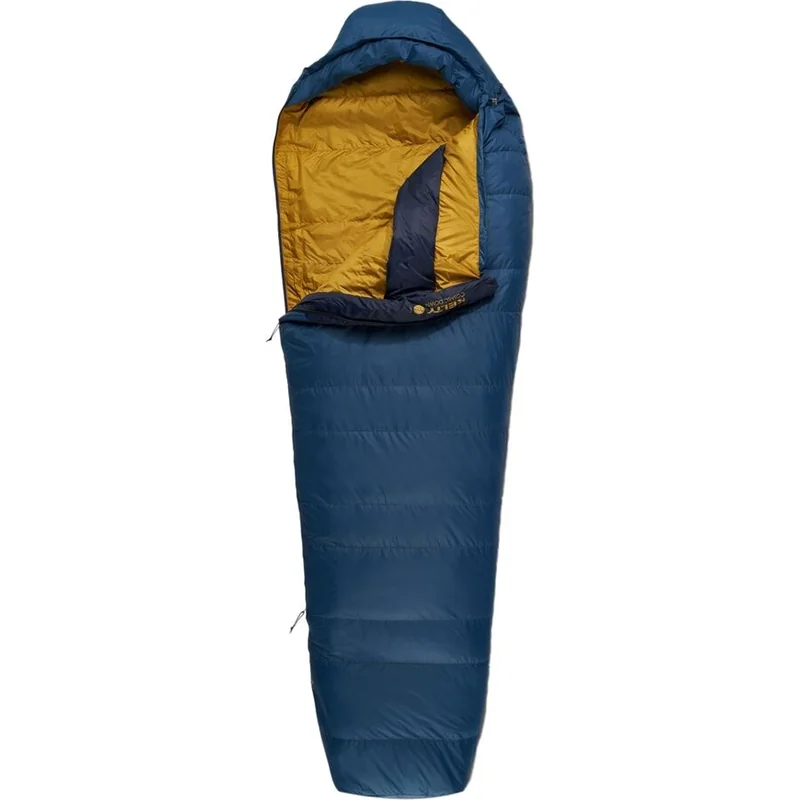 Kelty Cosmic Down 20
The lowest-priced way into down here, with 550 fill down and three lengths. Plan around about 30°F rather than the 20 in its name.
For Cold and Side Sleepers: NEMO Disco 15 Men’s and Women’s
The NEMO Disco 15 suits side sleepers and cold sleepers who want down. Its spoon shape gives room at the elbows and knees, and chest vents let heat out. NEMO lists the men’s at 27°F comfort and the women’s at 17°F, with 9 more ounces of 650 fill.
Best For
Side sleepers and restless sleepers, broad-shouldered hikers, and cold sleepers who want down, the women’s version especially. It also suits couples, since a men’s and a women’s Disco zip together.
Why It Stands Out
It gives you room to sleep on your side at a comfort rating in the high 20s°F for the men’s version. The vents widen the spread of nights it handles, so you’re not stuck choosing between sweating and unzipping the whole side.
Key Features and What They Mean
- 650 fill hydrophobic down, PFAS-free and certified to the Responsible Down Standard. That’s a third-party certification covering animal welfare and the chain of custody for the down inside.
- Classic Spoon shape, wider at the elbows and knees, so you can roll onto your side and bend your knees without the whole bag turning with you.
- Thermo Gill chest vents, each with an inner and outer zipper. You can dump heat near your core without opening the side zip to cold air.
- Blanket Fold draft collar. Tucked in, it blocks drafts at your neck, and pushed out, it lets heat escape.
- Waterproof hood and footbox, by NEMO’s description. These are the parts that touch a damp tent wall, and one owner credits the footwell with staying dry against it.
- Couple compatible: a men’s and a women’s Disco have opposite zippers and zip together.
The men’s Regular weighs 2 lb 11 oz at minimum, compresses to 6.7 liters and fits up to 6 ft, with girths of 62, 57 and 61 inches at the shoulder, hip and knee. The Regular Wide opens that to 70, 64 and 68 inches.
Long and Long Wide sizes cover taller hikers. The current bag is the Endless Promise Disco, and one owner says it runs about an inch smaller in every measurement than the earlier Disco 15, so go by the current size chart rather than an older review.
Many owners praise the room to shift positions, and several report a good fit for wide shoulders, in Backcountry reviews syndicated from NEMO. Several slept warm in the 30s and low 40s°F, and several single out the vents. One owner sums it up as “Better than a mummy.”
Men’s vs Women’s Fit
The women’s version is where the label trap shows most clearly. NEMO rates it 17°F comfort and 4°F limit, against 27°F and 16°F for the men’s, because it carries 2 lb 0 oz of fill against 1 lb 7 oz.
The women’s Regular fits up to 5 ft 6 in, with girths of 60, 56 and 59 inches, and weighs 3 lb 5 oz at minimum. It comes in Regular, Regular Wide and Long.
Its zipper sits on the opposite side, so a men’s and a women’s bag zip together. I didn’t find owners comparing the two versions directly.
Going by NEMO’s charts, the women’s Regular is about 2 inches narrower at the shoulders than the men’s, so a broad-shouldered woman may be better served by the women’s Regular Wide.
Where It Falls Short
It’s one of the two most expensive bags here at list price. The room and vents also cost weight against a mummy bag of similar warmth.
The owner evidence leans on NEMO’s own channel. NEMO’s page shows no review under 4 stars, and many Backcountry reviews are syndicated from NEMO, so I’d read the glowing average with that in mind.
One owner tore the footbox removing the tags, and another calls it “not the smallest for backpacking.”
Pros
Room to sleep on your side and bend your knees
Chest vents and a draft collar you can open, for a wider range of nights
A women’s version rated 10°F warmer at comfort, with more down
Wide and long sizes, and two bags that zip together
Cons
One of the two most expensive bags here at list price
Heavier than a mummy bag of similar warmth
Most owner reviews come through NEMO’s own site
Who Should Skip It
If you want the lightest, smallest down bag for summer, the Mountain Hardwear Bishop Pass 30 fits that better. And if your budget is tight, the Kelty Cosmic Down 20 gets you into down for less, as long as you plan around its comfort rating.
Verdict
I’d choose the Disco 15 if you sleep on your side or sleep cold and want down. If you run cold and one of the women’s sizes fits you, go for the women’s version, since NEMO rates it 10°F warmer at comfort.
The men’s suits average and warm sleepers on nights down to the high 20s°F, as long as you can carry the extra ounces and live with the price.
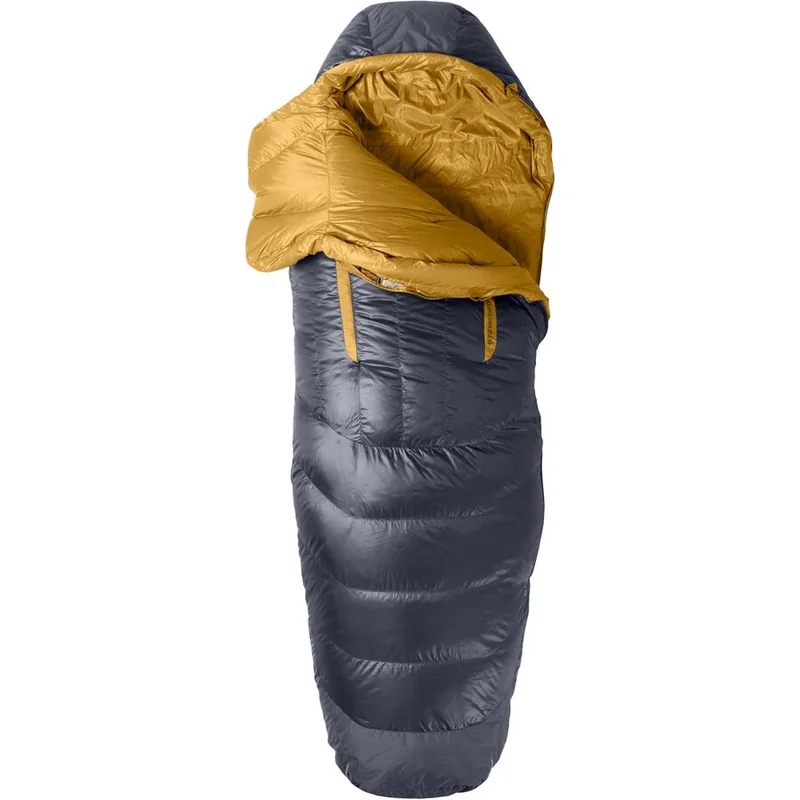 NEMO Disco 15 Men's
Room to sleep on your side, with chest vents that let heat out on mild nights. NEMO rates the men's at 27°F comfort.
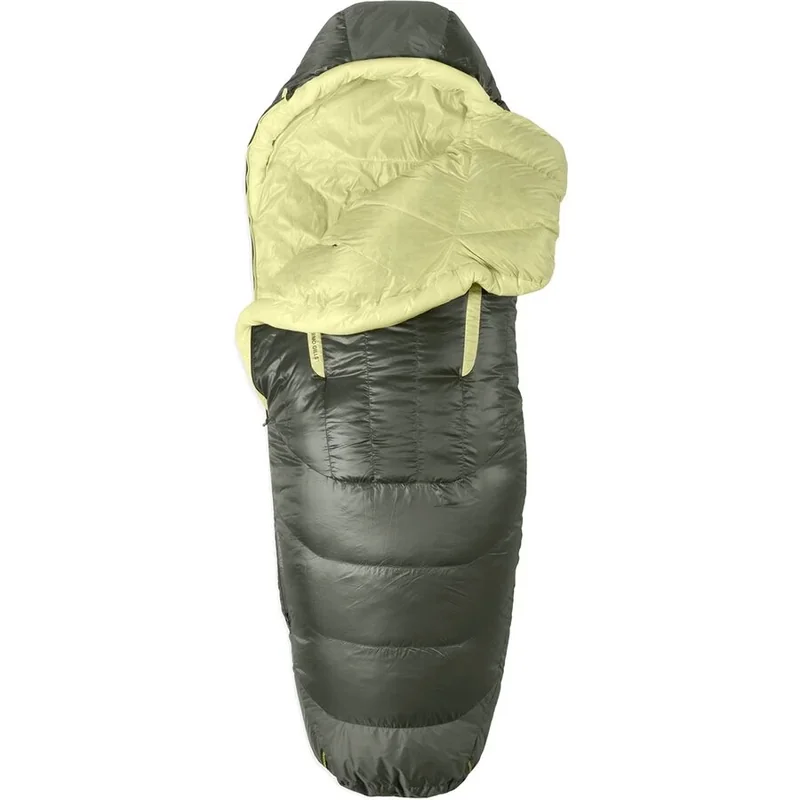 NEMO Disco 15 Women's
The warmer Disco, with 9 more ounces of 650 fill down and a 17°F comfort rating from NEMO. It zips to a men's Disco.
Mountain Hardwear Bishop Pass 30: The Lightest Bag Here, for Warm Nights
The Mountain Hardwear Bishop Pass 30 is the lightest bag here, under 2 pounds in the Regular with 650 fill RDS-certified down, by Mountain Hardwear’s figures. Its name says 30, but its listed ISO comfort rating is 40°F, so it suits warm sleepers on summer trips, not cold sleepers.
Best For
Warm sleepers on summer first overnights, where pack space and weight matter most. It also suits hikers carrying a small pack.
Why It Stands Out
It weighs 1 lb 12.6 oz in the Regular, with RDS-certified 650 fill down. The next lightest Regular on this list is the Kelty Cosmic Down 20, and it’s 2 lb 7 oz.
Key Features and What They Mean
Mountain Hardwear’s own page gives the Regular’s weight, fill, packed volume and girths, and the rest comes from REI’s and Backcountry’s listings:
- Regular: 1 lb 12.6 oz with 12.3 oz of fill, 7.8 liters compressed, a 7 x 13.5 inch stuff sack, and it fits up to 6 ft. That small packed size is what makes it work in a smaller pack.
- Long: 1 lb 14 oz, fitting up to 6 ft 6 in.
- Girth: 62 inches at the shoulders and 53 at the hips, the narrowest hips of the six. A closer cut saves weight but leaves less room to bend your knees.
- Zips: a left zip, and it zips to other Mountain Hardwear bags. A women’s Regular and Long are listed with a right zip, though its current listings give no women’s ISO figure.
- A down-filled face gasket, a contoured footbox and a full-length draft tube close off drafts at the hood opening, at your feet and along the zip.
- Small extras: a stash pocket, a glow-in-the-dark zipper pull, and sleeping pad loops that help keep the bag on your pad.
The owners who’ve reviewed it repeatedly call it light and say it packs small, though that’s a small sample. One owner found it “roomy for broad shoulders.”
Where It Falls Short
The 40°F comfort rating is the big one: if you sleep cold, treat this as a summer bag. One owner got “a little chilly at the lower end” of its range and fixed it with layers.
It’s one of the two most expensive bags here at list price, and only about ten owners have reviewed it so far, mostly in reviews syndicated from Mountain Hardwear. The narrow hips also give you less room to bend your knees than NEMO’s spoon shape.
Pros
The lightest bag here, under 2 lb in the Regular
RDS-certified 650 fill down
Face gasket, contoured footbox and draft tube against drafts
Zips to other Mountain Hardwear bags
Cons
A 40°F comfort rating, so a summer bag for cold sleepers
One of the two most expensive bags here at list price
Only about ten owner reviews so far
Narrow hips, with less room to bend your knees
Who Should Skip It
Skip it if you sleep cold, if your trips run into the shoulder seasons, or if you sleep on your side and want room to move.
Verdict
I’d choose the Bishop Pass 30 if you sleep warm, hike in summer and want the lightest bag on this list. Its 40°F comfort rating is the honest limit of what it’s for, so it won’t stretch to a frosty shoulder-season night for a cold sleeper.
For those nights, the Disco 15 or the Forte 20 is the safer call.
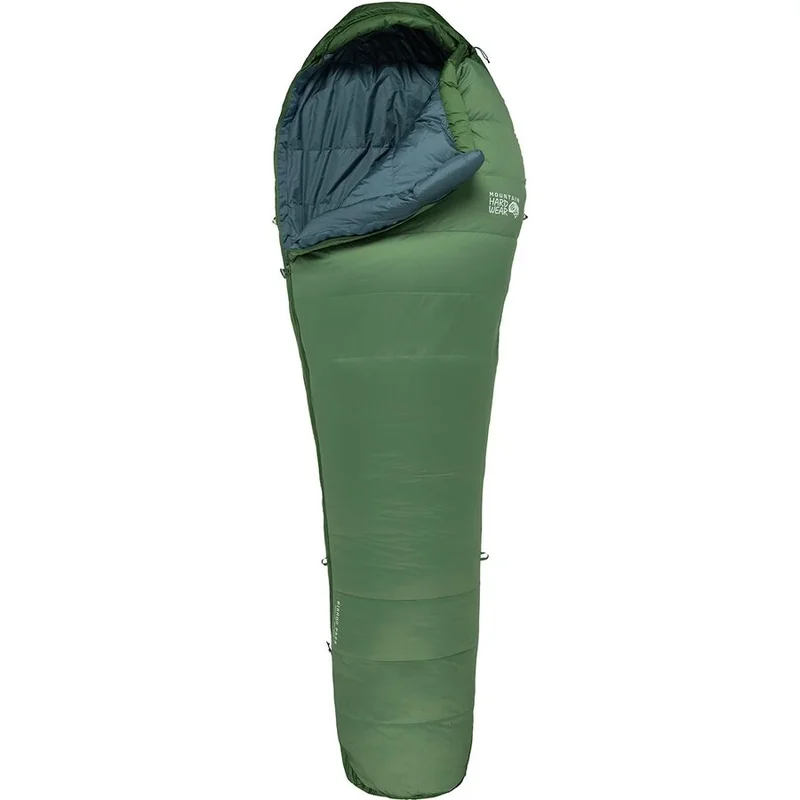 Mountain Hardwear Bishop Pass 30
The lightest bag here, under 2 pounds in the Regular. Its 40°F comfort rating makes it a summer bag for anyone who sleeps cold.
The Same Bag in Synthetic: Kelty Cosmic Synthetic 20
The next three picks are synthetic, in the same order as the down ones: the budget twin, the side sleeper’s bag, then the odd one out.
The Kelty Cosmic Synthetic 20 is the synthetic twin of the Cosmic Down 20, with the same name rating and features, the lowest list price of the six, and 6 more ounces. It takes about twice the down twin’s packed space, and few owners have reviewed it yet.
Best For
Budget first-timers, damp-climate campers who want synthetic fill, and anyone using the two Kelty bags side by side to decide on fill.
Why It Stands Out
It has the same name rating and the same comfort features as the Cosmic Down 20, at the lowest list price of the six. If down’s packed size isn’t worth the extra money to you, this gives you the same features without it.
Key Features and What They Mean
- Recycled CirroLoft ECO synthetic fill, 31.4 oz of it. Synthetic fill copes with damp better than untreated down, which is why it’s the usual pick for wet climates.
- 2 lb 13 oz in the Regular, stuffed 9.5 x 18 inches, fitting up to 6 ft. The Long weighs 3 lb 3 oz and fits up to 6 ft 6 in.
- ISO figures: Kelty publishes no ISO figure for the current bag. Backcountry lists 32°F comfort and 22°F lower limit for what looks like the previous version, so treat it as a guide and plan around about 30°F if you sleep cold.
- Shape: Kelty calls it a mummy “with a roomier fit.”
- Offset quilt construction, which Kelty says prevents cold spots. The stitching lines don’t line up through the bag, so no seam is left without insulation behind it.
- A draft collar and draft tube, a contoured hood, an expanded footbox and a stash pocket, the same comfort features as the down twin.
- A compression stuff sack comes with it, which helps with the bulk, though the listed stuffed size is still about twice the down bag’s.
The Women’s Cosmic Synthetic 20 is a separate listing, Regular only, for heights up to 5 ft 8 in. It carries 48.3 oz of fill, about half again the unisex bag’s, and weighs 3 lb 15 oz. Like the women’s down bag, it has no published ISO figure.
Where It Falls Short
Very few owners have reviewed it, so I can’t tell you what owners report about its warmth, durability or bulk. One owner finds it “a bit tight in the shoulders” and leaves it slightly unzipped, but that’s one person’s comment.
It also takes about twice the packed space of its down twin. Kelty describes it as light in your pack, which holds only next to heavier synthetic bags: it’s 6 oz heavier than the Cosmic Down 20.
Pros
The lowest list price of the six
The same name rating and comfort features as the Cosmic Down 20
Recycled synthetic fill that copes better with damp
A compression stuff sack included
Cons
Very few owner reviews to go on
About twice the packed space of its down twin
No ISO figure on Kelty’s own page
Who Should Skip It
Skip it if your pack is short on room, because the stuffed size is about twice the down twin’s. Skip it too if you’d rather buy a bag that lots of owners have already vouched for.
Verdict
I’d pick the Cosmic Synthetic 20 if budget comes first and your pack has room for the bulk. Its job is to be the cheaper twin of the Cosmic Down 20, with the same features and a name rating to match, and on paper it does that.
What it can’t offer yet is a track record, because so few owners have reviewed it.
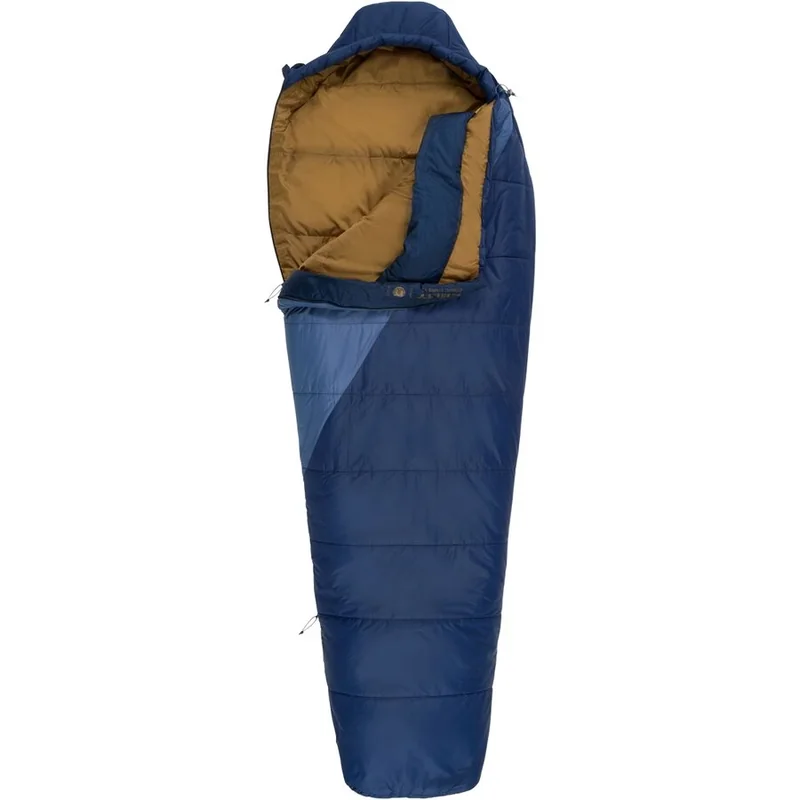 Kelty Cosmic Synthetic 20
The synthetic twin of the Cosmic Down 20, at the lowest list price of the six. It takes about twice the packed space, and few owners have reviewed it yet.
Side-Sleeper Room in Synthetic: NEMO Forte 20 Men’s and Women’s
NEMO’s Forte 20 gives side sleepers the Disco’s spoon shape and vents in synthetic, at a lower list price. NEMO lists the men’s at 29°F comfort and the women’s at 21°F. The cost is weight and bulk: the men’s Regular is the heaviest men’s Regular here, compressing to 10.6 liters.
Best For
Side sleepers who want synthetic for damp trips or a lower price, couples, since two Fortes with opposite zippers (a men’s and a women’s, for example) zip together, and anyone who needs a wide size.
Why It Stands Out
It gives you side-sleeper comfort in synthetic fill, with the Disco’s shape and vents, at a lower list price than the Disco.
Key Features and What They Mean
- Zerofiber 800 PCR synthetic fill, 100% post-consumer recycled, inside a 20D recycled polyester ripstop shell. NEMO says the Forte stays warm even when wet, which I’d read as the brand’s claim.
- Classic Spoon shape and Thermo Gill vents, the same as the Disco, so you can turn onto your side and let heat out without opening the side zip.
- A compression sack and a mesh storage cube come with it.
- Endless Promise take-back, NEMO’s program for a recyclable design, which can settle a close call if that matters to you.
The men’s Regular weighs 3 lb 5 oz at minimum, compresses to 10.6 liters and fits up to 6 ft, with girths of 62, 57 and 61 inches. There’s also a Regular Wide, a Long and a Long Wide.
Multiple owners say the spoon shape gives them room to sleep on their side, and several praise the vents. One found the Regular “slightly too narrow” and the Wide right.
Men’s vs Women’s Fit
The women’s Regular fits up to 5 ft 6 in, with girths of 60, 56 and 59 inches. NEMO rates it 21°F comfort and 9°F limit, against 29°F and 18°F for the men’s.
It weighs 3 lb 12 oz at minimum, compresses to 13.8 liters, and comes in Regular, Regular Wide and Long. I didn’t find owners comparing the two versions directly.
Going by NEMO’s charts, the women’s Regular is about 2 inches narrower at the shoulders than the men’s, so a broad-shouldered woman may be better served by the women’s Regular Wide.
Where It Falls Short
It’s the heaviest men’s or unisex Regular of the six, and the bulk is real. One owner of both NEMO bags says it takes close to twice the space of their Disco, and NEMO’s own figures back that up: 10.6 liters against 6.7.
A couple of owners call it their summer bag, while its 29°F comfort rating supports shoulder-season nights for a cold sleeper. Both can be true for different sleepers, so I’d plan by the rating and your own coldest night.
One owner found the footbox colder than they’d like. A few REI reviews describe other NEMO models, so I left those out.
Pros
Room to sleep on your side, plus chest vents
The Disco’s shape at a lower list price
A women’s version rated 8°F warmer at comfort
Wide sizes, and two Fortes with opposite zippers zip together
Cons
The heaviest men’s or unisex Regular of the six
10.6 liters compressed, about 1.6 times the Disco
A couple of owners use it mainly as a summer bag
Who Should Skip It
Skip it if your pack is short on room or you’re counting ounces, because it’s the heaviest men’s or unisex Regular here and takes about 1.6 times the space of the Disco.
Verdict
I’d choose the Forte 20 if you sleep on your side, want synthetic and can carry the weight. The women’s version is the one for cold sleepers, at 21°F comfort, while the men’s covers a cold sleeper down to about 29°F.
If pack space is tight, the Disco gives you the same shape in far less room, at a higher price.
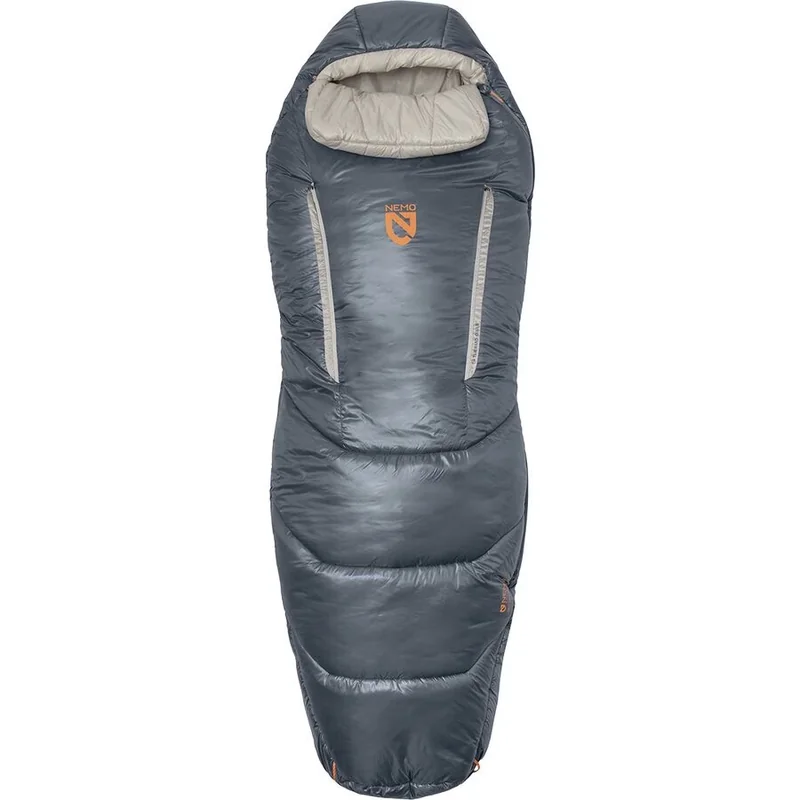 NEMO Forte 20 Men's
The Disco's spoon shape and chest vents in synthetic fill, at a lower list price. It's heavier and bulkier, so check your pack space first.
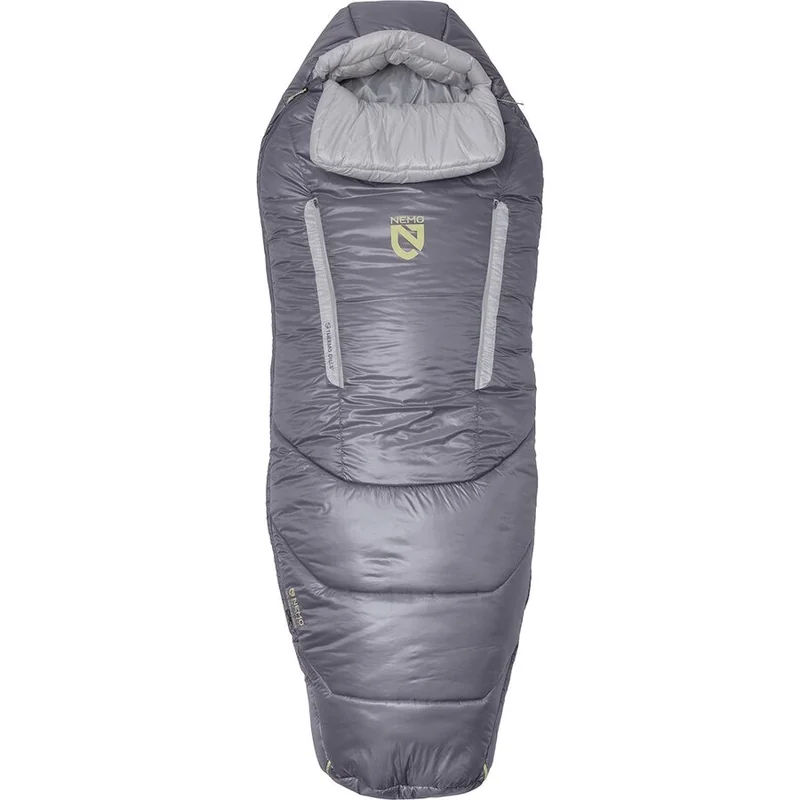 NEMO Forte 20 Women's
The warmer Forte, rated 21°F at comfort by NEMO, with the same spoon shape and vents. It zips to a men's Forte.
For Tight Budgets and Wide Builds: REI Co-op Trailmade 25
The REI Co-op Trailmade 25 suits tight budgets and broad or larger hikers, with six sizes that include wide cuts. Its name says 25, but REI lists an ISO comfort rating of 31°F. Two owners say it runs small, so size up if you’re between sizes.
Best For
Budget first-timers, broad or larger hikers who need a wide cut, and damp-climate campers who want synthetic. It also makes sense if you’re buying the REI Co-op Trailmade 60 pack, because its stuff sack is sized for that pack.
Why It Stands Out
It comes in six sizes with real girth options: Short, Short Wide, Medium, Medium Wide, Long and Long Wide. It also costs less at list price than any of the NEMO or Mountain Hardwear bags, so a wide cut doesn’t push you into a higher price.
Key Features and What They Mean
REI Co-op makes and sells it, so REI’s figures are the maker’s:
- Ratings: ISO comfort 31°F and lower limit 20°F, with 25°F in the name. REI says its nongendered bags carry a name rating between the two, so plan around 31°F if you sleep cold.
- Fill and shell: 100% recycled polyester fill and a 30D recycled ripstop shell with a PFAS-free DWR (a water-repellent coating), in a mummy shape with a left zip.
- Medium: 2 lb 15.14 oz, 8 liters compressed, fits up to 72 inches, with a girth of 62 inches at the shoulders and 54 at the hips.
- Medium Wide: 3 lb 3.25 oz, 9.1 liters compressed, with a girth of 69 and 62.5 inches. That extra room comes without moving up to a Long.
- Short and Long: the Short fits up to 66 inches (2 lb 12.35 oz, 7.3 liters) and the Long up to 78 inches (3 lb 2.48 oz, 8.5 liters), each with a wide version too.
- A snag-resistant zipper with a locking slider, so you can vent the footbox on a warm night.
- A face muffler, a full draft tube and a hood sized for a backpacking pillow, with different drawcords for the hood and neck so you can tell them apart in the dark.
- A stuff sack sized for the lower compartment of the REI Co-op Trailmade 60, one of the backpacking packs with a sleeping bag compartment I compared.
Two owners say it runs small and advise sizing up, one of them simply: “Order a size up!” Most owners report it warm, and one says the footbox venting is what sets it apart for hot sleepers. A 5 ft 2 in side sleeper says it moves with them.
Where It Falls Short
Two owners say it runs small, so the size chart alone may leave you short on room. Some owners also find it bulkier and heavier than they expected, and the Medium weighs a little more than the Kelty synthetic Regular.
There are no long-term durability reports yet.
Pros
Six sizes, including three wide cuts
Costs less at list price than the NEMO and Mountain Hardwear bags
A locking footbox vent for warm nights
A stuff sack sized for the Trailmade 60’s lower compartment
Cons
Runs small, by two owners’ reports
Bulkier and heavier than some owners expected
No long-term durability reports yet
Who Should Skip It
Skip it if you’re counting ounces or short on pack space. The Medium alone weighs close to 3 pounds.
Verdict
I’d pick the Trailmade 25 if you’re on a tight budget or need a wide cut. Plan around its 31°F comfort rating rather than the 25 in the name, and order a size up if you’re between sizes, as two owners advise.
If you’re watching every ounce, the Kelty Cosmic Synthetic 20 is a little lighter in the Regular.
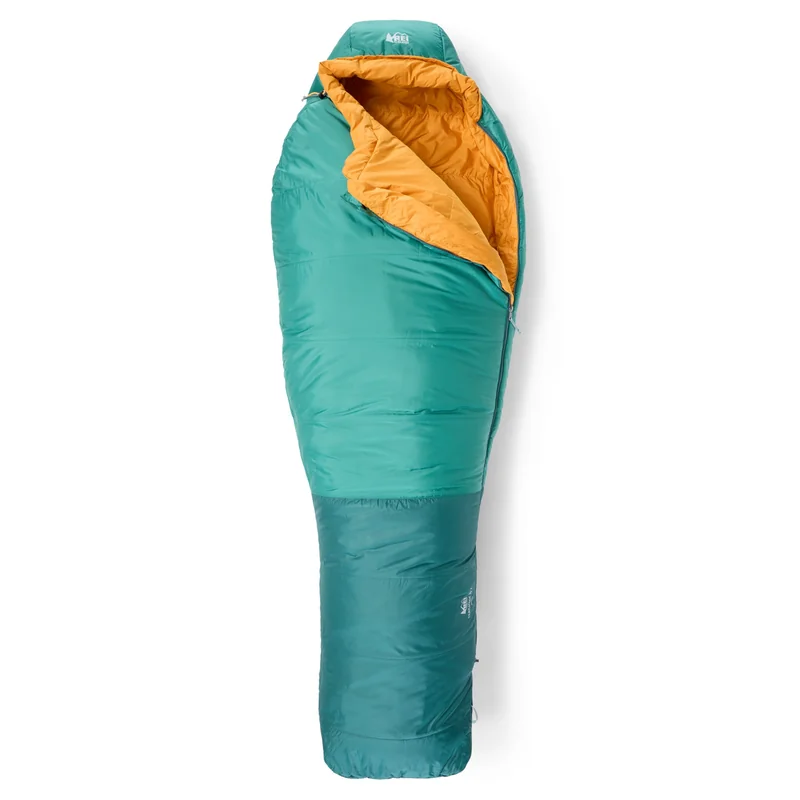 REI Co-op Trailmade 25
Six sizes, including three wide cuts, for less than the NEMO and Mountain Hardwear bags. Two owners say it runs small, so size up if you're between sizes.
Before You Order: Check Three Numbers Against Your Trip
Before you order, check three numbers against your trip and body: the comfort rating against your coldest night, the length and shoulder girth against your height and build, and the packed size against the space in your pack. A bag that passes all three is the one to order.
- Comfort rating against your coldest night. If you sleep cold, leave yourself a few degrees of margin below the forecast low, because the comfort figure assumes a pad with an R-value of at least 5.38 and a forecast can miss.
- Length and girth against your body. Compare the “fits up to” height and the shoulder girth with your own, and size up where owners say a bag runs small.
- Packed size against your pack. Check the liters or stuffed size against your pack’s sleeping bag compartment before you settle on a fill.
If I could check only one, it would be the comfort rating. It’s the number most often misread on the label, and it’s the one that decides whether you sleep.
So start with the forecast low for your first night out, then find the bag in the rating table near the top whose comfort figure covers it.
Founder & Gear Research Editor

Sonia Zannoni
I’m Sonia, the founder of Best Trail Backpacks. I don’t test gear myself. For every pack I cover, I read the manufacturer’s specs and sizing charts and look for what owners report again and again.
Fit comes first, because a pack that doesn’t match your torso and hips will hurt no matter what it cost. My goal is to help you choose a pack that suits your body, your trip and your budget.
About the Founder